June 2025 US History Regents — Answer Key & Worked Solutions
Every question from the June 2025 US History Regents exam, with the correct answer and a full step-by-step solution. Check your work, learn the method, then see how it's scored.
These are real questions from the June 2025 US History New York State Regents examination, published by NYSED. Worked solutions are written by RegentsLab.
Based on the engraving "The Town of Secota, 1590" shown, which statement about Native American societies can be inferred from this engraving?
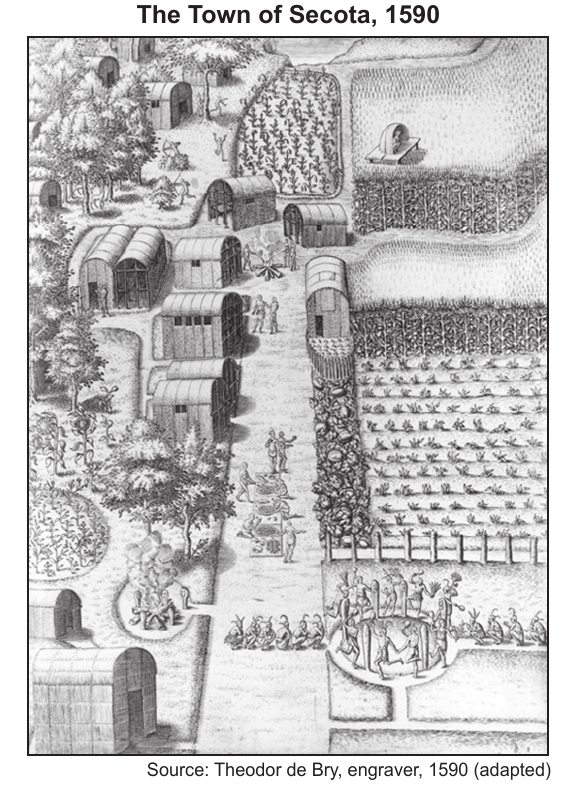
- (A) The inhabitants valued entertainment over field work.
- (B) The layouts of their villages were based on European societies.
- (C) Internal conflict and disease led to their decline.
- (D) Their communities were planned and supported an organized way of life. ✓
Worked solution
The de Bry engraving depicts a Native American village with distinct zones for farming, housing, and ceremony, showing deliberate organization and planning rather than chaos or European influence.
Based on the engraving "The Town of Secota, 1590" shown, a historian would find this engraving most useful for
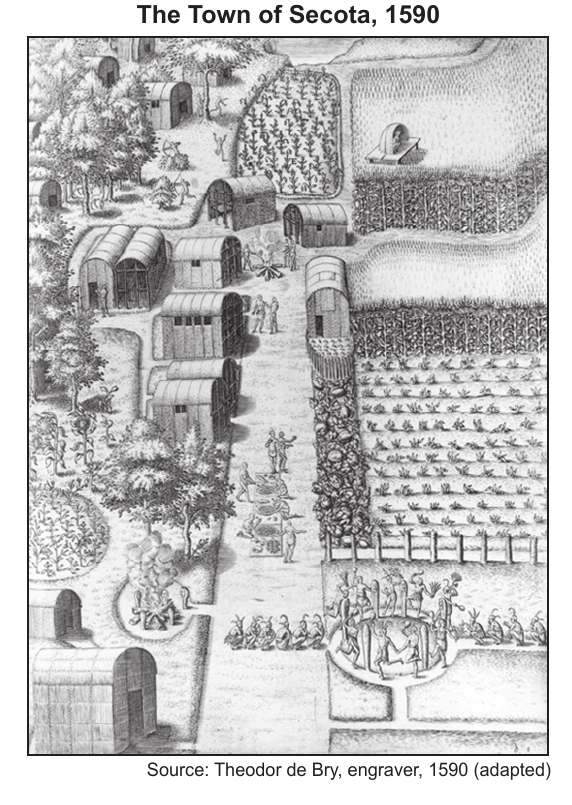
- (A) describing Native American societies prior to European colonization ✓
- (B) examining the way Native Americans dealt with hardship
- (C) illustrating the influence colonial leaders had on Native American societies
- (D) understanding the trading patterns of Native American societies
Worked solution
As a visual primary source of a Native village layout, the engraving is most valuable for describing what Native American life and settlement patterns looked like before European colonization.
Based on the map "North America, 1775" shown, the Proclamation Line of 1763 generally followed which geographic feature?
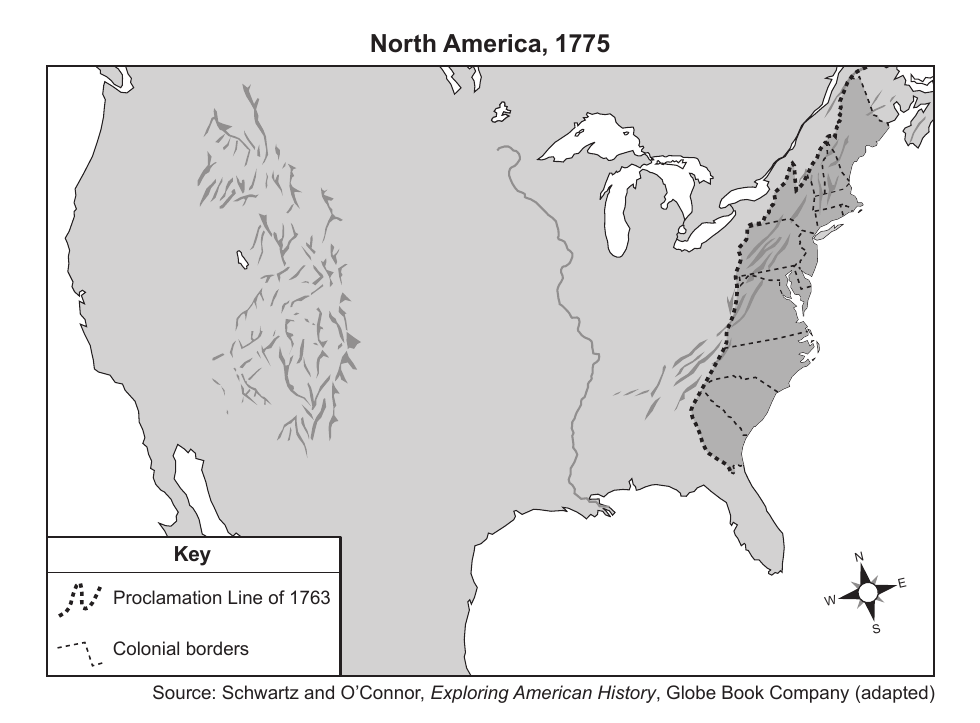
- (A) Great Lakes
- (B) Appalachian Mountains ✓
- (C) Rocky Mountains
- (D) Mississippi River
Worked solution
The Proclamation Line of 1763 ran along the Appalachian Mountains, forbidding colonial settlement west of that range to reduce conflict with Native Americans.
Based on the map "North America, 1775" shown, how did many American colonists respond to the establishment of the Proclamation Line of 1763?
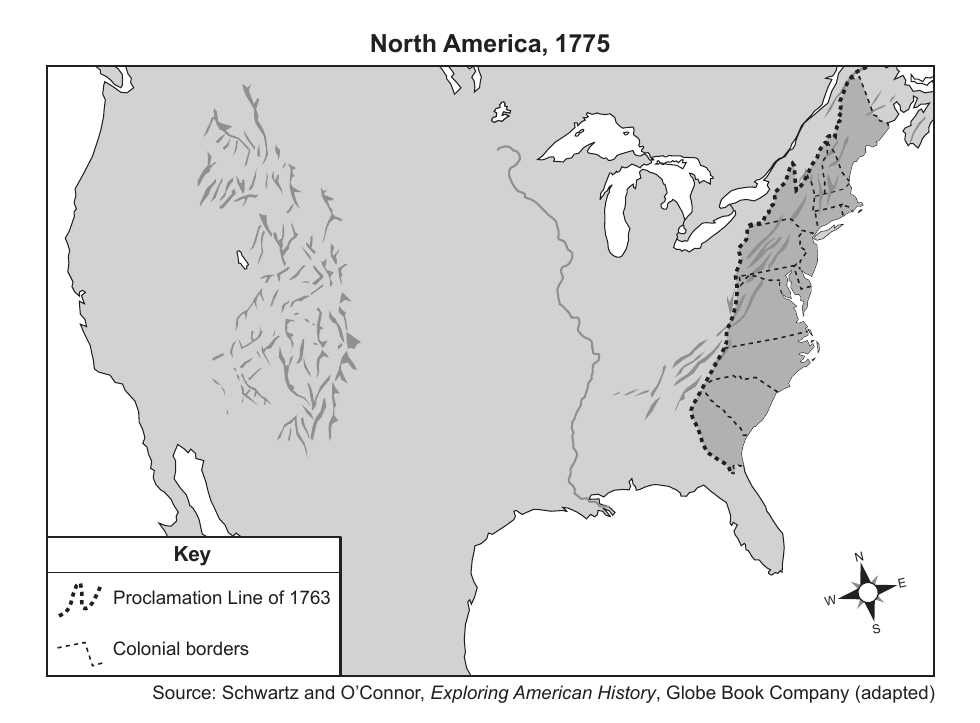
- (A) They argued it was an abuse of British authority. ✓
- (B) They established a colony on the Florida peninsula.
- (C) They honored Native American treaties.
- (D) They purchased land needed to construct the National Road.
Worked solution
Many colonists resented the Proclamation Line as an overreach of British power that blocked their access to western lands, adding to growing tensions before the Revolution.
Based on the passage from Alexander Hamilton's Federalist Papers, No. 15 (December 1, 1787) shown, what action would Alexander Hamilton recommend?
Excerpt from Alexander Hamilton, The Federalist Papers, No. 15, December 1, 1787: "We may indeed with propriety be said to have reached almost the last stage of national humiliation. There is scarcely anything that can wound the pride or degrade the character of an independent nation which we do not experience. ... The great and radical vice in the construction of the existing Confederation is in the principle of LEGISLATION for STATES or GOVERNMENTS, in their CORPORATE or COLLECTIVE CAPACITIES, and as contradistinguished from the INDIVIDUALS of which they consist." In this passage, Hamilton argues that the national government under the Articles of Confederation is too weak to enforce its laws and calls for a firmer union under the proposed Constitution.
- (A) strengthening the national government ✓
- (B) establishing a monarchy
- (C) increasing the power of the states
- (D) continuing to use the Articles of Confederation
Worked solution
Hamilton's essay criticizes the weakness of the Confederation government and argues for a stronger national government, laying groundwork for supporting the new Constitution.
Based on the passage from Alexander Hamilton's Federalist Papers, No. 15 (December 1, 1787) shown, the purpose of the Federalist Papers was to
Excerpt from Alexander Hamilton, The Federalist Papers, No. 15, December 1, 1787: "We may indeed with propriety be said to have reached almost the last stage of national humiliation. There is scarcely anything that can wound the pride or degrade the character of an independent nation which we do not experience. ... The great and radical vice in the construction of the existing Confederation is in the principle of LEGISLATION for STATES or GOVERNMENTS, in their CORPORATE or COLLECTIVE CAPACITIES, and as contradistinguished from the INDIVIDUALS of which they consist." The Federalist Papers were a series of essays by Hamilton, James Madison, and John Jay published in New York newspapers in 1787-1788 during the debate over the proposed Constitution.
- (A) discourage the creation of political parties
- (B) justify the American Revolution to the colonists
- (C) support ratification of the Constitution ✓
- (D) argue for a bill of rights
Worked solution
The Federalist Papers were written specifically to persuade New Yorkers and other Americans to support ratification of the U.S. Constitution.
Based on the excerpt from Chief Justice John Marshall's majority opinion in Marbury v. Madison (February 24, 1803) shown, the Supreme Court's decision in this case established the principle of
Excerpt from Chief Justice John Marshall's majority opinion in Marbury v. Madison, February 24, 1803: "It is emphatically the province and duty of the judicial department to say what the law is. Those who apply the rule to particular cases, must of necessity expound and interpret that rule. If two laws conflict with each other, the courts must decide on the operation of each. ... a law repugnant to the constitution is void; and ... courts, as well as other departments, are bound by that instrument."
- (A) states' rights
- (B) nullification
- (C) judicial review ✓
- (D) popular sovereignty
Worked solution
Marbury v. Madison (1803) established judicial review, the power of the Supreme Court to strike down laws that conflict with the Constitution.
Based on the excerpt from Chief Justice John Marshall's majority opinion in Marbury v. Madison (February 24, 1803) shown, what was a direct result of the Supreme Court's decision in this case?
Excerpt from Chief Justice John Marshall's majority opinion in Marbury v. Madison, February 24, 1803: "It is emphatically the province and duty of the judicial department to say what the law is. Those who apply the rule to particular cases, must of necessity expound and interpret that rule. If two laws conflict with each other, the courts must decide on the operation of each. ... a law repugnant to the constitution is void; and ... courts, as well as other departments, are bound by that instrument."
- (A) The power of the federal judiciary was strengthened. ✓
- (B) The court increased the number of justices.
- (C) The legislative branch's power was increased.
- (D) The authority of the executive branch expanded.
Worked solution
By claiming the power of judicial review, the Supreme Court in Marbury v. Madison strengthened the federal judiciary's authority and role as a check on the other branches.
Based on President Andrew Jackson's Second Annual Message to Congress (December 6, 1830) shown, what was the primary reason President Andrew Jackson supported the removal of Native Americans from their tribal lands?
Excerpt from President Andrew Jackson's Second Annual Message to Congress, December 6, 1830: "It gives me pleasure to announce to Congress that the benevolent policy of the Government, steadily pursued for nearly thirty years, in relation to the removal of the Indians beyond the white settlements is approaching to a happy consummation. ... It will place a dense and civilized population in large tracts of country now occupied by a few savage hunters. ... [Removal] will relieve the whole State of Mississippi and the western part of Alabama of Indian occupancy, and enable those States to advance rapidly in population, wealth, and power."
- (A) it provided fertile farmland to Native Americans
- (B) it gave political support to Native Americans
- (C) it opened Native American land to white settlement ✓
- (D) it granted citizenship to Native Americans
Worked solution
Jackson's message frames Native American removal as beneficial mainly because it would open southeastern tribal lands to white settlers and strengthen nearby states.
Based on President Andrew Jackson's Second Annual Message to Congress (December 6, 1830) shown, which Supreme Court case was directly related to the control of Native American land in the southeast?
Excerpt from President Andrew Jackson's Second Annual Message to Congress, December 6, 1830: "It gives me pleasure to announce to Congress that the benevolent policy of the Government, steadily pursued for nearly thirty years, in relation to the removal of the Indians beyond the white settlements is approaching to a happy consummation. ... It puts an end to all possible danger of collision between the authorities of the General and State Governments on account of the Indians. It will place a dense and civilized population in large tracts of country now occupied by a few savage hunters. By opening the whole territory between Tennessee on the north and Louisiana on the south to the settlement of the whites it will incalculably strengthen the southwestern frontier. ... It will separate the Indians from immediate contact with settlements of whites ... and perhaps cause them gradually, under the protection of the Government and through the influence of good counsels, to cast off their savage habits and become an interesting, civilized, and Christian community."
- (A) McCulloch v. Maryland
- (B) Worcester v. Georgia ✓
- (C) Dred Scott v. Sanford
- (D) Plessy v. Ferguson
Worked solution
Worcester v. Georgia (1832) directly concerned Cherokee land rights and state authority in the southeast, the same issue at the heart of Jackson's removal policy.
Based on the map "Electoral Votes in the Election of 1876" shown, this map of electoral votes in the 1876 presidential election shows that
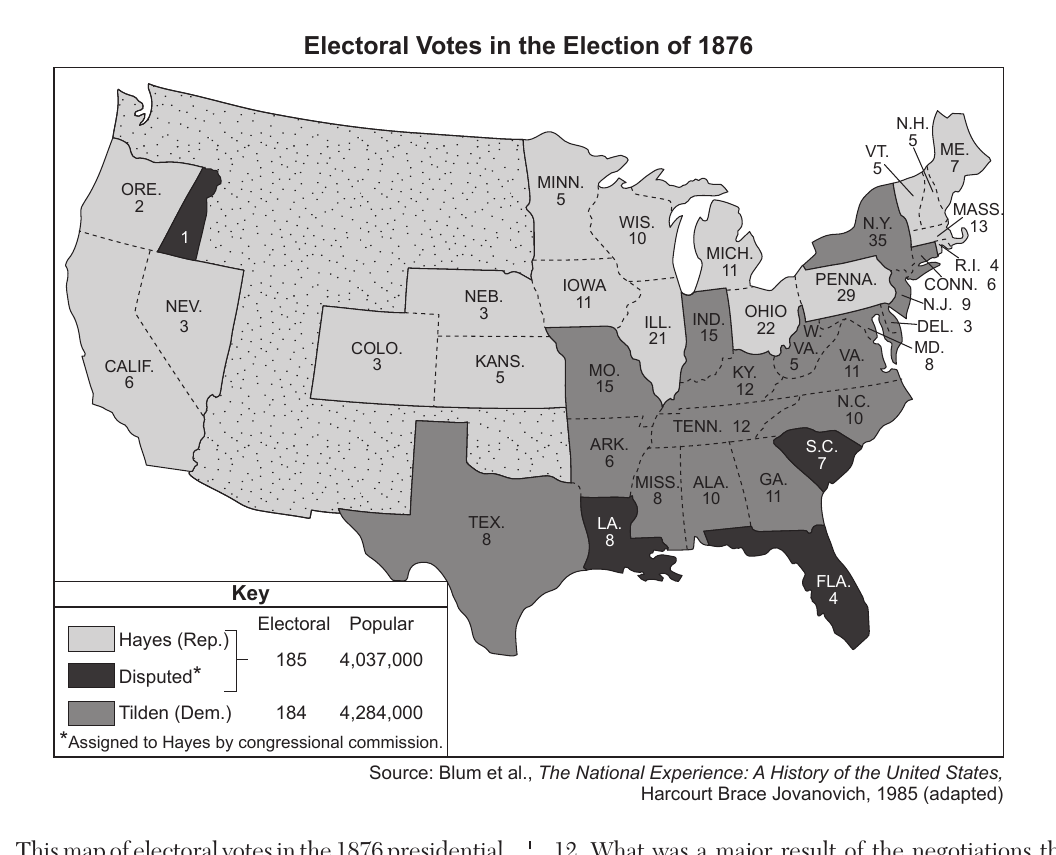
- (A) Samuel Tilden won in most western states
- (B) the votes of several northern states were disputed
- (C) the Democratic candidate won fewer popular votes
- (D) Rutherford B. Hayes won the presidential election ✓
Worked solution
Although Tilden won more popular votes, the disputed electoral votes were awarded to Hayes by a congressional commission, giving him the presidency.
Based on the map "Electoral Votes in the Election of 1876" shown, what was a major result of the negotiations that settled the election of 1876?
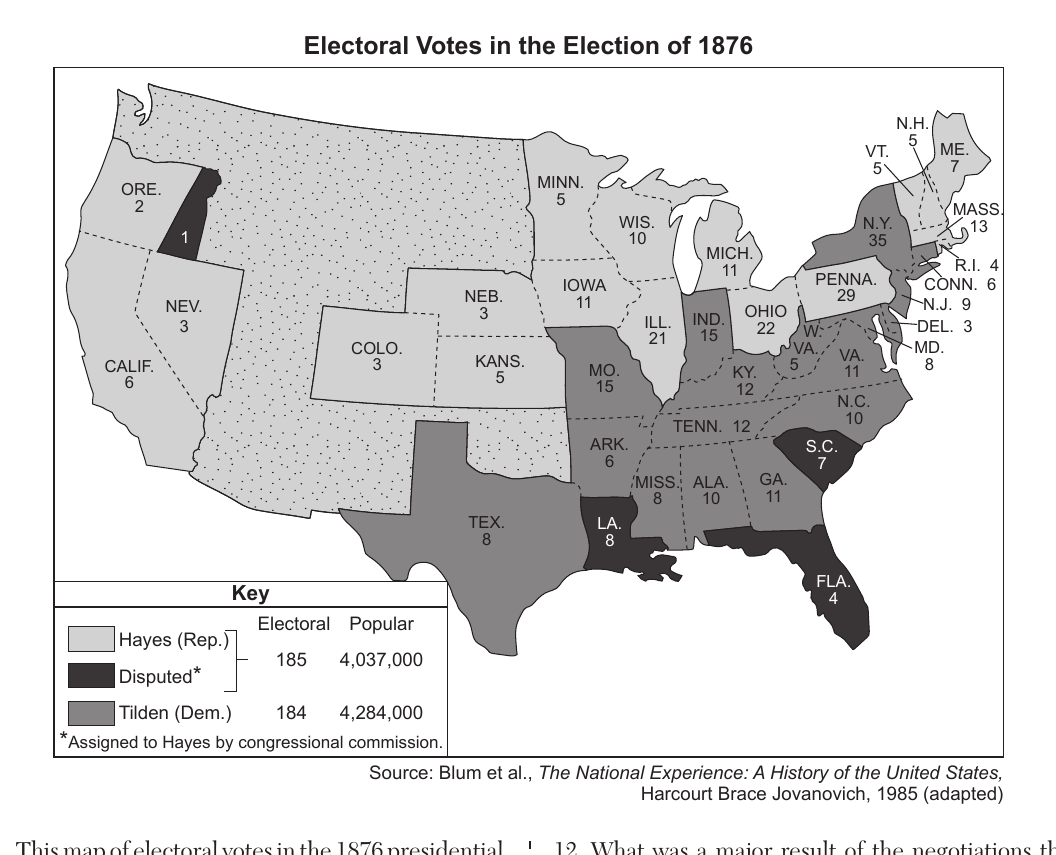
- (A) Confederate General Robert E. Lee surrendered to end the Civil War.
- (B) Manifest Destiny was completed with the addition of new western territory.
- (C) Slavery was abolished with the ratification of the 13th amendment.
- (D) Reconstruction ended with the removal of the Union army from the South. ✓
Worked solution
The Compromise of 1877 that resolved the disputed election gave Hayes the presidency in exchange for withdrawing federal troops from the South, ending Reconstruction.
Based on Emma Lazarus's poem "The New Colossus" (1883) shown, which group would most strongly oppose the idea expressed in this poem?
Excerpt from Emma Lazarus, "The New Colossus" (1883), inscribed on the pedestal of the Statue of Liberty: "Give me your tired, your poor, Your huddled masses yearning to breathe free, The wretched refuse of your teeming shore. Send these, the homeless, tempest-tost to me, I lift my lamp beside the golden door!"
- (A) nativists ✓
- (B) industrialists
- (C) suffragists
- (D) imperialists
Worked solution
Nativists, who wanted to limit immigration and favored native-born Americans, would most strongly oppose the poem's welcoming message toward immigrants.
Based on Emma Lazarus's poem "The New Colossus" (1883) shown, these words on the Statue of Liberty reflect 19th-century American support for
Excerpt from Emma Lazarus, "The New Colossus" (1883), inscribed on the pedestal of the Statue of Liberty: "Give me your tired, your poor, Your huddled masses yearning to breathe free, The wretched refuse of your teeming shore. Send these, the homeless, tempest-tost to me, I lift my lamp beside the golden door!"
- (A) socialism
- (B) populism
- (C) immigration ✓
- (D) neutrality
Worked solution
The poem's welcoming language toward the poor and displaced reflects the ideal, held by many Americans, of the United States as a refuge for immigrants.
A historian is studying a passage describing Standard Oil in the late 19th century, noting that the company operated 20,000 wells, 4,000 miles of pipelines, employed 100,000 people, and exported 50,000 barrels of oil daily. Historians could best use this passage to study
- (A) the transportation revolution in the early 19th century
- (B) industrialization during the late 19th century ✓
- (C) jobs creation under the New Deal
- (D) the impact of the Quota Acts
Worked solution
Rockefeller's Standard Oil exemplifies the massive scale of corporate consolidation that characterized industrialization in the late 1800s, making the passage most useful for studying that era.
Which writer became famous for exposing the questionable business tactics of Rockefeller's Standard Oil Company?
- (A) Upton Sinclair
- (B) Jacob Riis
- (C) Ida Tarbell ✓
- (D) Margaret Sanger
Worked solution
Ida Tarbell's investigative journalism exposed Standard Oil's ruthless business practices and contributed to the antitrust movement.
A passage from the Platform of the American Anti-Imperialist League (1899) condemns imperialism as hostile to liberty and criticizes the National Administration's policy in the Philippines, denouncing the slaughter of Filipinos. Which event led to the issues described in this passage?
Excerpt from the Platform of the American Anti-Imperialist League, 1899: "We hold that the policy known as imperialism is hostile to liberty and tends toward militarism, an evil from which it has been our glory to be free. We regret that it has become necessary in the land of Washington and Lincoln to reaffirm that all men, of whatever race or color, are entitled to life, liberty, and the pursuit of happiness. We maintain that governments derive their just powers from the consent of the governed. We insist that the subjugation of any people is 'criminal aggression' and open disloyalty to the distinctive principles of our Government. We earnestly condemn the policy of the present National Administration in the Philippines. It seeks to extinguish the spirit of 1776 in those islands. We deplore the sacrifice of our soldiers and sailors, whose bravery deserves admiration even in an unjust war. We denounce the slaughter of the Filipinos as a needless horror."
- (A) Mexican-American War
- (B) Civil War
- (C) Spanish-American War ✓
- (D) World War I
Worked solution
The Treaty of Paris ending the Spanish-American War gave the U.S. control of the Philippines, sparking the imperialism debate referenced in this platform.
Based on the passage from the Platform of the American Anti-Imperialist League (1899), condemning imperialism and the policy in the Philippines, which action would most likely have been rejected by the authors of this passage?
Excerpt from the Platform of the American Anti-Imperialist League, 1899: "We hold that the policy known as imperialism is hostile to liberty and tends toward militarism, an evil from which it has been our glory to be free. ... We insist that the subjugation of any people is 'criminal aggression' and open disloyalty to the distinctive principles of our Government. We earnestly condemn the policy of the present National Administration in the Philippines. It seeks to extinguish the spirit of 1776 in those islands. ... We denounce the slaughter of the Filipinos as a needless horror."
- (A) passage of an amendment for the direct election of senators
- (B) creation of the Pure Food and Drug Act
- (C) establishment of the Federal Reserve System
- (D) announcement of the Roosevelt Corollary ✓
Worked solution
The Anti-Imperialist League opposed U.S. overseas expansion and intervention, making the interventionist Roosevelt Corollary directly contrary to their principles.
In the Supreme Court decision Schenck v. United States (1919), Justice Oliver Wendell Holmes wrote that free speech would not protect a man falsely shouting fire in a theatre and causing a panic, and that the question is whether words create a clear and present danger. In this decision, the actions of Charles Schenck were labeled as a clear and present danger because the United States was
- (A) responding to strikes by organized labor
- (B) implementing a new immigration system
- (C) involved in fighting a world war ✓
- (D) concerned about a revolution in Russia
Worked solution
Schenck's distribution of pamphlets urging resistance to the draft during World War I was seen as a threat to national security, justifying restriction of his speech.
Based on the Schenck v. United States decision, which established the clear and present danger test regarding speech that creates a danger Congress has a right to prevent, which constitutional right was limited by this Supreme Court decision?
- (A) freedom of expression ✓
- (B) right to bear arms
- (C) right to counsel
- (D) trial by jury
Worked solution
The ruling limited First Amendment free speech protections when speech posed a clear and present danger, especially during wartime.
President Franklin D. Roosevelt, in his First Inaugural Address on March 4, 1933, stated: "the only thing we have to fear is fear itself, nameless, unreasoning, unjustified terror which paralyzes needed efforts to convert retreat into advance." What issue is being addressed by President Franklin D. Roosevelt in this speech?
- (A) the failure of Prohibition
- (B) the economic problems caused by the Great Depression ✓
- (C) the destruction caused by the attack on Pearl Harbor
- (D) the possibility of a military alliance with Great Britain
Worked solution
FDR delivered this address during the depths of the Great Depression, seeking to calm public fear and build support for his New Deal recovery efforts.
Based on President Franklin D. Roosevelt's First Inaugural Address speech addressing fear and the need for leadership during a critical time, which program was created in response to the situation described in this speech?
- (A) Fourteen Points
- (B) New Deal ✓
- (C) Lend-Lease
- (D) Great Society
Worked solution
The New Deal was FDR's direct legislative and programmatic response to the economic devastation of the Great Depression referenced in his address.
Supreme Court Justice Frank Murphy, in his dissenting opinion in Korematsu v. United States (1944), argued that to infer that examples of individual disloyalty prove group disloyalty and justify discriminatory action against an entire group is to deny that, under the system of law, individual guilt is the sole basis for deprivation of rights. What was the main reason for Justice Frank Murphy's dissent in Korematsu v. United States?
- (A) to ensure Japanese Americans remained loyal to the United States
- (B) to increase Japanese American participation in the military
- (C) to express opposition to the internment of Japanese Americans ✓
- (D) to pressure Congress to limit the rights of Japanese Americans during wartime
Worked solution
Murphy's dissent condemned the internment policy as racially discriminatory and a violation of the principle that guilt must be individual, not based on group membership.
Based on the 1951 political cartoon by Herblock titled "The Tumult and the Shouting Dies; the Captains and the Kings Depart," showing a president at a desk covered with papers labeled Korea, China, Europe, United Nations, A-Bomb, H-Bomb, Troops, and Peace or War, which idea is being illustrated in this cartoon?
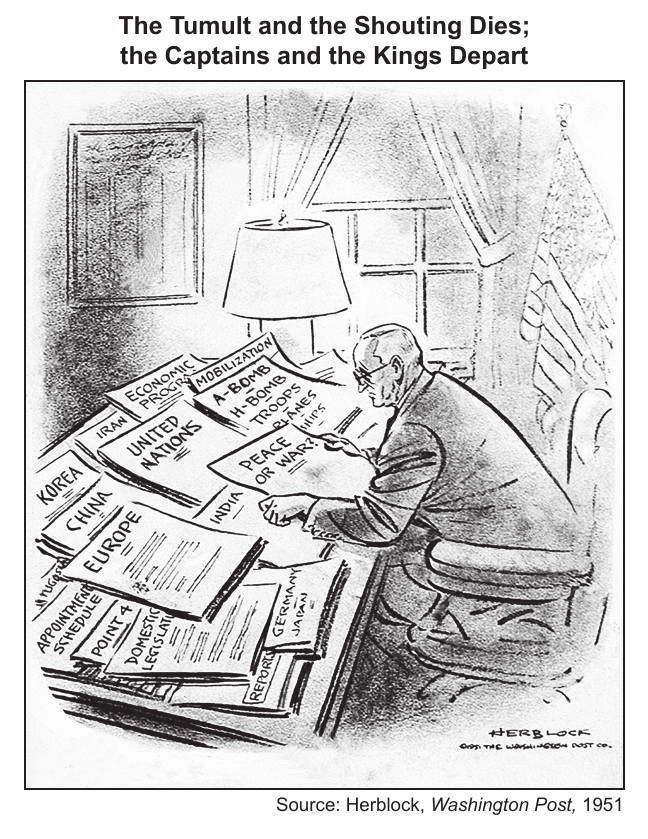
- (A) expansion of presidential responsibility ✓
- (B) increasing congressional checks on presidential power
- (C) increased role of the Supreme Court in United States foreign policy
- (D) use of executive orders to end foreign alliances
Worked solution
The cartoon shows a president buried under papers covering an enormous range of foreign and domestic issues, illustrating the expanding scope of presidential responsibility in the Cold War era.
Based on the 1951 political cartoon by Herblock showing a president overwhelmed by papers labeled Korea, China, Europe, United Nations, A-Bomb, H-Bomb, and Peace or War, what is causing the problems shown in this cartoon?
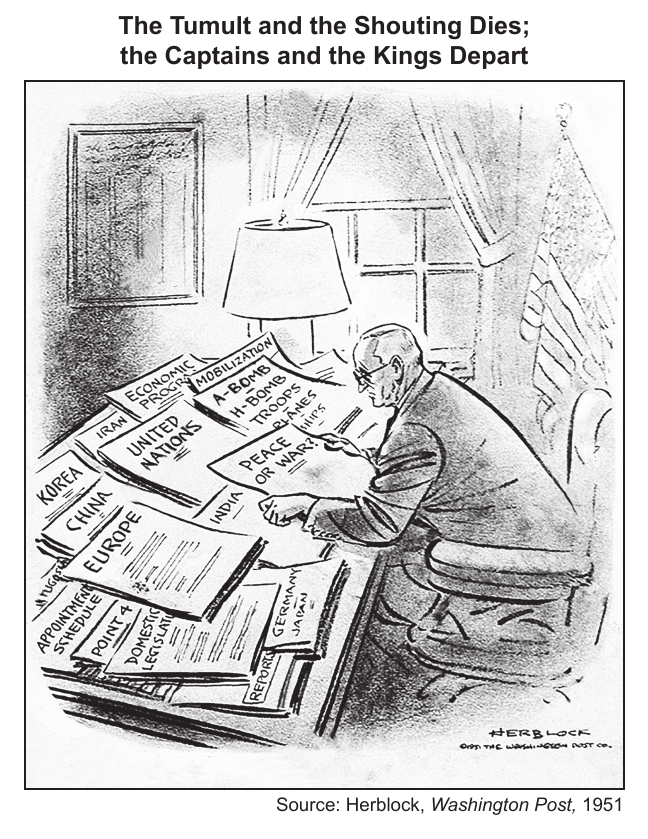
- (A) failure to sign the Universal Declaration of Human Rights
- (B) judgments made at the Nuremberg War Trials
- (C) President Harry Truman's decision to desegregate the military
- (D) emergence of the Cold War rivalry ✓
Worked solution
The overwhelming list of crises depicted, from the Korean War to the arms race, all stem from the emerging Cold War rivalry between the U.S. and the Soviet Union.
President Ronald Reagan, in his Speech at the Berlin Wall on June 12, 1987, described the wall as part of a system of barriers dividing Europe and stated that in the Communist world there is failure, technological backwardness, and want of basic food, concluding that freedom leads to prosperity. What was the main idea of President Ronald Reagan's speech?
- (A) to draw attention to the human rights violations in Western Europe
- (B) to increase humanitarian aid to the Communist bloc
- (C) to prevent a re-emergence of fascism in East Germany
- (D) to emphasize the failures of communism ✓
Worked solution
Reagan's Berlin Wall speech highlighted the economic and social failures of communism compared to the prosperity of free societies, a key rhetorical strategy near the end of the Cold War.
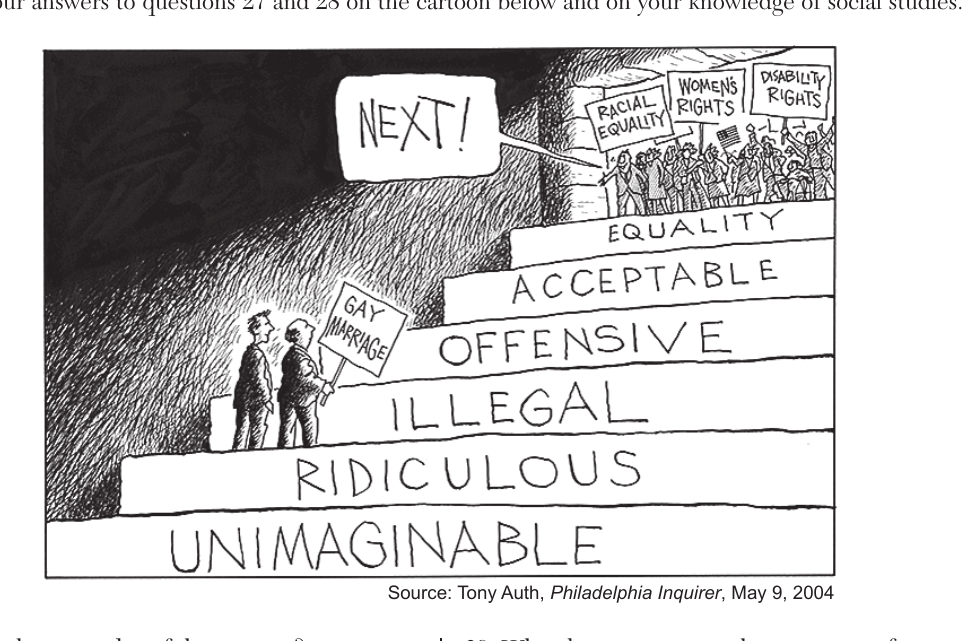
Based on the 2004 political cartoon by Tony Auth showing two men holding a "Gay Marriage" sign climbing steps labeled Unimaginable, Ridiculous, Illegal, Offensive, Acceptable, and Equality, while a crowd above holds signs for Racial Equality, Women's Rights, and Disability Rights, what is the main idea of this cartoon?
- (A) Equal rights are easily achieved by all groups.
- (B) The difficult path to equality for one group has opened the way to others. ✓
- (C) Gay marriage has lost support among racial and ethnic groups.
- (D) Women had more difficulty than any other group in gaining equality.
Worked solution
The cartoon depicts the gay marriage movement following the same difficult staircase toward acceptance that earlier civil rights movements traveled, suggesting a shared struggle for equality.
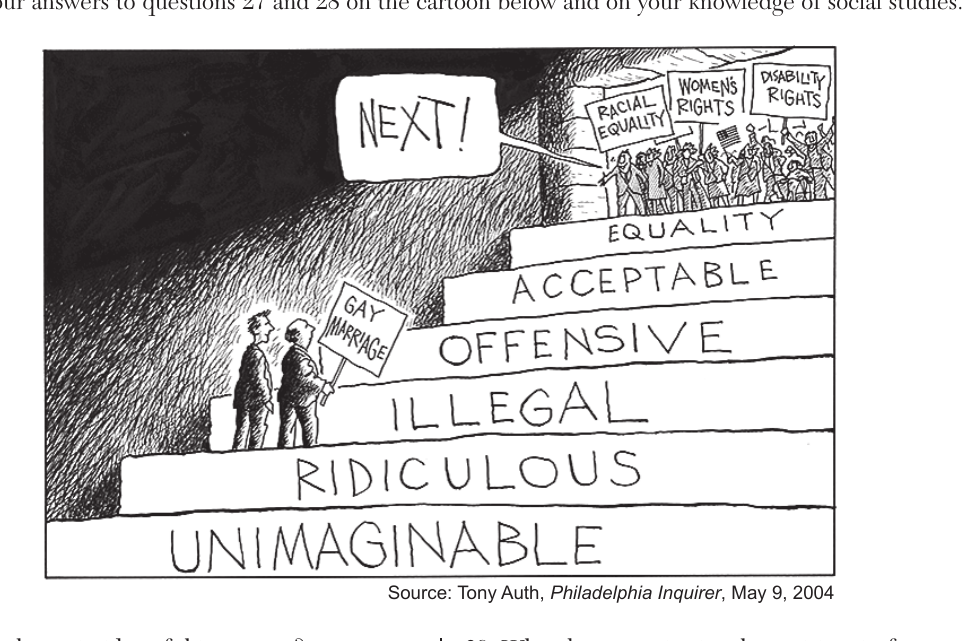
Based on the 2004 political cartoon depicting groups climbing a staircase toward equality, labeled with stages from Unimaginable to Equality, and referencing movements such as gay marriage, racial equality, women's rights, and disability rights, what key constitutional provision is frequently used by groups seeking legal equality?
- (A) 14th amendment, equal protection of the law ✓
- (B) 4th amendment, protection against unreasonable search and seizure
- (C) 6th amendment, right of trial by jury
- (D) Article 1, establishing rules for naturalization
Worked solution
The Equal Protection Clause of the 14th Amendment has been the cornerstone of legal challenges by groups seeking equal rights, including in landmark cases on marriage and civil rights.