June 2024 US History Regents — Answer Key & Worked Solutions
Every question from the June 2024 US History Regents exam, with the correct answer and a full step-by-step solution. Check your work, learn the method, then see how it's scored.
These are real questions from the June 2024 US History New York State Regents examination, published by NYSED. Worked solutions are written by RegentsLab.
Based on the passage below and on your knowledge of social studies, which claim about this group of Native Americans is supported by this passage? ". . . Having frequent Occasions to hold public Councils, they have acquired great Order and Decency in conducting them. The old Men sit in the foremost Ranks, the Warriors in the next, and the Women and Children in the hindmost. The Business of the Women is to take exact Notice of what passes, imprint it in their Memories (for they have no Writing), and communicate it to their Children. They are the Records of the Council, and they preserve Traditions of the Stipulations in Treaties 100 Years back; which, when we compare with our Writings, we always find exact. . . ." (Source: Benjamin Franklin Papers (Wampum Chronicles) before January 7, 1784)
- (A) Acquiring their land is justified.
- (B) Women play a significant role in their society. ✓
- (C) Their treaties are preserved in writing.
- (D) Colonial missionaries need to understand their beliefs.
Worked solution
The passage explicitly describes women as the memory-keepers and record-keepers of council proceedings and treaties, showing their significant societal role.
Base your answer on the passage below and on your knowledge of social studies. ". . . By adopting the three-fifths clause, prolonging the import slave trade, and providing a fugitive-slave clause, the constitution defended slavery. . . ." (Source: Alan Taylor, American Revolutions: A Continental History, 1750-1804, W. W. Norton & Company, 2016) Why were the writers of the United States Constitution willing to compromise on these issues?
- (A) to gain Southern support for ratification ✓
- (B) to make approval of the Bill of Rights easier
- (C) to end slavery after 1808
- (D) to give Northern states an advantage in the House of Representatives
Worked solution
Delegates from Southern states threatened to reject the Constitution unless slavery-related protections were included, so framers compromised to win their support for ratification.
Base your answer on the passage below and on your knowledge of social studies. ". . . By adopting the three-fifths clause, prolonging the import slave trade, and providing a fugitive-slave clause, the constitution defended slavery. . . ." (Source: Alan Taylor, American Revolutions: A Continental History, 1750-1804, W. W. Norton & Company, 2016) What was the primary purpose of the Three-fifths Clause?
- (A) to quickly end the importation of slaves
- (B) to help determine a state's congressional representation ✓
- (C) to provide for the return of escaped slaves
- (D) to ban slavery in the western territories
Worked solution
The clause was a compromise over how enslaved people would be counted toward a state's population for determining congressional representation.
Base your answer on the passage below and on your knowledge of social studies. ". . . I have said, fellow citizens, that the income reserved had enabled us to extend our limits; but that extension may possibly pay for itself before we are called on, and in the meantime, may keep down the accruing [added] interest; in all events, it will repay the advances we have made. I know that the acquisition of Louisiana has been disapproved by some, from a candid apprehension that the enlargement of our territory would endanger its union. But who can limit the extent to which the federative principle [republic] may operate effectively? The larger our association, the less will it be shaken by local passions; and in any view, is it not better that the opposite bank of the Mississippi should be settled by our own brethren and children, than by strangers of another family? With which shall we be most likely to live in harmony and friendly intercourse? . . ." (Source: President Thomas Jefferson, Second Inaugural Address, March 4, 1805) Which claim is best supported by the views of President Thomas Jefferson as stated in his second inaugural address?
- (A) The purchase of Louisiana greatly benefits the United States. ✓
- (B) The United States Constitution forbids buying land.
- (C) The United States lacks the funds to purchase the Louisiana Territory.
- (D) The Spanish would support United States westward expansion.
Worked solution
Jefferson's address defends the Louisiana Purchase as advantageous, arguing it strengthens rather than endangers the union.
Base your answer on the passage below and on your knowledge of social studies. ". . . I have said, fellow citizens, that the income reserved had enabled us to extend our limits; but that extension may possibly pay for itself before we are called on, and in the meantime, may keep down the accruing [added] interest; in all events, it will repay the advances we have made. I know that the acquisition of Louisiana has been disapproved by some, from a candid apprehension that the enlargement of our territory would endanger its union. But who can limit the extent to which the federative principle [republic] may operate effectively? . . ." (Source: President Thomas Jefferson, Second Inaugural Address, March 4, 1805) What is one concern about the acquisition of the Louisiana Territory raised in this passage?
- (A) The Supreme Court would declare the purchase unconstitutional.
- (B) Farms would not succeed west of the Mississippi River.
- (C) Such a large expanse of land would be difficult to govern. ✓
- (D) Attempts to explore the region would be impossible.
Worked solution
Jefferson addresses the concern that expanding the nation's territory so greatly could threaten the unity and governability of the republic.
Base your answer on the excerpt below and on your knowledge of social studies. Excerpt from President Abraham Lincoln's Second Inaugural Address on March 4, 1865: ". . . With malice toward none; with charity for all; with firmness in the right, as God gives us to see the right, let us strive on to finish the work we are in; to bind up the nation's wounds; to care for him who shall have borne the battle, and for his widow, and his orphan; to do all which may achieve and cherish a just, and a lasting peace, among ourselves, and with all nations. . . ." This excerpt suggests that President Abraham Lincoln believed the best way to heal the nation after the Civil War was through
- (A) anger
- (B) selfishness
- (C) vengeance
- (D) forgiveness ✓
Worked solution
Lincoln's words call for compassion and unity rather than vengeance, showing he sought a forgiving approach to postwar reconciliation.
Base your answer on the excerpt below and on your knowledge of social studies. Excerpt from President Abraham Lincoln's Second Inaugural Address on March 4, 1865: ". . . With malice toward none; with charity for all; with firmness in the right, as God gives us to see the right, let us strive on to finish the work we are in; to bind up the nation's wounds; to care for him who shall have borne the battle, and for his widow, and his orphan; to do all which may achieve and cherish a just, and a lasting peace, among ourselves, and with all nations. . . ." What does this excerpt suggest about President Lincoln's future Reconstruction policy?
- (A) It would be rejected by the defeated South.
- (B) Rapid reunification would be his goal. ✓
- (C) Federal military occupation of the South would be harsh.
- (D) It would guarantee his reelection.
Worked solution
Lincoln's conciliatory language foreshadows a Reconstruction policy aimed at swiftly and peacefully reuniting the nation rather than punishing the South.
Base your answer on the trial transcript below and on your knowledge of social studies. An Account of the Proceedings on the Trial of Susan B. Anthony on the Charge of Illegal Voting, . . . Rochester, NY, 1874: "Judge Hunt: The sentence of the Court is that you pay a fine of one hundred dollars and the costs of the prosecution. Miss Anthony: May it please your honor, I shall never pay a dollar of your unjust penalty. All the stock in trade I possess is a $10,000 debt, incurred by publishing my paper, The Revolution, four years ago, the sole object of which was to educate all women to do precisely as I have done, rebel against your man-made, unjust, unconstitutional forms of law, that tax, fine, imprison and hang women, while they deny them the right of representation in the government, and I shall work on with might and main to pay every dollar of that honest debt, but not a penny shall go to this unjust claim. And I shall earnestly and persistently continue to urge all women to the practical recognition of the old revolutionary maxim, that 'Resistance to tyranny is obedience to God.' . . ." Which type of action is Susan B. Anthony advocating in this transcript?
- (A) running for elected offices
- (B) civil disobedience ✓
- (C) unionization of workers
- (D) economic boycotts
Worked solution
Anthony's refusal to pay her fine and her call to keep 'resisting tyranny' exemplify civil disobedience against laws she considered unjust.
Base your answer on the trial transcript below and on your knowledge of social studies. An Account of the Proceedings on the Trial of Susan B. Anthony on the Charge of Illegal Voting, . . . Rochester, NY, 1874: "Judge Hunt: The sentence of the Court is that you pay a fine of one hundred dollars and the costs of the prosecution. Miss Anthony: May it please your honor, I shall never pay a dollar of your unjust penalty... rebel against your man-made, unjust, unconstitutional forms of law, that tax, fine, imprison and hang women, while they deny them the right of representation in the government. . . ." Anthony's statement is part of her campaign to gain
- (A) the abolition of slavery
- (B) a progressive income tax
- (C) woman's suffrage ✓
- (D) consumer safety regulations
Worked solution
Susan B. Anthony's illegal vote and trial were part of her lifelong activism to secure voting rights for women.
Based on the political cartoon shown ("The Bosses of the Senate," Source: Joseph J. Keppler, Puck, 1889, adapted), which depicts enormous money-bag-bodied trusts (such as the Steel Beam Trust, Copper Trust, Coal Trust, and Standard Oil Trust) looming over senators at their desks, with signs reading "This is a Senate of the monopolists by the monopolists and for the monopolists!" and a "Peoples Entrance Closed" sign, according to this cartoon, whose interests was the Senate serving?
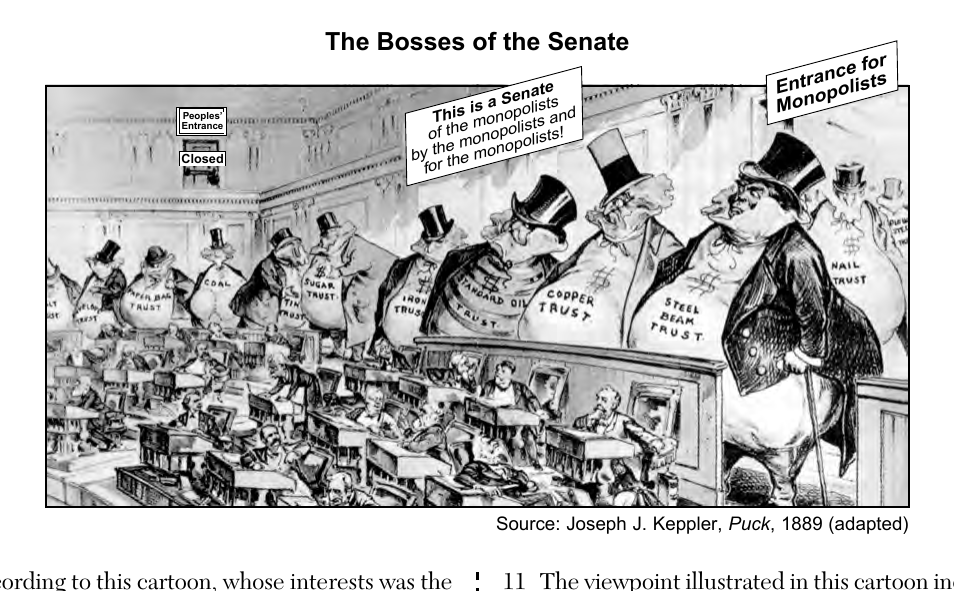
- (A) big business ✓
- (B) conservationists
- (C) labor unions
- (D) southern farmers
Worked solution
Keppler's cartoon satirizes Gilded Age corruption, portraying the Senate as controlled by giant industrial trusts rather than ordinary citizens.
Based on the political cartoon shown ("The Bosses of the Senate," Source: Joseph J. Keppler, Puck, 1889, adapted), depicting giant corporate trusts towering over senators with a closed 'Peoples Entrance,' the viewpoint illustrated in this cartoon increased public support for
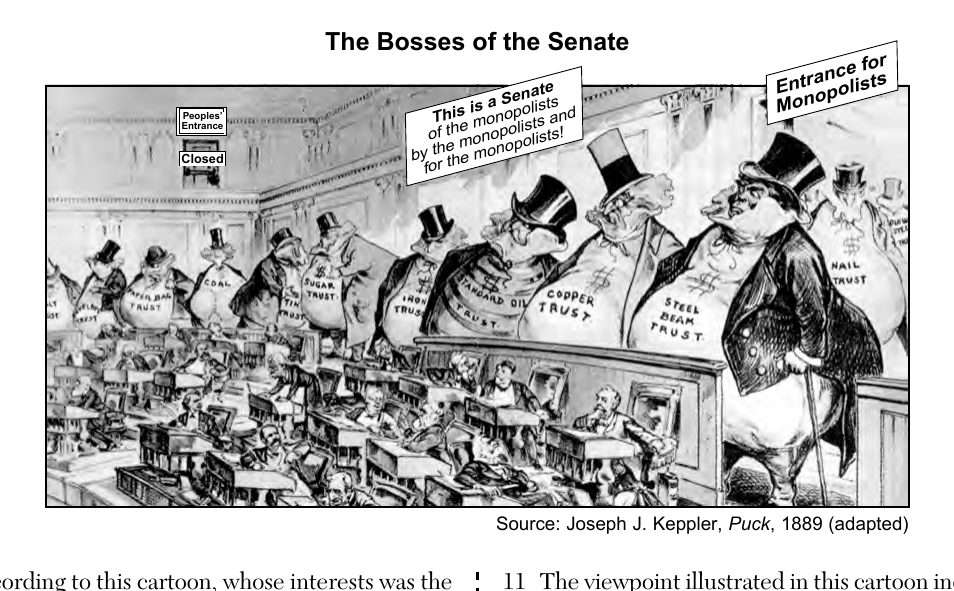
- (A) elimination of the electoral college
- (B) direct election of senators ✓
- (C) creation of the Interstate Commerce Commission
- (D) reducing the number of terms a president could serve
Worked solution
Cartoons like this fueled Progressive Era demands that senators be elected directly by the people instead of by state legislatures susceptible to corporate influence, leading to the Seventeenth Amendment.
Base your answer on the passage below and on your knowledge of social studies. War Message to Congress: ". . . The grounds for such intervention may be briefly summarized as follows: First. In the cause of humanity and to put an end to the barbarities, bloodshed, starvation, and horrible miseries now existing there... Second. We owe it to our citizens in Cuba to afford them that protection and indemnity [security] for life and property... Third. The right to intervene may be justified by the very serious injury to the commerce, trade, and business of our people... The issue is now with the Congress. It is a solemn responsibility. I have exhausted every effort to relieve the intolerable condition of affairs which is at our doors. Prepared to execute every obligation imposed upon me by the Constitution and the law, I await your action. . . ." (Source: President William McKinley, Message to Congress, April 11, 1898) President William McKinley's message to Congress illustrates which constitutional principle?
- (A) judicial review
- (B) reserved powers
- (C) popular sovereignty
- (D) separation of powers ✓
Worked solution
McKinley's message shows that while the president can recommend action, only Congress holds the power to declare war, illustrating the separation of powers.
Base your answer on the passage below and on your knowledge of social studies. War Message to Congress: ". . . The grounds for such intervention may be briefly summarized as follows: First. In the cause of humanity and to put an end to the barbarities, bloodshed, starvation, and horrible miseries now existing there... Second. We owe it to our citizens in Cuba to afford them that protection and indemnity [security] for life and property... Third. The right to intervene may be justified by the very serious injury to the commerce, trade, and business of our people. . . ." (Source: President William McKinley, Message to Congress, April 11, 1898) Which United States foreign policy was implemented during this time period?
- (A) mercantilism
- (B) isolationism
- (C) imperialism ✓
- (D) appeasement
Worked solution
The Spanish-American War, prompted by McKinley's message, marked the United States' turn toward imperialism as it acquired overseas territories like Cuba, Puerto Rico, and the Philippines.
Based on the political cartoon shown ("10,000 Miles From Tip to Tip," Source: Philadelphia Press, 1899, adapted), depicting a large American bald eagle labeled "United States" with its wingspan stretching over territories such as Hawaii, Manila, the Marianas, Caroline Islands, Samoa, and Porto Rico, along with the continental U.S. and Eastport, Maine, a historian would make best use of this cartoon to study which topic?
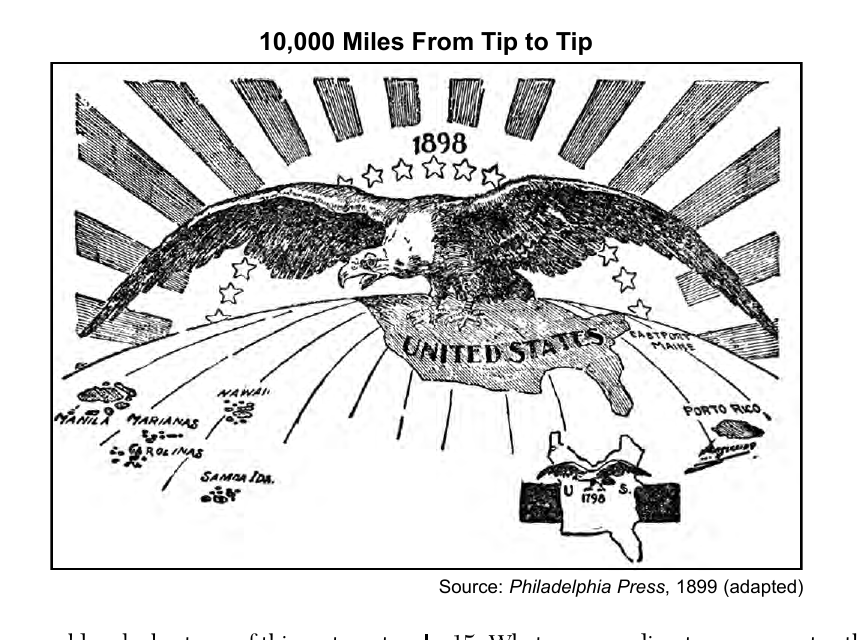
- (A) the purchase of Alaska
- (B) the Open Door policy
- (C) the United States as a world power ✓
- (D) United States entry into World War I
Worked solution
The cartoon visually depicts the dramatic overseas expansion of American territory after the Spanish-American War, illustrating the United States' rise as a world power.
Base your answer on the political cartoon "10,000 Miles From Tip to Tip" (Philadelphia Press, 1899) shown on the exam. What was a direct response to the situation illustrated in the cartoon?
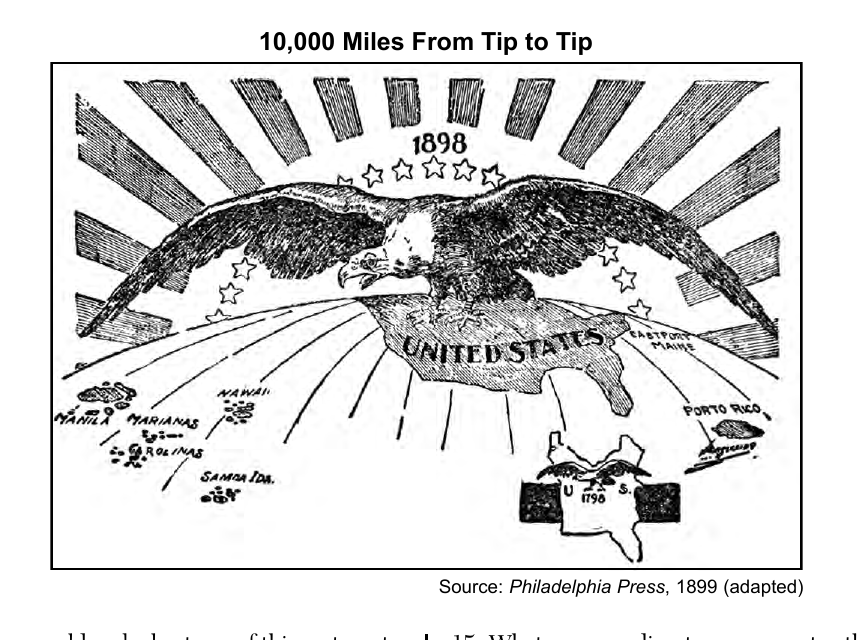
- (A) Anti-imperialist sentiment increased. ✓
- (B) Farmers demanded more imports of food products.
- (C) Industrialists sought tariffs on Asian manufactured goods.
- (D) Nativist attitudes decreased.
Worked solution
The 1899 cartoon celebrates US overseas expansion following the Spanish-American War, a policy that provoked a strong anti-imperialist backlash among Americans who opposed ruling foreign peoples without their consent.
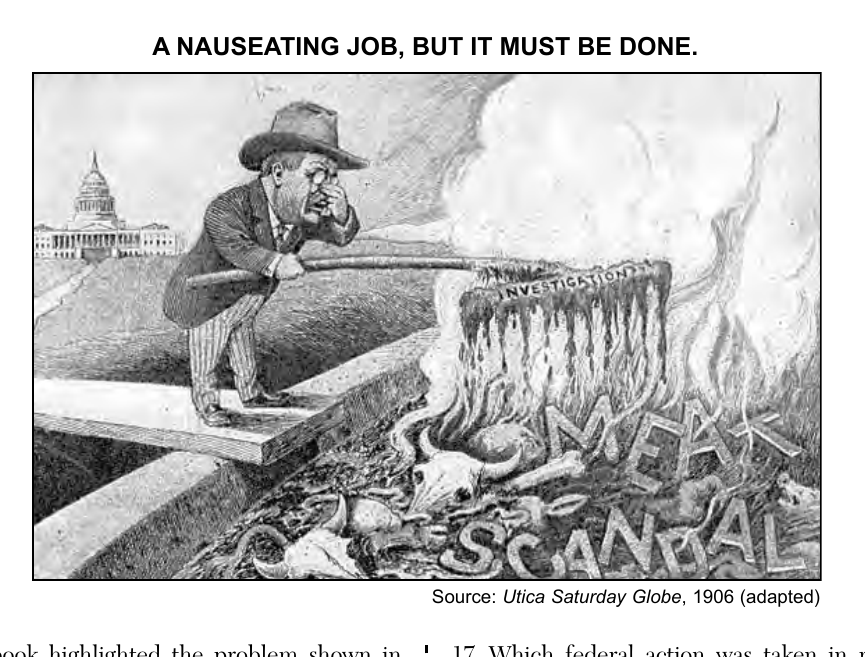
Base your answer on the political cartoon "A Nauseating Job, But It Must Be Done" (Utica Saturday Globe, 1906) shown on the exam. Which book highlighted the problem shown in this cartoon?
- (A) How the Other Half Lives
- (B) The Octopus
- (C) The Jungle ✓
- (D) The Shame of the Cities
Worked solution
Upton Sinclair's The Jungle exposed unsanitary conditions in the meatpacking industry, sparking the public outcry and federal investigation depicted in the cartoon.
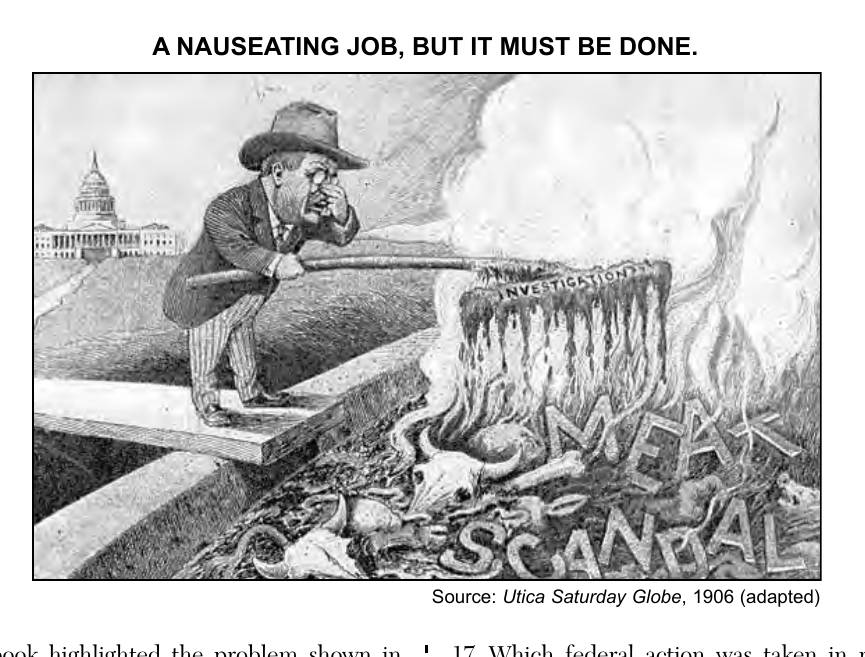
Base your answer on the same cartoon, "A Nauseating Job, But It Must Be Done." Which federal action was taken in response to conditions similar to those illustrated in this cartoon?
- (A) the passage of the Interstate Commerce Act
- (B) the passage of the Pure Food and Drug Act ✓
- (C) increased regulation of banks
- (D) increased efforts in the area of conservation
Worked solution
Congress passed the Pure Food and Drug Act (1906) to regulate food and medicine safety, directly responding to the meatpacking scandal exposed in the cartoon.
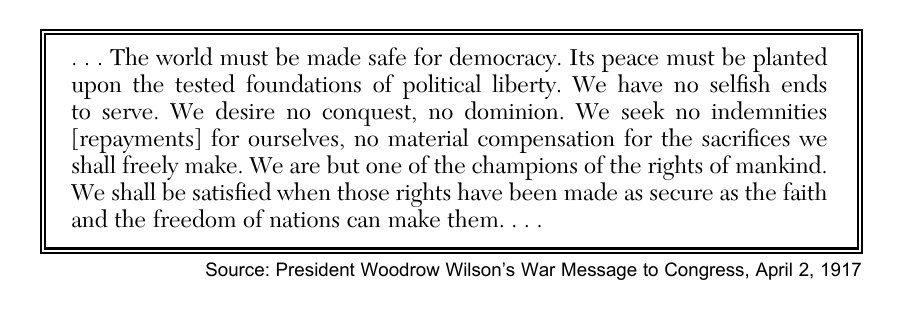
Base your answer on President Woodrow Wilson's War Message to Congress, April 2, 1917, shown on the exam, in which he stated the world must be made safe for democracy and that the United States sought no conquest or indemnities for itself. What is one justification President Woodrow Wilson gives for a declaration of war?
- (A) acquisition of overseas colonies
- (B) compensation for property lost at sea
- (C) increased immigration from Europe
- (D) self-government for all nations ✓
Worked solution
Wilson framed US entry into WWI as a moral crusade to secure democracy and self-determination worldwide, not for territorial or financial gain.
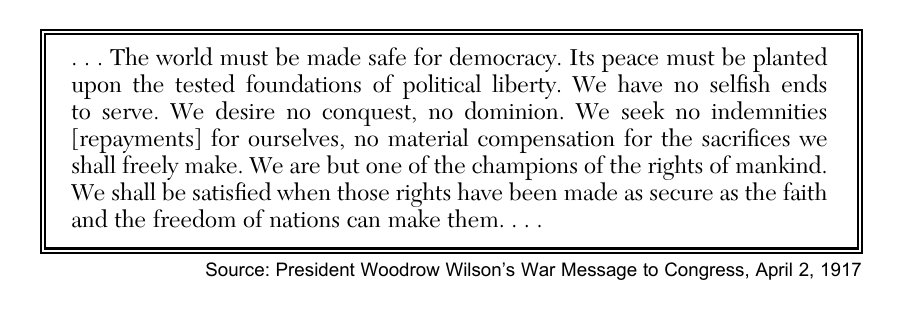
Base your answer on the same War Message passage from President Woodrow Wilson. What did President Wilson propose to support the ideals expressed in this message?
- (A) establishment of the Federal Reserve System
- (B) creation of the League of Nations ✓
- (C) passage of a higher protective tariff
- (D) decreasing aid to Europe
Worked solution
Wilson later proposed the League of Nations as part of his postwar vision, an international body meant to promote collective security and self-determination.
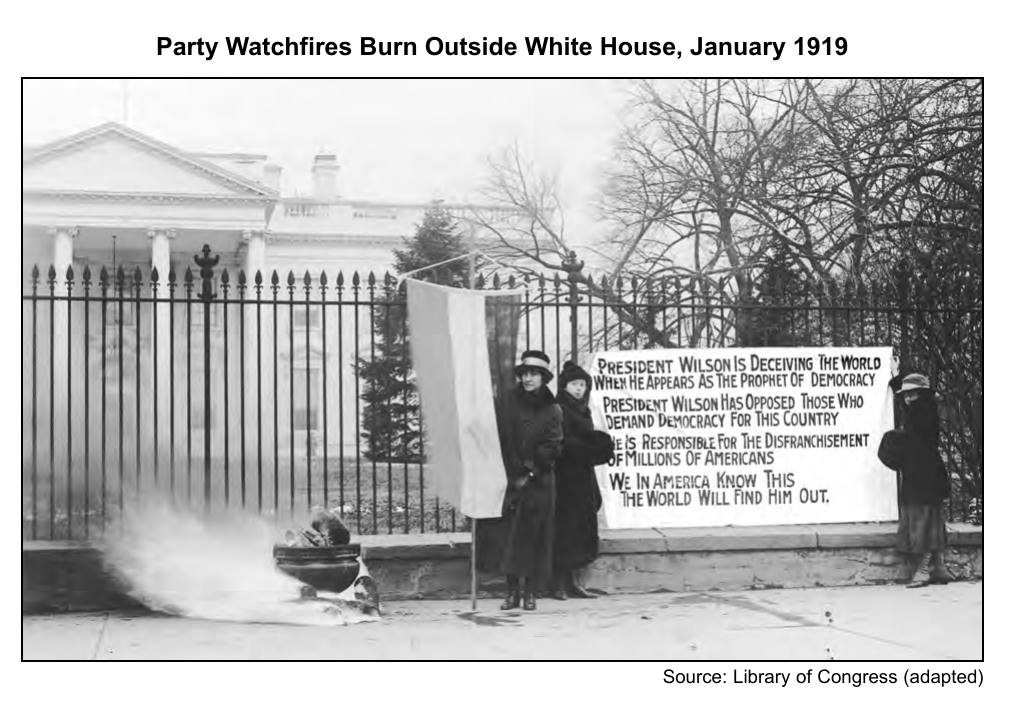
Base your answer on the photograph "Party Watchfires Burn Outside White House, January 1919" shown on the exam, depicting women picketing with banners criticizing President Wilson. Which section of the Bill of Rights protects the actions shown in this photograph?
- (A) "the right of the people to keep and bear arms, shall not be infringed"
- (B) "no warrants shall issue, but upon probable cause"
- (C) "nor shall any person subject for the same offense to be twice put in jeopardy"
- (D) "the right of the people peaceably to assemble" ✓
Worked solution
The suffragists' picketing and banner protest exemplify the First Amendment right to peaceable assembly and free expression.
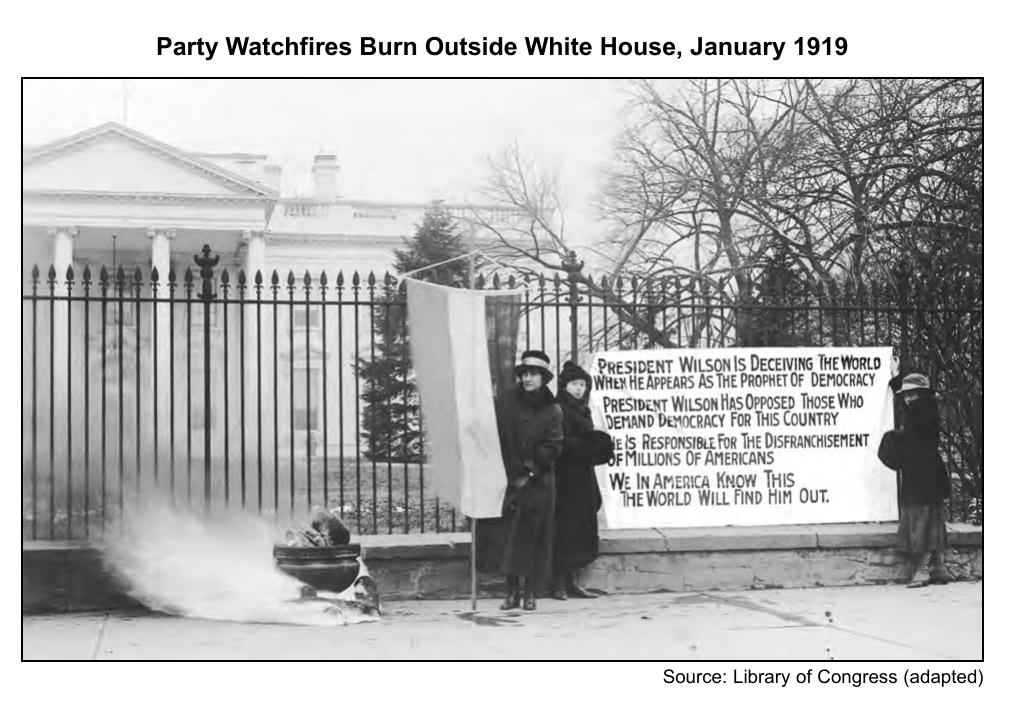
Base your answer on the same photograph, "Party Watchfires Burn Outside White House, January 1919." What was the primary goal of the protest shown in this photograph?
- (A) to disagree with American involvement in World War I
- (B) to promote the ratification of the Treaty of Versailles
- (C) to gain support for a national woman's suffrage amendment ✓
- (D) to oppose restrictive immigration legislation
Worked solution
The National Woman's Party picketed the White House to pressure President Wilson to support a constitutional amendment granting women the right to vote, achieved with the Nineteenth Amendment in 1920.
"It is impossible to tell whether prohibition is a good thing or a bad thing. It has never been enforced in this country. There may not be as much liquor in quantity consumed to-day as there was before prohibition, but there is just as much alcohol . . ." (New York City Mayor Fiorello H. LaGuardia, Statement to Congress on the subject of Prohibition, 1926). What was the primary reason for the problem described by New York City Mayor Fiorello LaGuardia?
- (A) Tax revenues increased as a result of Prohibition.
- (B) Many Americans refused to accept that consuming alcohol was wrong. ✓
- (C) Americans discovered that imported alcohol was superior to domestic alcohol.
- (D) Bootleggers drove up prices by restricting the supply of alcohol.
Worked solution
Prohibition largely failed because widespread public demand for alcohol continued unabated, since many Americans did not accept that drinking itself was wrong, undermining enforcement.
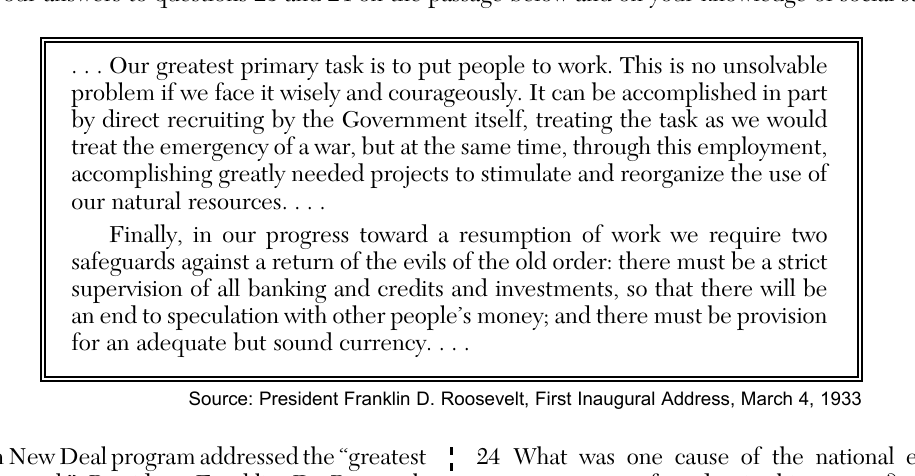
Base your answer on President Franklin D. Roosevelt's First Inaugural Address, March 4, 1933, shown on the exam, in which he described putting people to work as the greatest primary task and called for strict supervision of banking and credit. Which New Deal program addressed the "greatest primary task" President Franklin D. Roosevelt referred to in this passage?
- (A) Works Progress Administration ✓
- (B) Emergency Banking Relief Act
- (C) Securities and Exchange Commission
- (D) Social Security Act
Worked solution
FDR's "greatest primary task" was putting unemployed Americans back to work, a goal the Works Progress Administration directly addressed through public works employment.
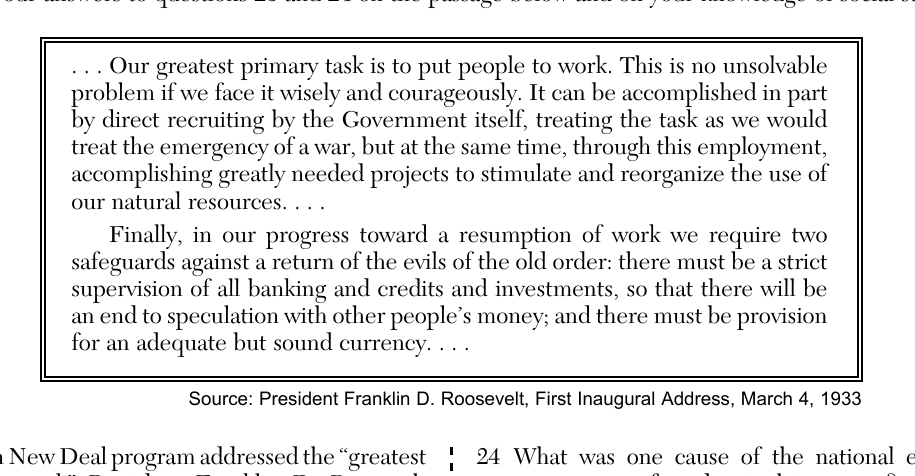
Base your answer on the same First Inaugural Address passage from President Franklin D. Roosevelt. What was one cause of the national economic emergency referred to in this passage?
- (A) costs of social welfare programs
- (B) passage of antitrust laws and high taxes
- (C) buying on margin and excessive use of credit ✓
- (D) a shortage of American factories making consumer goods
Worked solution
FDR alludes to reckless speculation with borrowed money, reflecting how excessive margin buying and overuse of credit helped cause the stock market crash and the Great Depression.
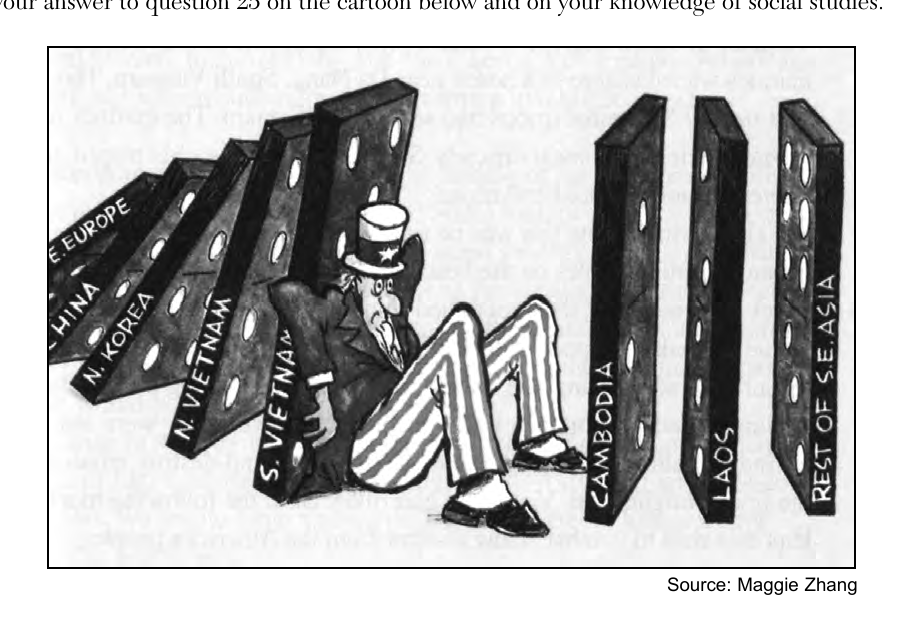
Base your answer on the political cartoon shown on the exam, which depicts Uncle Sam sitting braced against a row of falling dominoes labeled Eastern Europe, China, North Korea, and North Vietnam, holding back dominoes labeled South Vietnam, Cambodia, Laos, and the Rest of Southeast Asia. What conclusion can best be drawn from this cartoon?
- (A) The United States was reluctant to commit troops to Southeast Asia.
- (B) A united Vietnam was necessary for maintaining foreign alliances.
- (C) The United States was shifting its foreign policy from isolationism to imperialism.
- (D) Involvement in South Vietnam was necessary to prevent communist expansion. ✓
Worked solution
The domino theory held that if one Southeast Asian nation fell to communism, neighboring countries would follow in a chain reaction, justifying US intervention in Vietnam to halt the spread.
Base your answer on the political cartoon "Map of the U.S. (As viewed by the presidential candidates)" by Stuart Carlson, 2012, shown on the exam, which shows a few states greatly enlarged on the map while the rest of the country is shrunk. What conclusion can best be drawn from the cartoon?
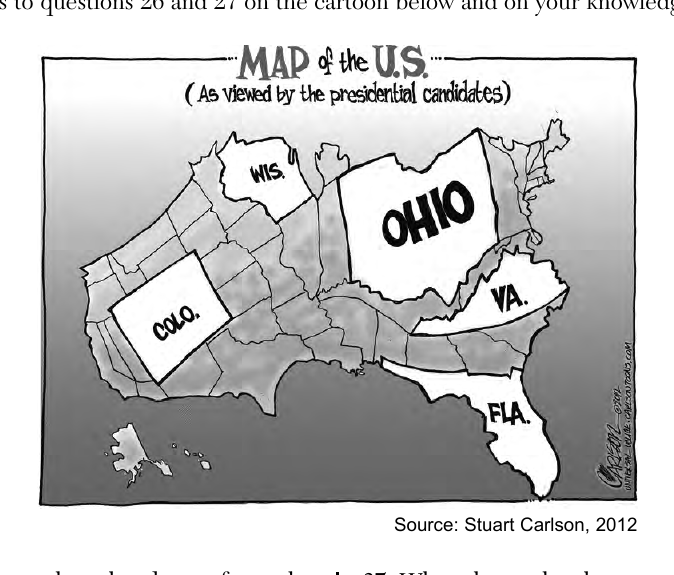
- (A) Voters in a few states can decide presidential elections. ✓
- (B) Boundary lines between states should be redrawn.
- (C) Presidential candidates only come from a few states.
- (D) Political power in Congress is held by the president's political party.
Worked solution
The cartoon exaggerates the size of swing states to show how the Electoral College concentrates campaign attention and decisive influence on a small number of battleground states.
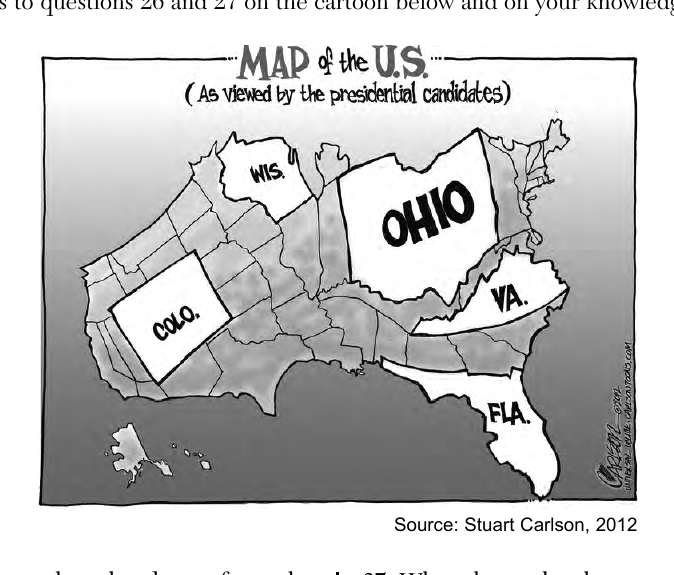
Base your answer on the same cartoon, "Map of the U.S. (As viewed by the presidential candidates)." What change has been proposed to address the issue raised by the cartoon?
- (A) reapportionment of state legislatures
- (B) direct popular vote for the president ✓
- (C) allowing Congress to elect the president
- (D) restricting voting rights of immigrants
Worked solution
Reformers have proposed abolishing the Electoral College in favor of a direct national popular vote so every voter's ballot counts equally, rather than concentrating power in swing states.
Base your answer on the passage "Demographic Trends in the 20th Century" (U.S. Census Bureau, November 2002) shown on the exam, describing how the population shifted from the Northeast and Midwest toward the South and West over the century, with the South and West reaching 58 percent of the population by 2000. What was a direct political result of the population changes described in the passage?
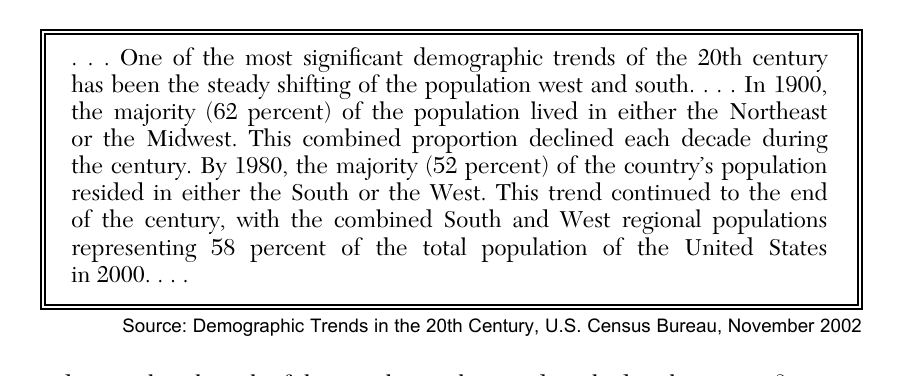
- (A) Southwest states gained more electoral votes in presidential elections. ✓
- (B) Midwest states lost representation in the Senate.
- (C) Northeast states gained representation in the House of Representatives.
- (D) Overall public support for the electoral college increased.
Worked solution
As population shifted toward the South and West, those regions gained more House seats through reapportionment following the census, directly increasing their electoral vote totals.