June 2023 US History Regents — Answer Key & Worked Solutions
Every question from the June 2023 US History Regents exam, with the correct answer and a full step-by-step solution. Check your work, learn the method, then see how it's scored.
These are real questions from the June 2023 US History New York State Regents examination, published by NYSED. Worked solutions are written by RegentsLab.
"...Small islands not capable of protecting themselves, are the proper objects for kingdoms to take under their care; but there is something very absurd, in supposing a continent to be perpetually governed by an island. In no instance hath nature made the satellite larger than its primary planet, and as England and America, with respect to each other, reverses the common order of nature, it is evident they belong to different systems: England to Europe, America to itself...." (Thomas Paine, Common Sense, 1776). According to this passage from Common Sense, the author is
- (A) trying to convince Americans to remain English colonists
- (B) suggesting that the colonies join a European confederation against England
- (C) proposing that the colonies revise the Articles of Confederation
- (D) urging Americans to become independent from their mother country ✓
Worked solution
In Common Sense, Paine used the island-continent analogy to argue that American independence was the natural and rational course of action.
"...Small islands not capable of protecting themselves, are the proper objects for kingdoms to take under their care; but there is something very absurd, in supposing a continent to be perpetually governed by an island. In no instance hath nature made the satellite larger than its primary planet, and as England and America, with respect to each other, reverses the common order of nature, it is evident they belong to different systems: England to Europe, America to itself...." (Thomas Paine, Common Sense, 1776). What is the primary argument used in this passage by Thomas Paine to make his point?
- (A) There is no economic relationship between the American colonies and England.
- (B) England cannot effectively govern the colonies because America is so much larger. ✓
- (C) The American colonies are already allied with France and do not need England.
- (D) England has denied the colonists any form of self-government.
Worked solution
Paine's rhetorical strategy in this passage centers on the natural absurdity of a small island permanently ruling a vastly larger continent.
"...This policy of supplying, by opposite and rival interests, the defect of better motives, might be traced through the whole system of human affairs, private as well as public. We see it particularly displayed in all the subordinate distributions of power, where the constant aim is to divide and arrange the several offices in such a manner as that each may be a check on the other, that the private interest of every individual may be a sentinel over the public rights. These inventions of prudence cannot be less requisite in the distribution of the supreme powers of the State...." (James Madison, Federalist No. 51, 1788). What was the primary reason James Madison wrote this and other Federalist Papers?
- (A) to support ratification of the Constitution ✓
- (B) to support creation of a national bank
- (C) to encourage increasing ties to Europe
- (D) to encourage the development of political parties
Worked solution
Madison, along with Hamilton and Jay, wrote the Federalist Papers under the pen name Publius specifically to build support for ratifying the new Constitution.
"...This policy of supplying, by opposite and rival interests, the defect of better motives, might be traced through the whole system of human affairs, private as well as public. We see it particularly displayed in all the subordinate distributions of power, where the constant aim is to divide and arrange the several offices in such a manner as that each may be a check on the other, that the private interest of every individual may be a sentinel over the public rights...." (James Madison, Federalist No. 51, 1788). Which constitutional principle does Madison most directly describe in this passage?
- (A) reserving the power of judicial review
- (B) separation of powers between the branches of government ✓
- (C) support for the rule of law
- (D) creation of a powerful military
Worked solution
Federalist No. 51 is famous for explaining how dividing government into branches with checks on one another prevents any one branch from becoming too powerful.
"...When the British and French both seized American vessels if they touched at the ports of the other, Jefferson decided to test one of his favorite doctrines, that war was both intolerable and unnecessary, and that the best weapon against both powers lay in economic sanctions. He got Congress to pass a series of five Embargo Acts, stringently forbidding U.S. trade with Britain and France not only overseas but even along the Canadian border...." (Max Lerner, Wounded Titans: American Presidents and the Perils of Power, 1996). According to this passage, what was President Thomas Jefferson's primary objective in proposing the Embargo Acts?
- (A) to raise revenue
- (B) to limit the slave trade
- (C) to avoid war ✓
- (D) to increase trade
Worked solution
Jefferson pursued the Embargo Acts as a peaceful alternative to war, using economic pressure instead of military conflict against Britain and France.
"...When the British and French both seized American vessels if they touched at the ports of the other, Jefferson decided to test one of his favorite doctrines, that war was both intolerable and unnecessary, and that the best weapon against both powers lay in economic sanctions. He got Congress to pass a series of five Embargo Acts, stringently forbidding U.S. trade with Britain and France not only overseas but even along the Canadian border...." (Max Lerner, Wounded Titans: American Presidents and the Perils of Power, 1996). What was one result of the failure of the Embargo Acts?
- (A) Louisiana Purchase
- (B) War of 1812 ✓
- (C) Missouri Compromise
- (D) Gibbons v. Ogden decision
Worked solution
The failure of economic sanctions to change British and French behavior contributed to escalating tensions that culminated in the War of 1812.
"...Apprehension seems to exist among the people of the Southern States that by the accession of a Republican Administration their property and their peace and personal security are to be endangered. There has never been any reasonable cause for such apprehension.... I have no purpose, directly or indirectly, to interfere with the institution of slavery in the States where it exists. I believe I have no lawful right to do so, and I have no inclination to do so...." (First Inaugural Address of Abraham Lincoln, March 4, 1861). What is one reason President Abraham Lincoln included these statements in this address?
- (A) to reduce the fears of slave-holding states ✓
- (B) to reestablish the foreign slave trade
- (C) to increase support of northern abolitionists
- (D) to encourage the expansion of slavery into the West
Worked solution
In his First Inaugural Address, Lincoln sought to reassure the South that he would not interfere with slavery in existing slave states in an attempt to prevent further secession.
"...I have no purpose, directly or indirectly, to interfere with the institution of slavery in the States where it exists. I believe I have no lawful right to do so, and I have no inclination to do so...." (First Inaugural Address of Abraham Lincoln, March 4, 1861). Which later action by President Lincoln demonstrated a change from his 1861 position?
- (A) signing the Pacific Railway Act
- (B) appointing William Seward Secretary of State
- (C) issuing the Emancipation Proclamation ✓
- (D) suspending habeas corpus
Worked solution
The Emancipation Proclamation of 1863 marked a significant departure from Lincoln's earlier stated policy of not interfering with slavery where it already existed.
"...Thus American development has exhibited not merely advance along a single line, but a return to primitive conditions on a continually advancing frontier line, and a new development for that area. American social development has been continually beginning over again on the frontier. This perennial rebirth, this fluidity of American life, this expansion westward with its new opportunities, its continuous touch with the simplicity of primitive society, furnish the forces dominating American character...." (Frederick Jackson Turner, "The Significance of the Frontier in American History," 1893). Which geographic feature does Frederick Jackson Turner suggest as primary in the creation of the American character?
- (A) an irregular coastline
- (B) the Great Lakes
- (C) unsettled wilderness ✓
- (D) the Mohawk Valley
Worked solution
Turner's Frontier Thesis argued that the existence of unsettled, open wilderness land shaped a uniquely American character through repeated cycles of settlement.
"...Thus American development has exhibited not merely advance along a single line, but a return to primitive conditions on a continually advancing frontier line, and a new development for that area.... this expansion westward with its new opportunities... furnish the forces dominating American character...." (Frederick Jackson Turner, "The Significance of the Frontier in American History," 1893). Which federal action is most consistent with the ideas expressed by Frederick Jackson Turner in this excerpt?
- (A) passage of the Federal Reserve Act
- (B) establishment of the Freedmen's Bureau
- (C) decision in Plessy v. Ferguson
- (D) passage of the Homestead Act ✓
Worked solution
The Homestead Act promoted the westward expansion and settlement of frontier land that Turner identified as central to American development.
"...Private monopolies are indefensible and intolerable. They destroy competition, control the price of all material, and of the finished product, thus robbing both producer and consumer. They lessen the employment of labor, and arbitrarily fix the terms and conditions thereof; and deprive individual energy and small capital of their opportunity of betterment...." (Democratic Party Platform of 1900). The authors of the passage would have been most critical of the activities of which two individuals?
- (A) Jacob Riis and Ida Tarbell
- (B) John D. Rockefeller and Andrew Carnegie ✓
- (C) William Jennings Bryan and Eugene V. Debs
- (D) Margaret Sanger and Jane Addams
Worked solution
Rockefeller and Carnegie built massive industrial monopolies and trusts, making them prime targets of the anti-monopoly criticism in the 1900 Democratic platform.
"...Private monopolies are indefensible and intolerable. They destroy competition, control the price of all material, and of the finished product, thus robbing both producer and consumer...." (Democratic Party Platform of 1900). During the late 19th and early 20th centuries, how did Congress attempt to address these practices?
- (A) They authorized a federal takeover of large industries.
- (B) They declared that all trade was interstate commerce.
- (C) They implemented a minimum wage.
- (D) They passed antitrust legislation. ✓
Worked solution
Congress responded to monopolistic practices by passing antitrust legislation like the Sherman Antitrust Act, aimed at restoring competition in the marketplace.
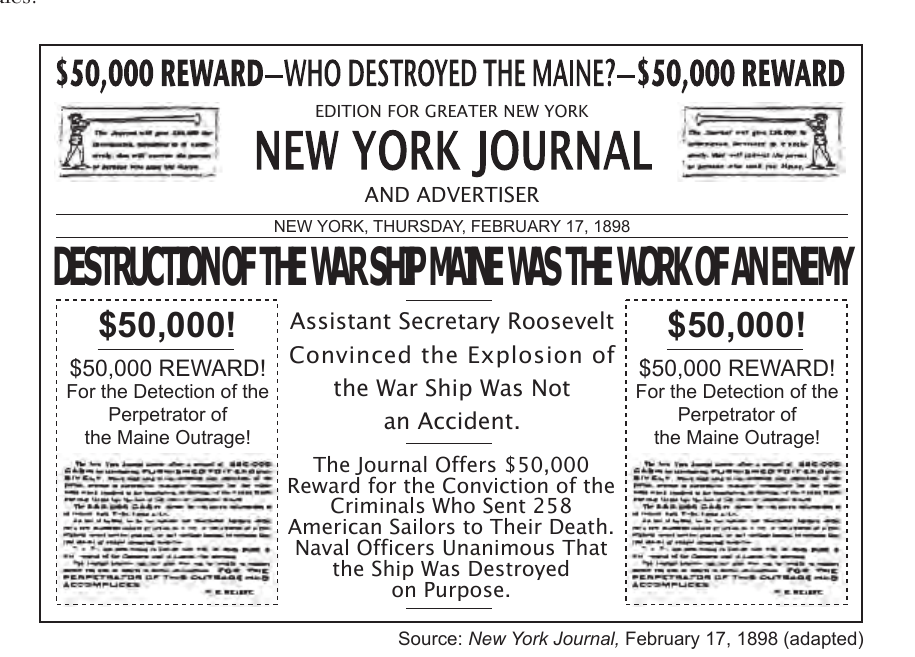
Based on the New York Journal newspaper headlines shown (February 17, 1898), reading "$50,000 Reward, Who Destroyed the Maine?" and "Destruction of the War Ship Maine Was the Work of an Enemy," a historian would most likely use this document to investigate events leading up to the
- (A) annexation of Alaska
- (B) war with Spain ✓
- (C) Open Door policy
- (D) invasion of Mexico
Worked solution
Yellow journalism surrounding the sinking of the USS Maine, as shown in this New York Journal headline, helped push the United States toward war with Spain in 1898.
Based on the New York Journal newspaper headlines shown (February 17, 1898) about the destruction of the USS Maine, how did United States foreign policy change in the years immediately following this event?
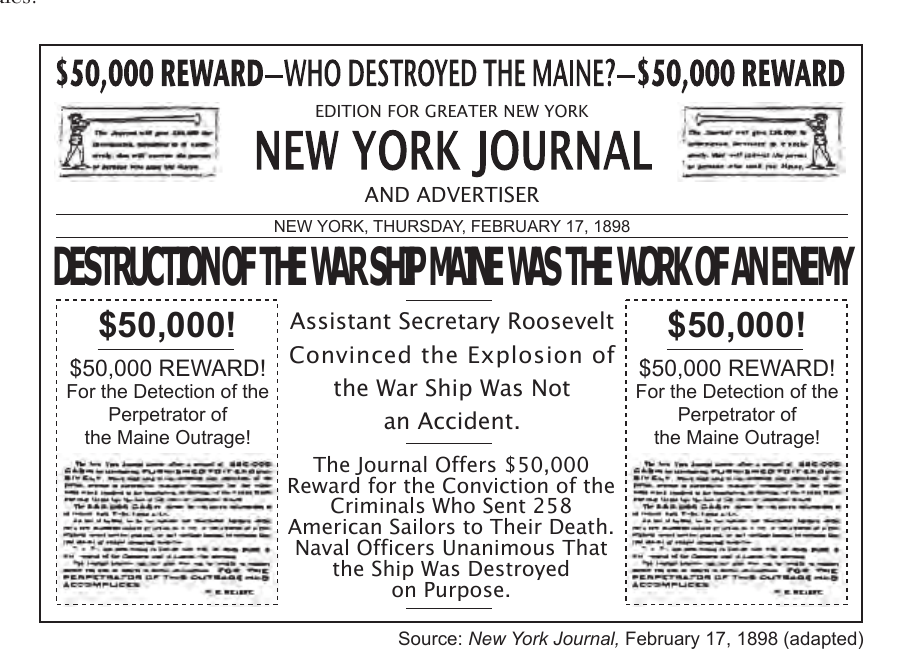
- (A) The United States entered a period of overseas expansion. ✓
- (B) The United States pursued a policy of containment.
- (C) The United States became more isolated.
- (D) The United States rejected the goal of Manifest Destiny.
Worked solution
Following the Spanish-American War, the United States acquired overseas territories, marking a new era of American imperialism and global expansion.
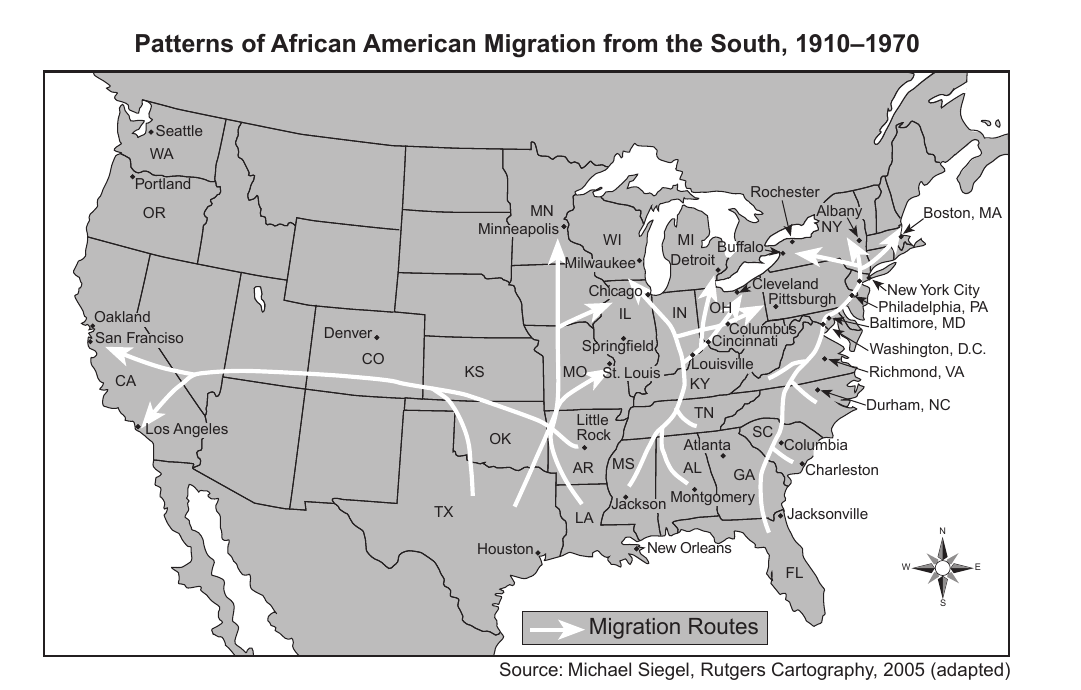
Based on the map "Patterns of African American Migration from the South, 1910-1970" shown, what was a main reason for the movement of people as shown on this map?
- (A) Foreign food imports replaced domestic production of crops.
- (B) Northern states banned all forms of racial discrimination.
- (C) Abolitionists promised a means of escape from slavery.
- (D) Industrialization provided more employment opportunities. ✓
Worked solution
The Great Migration was driven primarily by the pull of industrial jobs in northern cities, especially during and after World War I and World War II, as well as the push of Jim Crow oppression in the South.
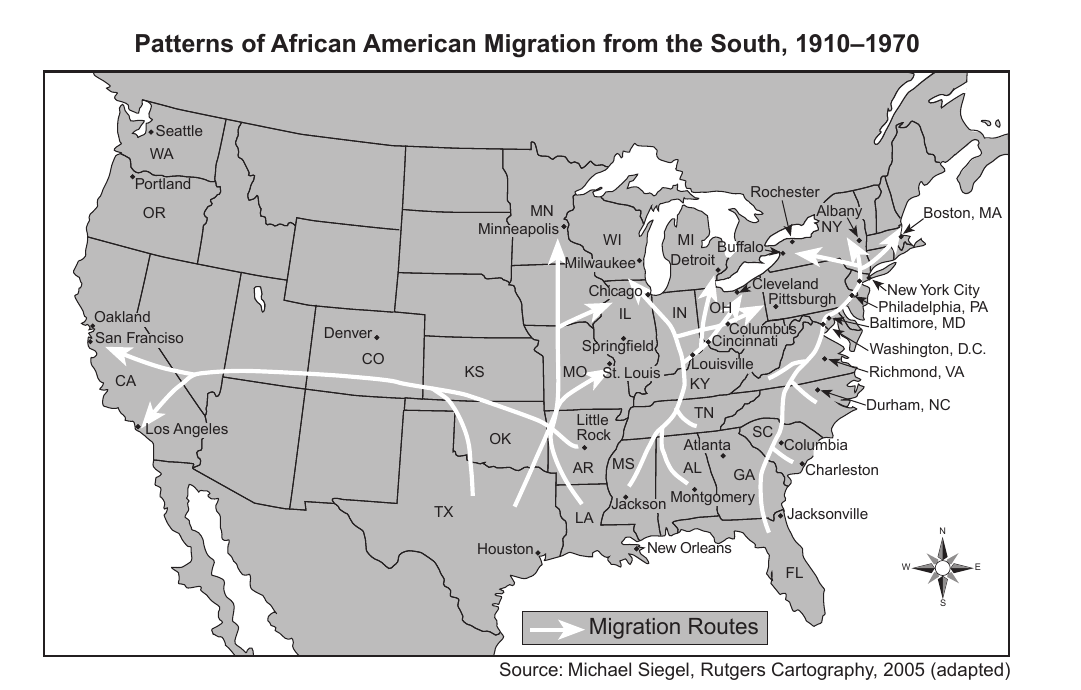
Based on the map "Patterns of African American Migration from the South, 1910-1970" shown, what was one result of the migration shown on the map?
- (A) The South became the new destination for most European immigrants.
- (B) The Democratic Party declined in the northern half of the country.
- (C) American culture was enriched by new forms of music and literature. ✓
- (D) Segregated communities throughout the nation came to an end.
Worked solution
The Great Migration helped spark the Harlem Renaissance and the spread of jazz and blues, significantly enriching American arts and culture.
Senator Robert M. La Follette stated in his 1917 speech "Free Speech in Wartime," "...the right to control their own government according to constitutional forms is not one of the rights that the citizens of this country are called upon to surrender in time of war.... More than all, the citizen and his representative in Congress in time of war must maintain his right of free speech." According to the passage, what is one argument in support of free speech during wartime?
- (A) Citizens must maintain their right to control the government even in times of war. ✓
- (B) Citizens must support the decisions of elected officials.
- (C) Military leaders are bound by constitutional oath to defend the rights of the people.
- (D) Congress has the authority to pass laws limiting first amendment rights.
Worked solution
La Follette opposed suppression of dissent during World War I, arguing free speech and democratic control of government are essential rights even in wartime.
Which Supreme Court decision addresses the issue raised by Senator La Follette in his 1917 speech "Free Speech in Wartime"?
- (A) Wabash, St. Louis & Pacific R.R. v. Illinois
- (B) Plessy v. Ferguson
- (C) Northern Securities Co. v. United States
- (D) Schenck v. United States ✓
Worked solution
Schenck v. United States (1919) is the landmark case addressing the limits of free speech during World War I, directly relevant to La Follette's argument.
Based on the political cartoon "A Wise Economist Asks a Question" (1931) shown, in which a squirrel asks a bank failure victim why he didn't save money, why were President Herbert Hoover and the Republican Party unable to solve the problem addressed in this cartoon?
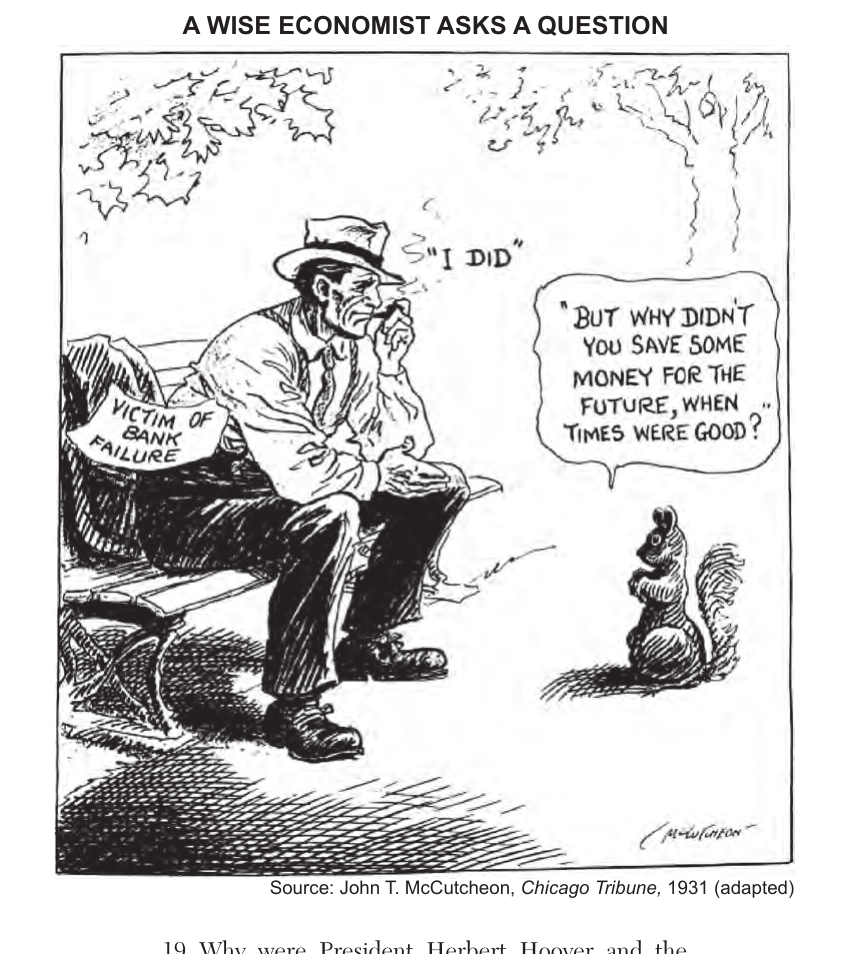
- (A) They believed in limited federal government intervention in economic activity. ✓
- (B) They knew the problem existed only in rural areas of the United States.
- (C) They thought that foreign influences were the primary cause of the bank crisis.
- (D) They believed the federal government must first pay back those who lost money due to stock speculation.
Worked solution
Hoover's commitment to limited federal intervention and voluntary cooperation prevented aggressive government action to combat the Depression's economic collapse.
Based on the political cartoon "Trying to Change the Umpiring" (1937) shown, depicting President Franklin D. Roosevelt confronting the Supreme Court as umpire with New Deal acts marked "out," what was the reason for President Franklin D. Roosevelt's reaction to the Supreme Court as shown in this cartoon?
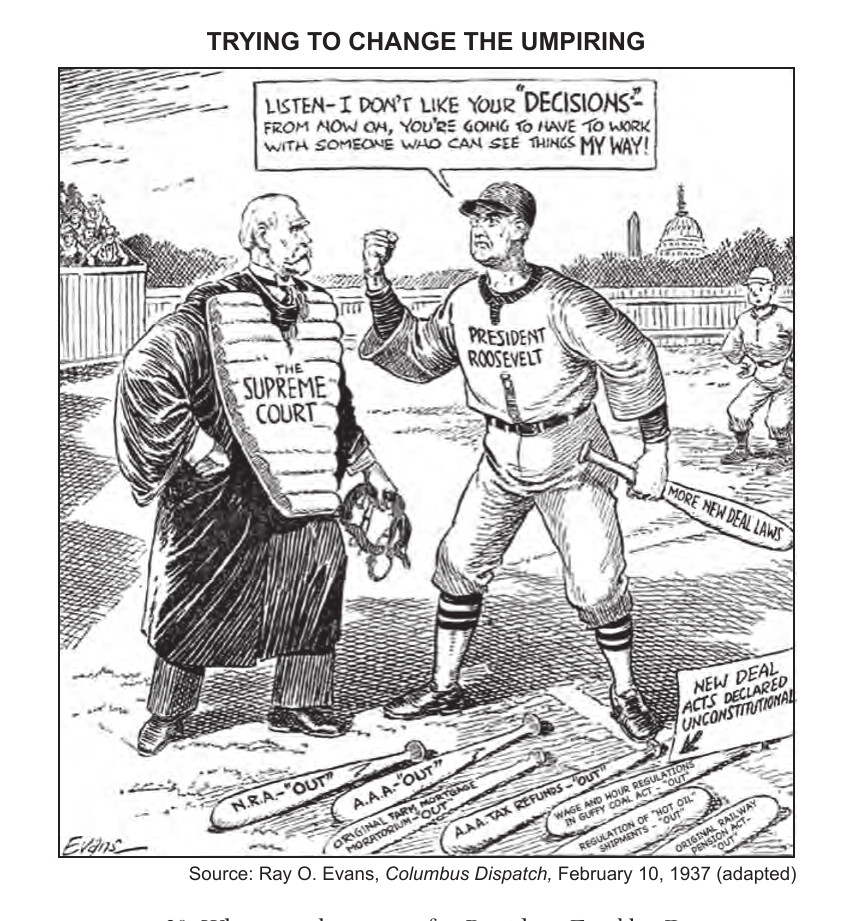
- (A) Congress had failed to pass any New Deal legislation.
- (B) Several New Deal programs had been invalidated. ✓
- (C) The House of Representatives had voted to impeach President Roosevelt.
- (D) Several Supreme Court Justices had been removed from office.
Worked solution
Roosevelt's frustration stemmed from the Supreme Court invalidating key New Deal legislation, prompting his attempt to reshape the Court.
Based on the 1942 poster "Instructions to All Persons of Japanese Ancestry" shown, issued by the Western Defense Command and Fourth Army Wartime Civil Control Administration, which situation led to the issuance of this order?
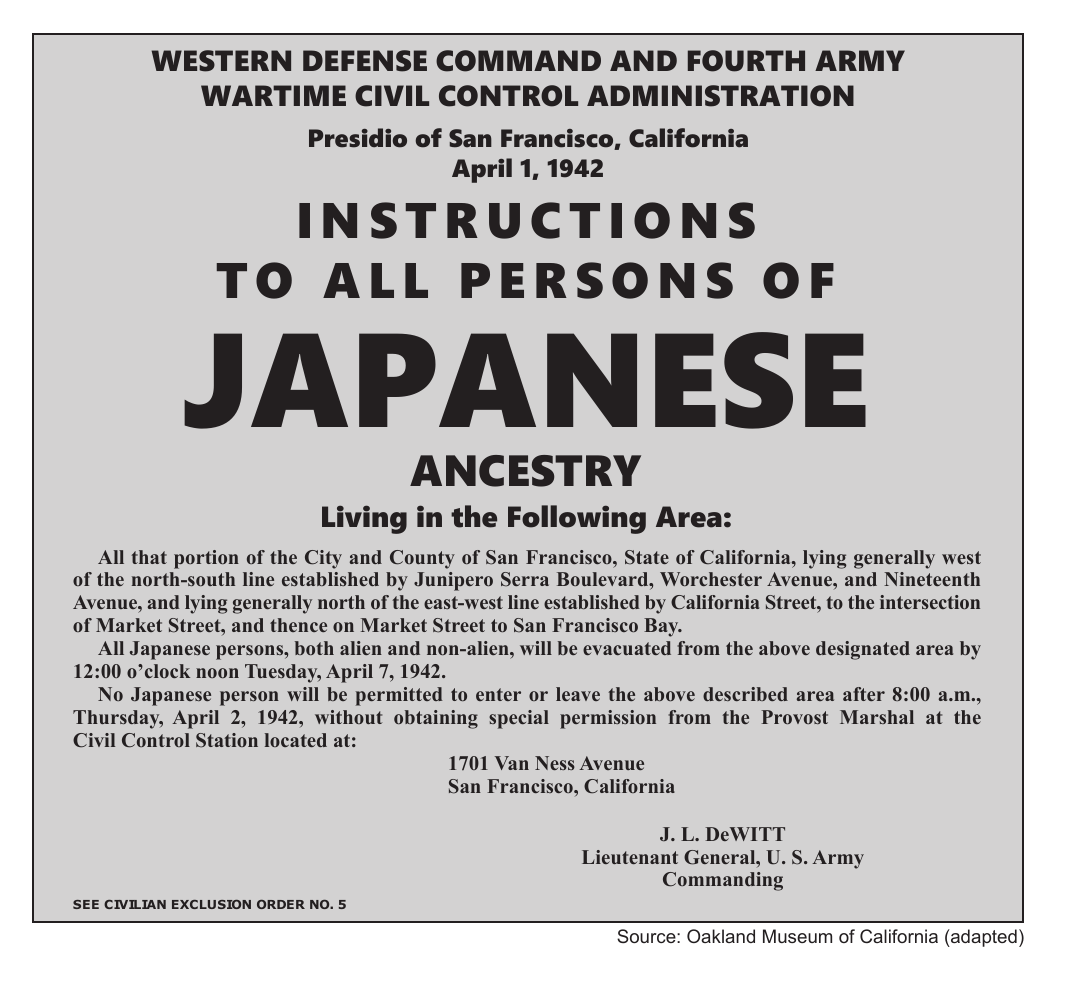
- (A) the Japanese attack on Pearl Harbor ✓
- (B) the lack of adequate housing on the West Coast
- (C) widespread acts of espionage by Japanese Americans
- (D) efforts to deport Japanese Americans
Worked solution
The Pearl Harbor attack triggered wartime hysteria that led to the forced relocation and internment of Japanese Americans, exemplified by this civilian exclusion order.
Based on the 1942 poster "Instructions to All Persons of Japanese Ancestry" shown, what Supreme Court case upheld the constitutionality of this order?
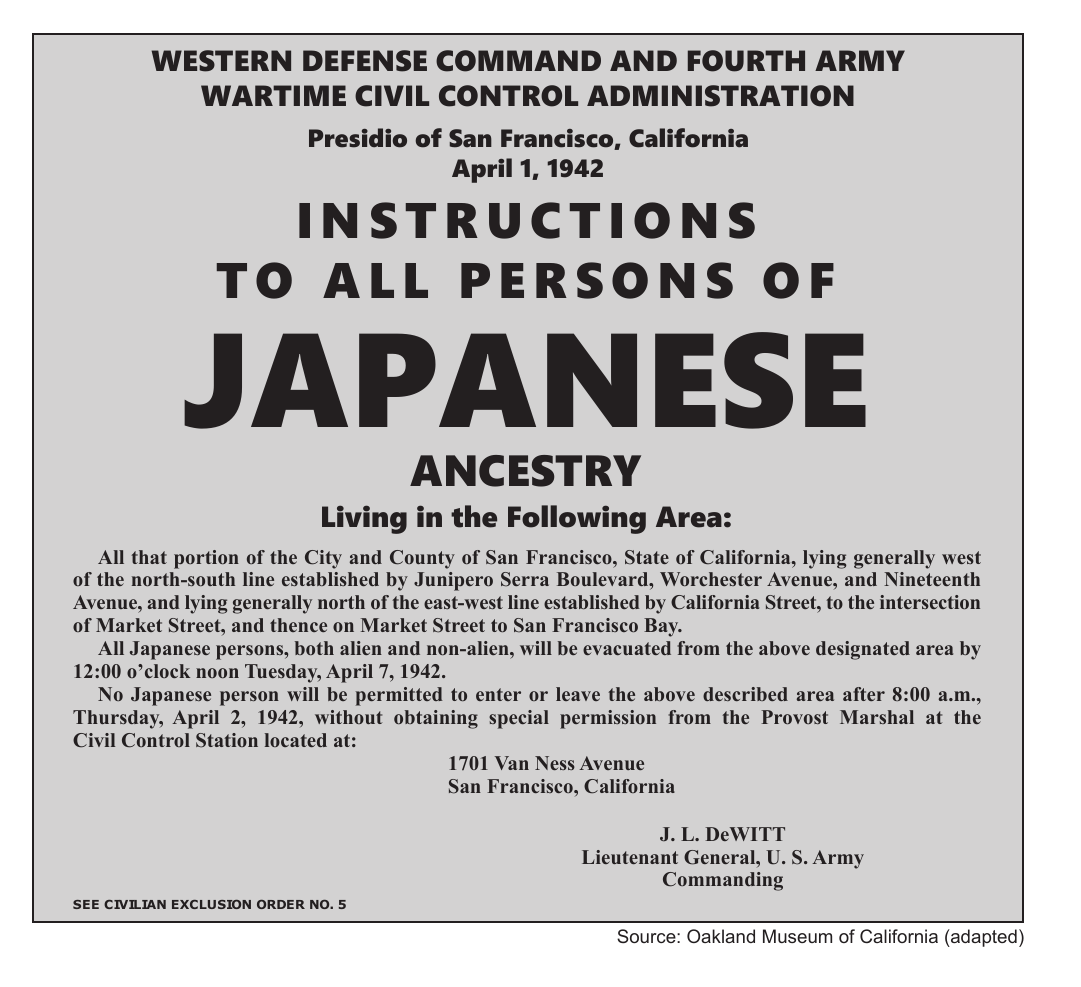
- (A) Mapp v. Ohio
- (B) Korematsu v. United States ✓
- (C) Gideon v. Wainwright
- (D) Miranda v. Arizona
Worked solution
Korematsu v. United States (1944) upheld the constitutionality of Japanese American internment during World War II, a decision widely criticized since.
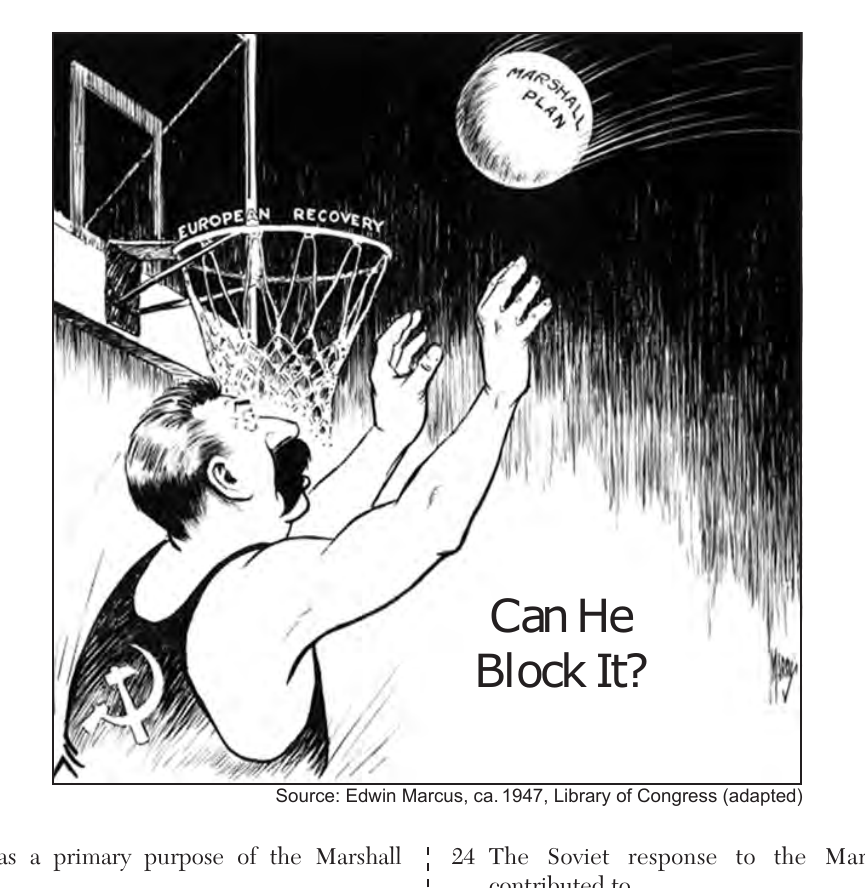
Based on the political cartoon "Can He Block It?" (ca. 1947) shown, depicting a Soviet figure trying to block a basketball labeled "Marshall Plan" from going through a hoop labeled "European Recovery," what was a primary purpose of the Marshall Plan?
- (A) to develop better relations with the Soviet Union
- (B) to expand United States territory
- (C) to support revolutions in the Middle East
- (D) to contain the spread of communism ✓
Worked solution
The Marshall Plan was a key Cold War policy intended to stabilize Western European economies and prevent communist influence from spreading.
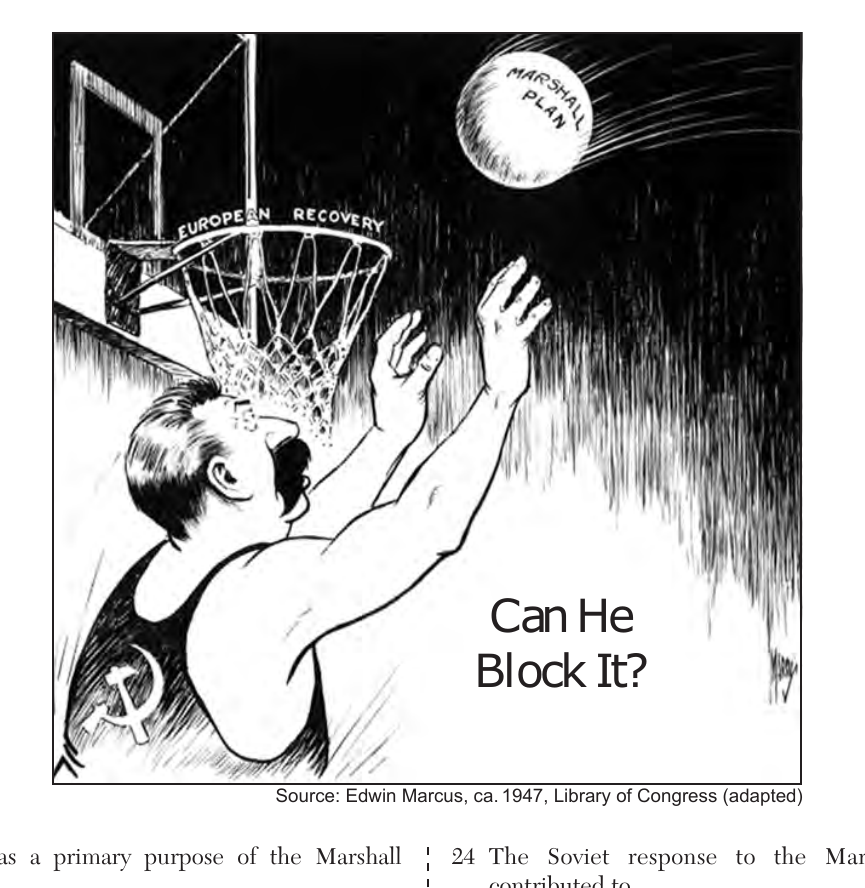
Based on the political cartoon "Can He Block It?" (ca. 1947) shown, the Soviet response to the Marshall Plan contributed to
- (A) a decline in United States-European trade
- (B) increased aid to African nations
- (C) the Cold War ✓
- (D) the end of the North Atlantic Treaty Organization (NATO)
Worked solution
Soviet rejection of and opposition to the Marshall Plan solidified the division of Europe and escalated Cold War hostilities between the U.S. and the USSR.
According to the 1973 War Powers Resolution excerpt shown, which states its purpose is "to fulfill the intent of the framers of the Constitution... that the collective judgment of both the Congress and the President will apply to the introduction of United States Armed Forces into hostilities," the purpose of this law was to
- (A) limit the power of the president from involving the United States in extended wars ✓
- (B) expand the power of the president as commander in chief
- (C) allow the president to declare war on foreign countries
- (D) prevent the president from signing a treaty without the consent of Congress
Worked solution
The War Powers Resolution of 1973 sought to limit the president's ability to commit U.S. forces to prolonged military conflicts without congressional approval.
According to the 1973 War Powers Resolution excerpt shown, what event most directly led to the passage of this act?
From the War Powers Resolution (1973): "... to fulfill the intent of the framers of the Constitution ... that the collective judgment of both the Congress and the President will apply to the introduction of United States Armed Forces into hostilities ..."
- (A) President Nixon's visit to China
- (B) President Kennedy's response to the Cuban missile crisis
- (C) involvement in the Vietnam War ✓
- (D) imposition of the Arab oil embargo
Worked solution
The Vietnam War's escalation under presidential authority without congressional declarations of war directly prompted Congress to pass the War Powers Resolution.
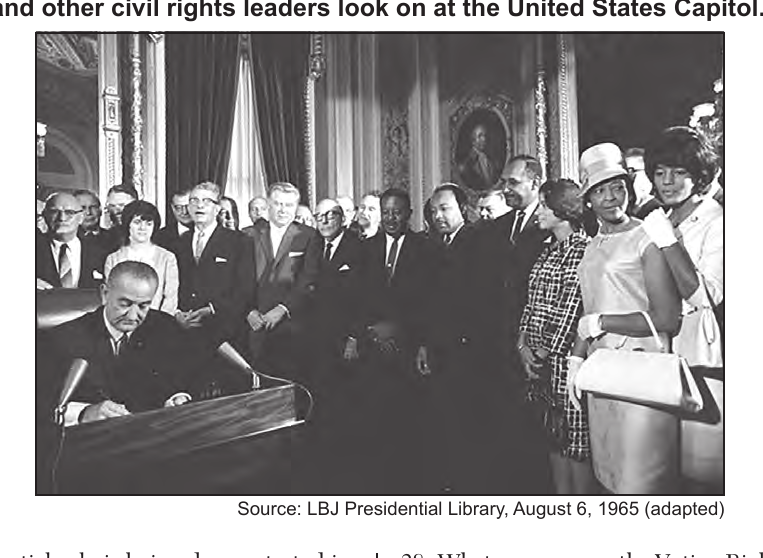
Based on the photograph shown of President Lyndon B. Johnson signing the Voting Rights Act as Martin Luther King Jr. and other civil rights leaders look on at the United States Capitol, which presidential role is being demonstrated in the photograph?
- (A) commander in chief of the armed forces
- (B) granting reprieves and pardons for federal offenses
- (C) treaty-making powers with foreign nations
- (D) chief executive approving congressional bills ✓
Worked solution
Signing legislation passed by Congress into law is a core function of the president's role as chief executive.
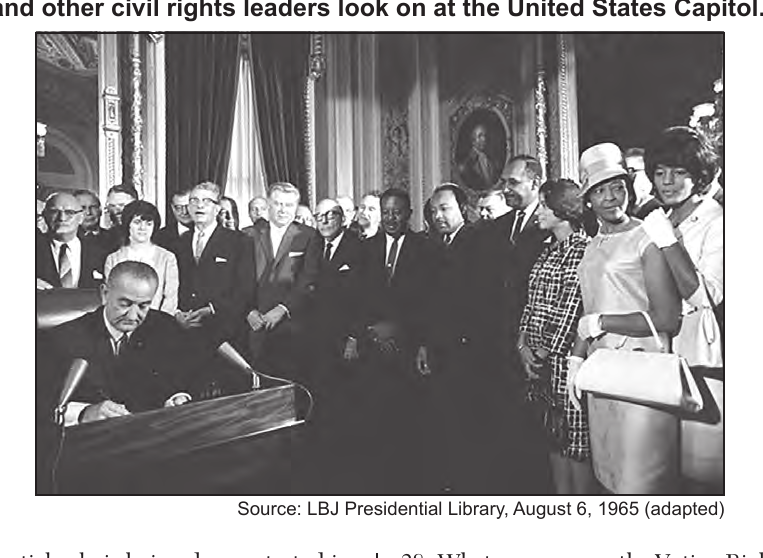
Based on the photograph shown of President Lyndon B. Johnson signing the Voting Rights Act, what was one way the Voting Rights Act expanded the civil rights of African Americans?
- (A) It stopped the practice of sharecropping.
- (B) It ended discrimination in public facilities.
- (C) It outlawed the use of literacy tests. ✓
- (D) It forced the integration of public schools.
Worked solution
The Voting Rights Act of 1965 eliminated literacy tests and other barriers that Southern states had used to prevent African Americans from voting.