January 2025 US History Regents — Answer Key & Worked Solutions
Every question from the January 2025 US History Regents exam, with the correct answer and a full step-by-step solution. Check your work, learn the method, then see how it's scored.
These are real questions from the January 2025 US History New York State Regents examination, published by NYSED. Worked solutions are written by RegentsLab.
"It is Ordered, sentenced, and decreed, that there shall be yearly two General Assemblies or Courts... wherein shall be yearly chosen from time to time, so many Magistrates and other public Officers as shall be found requisite... which choice shall be made by all that are admitted freemen and have taken the Oath of Fidelity..." (Fundamental Orders of Connecticut, Section 1, January 14, 1639). The Fundamental Orders of Connecticut represent an early step in the colonial advance toward
- (A) representative government ✓
- (B) an American monarchy
- (C) freedom of speech and of the press
- (D) abolition of slavery
Worked solution
The Fundamental Orders of Connecticut created an elected legislature chosen by freemen, an early model of representative self-government in the colonies.
Which colonial development was most similar to the Fundamental Orders of Connecticut?
- (A) Maryland Toleration Act
- (B) Virginia House of Burgesses ✓
- (C) Proclamation of 1763
- (D) Stamp Act
Worked solution
Both the Fundamental Orders of Connecticut and the Virginia House of Burgesses created elected representative legislatures, making them similar colonial developments toward self-government.
"Whereas it appears that a state of war exists between Austria, Prussia, Sardinia, Great Britain, and the United Netherlands, of the one part, and France on the other; and the duty and interest of the United States require, that they should with sincerity and good faith adopt and pursue a conduct friendly and impartial toward the belligerent Powers..." (President George Washington, Proclamation of Neutrality, April 22, 1793). What is the primary purpose of this proclamation?
- (A) to align the United States with Great Britain
- (B) to negotiate a peace treaty between the warring states of Europe
- (C) to avoid being drawn into the war between Great Britain and France ✓
- (D) to stay out of the affairs of the French colonies in Latin America
Worked solution
Washington's Proclamation of Neutrality aimed to keep the United States out of the conflict between Britain and France by declaring impartiality toward both sides.
Which later United States foreign policy action is most consistent with the ideas expressed in the Proclamation of Neutrality?
- (A) announcing the Monroe Doctrine ✓
- (B) ratifying the Treaty of Guadalupe Hidalgo
- (C) annexing the Philippines
- (D) negotiating the Camp David Accords
Worked solution
Both the Proclamation of Neutrality and the Monroe Doctrine reflect a policy of non-involvement in European conflicts, a consistent thread in early U.S. foreign policy.
"...The result is a conviction that the States have no power, by taxation or otherwise, to retard, impede, burden, or in any manner control, the operations of the constitutional laws enacted by Congress to carry into execution the powers vested in the general government... We are unanimously of opinion, that the law passed by the legislature of Maryland, imposing a tax on the Bank of the United States, is unconstitutional and void..." (McCulloch v. Maryland, 1819). What was an important impact of the McCulloch v. Maryland (1819) decision?
- (A) It established the idea that states should have the power to overturn federal laws.
- (B) It determined that the creation of the National Bank was constitutional. ✓
- (C) It stated that the bicameral legislature established by the Constitution was illegal.
- (D) It limited the power of Congress to add new states to the Union.
Worked solution
McCulloch v. Maryland confirmed Congress had the implied constitutional authority to create the National Bank and that states could not tax federal institutions.
The Supreme Court decision described in the McCulloch v. Maryland excerpt is an example of which principle?
- (A) republican government
- (B) popular sovereignty
- (C) sectionalism
- (D) federal supremacy ✓
Worked solution
The ruling that Maryland could not tax the federal Bank illustrates the principle of federal supremacy, that constitutional federal laws override state actions.
"...This treaty [Louisiana Purchase] must of course be laid before both houses, because both have important functions to exercise respecting it... But I suppose they must then appeal to the nation for an additional article to the constitution, approving and confirming an act which the nation had not previously authorised. The constitution has made no provision for our holding foreign territory, still less for incorporating foreign nations into our union..." (Thomas Jefferson, letter to John Breckinridge, August 12, 1803, adapted). Which claim about the Constitution is best supported by this letter?
- (A) It does not specifically state how to incorporate foreign territory. ✓
- (B) The Senate must provide the money for this purchase.
- (C) Adding articles to the Constitution requires presidential approval.
- (D) The Supreme Court must review treaties.
Worked solution
Jefferson's letter reveals his worry that the Constitution lacked explicit authority for acquiring and incorporating foreign territory like Louisiana.
One major goal for President Thomas Jefferson in purchasing the Louisiana Territory was that it would
- (A) promote the growth of manufacturing in the South
- (B) establish a base to exert control over Caribbean trade
- (C) help the United States expand the slave trade
- (D) give the United States full control of the Mississippi River ✓
Worked solution
Jefferson pursued the Louisiana Purchase primarily to secure American access to and control of the Mississippi River and the port of New Orleans, vital for western farmers' trade.
"...I would save the Union. I would save it the shortest way under the Constitution... My paramount object in this struggle is to save the Union, and is not either to save or destroy slavery..." (Letter from President Abraham Lincoln to Horace Greeley, August 22, 1862). According to this letter, President Abraham Lincoln's primary goal in fighting the Civil War was to
- (A) advance the cause of Northern abolitionists
- (B) save the Union ✓
- (C) extend the vote to African Americans
- (D) free African Americans enslaved in Confederate territory
Worked solution
Lincoln's letter to Greeley makes clear that preserving the Union, not the fate of slavery, was his primary war aim in 1862.
What was one action President Lincoln took to achieve his primary goal of saving the Union?
- (A) He signed the Homestead Act.
- (B) He vetoed a federal draft law.
- (C) He issued the Emancipation Proclamation. ✓
- (D) He supported passage of the Pacific Railway Act.
Worked solution
Lincoln issued the Emancipation Proclamation as a strategic move to undermine the Confederate war effort and strengthen the Union's cause, consistent with his stated goal of saving the Union.
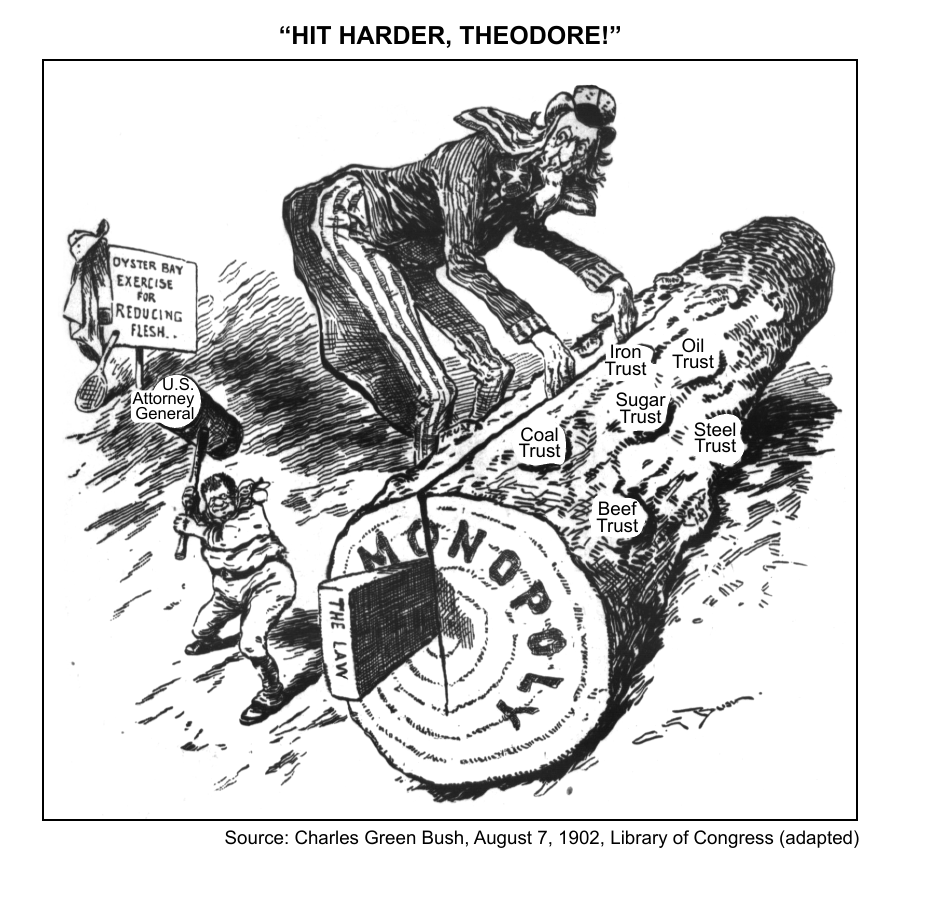
Based on the political cartoon titled "Hit Harder, Theodore!" (Charles Green Bush, August 7, 1902, showing Uncle Sam and the U.S. Attorney General splitting a log labeled MONOPOLY revealing Iron, Oil, Sugar, Steel, Coal, and Beef Trusts), which statement most accurately represents the point of view of this cartoonist?
- (A) President Roosevelt supported logging in national parks.
- (B) President Roosevelt opposed regulation of big business.
- (C) President Roosevelt refused to involve the attorney general in regulating monopolies.
- (D) President Roosevelt must use the full force of the law to end the power of trusts. ✓
Worked solution
The cartoon depicts Uncle Sam urging Roosevelt to strike harder at the log of monopoly with the axe of the law, expressing support for vigorous trust-busting.
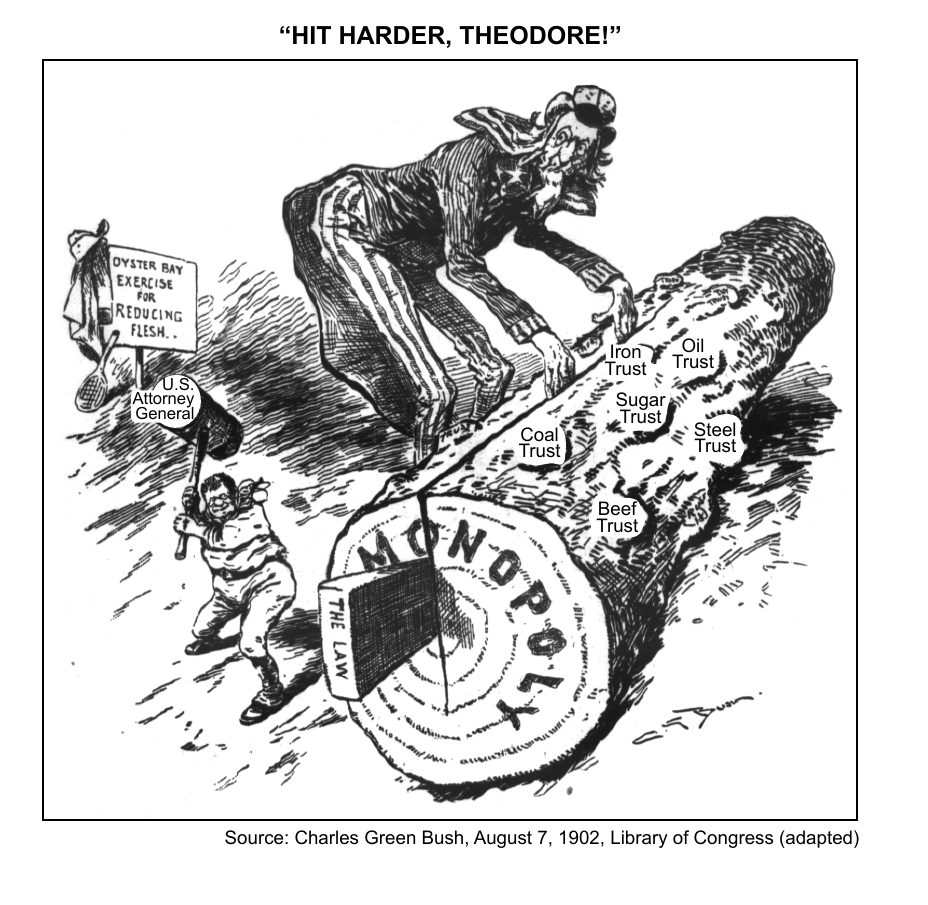
Based on the political cartoon "Hit Harder, Theodore!" showing trusts being split by the law, what law is this cartoonist referring to?
- (A) Pacific Railway Act
- (B) Chinese Exclusion Act
- (C) Sherman Antitrust Act ✓
- (D) Dawes Act
Worked solution
The Sherman Antitrust Act was the legal tool Theodore Roosevelt used to pursue and break up monopolistic trusts, as referenced by the axe labeled 'the law' in the cartoon.
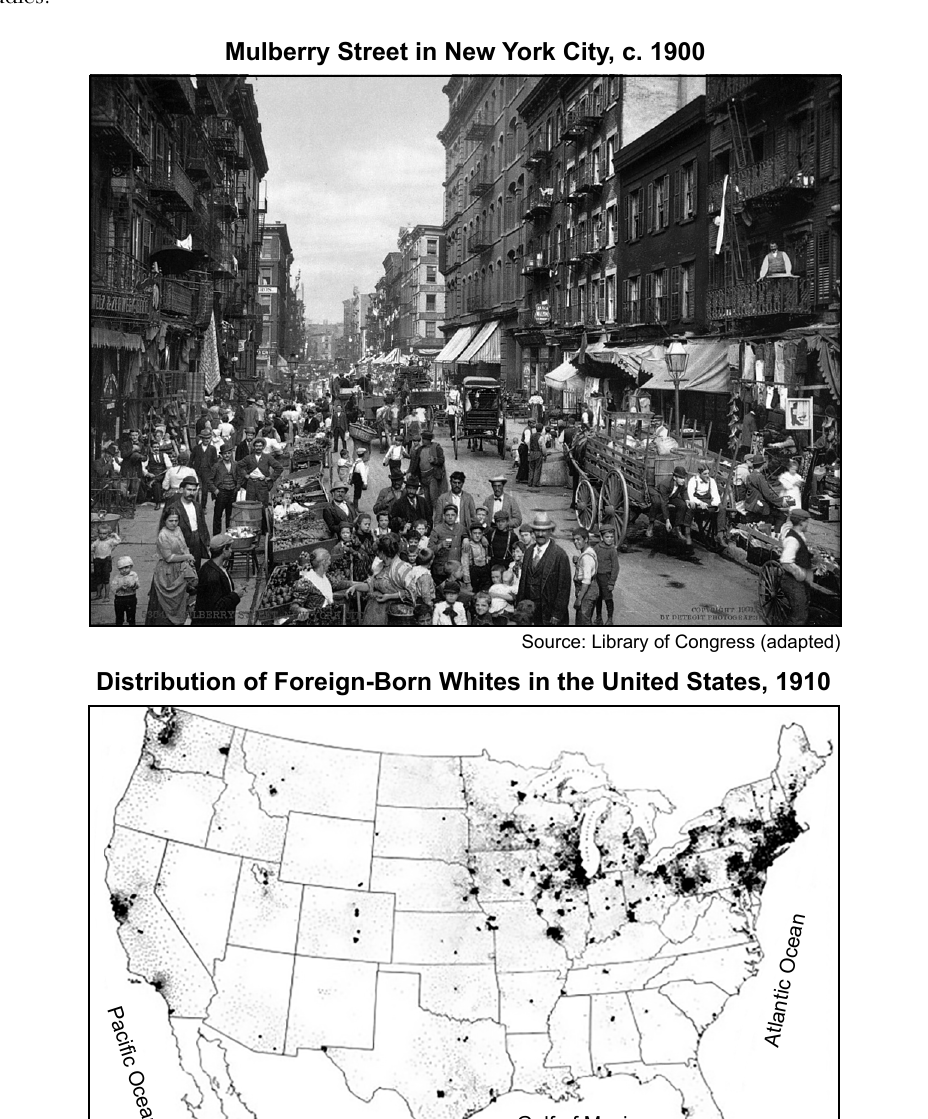
Based on the photograph of Mulberry Street in New York City, c. 1900, and the map showing the Distribution of Foreign-Born Whites in the United States, 1910, which conclusion is best supported by these documents?
- (A) Immigration to Texas and the Southwest outpaced other regions.
- (B) Northeastern cities became a refuge for immigrant families in the early 20th century. ✓
- (C) Agriculture was the dominant occupation for most immigrants in the Midwest.
- (D) The steel and petroleum industries grew near the Great Lakes because of rail transportation.
Worked solution
The photo of a crowded immigrant neighborhood in New York and the map's dense concentration of foreign-born residents in the Northeast together show that northeastern cities became centers of immigrant settlement.
The situation presented in the photograph of Mulberry Street and the map of foreign-born white distribution was addressed in the 1920s when
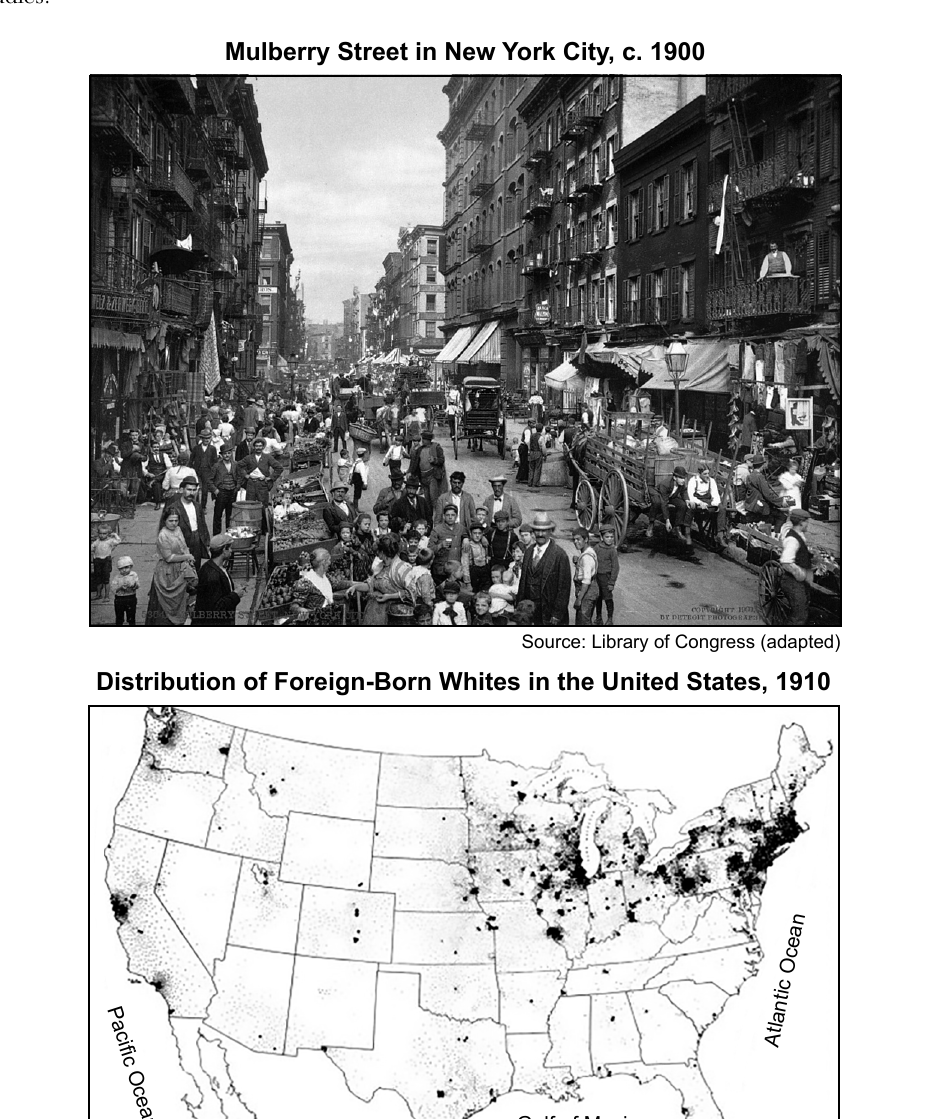
- (A) legislation was passed limiting the number of immigrants ✓
- (B) overcrowded cities received federal housing assistance
- (C) immigrants were relocated to less populated areas
- (D) deportation programs were eliminated
Worked solution
Concerns about immigrant overcrowding and cultural change depicted in these documents led Congress to pass restrictive quota legislation in the 1920s limiting immigration.
Base your answer on the excerpt from President Theodore Roosevelt's Second Annual Message to Congress, December 2, 1902 (in which he says the nation must "play a large part in the world" and cannot avoid "the endeavor from which either great failure or great success must come"). In his 1902 message to Congress, President Theodore Roosevelt expressed support for the
Excerpt from President Theodore Roosevelt's Second Annual Message to Congress, December 2, 1902: "As a people we have played a large part in the world, and we are bent upon making our future even larger than the past. In particular, the events of the last four years have definitely decided that, for woe or for weal, our place must be great among the nations. We may either fail greatly or succeed greatly; but we can not avoid the endeavor from which either great failure or great success must come."
- (A) creation of a permanent United States military
- (B) European colonization of Latin America
- (C) traditional United States foreign policy of isolationism
- (D) expansion of the United States as a world power ✓
Worked solution
Roosevelt's message reflects the turn-of-the-century push for American expansion and global influence (the era of the Spanish-American War, the Panama Canal, and the Roosevelt Corollary), directly contradicting isolationism.
Base your answer on the same 1902 message excerpt from President Theodore Roosevelt (in which he says the nation must play a large part in the world). Which action was most consistent with the ideas expressed in this message?
Excerpt from President Theodore Roosevelt's Second Annual Message to Congress, December 2, 1902: "As a people we have played a large part in the world, and we are bent upon making our future even larger than the past. In particular, the events of the last four years have definitely decided that, for woe or for weal, our place must be great among the nations. We may either fail greatly or succeed greatly; but we can not avoid the endeavor from which either great failure or great success must come."
- (A) United States construction of the Panama Canal ✓
- (B) opposition to the Open Door policy
- (C) signing consumer protection legislation
- (D) creation of the National Park Service
Worked solution
The Panama Canal, begun under Roosevelt, was a signature act of American global assertiveness and directly embodies the message's call to "play a large part" in the world.
Base your answer on the excerpt from President Franklin D. Roosevelt's statement on signing the Social Security Act, August 14, 1935, in which he says the law gives protection to "thirty millions of our citizens" through unemployment compensation, old-age pensions, and services for children. According to President Franklin D. Roosevelt, a major purpose of the Social Security system was to
Excerpt from President Franklin D. Roosevelt's statement on signing the Social Security Act, August 14, 1935: "This social security measure gives at least some protection to thirty millions of our citizens who will reap direct benefits through unemployment compensation, through old-age pensions and through increased services for the protection of children and the prevention of ill health. We can never insure one hundred percent of the population against one hundred percent of the hazards and vicissitudes of life, but we have tried to frame a law which will give some measure of protection to the average citizen and to his family against the loss of a job and against poverty-ridden old age."
- (A) end years of industrial practices that had hurt workers
- (B) eliminate deficits and balance the federal budget
- (C) improve medical care through grants to hospitals
- (D) provide benefits to jobless and aged citizens ✓
Worked solution
The Social Security Act of 1935 created unemployment insurance and old-age pensions, core New Deal programs aimed at protecting workers and the elderly from economic hardship.
Base your answer on the same excerpt from FDR's statement on signing the Social Security Act (which describes the law as a structure to lessen the impact of future depressions and provide economic soundness). By signing the Social Security Act into law, President Roosevelt was keeping his promise that the federal government would
Excerpt from President Franklin D. Roosevelt's statement on signing the Social Security Act, August 14, 1935: "We can never insure one hundred percent of the population against one hundred percent of the hazards and vicissitudes of life, but we have tried to frame a law which will give some measure of protection to the average citizen and to his family against the loss of a job and against poverty-ridden old age. This law, too, represents a cornerstone in a structure which is being built but is by no means complete. ... It is, in short, a law that will take care of human needs and at the same time provide for the United States an economic structure of vastly greater soundness."
- (A) take a more active role in the economy to improve the well-being of citizens ✓
- (B) give tax breaks to corporations to expand production and increase employment
- (C) protect the life savings of people who had trusted their banks
- (D) regulate the activities of the stock market in the future
Worked solution
Social Security exemplifies the New Deal philosophy that the federal government should actively intervene to protect citizens' economic welfare, a major and lasting shift in the role of government.
Based on the World War II era image shown (a United States "War Ration Book Four" issued by the Office of Price Administration, with instructions never to buy rationed goods without ration stamps or pay more than the legal price), why did the government establish a wartime rationing system?
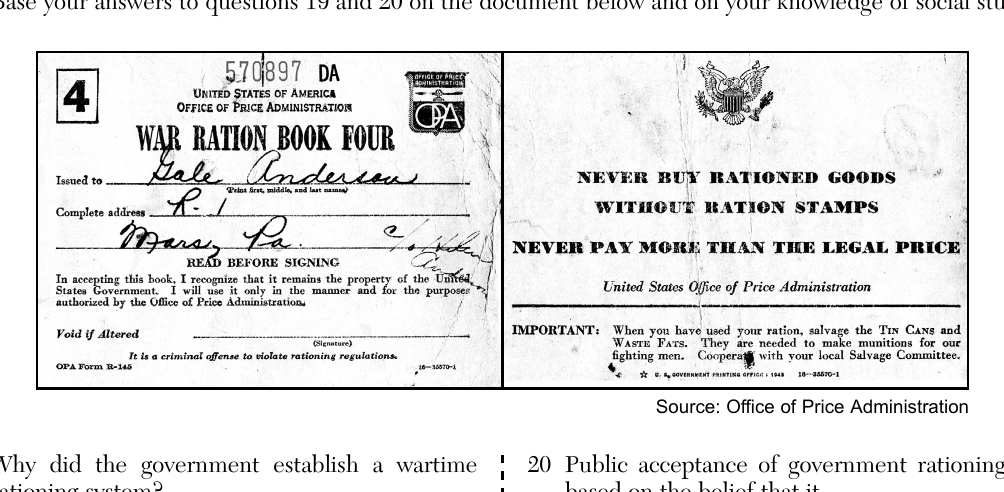
- (A) to limit consumption of critical, scarce resources ✓
- (B) to avoid price controls on goods and services
- (C) to protect the property of the United States
- (D) to help law enforcement prosecute criminal offenses
Worked solution
The federal Office of Price Administration issued ration books to conserve scarce materials needed for the war effort by controlling civilian consumption.
Based on the same World War II ration book image, public acceptance of government rationing was based on the belief that it
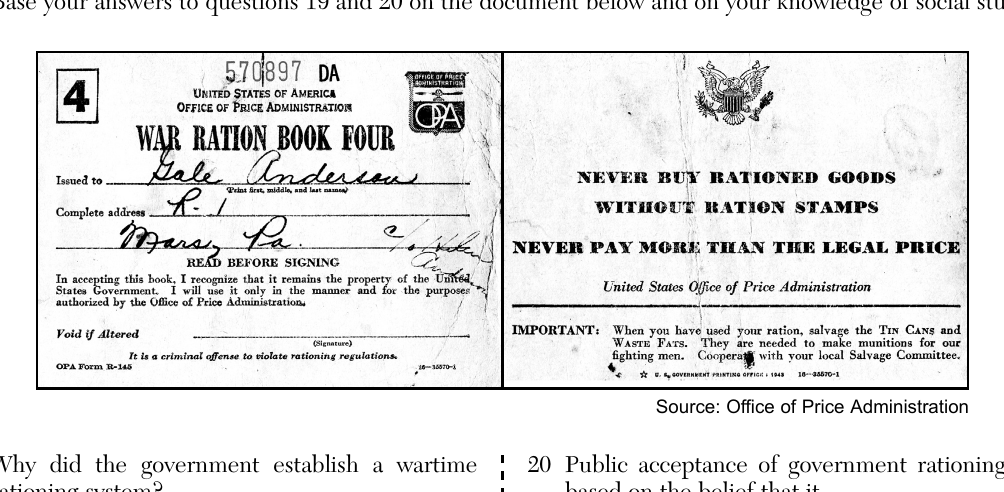
- (A) would increase profits for small farmers
- (B) would eliminate the influence of big businesses on political candidates
- (C) was basically a fair and equitable system ✓
- (D) guaranteed women equal pay for equal work
Worked solution
Rationing was widely accepted on the home front because it was seen as spreading wartime sacrifice equally among all citizens rather than favoring the wealthy.
Base your answer on President Harry Truman's statement on the situation in Korea, June 27, 1950, in which he describes North Korean forces attacking South Korea and states he has ordered U.S. air and sea forces to give the Korean government troops cover and support, warning that the attack shows communism will now use armed invasion. What was a major reason for President Harry Truman's June 27, 1950, statement?
- (A) the United States commitment to the Cold War policy of containment ✓
- (B) an attempt to gain the support of China to halt aggression against South Korea
- (C) the continuing presence of Japanese forces in Korea after World War II
- (D) the announcement of a plan to reunite North and South Korea
Worked solution
Truman's decision to intervene in Korea was a direct application of the containment doctrine, aimed at preventing the further spread of communism during the Cold War.
Base your answer on the same Truman statement on Korea, which notes that the Security Council of the United Nations called on all members to render assistance in support of South Korea. What made the response to North Korea's invasion of South Korea different from past conflicts?
- (A) The Soviet Union and the United States became allies.
- (B) The aggression of North Korea ended when the Soviet Union intervened.
- (C) Members of the United Nations supplied troops to defend South Korea. ✓
- (D) Neighboring Southeast Asian nations were divided over which side to support.
Worked solution
The Korean War was distinctive because it was fought under United Nations authorization, with troops from multiple member nations serving alongside U.S. forces.
Base your answer on the excerpt from Dr. Martin Luther King Jr.'s speech "Give Us the Ballot," May 17, 1957, in which he criticizes states for open defiance of the Supreme Court's desegregation ruling and describes "conniving methods" still used to prevent African Americans from becoming registered voters. What was one method that was used to deny African Americans the voting rights mentioned in this speech?
- (A) literacy tests and poll taxes ✓
- (B) deployment of federal troops
- (C) bus boycotts and sit-ins
- (D) student protests
Worked solution
Literacy tests and poll taxes were the main legal devices southern states used throughout the Jim Crow era to prevent African Americans from exercising their voting rights.
Based on the New York Times headline shown, dated October 5, 1957, reading "Soviet Fires Earth Satellite Into Space; It Is Circling the Globe at 18,000 M.P.H.; Sphere Tracked in 4 Crossings Over U.S.," why were Americans worried by the event described in this headline?
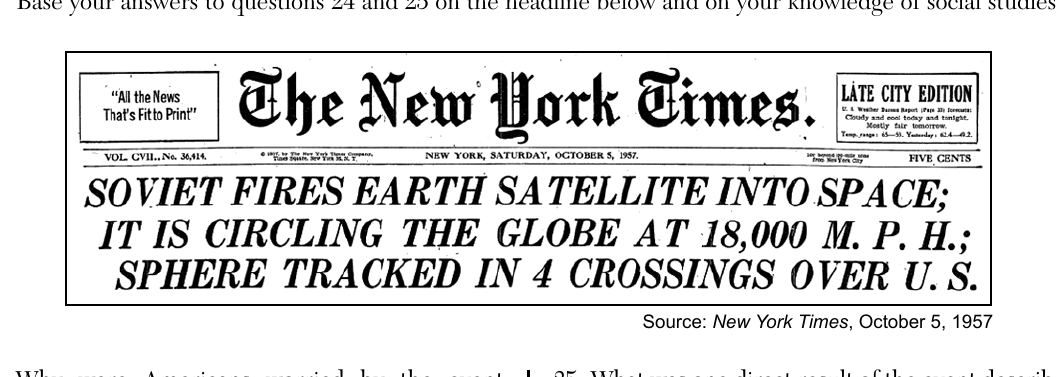
- (A) They feared the United States was being overtaken in the Cold War arms race. ✓
- (B) They believed the satellite might have a negative effect on weather patterns.
- (C) They thought launching the satellite violated international law.
- (D) They were concerned about the effects of satellite technology on future prosperity.
Worked solution
Sputnik's launch triggered fears that the Soviet Union was winning the Cold War arms and technology race, spurring the U.S. space program and education reforms.
Based on the same New York Times Sputnik headline, what was one direct result of the event described in this headline?
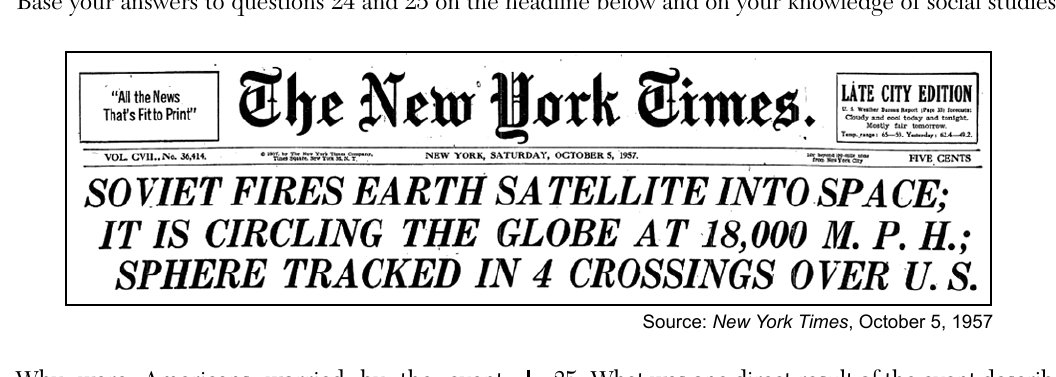
- (A) President Eisenhower mobilized the military for an attack.
- (B) The United Nations condemned the Soviet Union's actions.
- (C) Congress mandated that families build fallout shelters.
- (D) Congress passed legislation to promote science education in schools. ✓
Worked solution
In direct response to the Sputnik shock, Congress passed the National Defense Education Act of 1958 to strengthen American science and math education.
Base your answer on President Lyndon B. Johnson's Special Message to Congress, "The American Promise," in which he describes how every device of human ingenuity has been used to deny African American citizens the right to register to vote, including disqualification for technicalities and unfair literacy tests. Congress responded to President Lyndon B. Johnson's message by passing the
- (A) Equal Pay Act of 1963
- (B) Voting Rights Act of 1965 ✓
- (C) Immigration Act of 1965
- (D) Americans with Disabilities Act of 1990
Worked solution
President Johnson's "American Promise" speech directly led to the Voting Rights Act of 1965, which eliminated literacy tests and other barriers to Black voter registration.
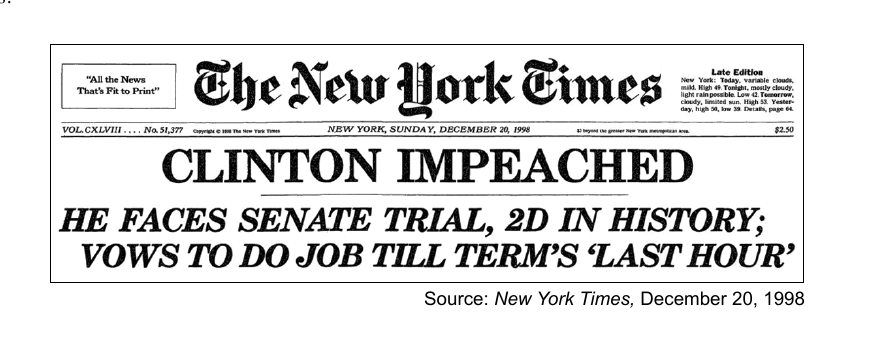
Based on the New York Times headline shown, dated December 20, 1998, reading "Clinton Impeached: He Faces Senate Trial, 2d in History; Vows to Do Job Till Term's 'Last Hour,'" which constitutional principle is illustrated by these headlines?
- (A) federalism
- (B) checks and balances ✓
- (C) judicial review
- (D) reserved powers
Worked solution
Impeachment and Senate trial of a president is a constitutional mechanism by which the legislative branch checks the power of the executive branch.
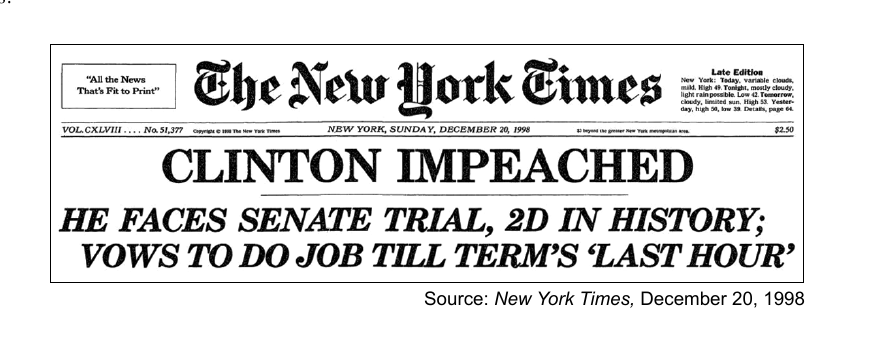
Based on the same New York Times headline about Bill Clinton's impeachment, which president faced the same constitutional challenge as President Bill Clinton?
- (A) Jimmy Carter
- (B) William McKinley
- (C) Andrew Johnson ✓
- (D) George W. Bush
Worked solution
Andrew Johnson, impeached in 1868 following disputes over Reconstruction policy, was the only other U.S. president to face a Senate impeachment trial before Clinton.