June 2025 Physics Regents — Answer Key & Worked Solutions
Every question from the June 2025 Physics Regents exam, with the correct answer and a full step-by-step solution. Check your work, learn the method, then see how it's scored.
These are real questions from the June 2025 Physics New York State Regents examination, published by NYSED. Worked solutions are written by RegentsLab.
Base your answers to questions 1 and 2 on the information below and on your knowledge of physics. A car, initially moving at 20.0 meters per second, travels 200. meters while accelerating uniformly to a speed of 30.0 meters per second. The magnitude of the acceleration of the car is
- (A) 0.0500 m/s$^2$
- (B) 1.25 m/s$^2$ ✓
- (C) 2.50 m/s$^2$
- (D) 3.13 m/s$^2$
Worked solution
Using the kinematics equation relating velocity, acceleration, and displacement (no time needed) gives a = 1.25 m/s^2.
Base your answers to questions 1 and 2 on the information below and on your knowledge of physics. A car, initially moving at 20.0 meters per second, travels 200. meters while accelerating uniformly to a speed of 30.0 meters per second. The time required for the car to travel the 200. meters is
- (A) 6.67 s
- (B) 8.00 s ✓
- (C) 10.0 s
- (D) 20.0 s
Worked solution
Using the acceleration found in question 1, solving for time with v = v0 + at gives 8.00 s.
A car traveling at 12 meters per second north accelerates in a straight line at 3.0 meters per second squared north for 4.0 seconds. How far north does the car travel during the 4.0 seconds it accelerates?
- (A) 24 m
- (B) 48 m
- (C) 54 m
- (D) 72 m ✓
Worked solution
Applying the displacement kinematics equation with the given initial velocity, acceleration, and time yields 72 m.
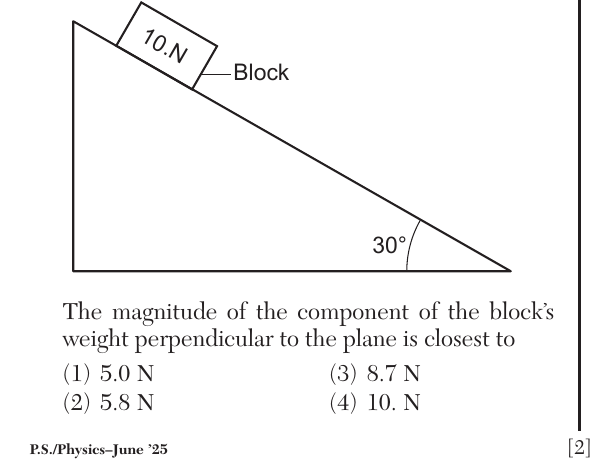
A block weighing 10. newtons rests on an inclined plane that makes an angle of 30° with the horizontal. The magnitude of the component of the block's weight perpendicular to the plane is closest to
- (A) 5.0 N
- (B) 5.8 N
- (C) 8.7 N ✓
- (D) 10. N
Worked solution
The perpendicular component of the weight equals the weight times the cosine of the incline angle, giving about 8.7 N.
A sailor is near the top of a sailboat mast. The sailboat is traveling at a constant velocity of 5.0 meters per second west. The sailor drops a screwdriver that falls freely for 1.0 second before hitting the deck of the sailboat. [Neglect friction.] Where does the screwdriver land?
- (A) directly below the sailor ✓
- (B) 5.0 m behind the sailor
- (C) 5.0 m in front of the sailor
- (D) 49 m behind the sailor
Worked solution
Since the screwdriver shares the sailboat's constant horizontal velocity when released, it continues moving with the boat and lands directly below the sailor, same as in the boat's reference frame.
A marble is projected horizontally from a fixed height above a level floor. If the marble is projected horizontally again from the same fixed height, but with twice the initial speed, its time of flight will be
- (A) halved
- (B) doubled
- (C) unchanged ✓
- (D) quartered
Worked solution
Time of flight for projectile motion depends only on the height dropped and gravitational acceleration, not on the horizontal launch speed, so it remains unchanged.
Which animal has the greatest inertia?
- (A) an 8.0-kg meerkat moving at 2 m/s
- (B) a 350-kg zebra moving at 18 m/s
- (C) a 190-kg lion moving at 0.5 m/s
- (D) an 1800-kg hippopotamus at rest ✓
Worked solution
Inertia depends only on mass, not speed, so the 1800-kg hippopotamus has the greatest inertia regardless of being at rest.
A cart is rolling along in a straight line on an inclined ramp. The cart is in equilibrium when it is rolling up or down the ramp with
- (A) decreasing speed
- (B) increasing speed
- (C) constant acceleration
- (D) constant speed ✓
Worked solution
An object in equilibrium has zero net force and therefore zero acceleration, meaning it moves at constant speed.
A 3.5-kilogram bowling ball and a 7.0-kilogram bowling ball are in free fall near the surface of Earth. Compared to the magnitude of the acceleration of the 3.5-kilogram ball, the magnitude of the acceleration of the 7.0-kg ball is
- (A) half as great
- (B) twice as great
- (C) the same ✓
- (D) four times greater
Worked solution
All objects in free fall near Earth's surface experience the same gravitational acceleration regardless of mass, so the two balls have the same acceleration.
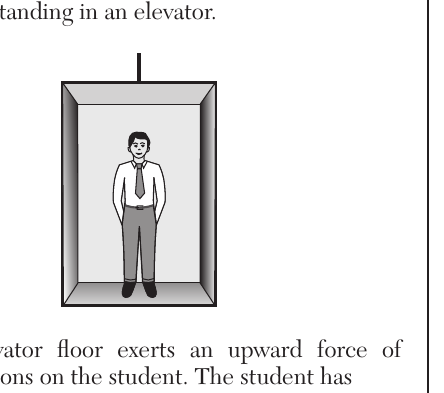
A 600-newton student is standing in an elevator. The elevator floor exerts an upward force of 400 newtons on the student. The student has
- (A) a constant velocity directed downward
- (B) a constant velocity directed upward
- (C) an acceleration directed downward ✓
- (D) an acceleration directed upward
Worked solution
Since the upward normal force (400 N) is less than the student's weight (600 N), the net force and resulting acceleration are directed downward.
One end of a spring is held stationary and a 40.-newton force applied to the free end of the spring elongates the spring 0.20 meter from its unstretched length. What is the magnitude of the total force required to stretch the spring 0.80 meter from its unstretched length if the spring's elastic limit has not been exceeded?
- (A) 10. N
- (B) 20. N
- (C) 120 N
- (D) 160 N ✓
Worked solution
Using Hooke's law, the spring constant found from the initial stretch is used to calculate the force needed for the larger elongation, giving 160 N.
The engine of a toy train is traveling at constant speed on a horizontal, circular track. If the speed of the engine is doubled, the magnitude of the centripetal acceleration of the engine is
- (A) halved
- (B) doubled
- (C) quartered
- (D) quadrupled ✓
Worked solution
Centripetal acceleration is proportional to the square of the speed, so doubling the speed quadruples the centripetal acceleration.
The strength of an electric field has a magnitude of $3.5 \times 10^5$ newtons per coulomb. What is the magnitude of the electrostatic force on a $5.3 \times 10^{-6}$-coulomb charge in this field?
- (A) $1.5 \times 10^{-11}$ N
- (B) 1.9 N ✓
- (C) 19 N
- (D) $6.6 \times 10^{10}$ N
Worked solution
Multiplying the charge by the electric field strength gives the electrostatic force, approximately 1.9 N.
A car is traveling on a level highway at a speed of 15.0 meters per second. A braking force of magnitude $3.00 \times 10^3$ newtons brings the car to a stop in 10.0 seconds. The mass of the car is
- (A) $1.50 \times 10^3$ kg
- (B) $2.00 \times 10^3$ kg ✓
- (C) $3.00 \times 10^3$ kg
- (D) $4.50 \times 10^3$ kg
Worked solution
Finding the deceleration from the given time and speed change, then applying Newton's second law (m = F/a), gives a mass of 2.00 x 10^3 kg.
A 5.00-kilogram cart traveling east at a speed of 15.0 meters per second collides with a 10.0 kilogram cart traveling west at a speed of 15.0 meters per second. The total momentum of the two-cart system after the collision is
- (A) 75.0 kg $\cdot$ m/s west ✓
- (B) 75.0 kg $\cdot$ m/s east
- (C) 225 kg $\cdot$ m/s west
- (D) 225 kg $\cdot$ m/s east
Worked solution
By conservation of momentum, the total momentum after the collision equals the total momentum before, which is 75.0 kg·m/s directed west (the heavier cart's momentum dominates).
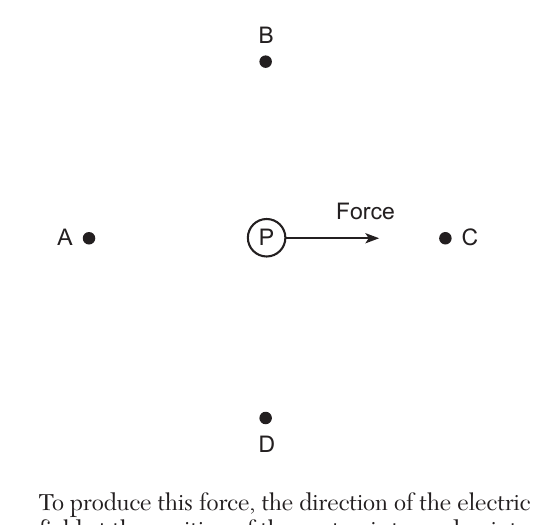
In the diagram below, a force acts to the right on a proton, P, in an electric field. To produce this force, the direction of the electric field at the position of the proton is toward point
- (A) A
- (B) B
- (C) C ✓
- (D) D
Worked solution
For a positive charge like a proton, the electric force is in the same direction as the electric field, so since the force points right toward C, the field also points toward C.
While investigating static electricity, a student notices a negatively charged plastic rod attracts a small piece of paper. The student correctly concludes the charge of the paper
- (A) must be negative
- (B) must be positive
- (C) could be negative or neutral
- (D) could be positive or neutral ✓
Worked solution
A charged object can attract either an oppositely charged object or a neutral object through induced polarization, so the paper could be positive or neutral, but not negative.
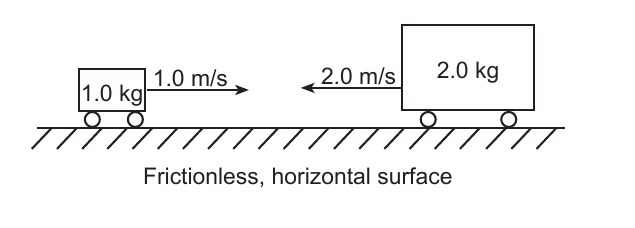
A 1.0-kilogram cart moving to the right at 1.0 meter per second is about to collide head on with a 2.0-kilogram cart moving to the left at 2.0 meters per second, both on a frictionless, horizontal surface. During the collision, the magnitude of the force exerted on the 1.0-kilogram cart by the 2.0-kilogram cart is F. What is the magnitude of the force exerted on the 2.0-kilogram cart by the 1.0-kilogram cart during the collision?
- (A) F/4
- (B) F/2
- (C) F ✓
- (D) 2F
Worked solution
By Newton's third law, the forces of an action-reaction pair are always equal in magnitude, so the force exerted on the 2.0-kg cart is also F.
Sunlight shines on solar panels on the roof of a house. The panels are hooked up to the house's electrical system, which is used to operate a microwave oven that heats up a cup of coffee. What energy conversions are taking place in this entire process?
- (A) electromagnetic $\rightarrow$ electrical $\rightarrow$ electromagnetic $\rightarrow$ thermal ✓
- (B) thermal $\rightarrow$ electromagnetic $\rightarrow$ nuclear $\rightarrow$ electrical
- (C) mechanical $\rightarrow$ electrical $\rightarrow$ electromagnetic $\rightarrow$ chemical
- (D) electromagnetic $\rightarrow$ thermal $\rightarrow$ mechanical $\rightarrow$ electrical
Worked solution
Sunlight (electromagnetic) is converted to electrical energy by the solar panel, which powers the microwave oven that generates electromagnetic microwaves, which are absorbed by the coffee as thermal energy.
Which graph best represents the relationship between the potential difference across a resistor and the resulting current through the resistor, for a resistor that obeys Ohm's law?
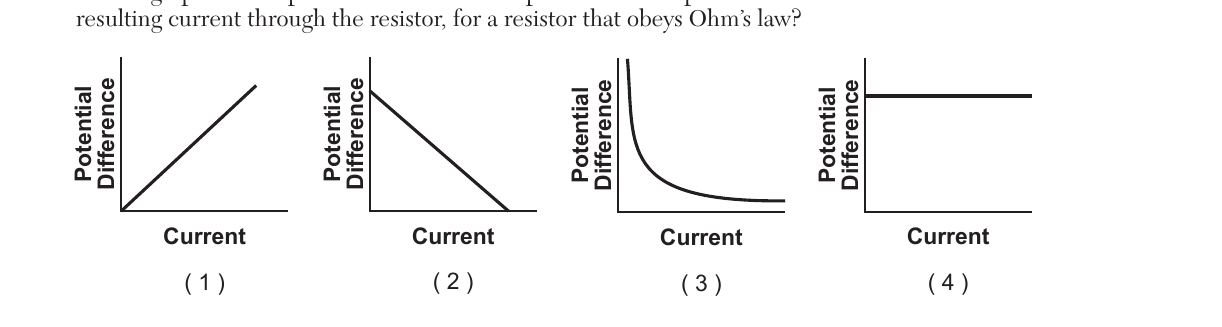
- (A) Graph (1): a straight line with positive slope passing through the origin ✓
- (B) Graph (2): a straight line with negative slope, decreasing from the vertical axis
- (C) Graph (3): a curve that decreases steeply and levels off, concave up, approaching the horizontal axis
- (D) Graph (4): a horizontal straight line (constant potential difference)
Worked solution
Ohm's law states V = IR, so for a fixed resistance, potential difference is directly proportional to current, producing a straight line through the origin (graph 1).
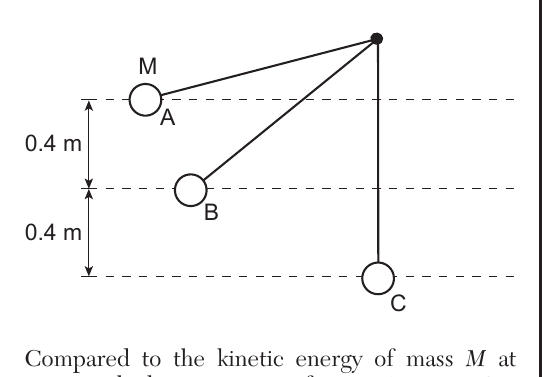
As shown in the diagram of a pendulum below, mass M is released from rest at point A and allowed to swing through point B to point C. [Neglect friction.] Compared to the kinetic energy of mass M at point B, the kinetic energy of mass M at point C is
- (A) half as great
- (B) twice as great ✓
- (C) the same
- (D) four times greater
Worked solution
Since mechanical energy is conserved and C is twice as far below the starting point A as B is, the kinetic energy at C is twice the kinetic energy at B.
A student, running at 6 meters per second, slides to rest on a horizontal floor. As the student slides, the internal energy of the student-floor system
- (A) decreases and the student's kinetic energy decreases
- (B) increases and the student's kinetic energy decreases ✓
- (C) decreases and the student's kinetic energy remains the same
- (D) increases and the student's kinetic energy remains the same
Worked solution
Friction between the student and floor converts the student's kinetic energy into internal (thermal) energy, so kinetic energy decreases while internal energy of the system increases.
Which object will most likely produce a magnetic field?
- (A) a stationary neutral object
- (B) a moving neutral object
- (C) a stationary charged object
- (D) a moving charged object ✓
Worked solution
Only moving charges constitute a current, and it is current (moving charge) that generates a magnetic field.
To reduce the electrical resistance of a copper wire, increase the wire's
- (A) length
- (B) temperature
- (C) diameter ✓
- (D) resistivity
Worked solution
Resistance is inversely proportional to cross-sectional area, so a larger diameter (larger area) lowers resistance; increasing length, temperature, or resistivity would all increase resistance.
A potential difference of 12 volts is applied across a resistor for 60. seconds. A constant current of 0.10 ampere flows through the resistor during this time. What is the power of the resistor?
- (A) 1.2 W ✓
- (B) 12 W
- (C) 72 W
- (D) 120 W
Worked solution
Power delivered to a resistor equals current times potential difference; the 60-second duration is not needed for this calculation.
What type of waves are sound waves?
- (A) longitudinal waves ✓
- (B) transverse waves
- (C) electromagnetic waves
- (D) ultraviolet waves
Worked solution
Sound propagates through the vibration of particles parallel to the direction of wave travel, which is the definition of a longitudinal wave.
As waves travel through space, they transfer
- (A) mass, only
- (B) energy, only ✓
- (C) both mass and energy
- (D) neither mass nor energy
Worked solution
A defining property of waves is that they carry energy through a medium (or space, for EM waves) without transporting mass.
The frequency of an orange light wave is $4.85 \times 10^{14}$ hertz. What is the wavelength of the wave in a vacuum?
- (A) $1.00 \times 10^{-7}$ m
- (B) $4.82 \times 10^{-7}$ m
- (C) $5.96 \times 10^{-7}$ m
- (D) $6.19 \times 10^{-7}$ m ✓
Worked solution
All electromagnetic waves travel at speed c in a vacuum, so the wavelength is found by dividing c by the given frequency.
Which statement describes mechanical and electromagnetic waves?
- (A) Mechanical waves all travel at the same speed in a vacuum, whereas the speeds of electromagnetic waves vary in a vacuum.
- (B) Mechanical waves all have the same frequency, whereas electromagnetic waves all have the same period.
- (C) Mechanical waves require a material medium through which to travel, whereas eletromagnetic waves can travel through a vacuum. ✓
- (D) Mechanical waves are transverse waves, whereas electromagnetic waves are longitudinal waves.
Worked solution
The key distinguishing feature is that mechanical waves cannot travel through a vacuum since they require matter to propagate, while electromagnetic waves can.
Which diagram represents a parallel circuit with an equivalent resistance of 4.0 ohms?
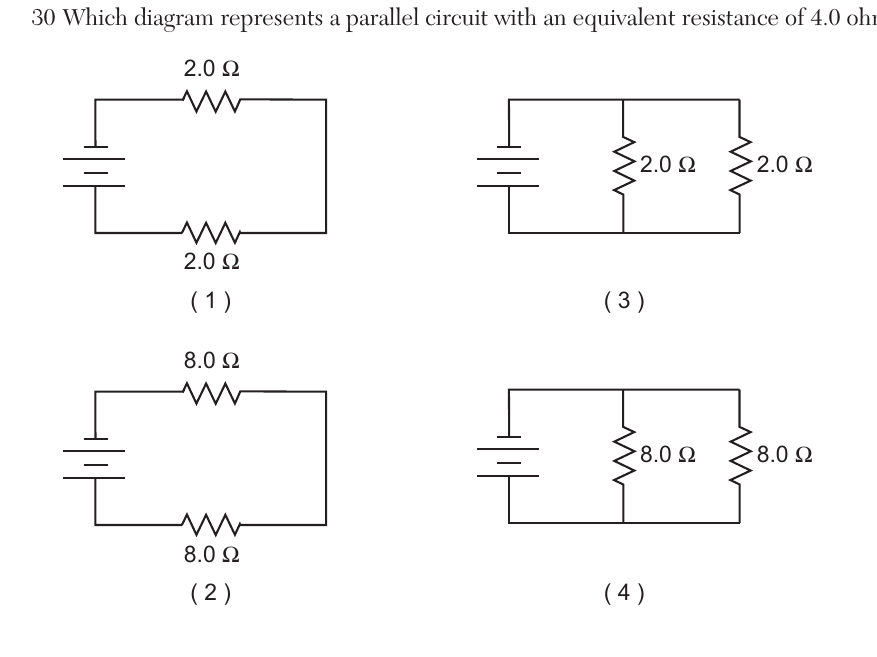
- (A) A single-loop (series) circuit with a battery and two 2.0 Ω resistors connected one after another in the loop.
- (B) A single-loop (series) circuit with a battery and two 8.0 Ω resistors connected one after another in the loop.
- (C) A circuit with a battery connected to two 2.0 Ω resistors in separate parallel branches.
- (D) A circuit with a battery connected to two 8.0 Ω resistors in separate parallel branches. ✓
Worked solution
Only the parallel combination of two 8.0-ohm resistors gives an equivalent resistance of 4.0 ohms; the series combinations give 4.0 or 16 ohms and the parallel 2.0-ohm resistors give 1.0 ohm.
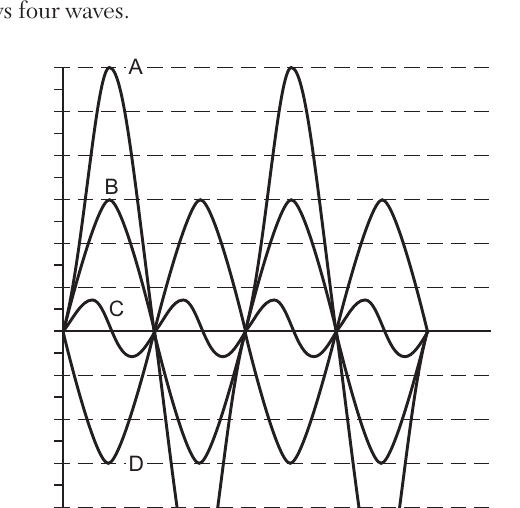
The diagram below shows four waves. Which two waves, when superimposed, would produce complete destructive interference at every point along the waves?
- (A) A and C
- (B) A and D
- (C) B and C
- (D) B and D ✓
Worked solution
For total cancellation everywhere along the waves, the two waves must have identical amplitude and be perfectly out of phase; only waves B and D meet both conditions.
A musician plays a flute by blowing across the opening in the mouth piece of the flute. This causes the air inside the flute to vibrate and produce sound waves. The phenomenon that causes the creation of these sound waves in a flute is
- (A) diffraction
- (B) refraction
- (C) resonance ✓
- (D) the Doppler effect
Worked solution
The air column inside the flute vibrates at its natural frequency in response to the driving disturbance, which is the phenomenon of resonance.
Compared to FM radio waves, AM radio waves
- (A) travel faster in a vacuum
- (B) travel slower in a vacuum
- (C) have a higher frequency
- (D) have a longer wavelength ✓
Worked solution
AM and FM radio waves are both electromagnetic and travel at the same speed in a vacuum; AM's lower carrier frequency corresponds to a longer wavelength.
A star approaches Earth. Compared to the frequency and wavelength of the light emitted by the star, the light detected by an observer on Earth would have a
- (A) lower frequency and shorter wavelength
- (B) lower frequency and longer wavelength
- (C) higher frequency and shorter wavelength ✓
- (D) higher frequency and longer wavelength
Worked solution
Since the star is moving toward Earth, the light is Doppler blueshifted, meaning the observed frequency is higher and the wavelength shorter than emitted.
A beam of electrons directed at a polycrystalline nickel target scatters to form a diffraction pattern on a detecting screen. The diffraction of electrons is an example of the
- (A) particle nature of light
- (B) Doppler effect
- (C) action-reaction principle
- (D) wave nature of matter ✓
Worked solution
Diffraction is a wave phenomenon; observing it with an electron beam (the Davisson-Germer type experiment) demonstrates that matter exhibits wave-like behavior.
What is the approximate width of a typical five-passenger automobile?
- (A) $2 \times 10^{-1}$ m
- (B) $2 \times 10^{0}$ m ✓
- (C) $2 \times 10^{1}$ m
- (D) $2 \times 10^{2}$ m
Worked solution
An everyday car is roughly 2 meters wide, matching the order-of-magnitude estimate of $2 \times 10^{0}$ m.
Two identical metal spheres with charges of +3.0 microcoulombs and -1.0 microcoulomb, respectively, are brought into contact and then separated. Which statement describes the electrostatic force between the spheres?
- (A) It is attractive before contact and repulsive after contact. ✓
- (B) It is attractive both before contact and after contact.
- (C) It is repulsive before contact and attractive after contact.
- (D) It is repulsive both before contact and after contact.
Worked solution
Opposite charges attract before contact; touching identical conducting spheres shares the total charge equally, leaving both spheres positively charged and thus repelling each other afterward.
Which graph best represents the relationship between velocity, $v$, and time, $t$, for an object moving with constant positive acceleration?
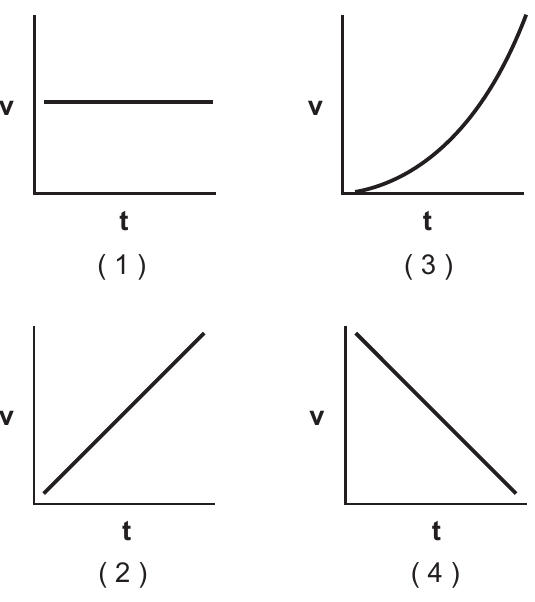
- (A) A horizontal line showing constant velocity (zero slope) on a v vs. t graph.
- (B) A straight line with positive slope through the origin on a v vs. t graph. ✓
- (C) An upward-curving (increasing slope) line on a v vs. t graph.
- (D) A straight line with negative slope on a v vs. t graph.
Worked solution
Constant acceleration means velocity changes linearly with time, which is graphically a straight line with constant (positive) slope, not a curve or horizontal/negative-slope line.
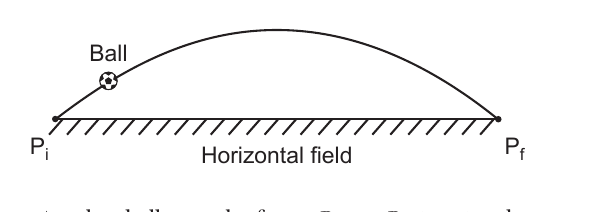
A soccer ball is kicked from point $P_i$ at an angle above a horizontal field and lands on the field at point $P_f$. [Neglect friction.] As the ball travels from $P_i$ to $P_f$ in air, the horizontal component of its velocity
- (A) decreases, only
- (B) increases, only
- (C) decreases and then increases
- (D) remains the same ✓
Worked solution
Neglecting friction means the only force on the ball in flight is gravity, which acts vertically; with no horizontal force, the horizontal velocity component stays constant.
Which graph best represents the relationship between the forces of kinetic friction and the normal force exerted on wooden boxes of various weights as they are moved at constant velocity across a level, wooden floor?
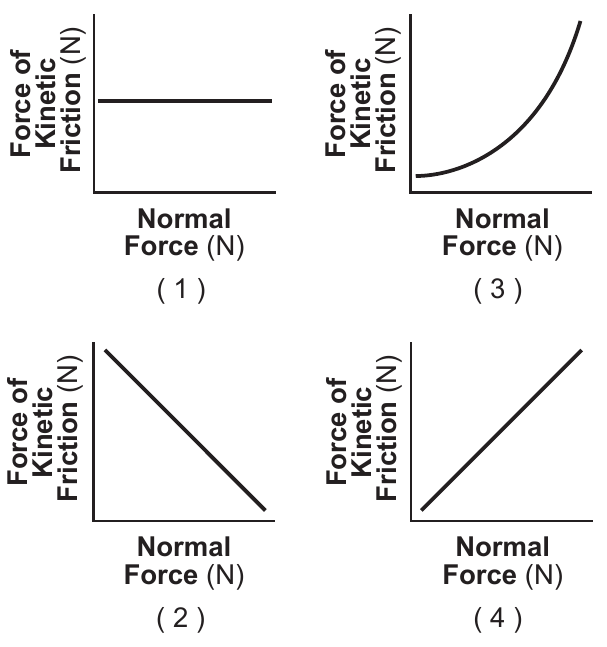
- (A) A horizontal line showing kinetic friction force constant regardless of normal force.
- (B) A straight line with negative slope showing kinetic friction force decreasing as normal force increases.
- (C) An upward-curving line showing kinetic friction force increasing faster than normal force.
- (D) A straight line with positive slope through the origin showing kinetic friction force directly proportional to normal force. ✓
Worked solution
The kinetic friction force is directly proportional to the normal force through the coefficient of kinetic friction, so the correct graph is a straight line with positive slope passing through the origin.
A 75-kilogram student runs up a set of stairs a vertical distance of 13 meters in 25 seconds. The average power developed by the student is
- (A) 3.0 W
- (B) 39 W
- (C) 380 W ✓
- (D) 9600 W
Worked solution
Average power is the work done against gravity (mgh) divided by the time taken, giving approximately 380 watts.
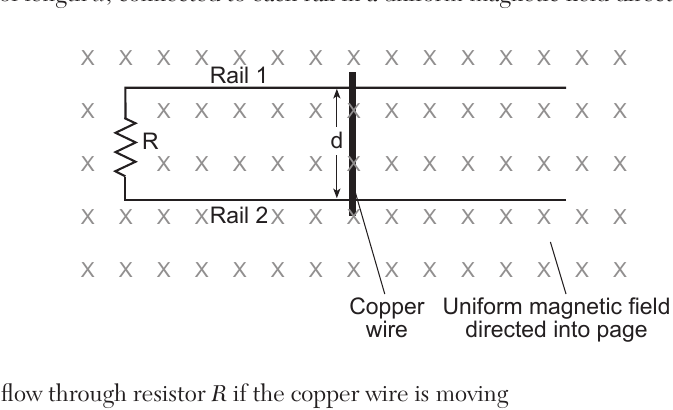
The diagram below represents an apparatus consisting of two conducting rails connected to a resistor, $R$, and a copper wire of length $d$, connected to each rail in a uniform magnetic field directed into the page. Electrons will flow through resistor $R$ if the copper wire is moving
- (A) to the right, only
- (B) to the left, only
- (C) either right or left ✓
- (D) neither right nor left
Worked solution
Motional EMF is induced any time the conducting rod moves through the magnetic field, whether to the right or left, so electrons flow through R for motion in either direction, just reversing direction of current.
The current through an incandescent lamp is 0.500 ampere. The number of elementary charges that pass through the lamp in 5.00 seconds is
- (A) $8.00 \times 10^{-20}$
- (B) $4.00 \times 10^{-19}$
- (C) $3.13 \times 10^{18}$
- (D) $1.56 \times 10^{19}$ ✓
Worked solution
The total charge is found from q = It, and dividing by the elementary charge e gives the number of electrons that passed through the lamp.
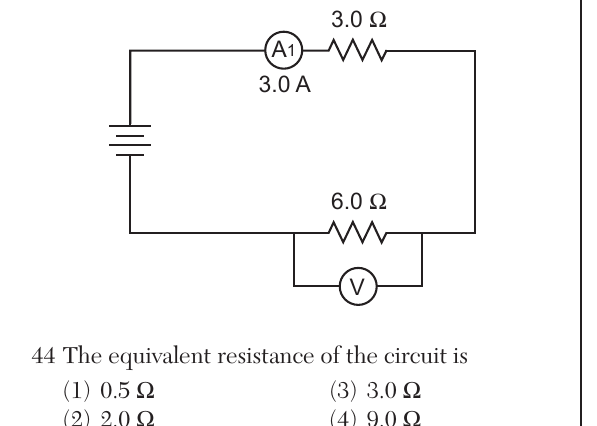
Base your answer on the following information and diagram: The diagram below represents an electrical circuit. The reading of $A_1$ is 3.0 amperes. The circuit consists of a battery connected to an ammeter $A_1$ in series with a 3.0-ohm resistor, which is in turn connected in series to a 6.0-ohm resistor with a voltmeter $V$ connected across part of the circuit. The equivalent resistance of the circuit is
- (A) 0.5 Ω
- (B) 2.0 Ω
- (C) 3.0 Ω
- (D) 9.0 Ω ✓
Worked solution
Since the circuit is a single loop (series circuit) with only one ammeter reading for the whole circuit, the equivalent resistance is simply the sum of the two resistors.
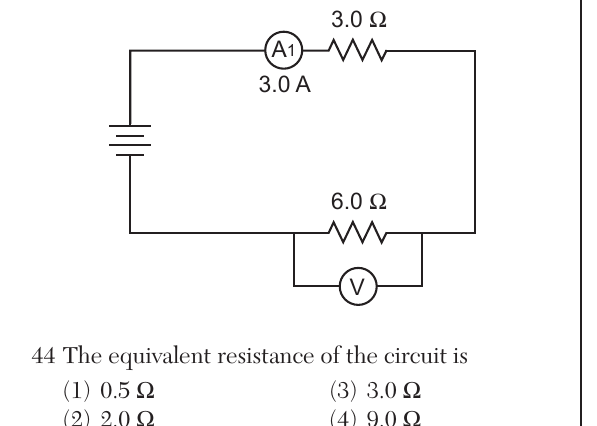
The diagram below represents an electrical circuit. The reading of $A_1$ is 3.0 amperes. Compared to the potential difference across the 6-ohm resistor, the potential difference across the 3-ohm resistor is
- (A) the same
- (B) twice as much
- (C) one half as much ✓
- (D) one quarter as much
Worked solution
The 3.0-ohm and 6.0-ohm resistors are in series (the voltmeter carries no current), so the same 3.0 A flows through both. Since V = IR, the potential difference is directly proportional to resistance, so the drop across the 3-ohm resistor is half that across the 6-ohm resistor.
Which expression is a unit of work?
- (A) $\dfrac{V^2 \cdot s}{\Omega}$ ✓
- (B) $\dfrac{V^2}{\Omega}$
- (C) $\dfrac{kg \cdot m}{s^2}$
- (D) $\dfrac{kg \cdot m^3}{s^3}$
Worked solution
Work (and energy) is measured in joules, which equal watts multiplied by seconds. Since V^2/Ω has the units of power (watts), multiplying by seconds gives joules, a unit of work.
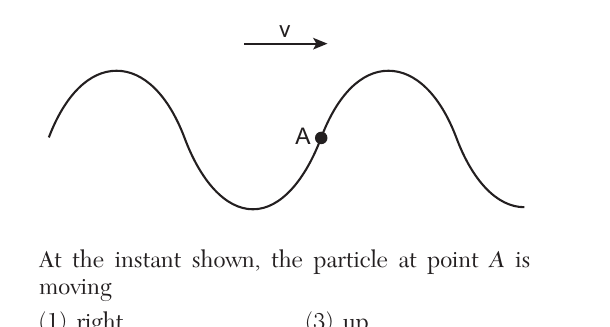
The diagram below represents a wave propagating to the right through a uniform medium. Point A represents a particle of the medium. At the instant shown, the particle at point A is moving
- (A) right
- (B) left
- (C) up
- (D) down ✓
Worked solution
Particles in a transverse wave oscillate perpendicular to the direction the wave travels. Using the 'shift the wave slightly and see where the point moves to' method, point A, located on the descending part of the curve just ahead of the wave's motion, is moving downward at this instant.
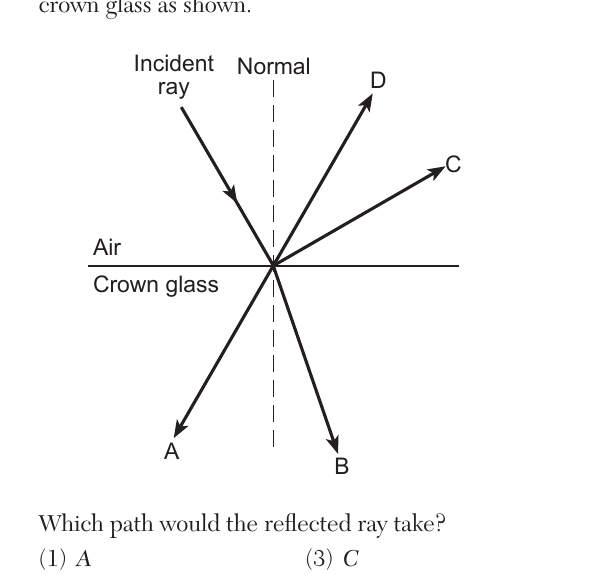
A ray traveling through air strikes a boundary with crown glass, as shown in the diagram below. Which path would the reflected ray take?
- (A) A
- (B) B
- (C) C
- (D) D ✓
Worked solution
The reflected ray remains in air (above the boundary) and makes an angle equal to the angle of incidence, measured on the opposite side of the normal, which corresponds to path D.
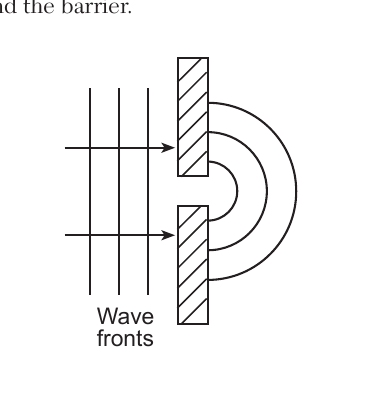
The diagram below shows wave fronts going through an opening and spreading into the area behind the barrier. Which wave phenomenon is represented in the diagram?
- (A) resonance
- (B) Doppler effect
- (C) diffraction ✓
- (D) reflection
Worked solution
The spreading of straight wave fronts into circular wave fronts after passing through a narrow opening is the defining characteristic of diffraction.
What occurs as an electron in a mercury atom moves from energy level b to energy level a?
- (A) a photon is emitted with an energy of 4.64 J
- (B) a photon is absorbed with an energy of 4.64 J
- (C) a photon is emitted with an energy of $7.42 \times 10^{-19}$ J ✓
- (D) a photon is absorbed with an energy of $7.42 \times 10^{-19}$ J
Worked solution
Moving from a higher energy level to a lower one releases energy as an emitted photon. Converting the 4.64 eV energy difference between mercury's levels b and a into joules gives 7.42 x 10^-19 J.
Base your answers to questions 51 through 53 on the information below and on your knowledge of physics. A 750-watt toaster is operating at 120 volts and is being used to heat a blueberry bagel for 2.5 minutes. Determine the resistance of the toaster.
Worked solution
Using the power equation P = V^2/R and solving for resistance gives R = V^2/P, which yields 19.2 ohms for this toaster.
A 750-watt toaster is operating at 120 volts and is being used to heat a blueberry bagel for 2.5 minutes. Calculate the total amount of electrical energy consumed by the toaster during the heating of the bagel. [Show all work, including the equation and substitution with units.]
Worked solution
Electrical energy consumed equals power multiplied by time. Converting 2.5 minutes to 150 seconds and multiplying by the 750 W rating gives 112,500 joules.
In a linear accelerator, a proton is accelerated from rest through a potential difference of $4.40 \times 10^6$ volts. Determine the total kinetic energy, in joules, gained by this proton as it travels through this linear accelerator.
Worked solution
All electrical potential energy lost by the proton as it is accelerated converts to kinetic energy, so KE = qV, using the elementary charge of a proton.
Calculate the resistance of a 0.050-meter-long copper wire having a cross-sectional area of $5.73 \times 10^{-10}$ meter squared at 20°C. [Show all work, including the equation and substitution with units.]
Worked solution
Resistance of a wire is found from R = ρL/A, using copper's resistivity from the Reference Tables. Substituting the given length and cross-sectional area gives about 1.5 ohms.
During a football game, player A, a 70.0-kilogram football player, attempts to prevent player B, a 90.0-kilogram player, from scoring a touchdown. Player B is running toward player A at a constant speed of 6.50 meters per second. Calculate the speed of player A such that the magnitude of the momentum of player A is equal to the magnitude of the momentum of player B. [Show all work, including the equation and substitution with units.]
Worked solution
Momentum is mass times velocity. Setting player A's momentum magnitude equal to player B's calculated momentum and solving for A's speed gives about 8.36 m/s.
A photon has a wavelength of $5.03 \times 10^{-7}$ meter. Calculate the energy of this photon. [Show all work, including the equation and substitution with units.]
Worked solution
Photon energy is found using E = hc/λ. Substituting Planck's constant, the speed of light, and the given wavelength yields approximately 3.95 x 10^-19 J.
Base your answers to questions 61 and 62 on the information below and on your knowledge of physics. A 53-newton box on a horizontal surface is pulled toward the right by a horizontal force of 27 newtons. The force of friction exerted on the box by the surface has a magnitude of 16 newtons. On the diagram in your answer booklet, use a scale of 1.0 cm = 10. N and start at point P to construct a vector representing the normal force exerted on the box by the floor.
Worked solution
Since the box does not accelerate vertically, the normal force must balance the box's weight, giving a normal force of 53 N directed straight up. Using the given scale, that corresponds to a 5.3 cm vector drawn upward from point P.
Base your answers to questions 61 and 62 on the information below and on your knowledge of physics. A 53-newton box on a horizontal surface is pulled toward the right by a horizontal force of 27 newtons. The force of friction exerted on the box by the surface has a magnitude of 16 newtons. Determine the magnitude of the net force acting on the box.
Worked solution
The applied force and friction force act in opposite horizontal directions, so the net horizontal force is their difference, 11 N.
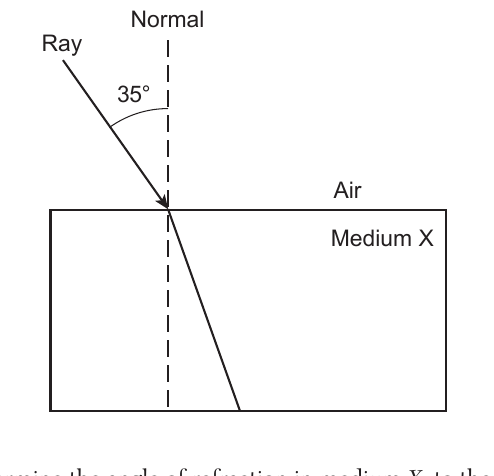
Base your answers to questions 63 through 65 on the information and diagram below and on your knowledge of physics. A ray of monochromatic light (f = $5.09 \times 10^{14}$ hertz) passes from air into a transparent medium, X, as shown in the diagram below. Using a protractor, determine the angle of refraction in medium X, to the nearest degree.
Worked solution
This question requires physically measuring the refracted ray's angle from the normal on the printed diagram with a protractor; based on the diagram's geometry the refracted ray bends toward the normal to roughly 20 degrees, since medium X is optically denser than air.
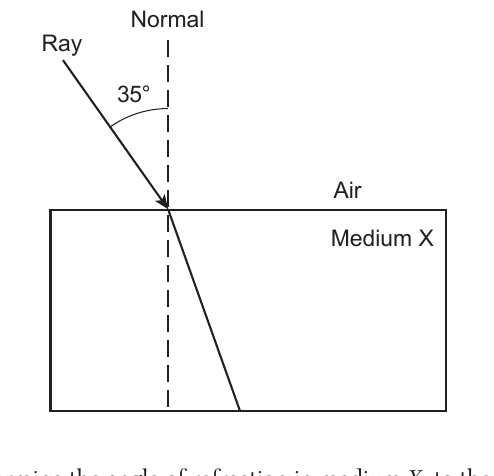
Base your answers to questions 63 through 65 on the information and diagram below and on your knowledge of physics. A ray of monochromatic light (f = $5.09 \times 10^{14}$ hertz) passes from air into a transparent medium, X, as shown in the diagram below. Calculate the absolute index of refraction of medium X. [Show all work, including the equation and substitution with units.]
Worked solution
Snell's Law relates the angle of incidence in air to the angle of refraction in medium X through the index of refraction. Using the 35 degree incidence angle and the protractor-measured refraction angle (about 20 degrees) from question 63 gives an index of refraction near 1.7.
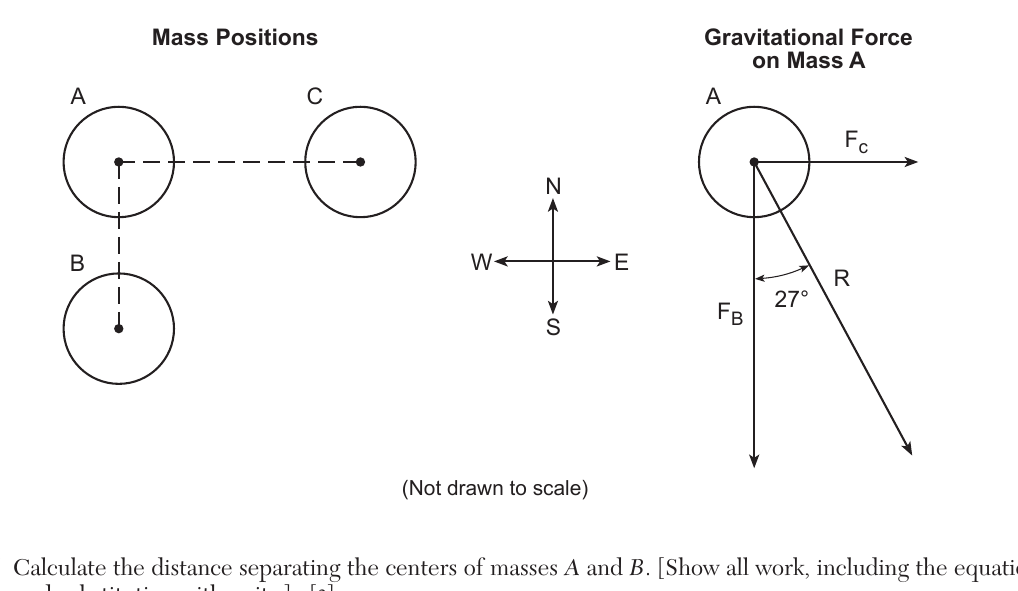
Base your answers to questions 66 through 68 on the information below and on your knowledge of physics. Three 4.0-kilogram spherical masses, A, B, and C, are positioned so that mass B is due south of mass A and mass C is due east of mass A. Mass B and mass C exert gravitational forces on mass A. The gravitational force, $F_B$, exerted by mass B on mass A is $5.08 \times 10^{-10}$ newton south. The force $F_C$ exerted by mass C on mass A points east, and the resultant gravitational force, R, exerted on mass A is $5.74 \times 10^{-10}$ newton at 27° east of south. Calculate the distance separating the centers of masses A and B. [Show all work, including the equation and substitution with units.]
Worked solution
Newton's law of universal gravitation gives F = Gm1m2/d^2. Solving for the distance using the given gravitational force between A and B and their equal 4.0 kg masses yields about 1.4 to 1.45 meters.
Mass $A$ is removed and a 7.0-kilogram mass is placed at the same position. Compare the magnitude of the resultant gravitational force on the 7.0-kilogram mass with the magnitude of the original resultant gravitational force, $R$.
Worked solution
Since the gravitational force from each source mass on the object at position A is directly proportional to the mass placed there, increasing the mass from 4.0 kg to 7.0 kg increases the resultant force proportionally, making it greater than the original R.
Base your answers to questions 69 through 73 on the information and data table below and on your knowledge of physics. An electric train with a mass of 2.8 kilograms moves from rest down a long, straight track. The table shows the train's momentum during the first 4.0 seconds of its trip. Data Table: Time (s): 0.0, 0.5, 1.0, 1.5, 2.0, 2.5, 3.0, 3.5, 4.0. Momentum (kg·m/s): 0.0, 2.1, 4.2, 6.3, 8.4, 11.0, 13.0, 15.0, 18.0. Using information from the data table, construct a graph in your answer booklet, following the directions below. 69 Plot the momentum versus time for the first 4.0 seconds of the train's trip.
The best-fit line is drawn on the graph plotted in question 69, using this data for the 2.8 kg train: | Time (s) | Momentum (kg*m/s) | |---|---| | 0.0 | 0.0 | | 0.5 | 2.1 | | 1.0 | 4.2 | | 1.5 | 6.3 | | 2.0 | 8.4 | | 2.5 | 11.0 | | 3.0 | 13.0 | | 3.5 | 15.0 | | 4.0 | 18.0 |
Worked solution
This is a data-plotting task; credit is earned for correctly plotting all nine points using a suitable, consistent scale on labeled axes.
Draw a best-fit line, using a straight edge, to represent the relationship between momentum and time.
The best-fit line is drawn on the graph plotted in question 69, using this data for the 2.8 kg train: | Time (s) | Momentum (kg*m/s) | |---|---| | 0.0 | 0.0 | | 0.5 | 2.1 | | 1.0 | 4.2 | | 1.5 | 6.3 | | 2.0 | 8.4 | | 2.5 | 11.0 | | 3.0 | 13.0 | | 3.5 | 15.0 | | 4.0 | 18.0 |
Worked solution
Since the momentum data increases roughly linearly with time, a single best-fit straight line through the plotted points represents the relationship, allowing the slope to be used to find the net force.
Using your best-fit line, determine the average force that acted upon the train.
The best-fit line comes from the momentum versus time graph of this data for the 2.8 kg train: | Time (s) | Momentum (kg*m/s) | |---|---| | 0.0 | 0.0 | | 0.5 | 2.1 | | 1.0 | 4.2 | | 1.5 | 6.3 | | 2.0 | 8.4 | | 2.5 | 11.0 | | 3.0 | 13.0 | | 3.5 | 15.0 | | 4.0 | 18.0 | The average force equals the slope of the best-fit line (F = change in momentum / change in time).
Worked solution
Because F = dp/dt, the slope of a momentum vs. time graph gives the net average force acting on the object; reading the slope of the best-fit line yields about 4.4-4.5 N.
Calculate the magnitude of the average acceleration of the train. [Show all work, including the equation and substitution with units.]
Worked solution
Using the final momentum to find final velocity (v = p/m) and dividing the change in velocity by the elapsed time gives the average acceleration of the train.
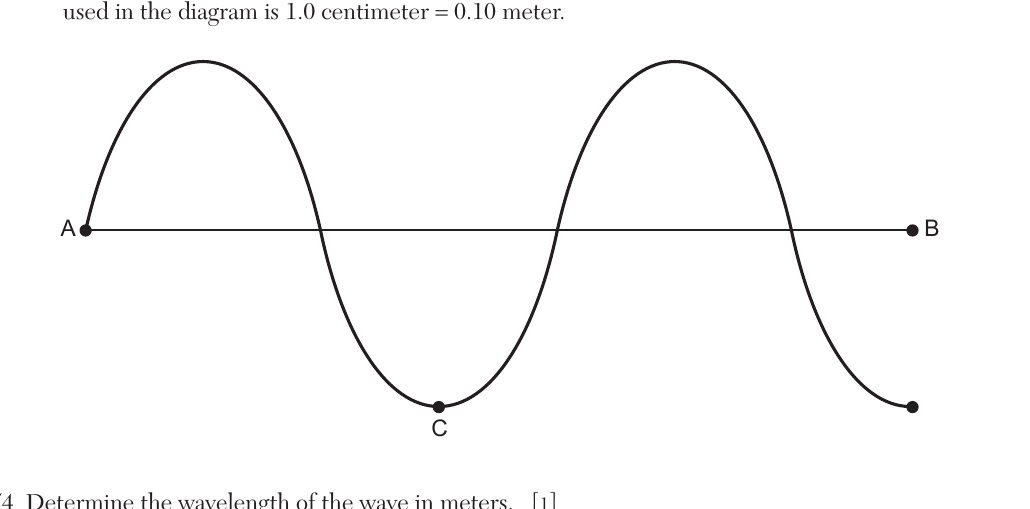
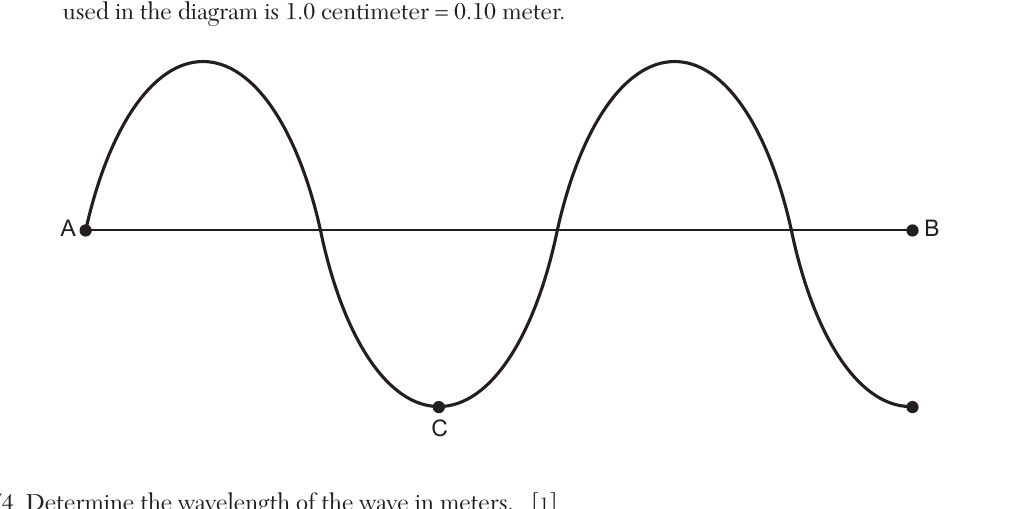
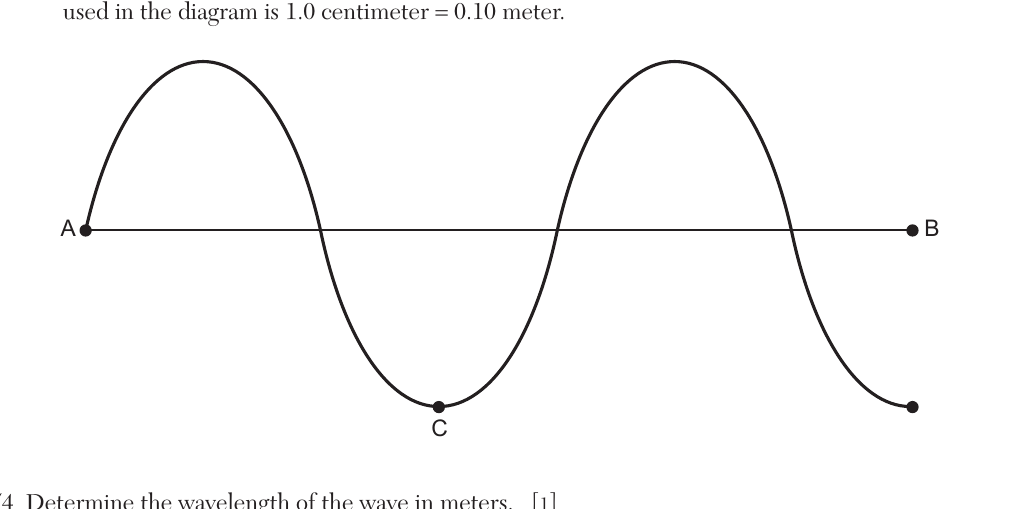
Base your answers to questions 74 through 77 on the information and diagram below and on your knowledge of physics. The diagram below represents a medium as a periodic wave passes through it, traveling to the right. The wave requires 2.0 seconds to travel from point $A$ to point $B$. The scale used in the diagram is 1.0 centimeter = 0.10 meter. (The diagram shows a sinusoidal wave beginning at point A on the axis, rising to a crest, descending through the axis to a trough labeled point C, rising again to a second crest, then descending to an unlabeled point below the axis, with point B marked further to the right on the axis.) 74 Determine the wavelength of the wave in meters.
Worked solution
The wavelength is the horizontal distance for one complete wave cycle (crest to crest), found by measuring the diagram with a ruler in centimeters and converting to meters with the given scale.
Calculate the speed of the wave in meters per second. [Show all work, including the equation and substitution with units.]
Worked solution
The wave speed is found by measuring the total horizontal distance from A to B on the scaled diagram, converting to meters, and dividing by the given travel time of 2.0 seconds.
On the diagram in your answer booklet, place an X on the wave at a position that is 180 degrees out of phase with point C.
Worked solution
Points 180 degrees out of phase move in exactly opposite directions at every instant; since C is at a trough, the point 180 degrees out of phase with it is at a crest of the same wave.
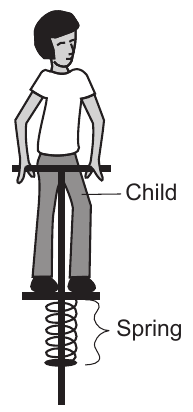
Base your answers to questions 78 through 82 on the information and diagram below and on your knowledge of physics. A pogo stick is a popular children's toy with a spring on the bottom. When a 51.0-kilogram child stands at rest on a pogo stick, the spring is compressed 0.15 meter. (Diagram shows a child standing on a pogo stick with a spring at the bottom, labeled 'Child' and 'Spring'.) 78 Determine the magnitude of the weight of the child in newtons.
Worked solution
Weight is calculated by multiplying the child's mass by the acceleration due to gravity, g = 9.81 m/s^2.
Calculate the spring constant of the spring on the pogo stick. [Show all work, including the equation and substitution with units.]
Worked solution
At rest, the spring force balances the child's weight, so Hooke's law (F = kx) can be rearranged to solve for the spring constant using the weight and compression distance.
Calculate the total energy stored in the pogo stick's spring when the child's weight has compressed the spring 0.15 meter. [Show all work, including the equation and substitution with units.]
Worked solution
The elastic potential energy stored in a compressed spring is found using PE = (1/2)kx^2, using the spring constant found previously and the given compression distance.
Base your answers to questions 83 through 85 on the information below and on your knowledge of physics. Scientists at the CERN Large Hadron Collider discovered a new subatomic particle. It is called the $X_b$ particle and is composed of one down quark, one strange quark, and one bottom quark. The mass of the $X_b$ particle is approximately 5950 MeV. 83 Determine both the sign and the magnitude of the charge of the $X_b$ particle, in elementary charges.
Worked solution
Down, strange, and bottom quarks are all down-type quarks, each carrying a charge of -1/3 elementary charge, so their sum gives a total particle charge of -1 elementary charge (negative).
Identify the fundamental force that holds the quarks together in the $X_b$ particle.
Worked solution
The strong nuclear force is the fundamental interaction responsible for binding quarks together to form composite particles such as baryons.
Determine the mass of the $X_b$ particle, in universal mass units.
Worked solution
Dividing the given mass in MeV by the conversion factor of 931 MeV per universal mass unit converts the particle's mass into universal mass units.