June 2023 Physics Regents — Answer Key & Worked Solutions
Every question from the June 2023 Physics Regents exam, with the correct answer and a full step-by-step solution. Check your work, learn the method, then see how it's scored.
These are real questions from the June 2023 Physics New York State Regents examination, published by NYSED. Worked solutions are written by RegentsLab.
Which pair of quantities are both scalar quantities?
- (A) speed and mass ✓
- (B) speed and momentum
- (C) momentum and displacement
- (D) mass and displacement
Worked solution
Scalars have magnitude only; speed and mass are both scalars, while momentum and displacement are vectors.
In an attempt to get ketchup out of a bottle, a student takes off the cap, turns the bottle upside down, accelerates it downward, and then suddenly stops. Ketchup is released from the open bottle because the ketchup doesn't stop moving when the bottle does. The ketchup leaving the bottle illustrates
- (A) inertia ✓
- (B) resistivity
- (C) resonance
- (D) mass being converted to energy
Worked solution
This is Newton's first law: the ketchup's inertia keeps it moving even after the bottle stops.
The same net force is applied to object A and object B. The mass of B is three times greater than the mass of A. Compared to the acceleration of A, the acceleration of B is
- (A) the same
- (B) one-third as great ✓
- (C) three times as great
- (D) one-ninth as great
Worked solution
Since a = F/m and F is the same for both, tripling the mass reduces acceleration to one-third.
What is the mass equivalent of $3.37\times10^{-19}$ joule?
- (A) $1.26\times10^{-54}$ kg
- (B) $3.74\times10^{-36}$ kg ✓
- (C) $1.12\times10^{-27}$ kg
- (D) $5.08\times10^{14}$ kg
Worked solution
Using mass-energy equivalence, divide the energy by the speed of light squared to find the equivalent mass.
Which object is in equilibrium?
- (A) Earth orbiting the Sun
- (B) a thrown baseball at its highest point above the ground
- (C) a car moving at a constant speed in a straight line ✓
- (D) a bicycle skidding to a stop in a straight line
Worked solution
An object in equilibrium has zero net force and zero acceleration, which describes constant velocity in a straight line, not circular motion, a point of zero velocity with gravity acting, or a decelerating object.
A race car travels around a flat circular track at constant speed. The net force on the car acts
- (A) perpendicular to the car's velocity and toward the center of the circle ✓
- (B) perpendicular to the car's velocity and away from the center of the circle
- (C) parallel to the car's velocity and in the same direction as the velocity
- (D) parallel to the car's velocity and in the opposite direction as the velocity
Worked solution
For uniform circular motion, the net (centripetal) force is always directed toward the center, perpendicular to the velocity.
An object is traveling in a horizontal, circular path at a constant speed. If the radius of the path were doubled while the speed remained constant, the centripetal acceleration would be
- (A) quartered
- (B) doubled
- (C) halved ✓
- (D) quadrupled
Worked solution
Centripetal acceleration is inversely proportional to radius when speed is constant, so doubling the radius halves the acceleration.
A 600.-newton student pushes on a vertical wall for 20.0 seconds with a constant force having a magnitude of 100. newtons. What is the magnitude of the force that the wall exerts on the student?
- (A) 0.00 N
- (B) 5.00 N
- (C) 100. N ✓
- (D) 600. N
Worked solution
Newton's third law states the wall exerts an equal and opposite reaction force of 100. N on the student, regardless of the student's weight or the time pushed.
An unbalanced force of 20. newtons is applied to a mass of $1.0\times10^3$ kilograms. After 10. seconds, the momentum of the mass will have changed by
- (A) $2.0\times10^2\ \text{kg}\cdot\text{m/s}$ ✓
- (B) $2.0\times10^3\ \text{kg}\cdot\text{m/s}$
- (C) $1.0\times10^4\ \text{kg}\cdot\text{m/s}$
- (D) $2.0\times10^4\ \text{kg}\cdot\text{m/s}$
Worked solution
The impulse-momentum theorem gives the change in momentum as the product of force and time, independent of the object's mass.
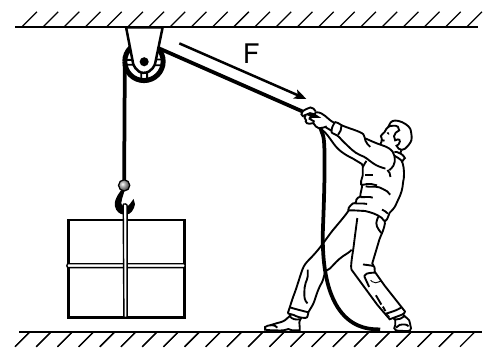
To lift a heavy block off the floor, a student pulls with force F on a rope that passes over a pulley, as shown in the diagram below. Which pair of vectors represents the perpendicular components of the force the student exerts on the rope?
- (A) Vector diagram (1): a downward arrow and a shorter downward arrow
- (B) Vector diagram (2): a leftward arrow and an upward-then-rightward arrow forming a right angle ✓
- (C) Vector diagram (3): a vertical upward arrow and a horizontal rightward arrow forming an L shape at origin
- (D) Vector diagram (4): two arrows, one upward and one leftward, both from the same point
Worked solution
The perpendicular components of F must be one purely horizontal and one purely vertical vector whose vector sum reconstructs F along the rope's actual direction; this requires seeing the figure to confirm orientation.
Which graph best represents the relationship between the mass of an object and its distance from Earth's surface?
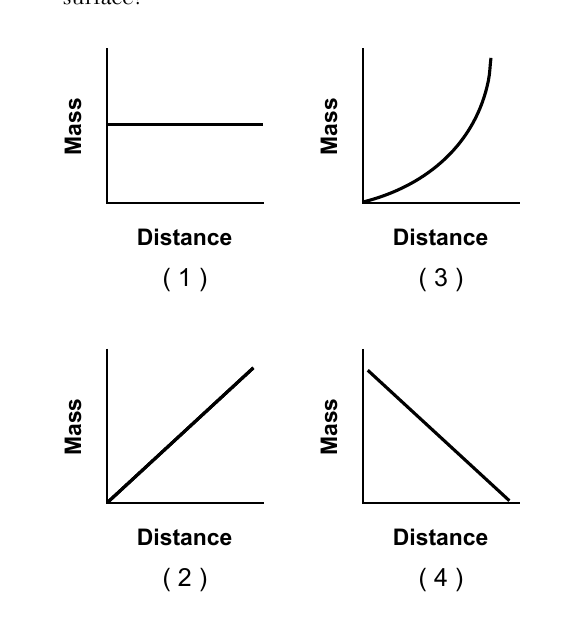
- (A) Graph (1): a horizontal line (mass constant with distance) ✓
- (B) Graph (2): a straight line increasing from the origin
- (C) Graph (3): an exponentially increasing curve
- (D) Graph (4): a straight line decreasing
Worked solution
Mass is independent of location, so a graph of mass versus distance from Earth's surface is a horizontal line.
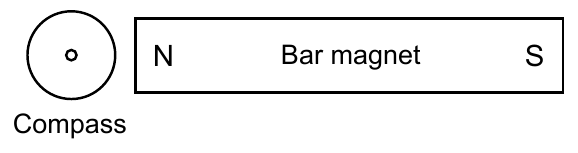
A compass is placed near a strong bar magnet as represented in the diagram below (compass on the left, bar magnet to its right with N pole on the left side and S pole on the right side). Which diagram best represents the direction of the compass needle?
- (A) Diamond needle with N (dot, filled diamond) on top pointing up, S on bottom
- (B) Diamond needle with S on top, N on bottom
- (C) Horizontal diamond needle with N pointing left, S pointing right ✓
- (D) Horizontal diamond needle with S pointing left, N pointing right
Worked solution
A compass needle aligns with the local magnetic field of the bar magnet; near the side of the magnet the field lines run roughly parallel to the magnet's axis, so the needle orients horizontally with its N pole pointing toward the magnet's N pole.
As Earth orbits the Sun in its elliptical orbit, the gravitational force between the Sun and Earth is
- (A) always attractive ✓
- (B) attractive as the Sun and Earth get closer together and repulsive as the Sun and Earth get farther apart
- (C) repulsive as the Sun and Earth get closer together and attractive as the Sun and Earth get farther apart
- (D) always repulsive
Worked solution
Gravity is always an attractive force between any two masses, so the Sun-Earth gravitational force remains attractive throughout the orbit.
Which unit is used to measure the work per unit charge required to move a charge in an electric field?
- (A) ampere
- (B) coulomb
- (C) volt ✓
- (D) watt
Worked solution
Electric potential difference (voltage) is defined as work per unit charge, and its SI unit is the volt.
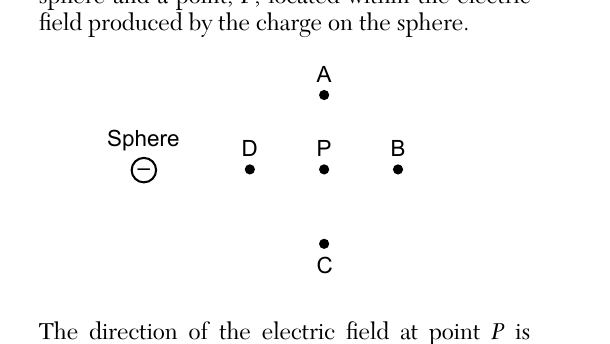
The diagram below shows a negatively charged sphere and a point, P, located within the electric field produced by the charge on the sphere. Points A, C, D, and B are arranged around P (A above, C below, D to the left, B to the right of P, with the sphere farther to the left of D). The direction of the electric field at point P is toward point
- (A) A
- (B) B
- (C) C
- (D) D ✓
Worked solution
For a negative charge, electric field vectors point toward the charge; since the sphere lies in the direction of point D from P, the field at P points toward D.
Two point charges, $q_1$ and $q_2$, are initially a distance, d, apart. Which change will cause the greatest increase in the electrostatic force between the two point charges, $q_1$ and $q_2$?
- (A) double $q_1$
- (B) halve $q_2$
- (C) double $d$
- (D) halve $d$ ✓
Worked solution
Because electrostatic force depends on the inverse square of distance, halving the distance quadruples the force, a greater increase than doubling a charge (which only doubles the force).
The diagram below represents two identical conducting spheres, A and B, each showing a mixture of + and - charge symbols distributed within them (sphere A shows charges scattered somewhat randomly; sphere B shows + charges concentrated on the left side and - charges concentrated on the right side near where it faces sphere A). Which statement could be the correct explanation for the charge distribution on the spheres?
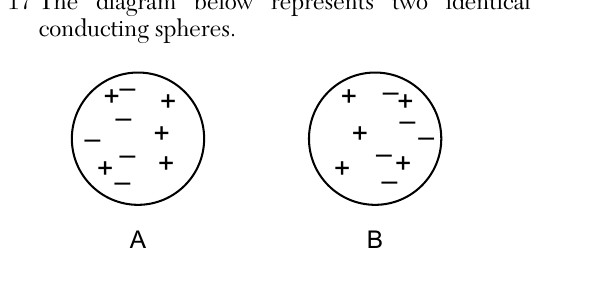
- (A) A small positively charged object is located between sphere A and sphere B.
- (B) A small negatively charged object is located between sphere A and sphere B. ✓
- (C) A small positively charged object is located to the right of sphere B.
- (D) A small negatively charged object is located to the right of sphere B.
Worked solution
The charge redistribution pattern between the two spheres is consistent with electrostatic induction caused by a small negative charge placed between them, repelling electrons in each sphere to the far sides.
The diagram below represents a circuit containing a battery, two operating lamps, A and B, and four closed switches, $S_1$, $S_2$, $S_3$, and $S_4$. Lamp A is in series with switch $S_2$ in one branch, and lamp B is in series with switch $S_3$ in a parallel branch; switch $S_4$ connects across the top joining both branches, and switch $S_1$ is in the main line from the battery. Which switch, when opened, causes both lamps to turn off?
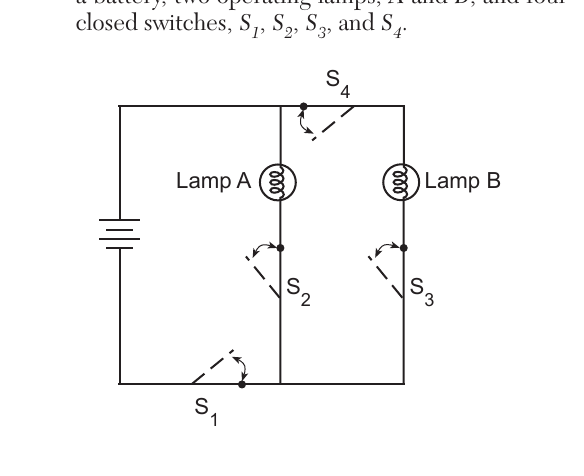
- (A) $S_1$ ✓
- (B) $S_2$
- (C) $S_3$
- (D) $S_4$
Worked solution
Since S1 is located in the main circuit line before the parallel branches split, opening it disconnects the battery from both lamps simultaneously.
What is the resistance of a 100.-watt bulb when operating a potential difference of 120. volts?
- (A) $1.20\ \Omega$
- (B) $100.\ \Omega$
- (C) $120.\ \Omega$
- (D) $144\ \Omega$ ✓
Worked solution
Using the power formula P = V^2/R and solving for R gives 144 ohms.
The interaction that is most responsible for binding three quarks together in a proton is the
- (A) strong force ✓
- (B) electromagnetic force
- (C) weak force
- (D) gravitational force
Worked solution
The strong force (mediated by gluons) is responsible for binding quarks together within protons and neutrons.
One example of a force doing work is the force exerted by
- (A) Earth on a high diver falling toward a pool from a platform above ✓
- (B) a hook on an engine held stationary above a car
- (C) a frictionless horizontal air hockey table on a puck moving across the table at a constant velocity
- (D) a weightlifter on a barbell he holds motionless over his head
Worked solution
Work is done only when a force causes displacement along its direction; gravity does work on the falling diver, whereas the other examples involve either no displacement or a force perpendicular to the motion.
A ball falls freely from a rooftop to the street below. The ball starts from rest with 20. joules of gravitational potential energy with respect to the street. The total mechanical energy of the ball just before it hits the street is
- (A) 0 J
- (B) 5.0 J
- (C) 10. J
- (D) 20. J ✓
Worked solution
In free fall with no friction, total mechanical energy is conserved, so the total mechanical energy just before impact equals the initial 20. J of potential energy.
Which statement describes the gravitational potential energy (PE), kinetic energy (KE), and internal (thermal) energy (Q), of a wooden crate as it is pushed across a level classroom floor at constant speed?
- (A) The PE decreases, KE remains the same, and Q decreases.
- (B) The PE increases, KE increases, and Q decreases.
- (C) The PE remains the same, KE decreases, and Q increases.
- (D) The PE remains the same, KE remains the same, and Q increases. ✓
Worked solution
On a level floor at constant speed there is no change in height or speed, so PE and KE stay constant; the work done against friction is converted into internal thermal energy.
The oscillation of electrons up and down a metal antenna produces waves. These waves are
- (A) mechanical and longitudinal
- (B) mechanical and transverse
- (C) electromagnetic and transverse ✓
- (D) electromagnetic and longitudinal
Worked solution
Accelerating electrons in an antenna radiate electromagnetic radiation, and all electromagnetic waves are transverse.
The diagram below shows an incident light ray reflecting from a plane mirror. The incident ray and the reflected ray meet at the mirror surface, forming an angle of 84° between the incident ray and the reflected ray. What is the angle of reflection?
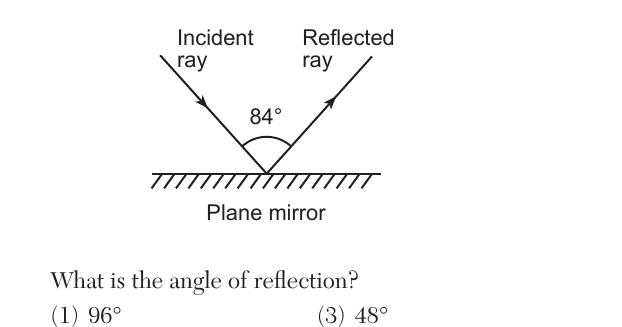
- (A) 96°
- (B) 84°
- (C) 48°
- (D) 42° ✓
Worked solution
The 84° angle shown is the angle between the incident and reflected rays; since these angles are equal and measured from the normal, each equals half of 84°.
A characteristic common to both sound waves and x rays is that they both
- (A) travel fastest in a vacuum
- (B) cause particles to vibrate in a direction parallel to the wave's direction of motion
- (C) transmit energy without transmitting matter ✓
- (D) are mechanical
Worked solution
Sound waves are mechanical and longitudinal while x rays are electromagnetic and transverse, so the only property they share from the choices is that both transmit energy without transmitting matter.
The diagram below represents a wave moving to the right through a rope. Point P is marked on the rope. Point P in the rope is moving toward the
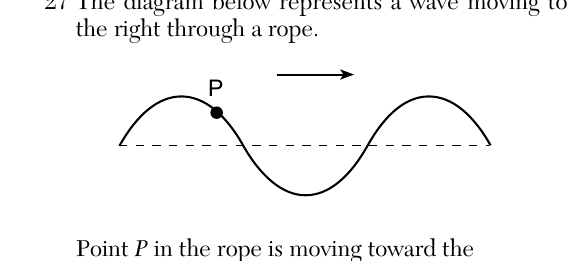
- (A) top of the page ✓
- (B) bottom of the page
- (C) right
- (D) left
Worked solution
For a transverse wave moving right, a point's future position matches the waveform currently just to its left; since that portion of the curve at P's location is rising, P is momentarily moving toward the top of the page.
What is the wavelength of a 300.-hertz sound wave in air at STP?
- (A) 0.906 m
- (B) 1.10 m ✓
- (C) $3.00 \times 10^2$ m
- (D) $1.00 \times 10^6$ m
Worked solution
Using the speed of sound in air at STP (331 m/s) and the wave equation v = fλ, dividing gives a wavelength of about 1.10 m.
In the diagram below, a remote control is aimed at a television. When the signal from the remote reaches the sensor on the television, the signal will most likely be
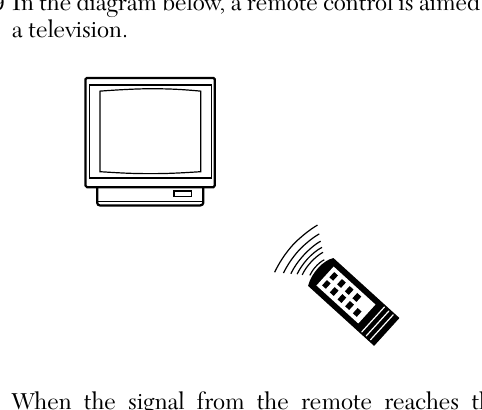
- (A) neither reflected nor absorbed
- (B) partially absorbed and partially reflected ✓
- (C) completely reflected
- (D) completely absorbed
Worked solution
No real surface completely absorbs or completely reflects all incident light, so the infrared signal striking the sensor is partially absorbed (to be detected) and partially reflected.
Compared to waves of blue light traveling in a vacuum, waves of red light traveling in a vacuum have
- (A) a lower frequency and a lower speed
- (B) a lower frequency and the same speed ✓
- (C) the same frequency and a lower speed
- (D) the same frequency and the same speed
Worked solution
In a vacuum all electromagnetic waves travel at the same speed c, but red light has a lower frequency than blue light because it has a longer wavelength.
Earthquakes often cause buildings between twelve and forty stories high to vibrate at an amplitude high enough to be destructive. Buildings are often designed to absorb this vibrational energy that might cause them to vibrate at their natural frequency. This tendency for an earthquake to cause a building to vibrate at a large amplitude is an example of
- (A) resonance ✓
- (B) the Doppler effect
- (C) refraction
- (D) diffraction
Worked solution
When a periodic driving force (the earthquake) matches an object's natural frequency, the resulting large-amplitude vibration is called resonance.
During the radioactive decay of a uranium-238 atom, a thorium-234 atom and an alpha particle are produced. During this process, there is conservation of
- (A) charge, only
- (B) mass-energy, only
- (C) both charge and mass-energy ✓
- (D) neither charge nor mass-energy
Worked solution
In all nuclear reactions, including alpha decay, both total charge and total mass-energy are conserved.
An antiproton has a charge of
- (A) +1e
- (B) $+\frac{2}{3}e$
- (C) 0
- (D) -1e ✓
Worked solution
An antiparticle has the same mass as its corresponding particle but opposite charge, so since the proton has charge +1e, the antiproton has charge -1e.
Two pulses approach each other in the same medium. Which pair of pulses will result in the largest magnitude displacement of the medium as the pulses pass through each other?
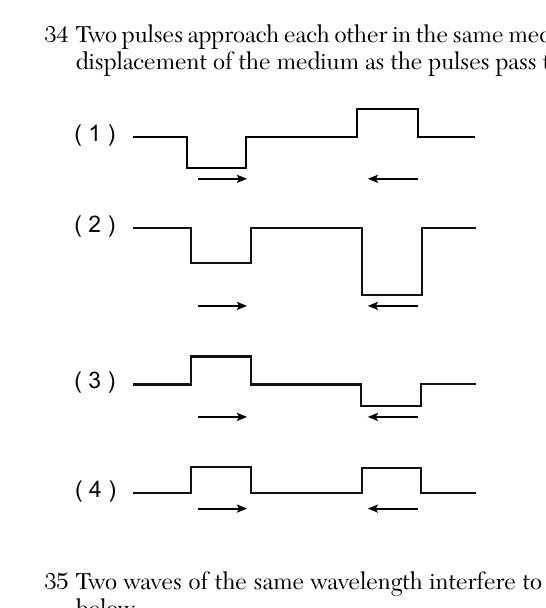
- (A) Pulse pair 1 (as shown in the diagram)
- (B) Pulse pair 2 (as shown in the diagram) ✓
- (C) Pulse pair 3 (as shown in the diagram)
- (D) Pulse pair 4 (as shown in the diagram)
Worked solution
By the principle of superposition, the greatest combined displacement occurs for the pair whose two pulses have the largest amplitudes displaced in the same direction, so their heights add constructively; pulse pair 2 shows this combination.
Two waves of the same wavelength interfere to form a standing wave pattern as represented in the diagram below. Which point on the diagram represents a node?
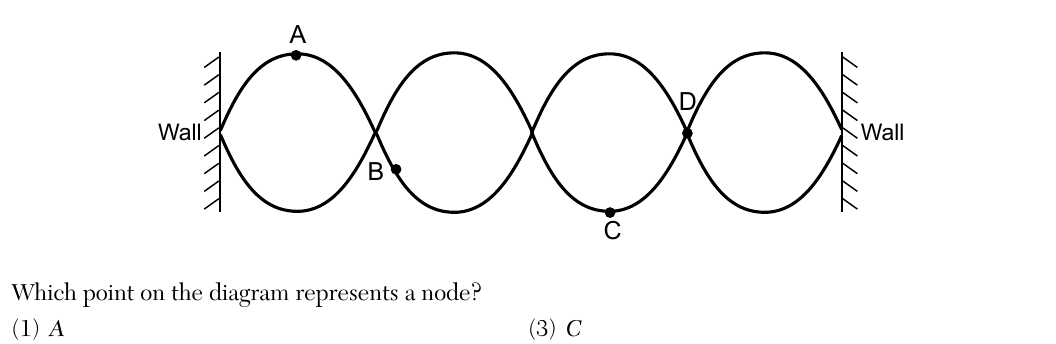
- (A) A
- (B) B
- (C) C
- (D) D ✓
Worked solution
A node is a point of the standing wave pattern that stays at zero displacement; point D is located where the standing wave pattern crosses the central axis between loops, identifying it as a node, while A and C sit at the crest/trough of a loop (antinodes).
A round dinner plate has a diameter closest to
- (A) $2\times10^{-2}$ m
- (B) $2\times10^{-1}$ m ✓
- (C) $2\times10^{0}$ m
- (D) $2\times10^{1}$ m
Worked solution
A typical dinner plate is roughly 20 centimeters, or 2×10⁻¹ meters, in diameter.
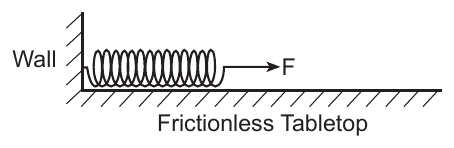
Several springs are lying on frictionless tabletops with one end attached to a wall and a variable force F applied to the free end of each spring. The springs have different spring constants, k. The diagram below shows the setup for one of the springs. The elongation of the springs produced by force F depends
- (A) directly on both F and k
- (B) directly on F and inversely on k ✓
- (C) inversely on F and directly on k
- (D) inversely on both F and k
Worked solution
By Hooke's law, F = kx, so elongation x = F/k, which increases directly with F and decreases (inversely) as k increases.
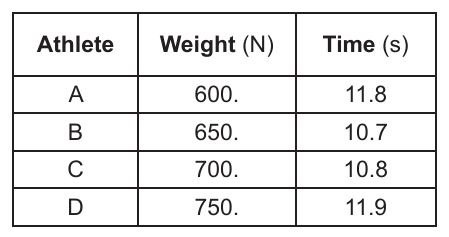
The table below shows the weight of four athletes (A, B, C, and D) and the time required for each athlete to run from the base of a hill to its top. Which athlete ran up the hill with the greatest average power?
- (A) A
- (B) B
- (C) C ✓
- (D) D
Worked solution
Since all athletes climb the same hill (same height gain), average power is proportional to weight divided by time; computing this ratio for each athlete shows athlete C has the highest value.
A copper wire carries 2.8 amperes of current. The total amount of charge that passes a point in the wire in 1.3 milliseconds is
- (A) $4.6\times10^{-4}$ C
- (B) $3.6\times10^{-3}$ C ✓
- (C) 3.6 C
- (D) $2.2\times10^3$ C
Worked solution
Using q = It with the current in amperes and time converted to seconds gives a charge of about 3.6×10⁻³ C.
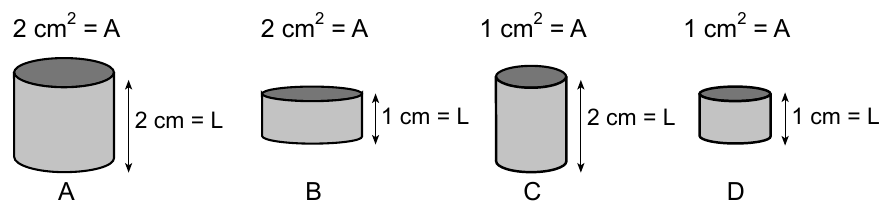
The diagram below represents four solid copper wire segments at 20°C with different lengths (L) and cross-sectional areas (A): Segment A has A = 2 cm² and L = 2 cm; segment B has A = 2 cm² and L = 1 cm; segment C has A = 1 cm² and L = 2 cm; segment D has A = 1 cm² and L = 1 cm. Which two segments have the same resistance?
- (A) A and B
- (B) B and D
- (C) B and C
- (D) A and D ✓
Worked solution
Since resistance is proportional to L/A for wires of the same material, computing L/A for each segment shows that segments A and D have the same ratio (1) and therefore the same resistance.
In substance X, a ray of light with a frequency of $5.09\times10^{14}$ hertz has a speed of $2.04\times10^{8}$ meters per second. Substance X could be
- (A) diamond
- (B) water
- (C) zircon
- (D) glycerol ✓
Worked solution
Dividing the speed of light in a vacuum by the given speed yields an index of refraction of about 1.47, which matches the reference-table value for glycerol.
Which could not be the charge on a particle?
- (A) $3.2\times10^{-19}$ C
- (B) $4.5\times10^{-19}$ C ✓
- (C) $4.8\times10^{-19}$ C
- (D) $6.4\times10^{-19}$ C
Worked solution
Electric charge is quantized in integer multiples of the elementary charge e; dividing each choice by e shows only 4.5×10⁻¹⁹ C is not a whole-number multiple, so it cannot be a particle's charge.
Which graph best represents the relationship between photon energy ($E_{photon}$) and wavelength?
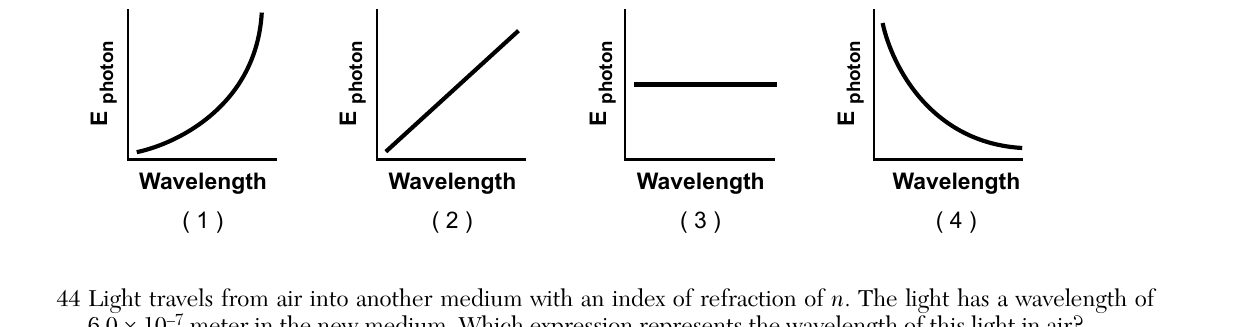
- (A) Graph 1: a steeply rising, concave-up curve of $E_{photon}$ vs. Wavelength
- (B) Graph 2: a straight line rising linearly with Wavelength
- (C) Graph 3: a horizontal, constant line of $E_{photon}$ vs. Wavelength
- (D) Graph 4: a decreasing, concave-up curve (hyperbola-like) of $E_{photon}$ vs. Wavelength ✓
Worked solution
Since photon energy equals hc/λ, energy is inversely proportional to wavelength, which is represented by a decreasing, concave-up curve like graph 4, not a straight line or constant value.
Light travels from air into another medium with an index of refraction of n. The light has a wavelength of $6.0\times10^{-7}$ meter in the new medium. Which expression represents the wavelength of this light in air?
- (A) $n(6.0\times10^{-7}\text{m})$ ✓
- (B) $\dfrac{6.0\times10^{-7}\text{m}}{n}$
- (C) $\dfrac{n}{6.0\times10^{-7}\text{m}}$
- (D) $(6.0\times10^{-7}\text{m}) - n$
Worked solution
The index of refraction relates the wavelength in air to the wavelength in the medium by n = λ_air/λ_medium, so solving for λ_air gives n times the wavelength in the medium.
If 80. joules of electrical energy is dissipated by a 10.-ohm resistor in 2.0 seconds, the current in the resistor is
- (A) 5.0 A
- (B) 2.0 A ✓
- (C) 8.0 A
- (D) 4.0 A
Worked solution
Power is energy per unit time, and once power and resistance are known the current follows directly from P = I^2R.
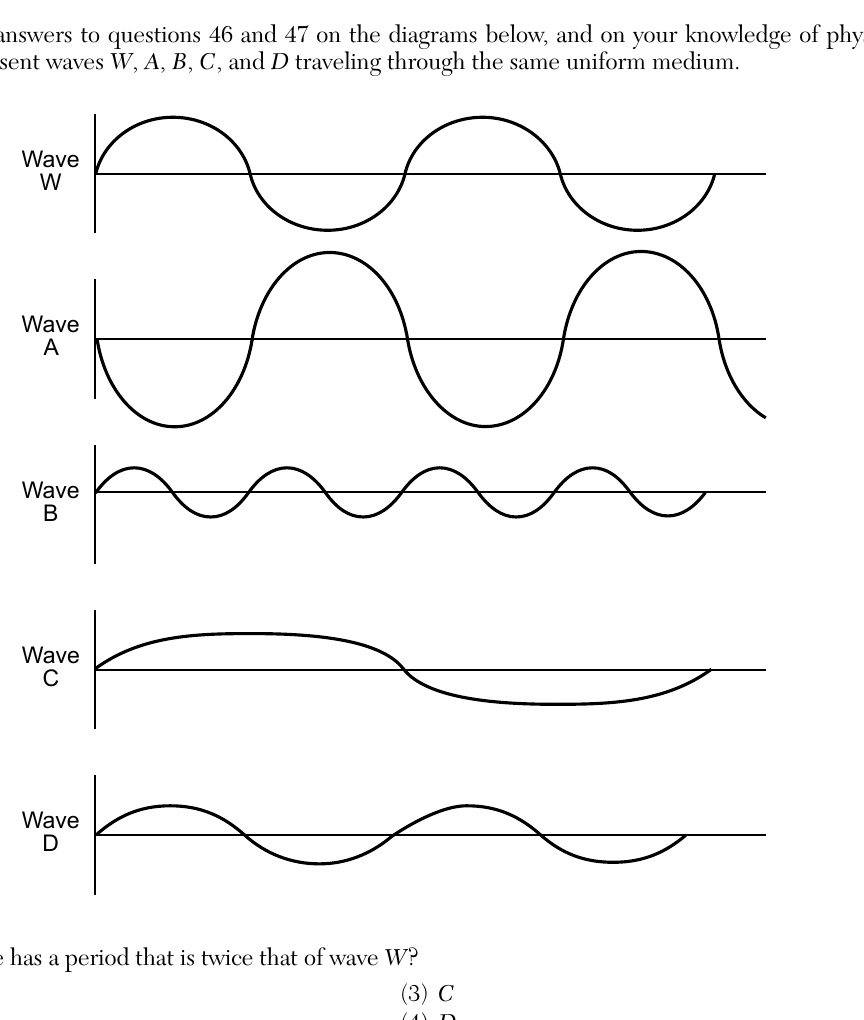
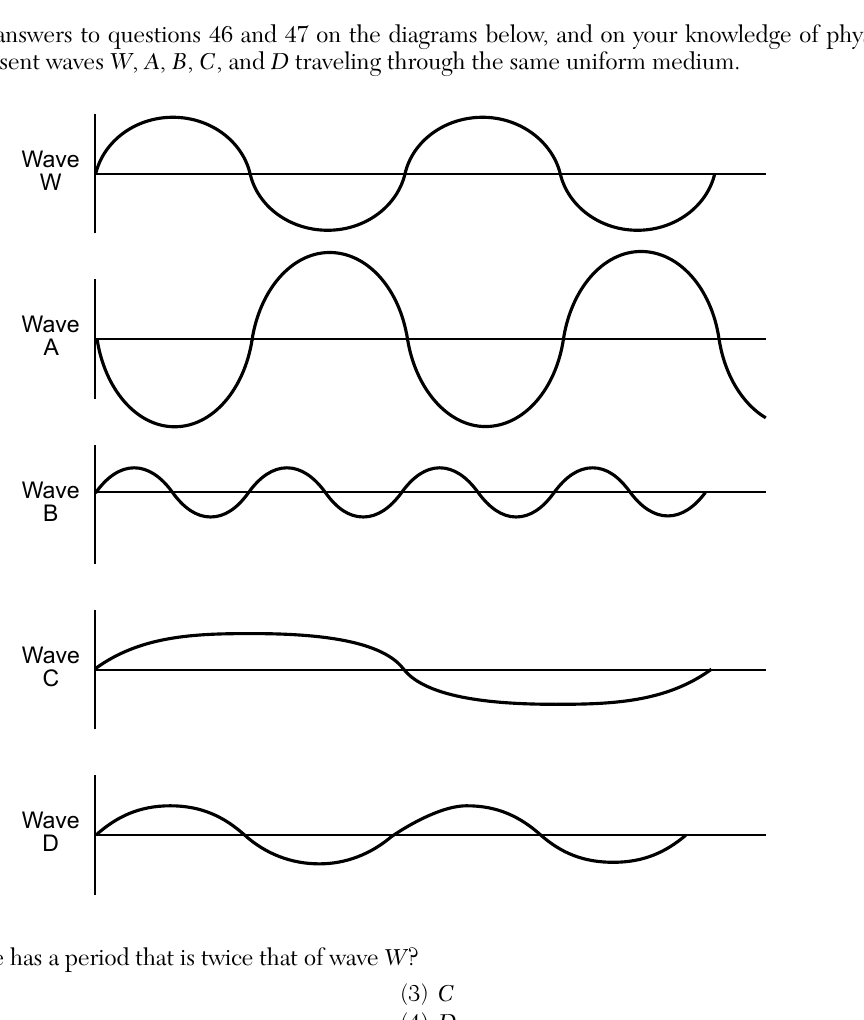
Base your answer on the diagrams below, and on your knowledge of physics. The diagrams represent waves W, A, B, C, and D traveling through the same uniform medium. Which wave has a period that is twice that of wave W?
- (A) A
- (B) B
- (C) C ✓
- (D) D
Worked solution
Since all waves travel through the same medium at the same speed, the wave that completes half as many full cycles over the same horizontal extent as wave W has twice the period of wave W.
Which wave is always 180 degrees out of phase with wave W?
- (A) A ✓
- (B) B
- (C) C
- (D) D
Worked solution
A constant 180 degree phase difference requires the same period and an inverted displacement pattern at every point, which matches wave A relative to wave W.
Which graph best represents the relationship between acceleration and time for a freely falling object as the object falls near the surface of Earth?
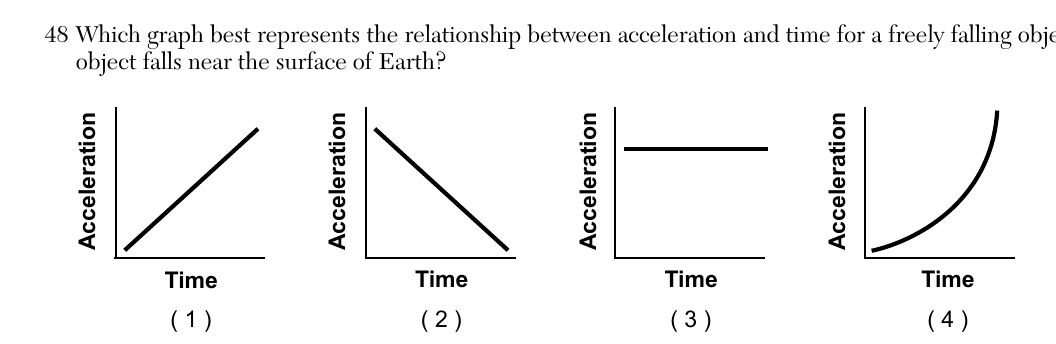
- (A) Graph (1): Acceleration increasing linearly with time (straight line through origin, positive slope)
- (B) Graph (2): Acceleration decreasing linearly with time (straight line, negative slope)
- (C) Graph (3): Acceleration constant with time (horizontal line) ✓
- (D) Graph (4): Acceleration increasing exponentially/curving upward with time
Worked solution
Near Earth's surface a freely falling object (neglecting air resistance) has a constant acceleration equal to g, so acceleration versus time is a horizontal line.
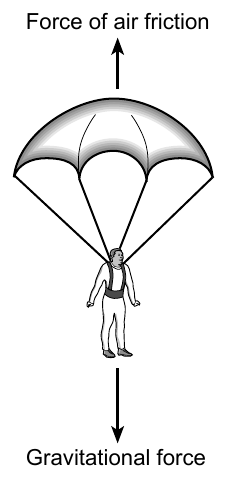
The diagram below represents the forces acting on a skydiver with his parachute. An arrow labeled "Force of air friction" points upward above the skydiver, and an arrow labeled "Gravitational force" points downward below the skydiver. The total mass of the skydiver with his parachute is 85.0 kilograms. If the magnitude of the gravitational force is 834 newtons, and the magnitude of the force of air friction is 652 newtons, the acceleration of the skydiver at the time shown is
- (A) 2.14 m/s\(^2\) up
- (B) 2.14 m/s\(^2\) down ✓
- (C) 7.67 m/s\(^2\) up
- (D) 9.81 m/s\(^2\) down
Worked solution
The gravitational force is larger than the upward air friction force, so the net force and resulting acceleration both point downward.
A 15.0-gram air hockey puck sliding on a horizontal surface at a velocity of 7.00 meters per second north collides with a 15.0-gram air hockey puck traveling at a velocity of 8.00 meters per second south. The momentum of the system of pucks after the collision is
- (A) 0.0150 kg•m/s north
- (B) 0.0150 kg•m/s south ✓
- (C) 0.225 kg•m/s north
- (D) 0.225 kg•m/s south
Worked solution
Total momentum is conserved in the collision, so the system's momentum after collision equals its momentum before collision, found by subtracting the two oppositely-directed momenta.
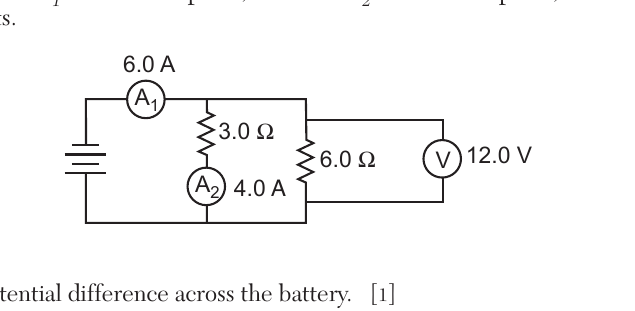
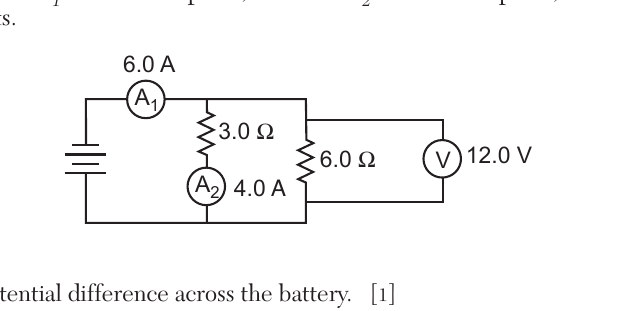
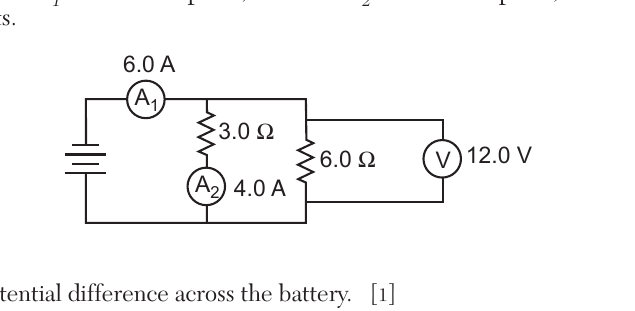
Base your answer on the information and circuit diagram below and on your knowledge of physics. An electric circuit contains a battery, a 3.0-ohm resistor, a 6.0-ohm resistor, and three meters. Ammeter A1 reads 6.0 amperes, ammeter A2 reads 4.0 amperes, and the voltmeter reads 12.0 volts. Determine the potential difference across the battery.
Worked solution
In a parallel circuit with no other series resistance, the voltage across the battery equals the voltage across the parallel combination, which is given directly by the voltmeter reading and is confirmed by checking both ammeter readings.
Determine the current through the 6.0-ohm resistor.
Worked solution
Ohm's law applied to the 6.0-ohm resistor using the 12.0 V reading from the voltmeter across it gives the branch current directly.
Calculate the equivalent resistance of the circuit. [Show all work, including the equation and substitution with units.]
Worked solution
For resistors wired in parallel, the reciprocal of the equivalent resistance is the sum of the reciprocals of each resistor; the result is confirmed by dividing total battery voltage by total current.
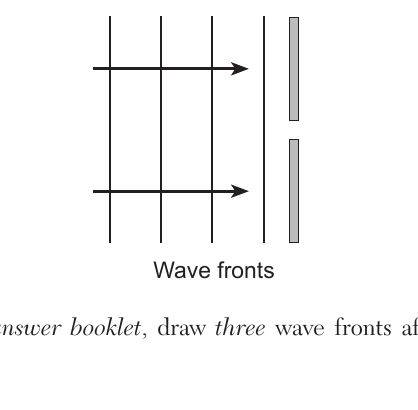
The diagram below shows parallel straight wave fronts approaching a rigid barrier that has a small opening in its center. On the diagram in your answer booklet, draw three wave fronts after they have passed through the opening.
Worked solution
Diffraction causes the straight wave fronts to bend around the edges of the small opening, producing circular (semicircular) wave fronts that spread out in all directions beyond the barrier.
Base your answer on the information below and on your knowledge of physics. A projectile is launched from level ground with an initial vertical speed of 26 meters per second upward and an initial horizontal speed of 15 meters per second. [Neglect friction.] Calculate the total time the projectile is in the air before the projectile returns to the level ground. [Show all work, including the equation and substitution with units.]
Worked solution
For a projectile launched from and landing at the same height, the total flight time is twice the time to reach maximum height, found from the vertical initial speed and gravitational acceleration.
Determine the total horizontal distance the projectile travels before the projectile returns to the ground.
Worked solution
Since horizontal velocity is constant (no friction), the horizontal range is simply the horizontal speed multiplied by the total flight time found in question 56-57.
Determine the angle above the horizontal at which the projectile is launched.
Worked solution
The launch angle is found from the inverse tangent of the ratio of the vertical to horizontal initial speed components.
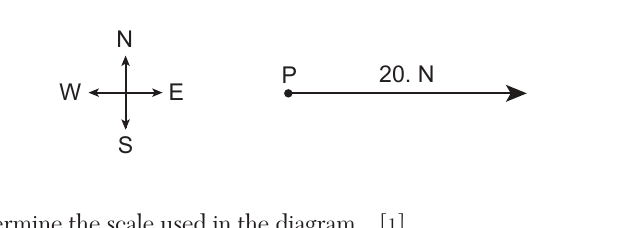
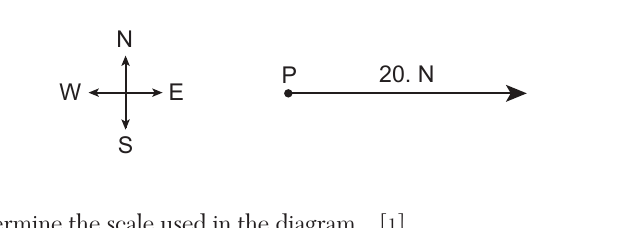
Base your answer on the information below and on your knowledge of physics. A 20.-newton force due east and a 25-newton force due south act concurrently at point P. The diagram shows a vector drawn to scale representing the 20.-newton force due east. Using a ruler, determine the scale used in the diagram.
Worked solution
The scale is found by physically measuring the printed length of the 20. N vector with a ruler and dividing the known force by that length; this requires the actual printed diagram rather than the transcribed text.
On the diagram in your answer booklet, use a metric ruler and the scale shown in the diagram to draw a vector to represent the 25 newton force due south acting at point P. Begin the vector at point P and label its magnitude in newtons.
Worked solution
The vector's direction (south) is given, and its drawn length is set by dividing the 25 N magnitude by the diagram's established scale from question 60.
Determine the magnitude of the resultant force acting at point P.
At point P, a 20. N force acts toward the east and a 25 N force acts toward the south (the two forces are perpendicular).
Worked solution
Because the 20 N and 25 N forces act perpendicular to each other (east and south), the Pythagorean theorem gives the magnitude of their resultant.
Determine the amount of energy, in electronvolts, that must be absorbed by a hydrogen atom to excite the atom from the n = 1 energy level directly to the n = 4 energy level.
Worked solution
The energy absorbed to move an electron between energy levels equals the difference between the final and initial energy level values listed in the reference tables.
Determine the sign and magnitude of the net charge, in coulombs, of a particle that has a quark composition of bbb.
Worked solution
Each bottom quark carries a charge of negative one-third the elementary charge, so three bottom quarks combine to give a net charge of exactly minus one elementary charge.
What type of electromagnetic radiation would contain photons each having an energy of 2.65 × 10⁻²⁰ joule?
Worked solution
Dividing the photon energy by Planck's constant gives the photon frequency, which falls in the infrared band of the electromagnetic spectrum chart in the reference tables.
Base your answers to questions 66 through 70 on the information below and on your knowledge of physics. A car, initially traveling at a velocity of 25 meters per second west, accelerates uniformly at a rate of 1.5 meters per second squared east for 6.0 seconds. Calculate the magnitude of the car's velocity after the 6.0 seconds. [Show all work, including the equation and substitution with units.]
Worked solution
Choosing west as the positive direction, the eastward acceleration is negative; applying v_f = v_i + at over the given time gives the final velocity's magnitude.
Determine the direction of the car's velocity after the 6.0 seconds.
Worked solution
Since v_f is still negative in the west-negative convention, the car (though it has slowed down) is still moving west after 6.0 seconds.
Calculate the total distance traveled by the car during the 6.0 seconds. [Show all work, including the equation and substitution with units.]
Worked solution
Because the velocity never reaches zero during the 6.0 s interval (it would take about 16.7 s to stop), the car never reverses direction, so the magnitude of displacement equals the total distance traveled.
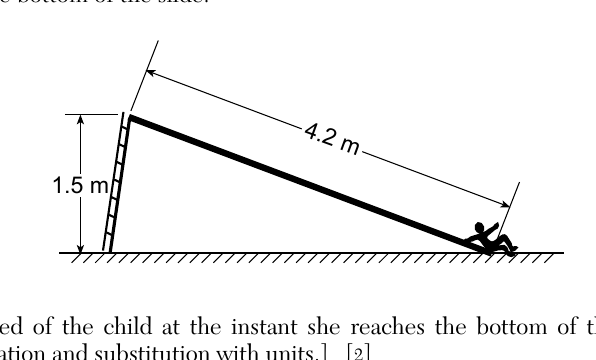
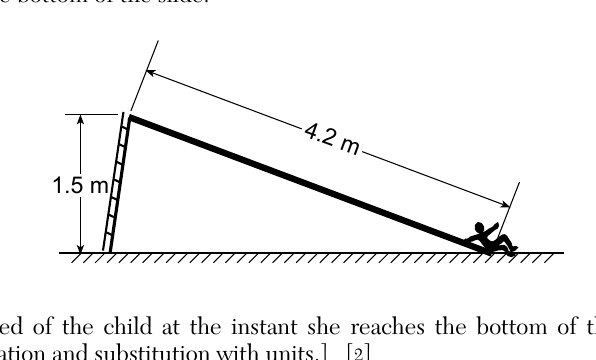
Base your answer to questions 71 through 76 on the information below and on your knowledge of physics. Starting from rest at the top of the slide, a 40.-kilogram child accelerates uniformly along the surface of a 4.2-meter-long slide at a rate of 0.30 meter per second squared until she reaches the bottom of the slide. Calculate the speed of the child at the instant she reaches the bottom of the slide. [Show all work, including the equation and substitution with units.]
Worked solution
Using kinematics with initial speed zero, the child's speed at the bottom of the slide is found from v_f squared equals 2ad, using the 4.2 m slide length and 0.30 m/s squared acceleration given in the text.
Calculate the child's kinetic energy at the bottom of the slide. [Show all work, including the equation and substitution with units.]
Worked solution
Using the mass of 40. kg and the speed squared (2.52 m^2/s^2) found from the previous kinematics calculation, the kinetic energy at the bottom of the slide is 50.4 J.
Determine the total gravitational potential energy gained by the child when climbing 1.5 meters vertically from the bottom to the top of the slide.
Worked solution
The gravitational potential energy gained equals the weight of the child times the vertical height climbed, using the 1.5 m height shown in the diagram.
Determine the total amount of mechanical energy lost by the child-slide system as the child slides from the top to the bottom of the slide.
Worked solution
Since the child starts at rest at the top with only gravitational potential energy and ends at the bottom with only kinetic energy, the mechanical energy lost to friction is the difference between the initial potential energy and the final kinetic energy.
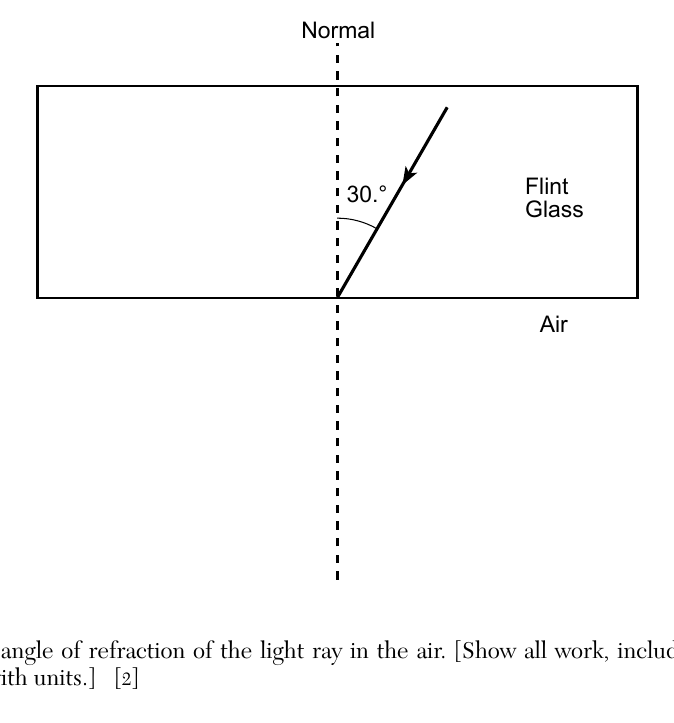
Base your answer to questions 77 through 80 on the information below and on your knowledge of physics. A ray of light ($f = 5.09 \times 10^{14}$ Hz) in flint glass is incident on air at an angle of incidence of 30.$^\circ$. Calculate the angle of refraction of the light ray in the air. [Show all work, including the equation and substitution with units.]
Worked solution
Applying Snell's Law with the absolute index of refraction of flint glass (1.66) from the reference tables and air (1.00), the angle of refraction in air is about 56 degrees, bending away from the normal since light travels from a denser to a less dense medium.
Using a protractor and a straightedge, draw the refracted light ray on the diagram in your answer booklet.
Worked solution
The refracted ray must be drawn at approximately 56 degrees from the normal on the air side of the boundary, bending away from the normal because the light is moving from a more optically dense medium into a less dense one.
State what happens to the wavelength of the light ray as the light ray passes into the air from the flint glass.
Worked solution
Frequency does not change when light crosses a boundary between media, but since air has a lower index of refraction than flint glass, the speed of light increases, so the wavelength must increase proportionally.
Base your answers to questions 81 through 85 on the information, graph, and diagram below and on your knowledge of physics. A student pulls a block weighing 2.0 newtons, resting on a horizontal laboratory table, with a string and force sensor. The sensor measures the force applied to the block when the block is at rest and when the block is moving. The force applied to the block is plotted against time on the graph. (Diagram: a force sensor connected by a string to a block on a horizontal table. Graph: Force (N) on the y-axis from 0 to 1.2 N, Time (s) on the x-axis from 0 to 4.0 s. The force rises roughly linearly (slightly curved) from 0 N at t=0 to about 1.0 N at t=2.0 s, labeled "Block started in motion" at that peak; then the force drops and levels off at about 0.9 N from t=2.0 s to t=4.0 s.) Based on the graph, determine the force of kinetic friction acting on the block as it is pulled at constant velocity across the laboratory table.
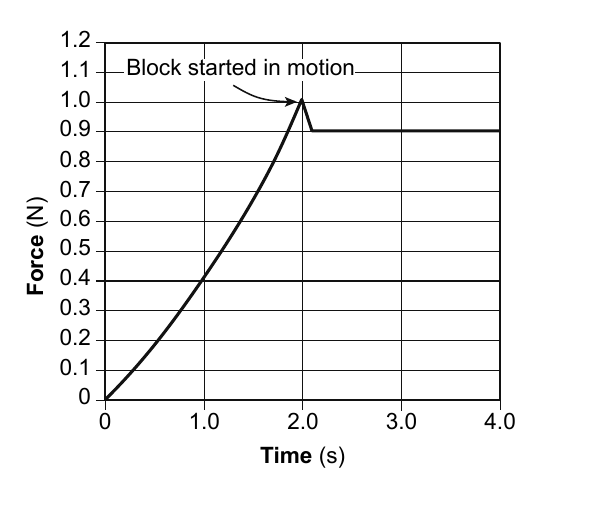
Worked solution
Once the block is moving at constant velocity, the net force is zero, so the applied force read from the flat portion of the graph (about 0.9 N) equals the kinetic friction force.
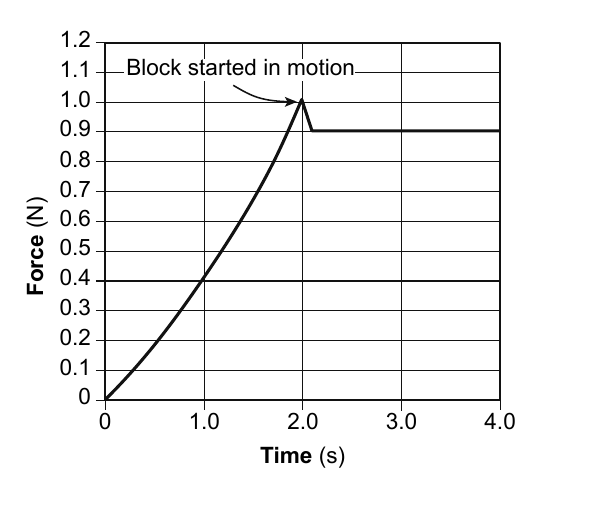
Calculate the coefficient of kinetic friction between the block and the laboratory table. [Show all work, including the equation and substitution with units.]
Worked solution
The coefficient of kinetic friction is the ratio of the kinetic friction force (read from the graph) to the normal force, which equals the block's weight of 2.0 N on a horizontal table.
At the instant the block begins to move, what happens to the value of the coefficient of friction?
Worked solution
The coefficient of static friction is always greater than or equal to the coefficient of kinetic friction, so as the block transitions from rest to sliding, the coefficient of friction decreases (matching the drop in force seen on the graph at t = 2.0 s).
How would the coefficient of kinetic friction ($\mu$) between the block and the laboratory table be affected if a 0.50-kilogram mass were placed on the block?
Worked solution
The coefficient of kinetic friction depends only on the nature of the two surfaces in contact, not on the normal force or mass, so adding a 0.50 kg mass to the block would not change the value of mu.