June 2025 Global History Regents — Answer Key & Worked Solutions
Every question from the June 2025 Global History Regents exam, with the correct answer and a full step-by-step solution. Check your work, learn the method, then see how it's scored.
These are real questions from the June 2025 Global History New York State Regents examination, published by NYSED. Worked solutions are written by RegentsLab.
Base your answer on the passage: "For seven centuries, from the late-12th century until 1868, Japan was ruled by a warrior elite. For over two centuries, beginning in the 1630s, the feudal government based in Edo had enforced a strict 'closed country' (sakoku) policy that prohibited Japanese from leaving and foreigners from entering... Cities grew, commerce flourished, and literacy became widespread during this long period of isolation." Which claim is best supported by this passage?
- (A) Japan challenged China for supremacy in Asia.
- (B) Japan relied on natural resources for industrial growth.
- (C) Japan made great industrial and territorial gains that rivaled world powers.
- (D) Japan experienced a period of cultural development despite its isolation. ✓
Worked solution
The passage emphasizes urban growth, commerce, and literacy flourishing even as Japan remained isolated from the outside world under the Tokugawa sakoku policy.
Base your answer on the same passage about Japan's isolation and the Tokugawa era. This passage best describes which development in Japanese history?
- (A) the rule of the Tokugawa Shogunate ✓
- (B) the arrival of Commodore Matthew Perry
- (C) the Meiji Restoration
- (D) the annexation of Korea
Worked solution
The Edo-based feudal government described enforcing sakoku from the 1630s until 1868 is the Tokugawa Shogunate.
Base your answer on the document: ". . . As all persons are held innocent until they shall have been declared guilty, if arrest shall be deemed indispensable, all harshness not essential to the securing of the prisoner's person shall be severely repressed by law. No one shall be disquieted [oppressed] on account of his opinions, including his religious views... The free communication of ideas and opinions is one of the most precious of the rights of man. Every citizen may, accordingly, speak, write, and print with freedom..." (Source: Declaration of the Rights of Man and of the Citizen, 1789) Which group would be most likely to support the ideas presented in this document?
- (A) the nobility
- (B) the clergy
- (C) the Third Estate ✓
- (D) the royal officials
Worked solution
The Declaration of the Rights of Man and of the Citizen granted rights and equality that most benefited the common people of the Third Estate, who previously had no political privileges under the ancien regime.
Base your answer on the same document (Declaration of the Rights of Man and of the Citizen, 1789), which states people are presumed innocent until proven guilty, no one shall be oppressed for their opinions or religious views, and free communication of ideas is among the most precious rights of man. Which claim is best supported by this document?
- (A) People arrested should be presumed guilty until proven innocent.
- (B) The rights of all citizens should be respected with fairness and justice. ✓
- (C) Religious practices should be limited by the government.
- (D) Freedom of speech should be restricted for the public good.
Worked solution
The document's articles collectively affirm that all citizens are entitled to fair treatment, protection from unjust punishment, and freedom of belief and expression.
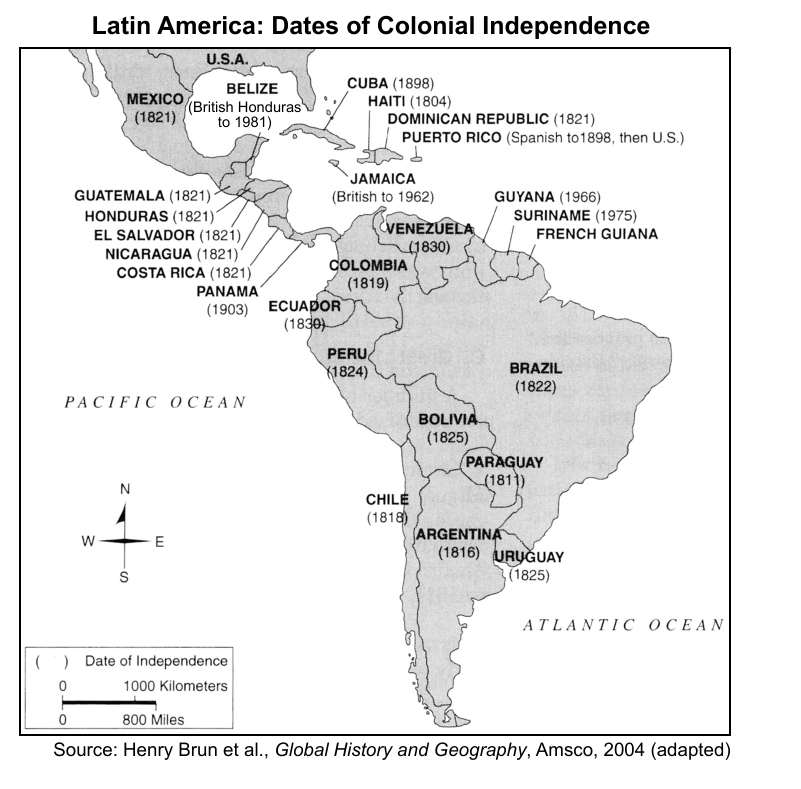
Based on the map of Latin America showing dates of colonial independence, the situation shown on this map was most influenced by the
- (A) French Revolution ✓
- (B) German Unification
- (C) Balfour Declaration
- (D) Treaty of Versailles
Worked solution
Enlightenment and nationalist ideas unleashed by the French Revolution inspired the wave of Latin American independence movements in the early 1800s.
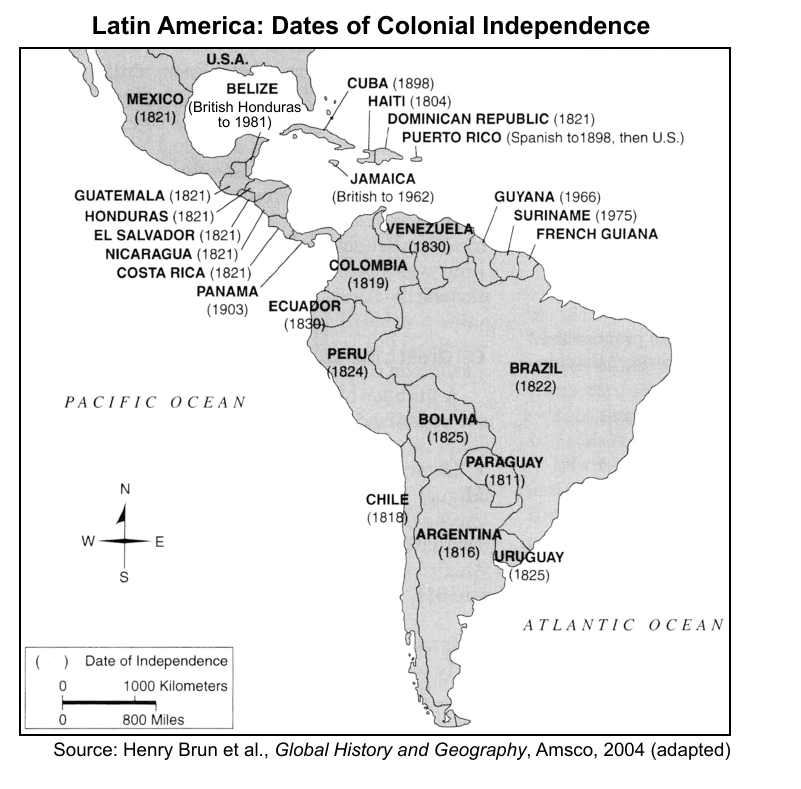
Based on the same map of Latin America showing dates of colonial independence, which claim about Latin America is best supported by the information on this map?
- (A) European countries had control over most of the region until World War I.
- (B) Most independence movements occurred in the 20th century.
- (C) Nationalism became a growing force during the 19th century. ✓
- (D) Most countries gained independence before the Haitian Revolution.
Worked solution
The dates on the map cluster heavily in the early-to-mid 19th century, showing nationalism driving independence movements throughout that century.
Base your answer on the passage: "Agriculture had dominated the British economy for centuries. During the 18th century, after a long period of enclosures, new farming systems created an agricultural revolution that produced larger quantities of crops to feed the increasing population... New tools, fertilizers and harvesting techniques were introduced, resulting in increased productivity and agricultural prosperity... Geographical specialization of products was established, with south-eastern England specializing in grain, for example, and Scotland or Leicestershire in breeding cattle and sheep." (Source: The British Museum online) This passage would be most useful for
- (A) studying how urbanization affected British government policies
- (B) explaining the economic benefits of the Agricultural Revolution in Britain ✓
- (C) analyzing the distribution of natural resources in Britain
- (D) understanding how the Agricultural Revolution led to British imperialism
Worked solution
The passage focuses on increased productivity, prosperity, and specialization resulting from the Agricultural Revolution, making it most useful for explaining its economic benefits.
Base your answer on the same passage about the British Agricultural Revolution, which notes that south-eastern England specialized in grain while Scotland and Leicestershire specialized in raising cattle and sheep. What was one way British farmers responded to the changes described in this passage?
- (A) The enclosure system was eliminated.
- (B) Agricultural productivity in Britain decreased.
- (C) Farmers specialized based on their location. ✓
- (D) Most farmers in the provinces fled to the countryside.
Worked solution
The passage directly states that geographical specialization occurred, with different regions of Britain focusing on different agricultural products.
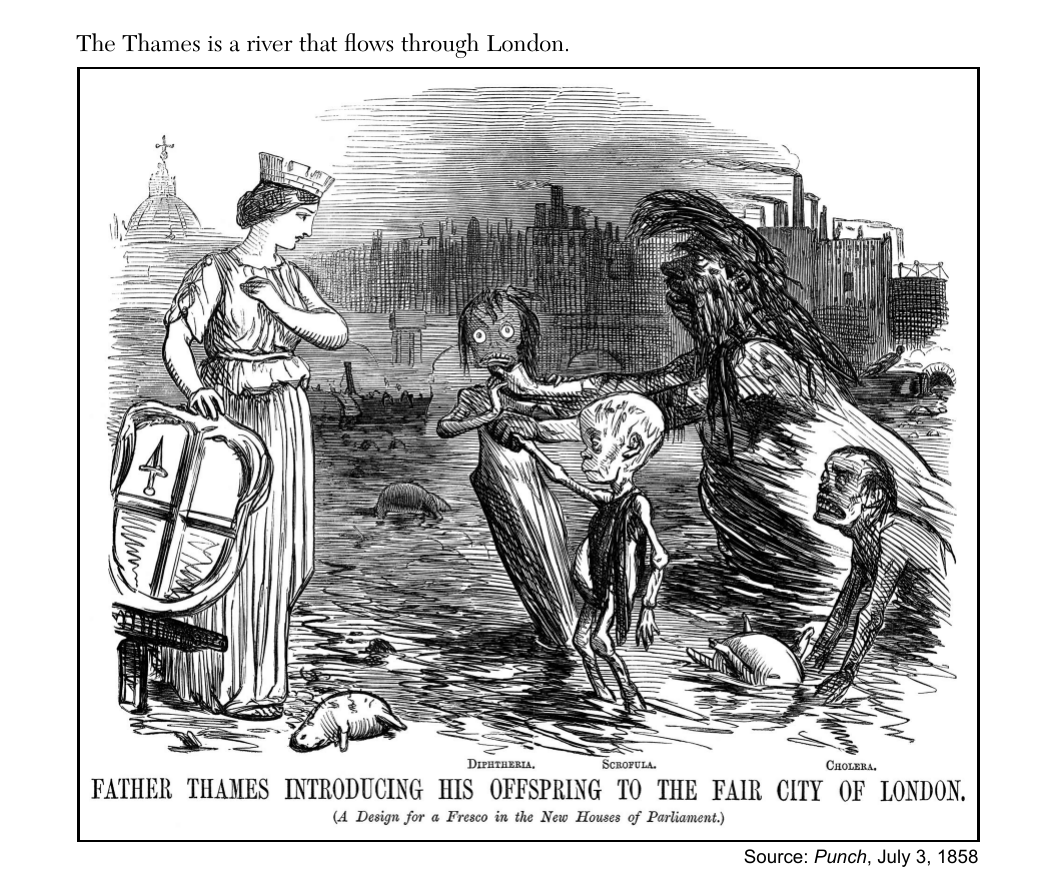
Based on the political cartoon shown, titled "Father Thames Introducing His Offspring to the Fair City of London" (Punch, July 3, 1858), which statement best explains the cartoonist's perspective of conditions in London during this time period?
- (A) Industrialization led to contamination of water supplies and illness. ✓
- (B) The growth of factories contributed to poor working conditions.
- (C) Urbanization caused a scarcity of food and mass starvation.
- (D) The church offered support to those living in urban poverty.
Worked solution
The cartoon personifies diseases emerging from the polluted Thames, reflecting how industrial waste contaminated London's water supply and caused illness.
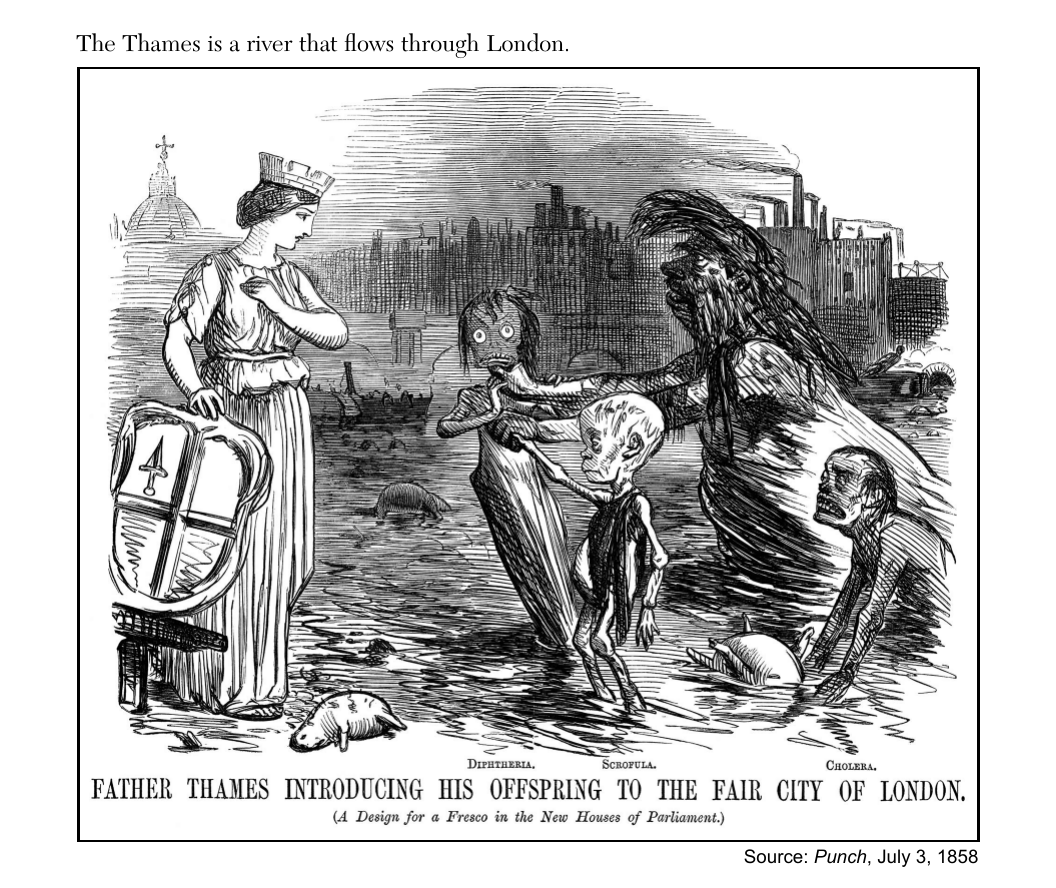
Based on the same political cartoon from Punch (1858) depicting Father Thames and disease-ridden figures rising from the river, what was the cartoonist's purpose in creating this illustration?
- (A) to attract people to settle in London
- (B) to promote Queen Victoria's humanitarian efforts
- (C) to encourage the government to make reforms ✓
- (D) to raise public awareness of the impacts of irrigation
Worked solution
By vividly depicting disease born from the polluted Thames, the cartoonist sought to shame the government into taking action on sanitation reform.
Based on the map shown, titled "Africa and Asia, 1880-1914," which two countries acquired the most foreign territory?
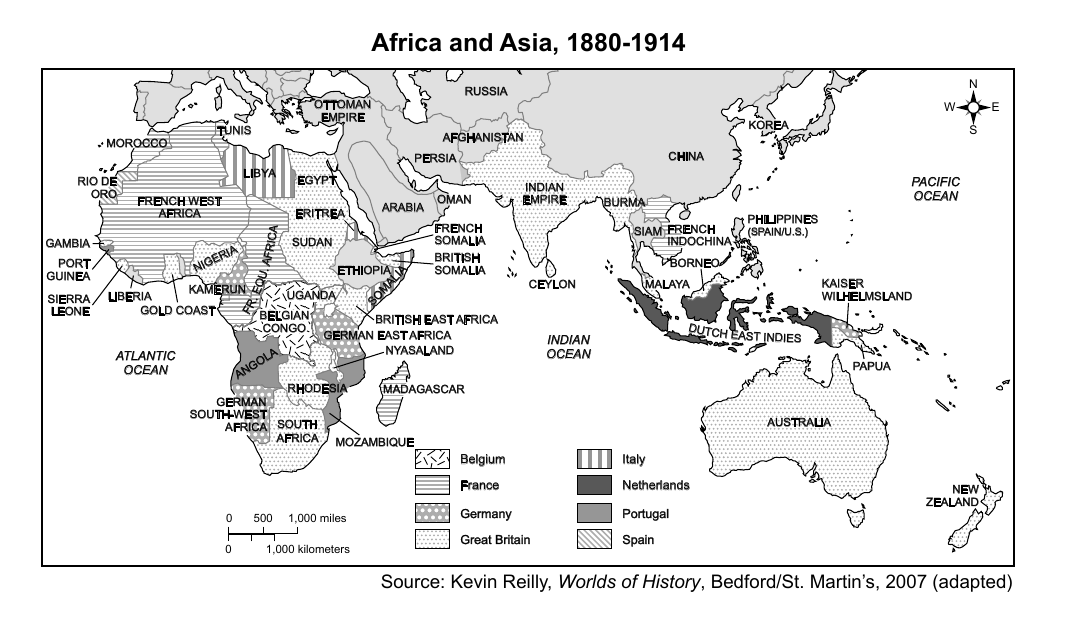
- (A) Great Britain and France ✓
- (B) the Netherlands and Belgium
- (C) Spain and Portugal
- (D) Germany and Italy
Worked solution
During the Age of Imperialism from 1880-1914, Great Britain and France controlled the largest colonial holdings in Africa and Asia, as shown by the extent of their territories on the map.
Based on the same map of Africa and Asia (1880-1914) showing European colonial holdings, the situation shown on this map was caused in part by European nations' desire to
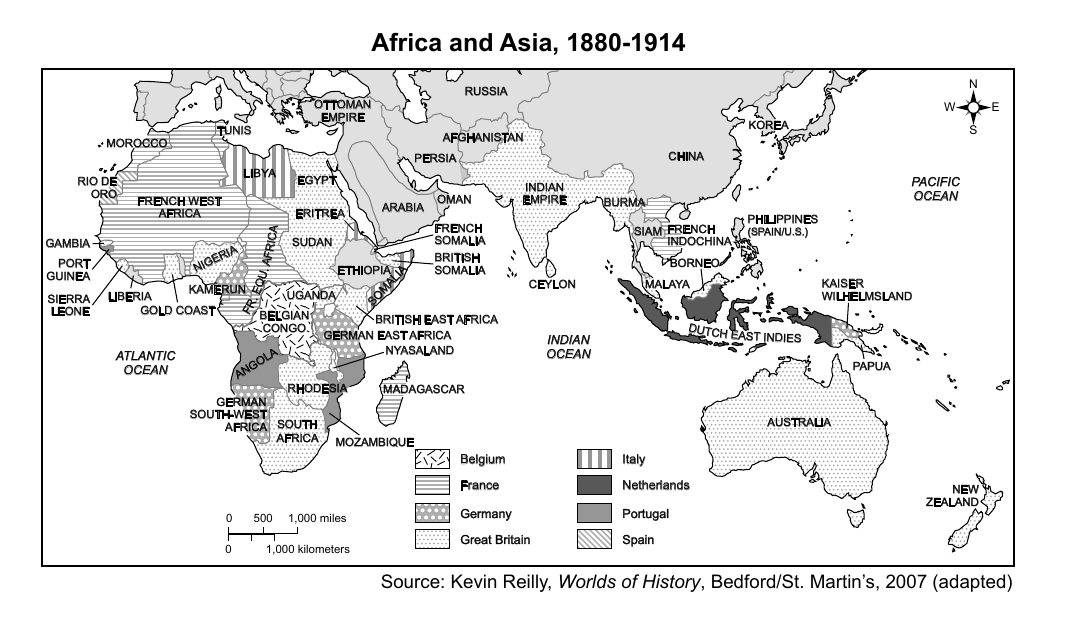
- (A) import factory-made goods
- (B) encourage immigration into their countries
- (C) establish democratic governments worldwide
- (D) obtain raw materials for their industries ✓
Worked solution
A primary motive for the New Imperialism shown on the map was the European industrial economies' need for raw materials to supply their factories.
Based on the illustration shown, titled "The Emergence of Six Independent States" and "Turkish Power" (from Visualized World History), which empire's decline is depicted in this illustration?
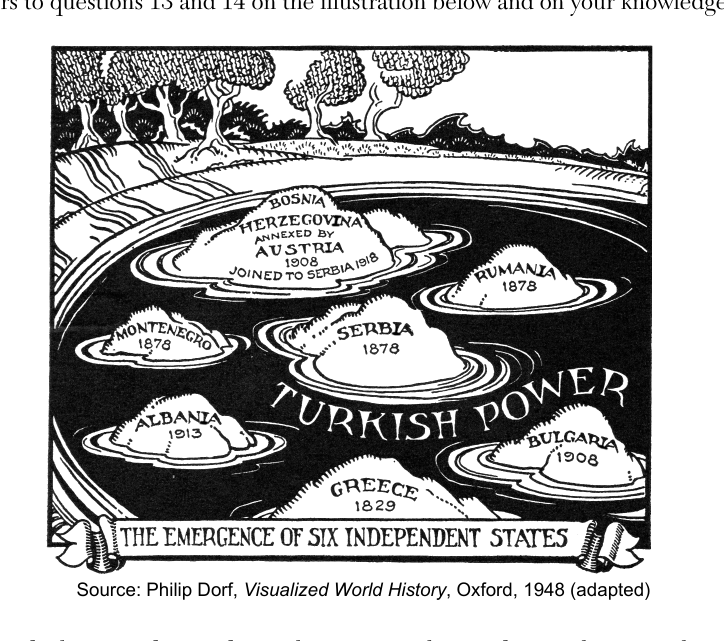
- (A) Mughal Empire
- (B) Ottoman Empire ✓
- (C) Austro-Hungarian Empire
- (D) British Empire
Worked solution
The illustration depicts Balkan nations breaking free from 'Turkish Power,' representing the gradual decline and fragmentation of the Ottoman Empire.
Based on the same illustration showing the emergence of independent Balkan states from declining Ottoman (Turkish) power, the conditions shown in this illustration played a major role in bringing about the
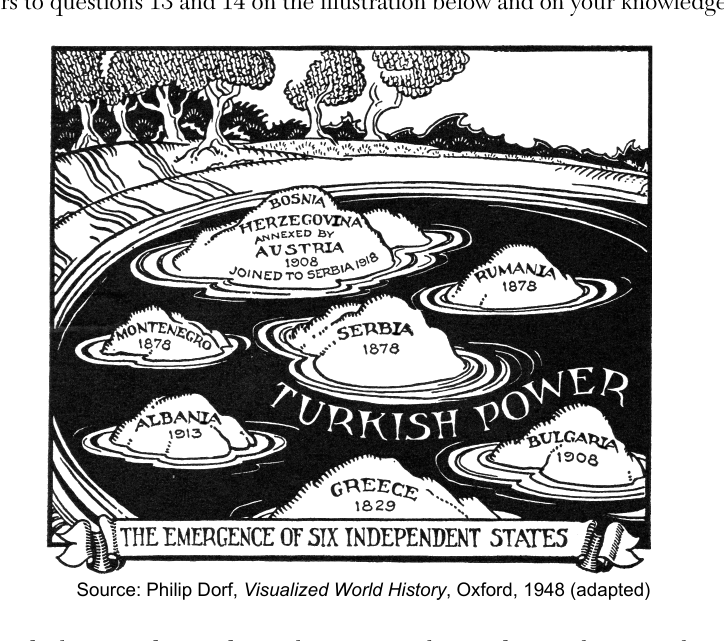
- (A) unification of Italy
- (B) start of World War I ✓
- (C) Potsdam Conference
- (D) signing of the Warsaw Pact
Worked solution
Balkan nationalism and the instability caused by the Ottoman Empire's decline made the region a flashpoint that helped trigger World War I.
Based on the August 18, 1915 New York Times article reporting on the deportation and massacre of Armenians in Turkey, which group faced treatment most similar to the group addressed in this article?
Excerpt from a New York Times article dated August 18, 1915, reporting on events in the Ottoman Empire (Turkey) during World War I. The article states that Armenians were being deported en masse from their homes and sent to perish in the desert, and it accuses Turkish authorities of a deliberate plan to exterminate the Armenian population, describing massacres of Armenian civilians.
- (A) the First Estate in pre-revolutionary France
- (B) the French in Haiti
- (C) Indians under the British Raj
- (D) Jews in Nazi Germany ✓
Worked solution
The Armenian Genocide involved forced deportation and mass killing of an ethnic minority by the ruling government, a pattern most closely paralleled by the Holocaust against Jews in Nazi Germany.
Based on the 1915 New York Times article reporting on the Armenian massacres, a historian would find this article most useful for
Excerpt from a New York Times article dated August 18, 1915, reporting on events in the Ottoman Empire (Turkey) during World War I. The article states that Armenians were being deported en masse from their homes and sent to perish in the desert, and it accuses Turkish authorities of a deliberate plan to exterminate the Armenian population, describing massacres of Armenian civilians.
- (A) identifying the cause of the incident
- (B) researching the geography of Turkey
- (C) supporting the claim that a genocide took place ✓
- (D) determining the number of people affected by the incident
Worked solution
As a primary source documenting deliberate, large-scale persecution of an ethnic group, the article provides evidence historians use to support the claim of genocide.
Based on Ho Chi Minh's February 18, 1930 speech announcing the founding of the Indochinese Communist Party, which claim is best supported by the evidence in this speech?
Excerpt (paraphrased summary) from Ho Chi Minh's February 18, 1930 appeal on the founding of the Indochinese Communist Party: Ho Chi Minh states that the French imperialists have seized Vietnam and Indochina by force. He charges that they have ruthlessly exploited the Vietnamese people, robbed them of their rice fields, mines, forests, and raw materials, imposed heavy and unjust taxes, and used Vietnamese people as cannon fodder in imperialist wars. He famously notes that the French have 'built more prisons than schools' and have kept the people in ignorance and poverty. He declares that the newly founded Communist Party will lead the struggle to overthrow French imperialism and Vietnamese feudalism, to make Indochina completely independent, and to return the land and wealth taken by the French to the Vietnamese people, along with reforms such as an eight-hour working day and abolition of unjust taxes.
- (A) Under French control, the Vietnamese economy had grown.
- (B) The French had established education systems throughout Indochina.
- (C) Ho Chi Minh gained Western support for a democratic republic in Vietnam.
- (D) Ho Chi Minh intended to reclaim what the French had taken from his people. ✓
Worked solution
Ho Chi Minh's slogans explicitly call for overthrowing French imperialism and redistributing confiscated French-held property to the Vietnamese people, showing his intent to reclaim what colonialism had taken.
Based on Ho Chi Minh's 1930 speech founding the Indochinese Communist Party, which statement best describes the author's purpose in delivering this speech?
Same stimulus as the previous question. Excerpt (paraphrased summary) from Ho Chi Minh's February 18, 1930 appeal on the founding of the Indochinese Communist Party: Ho Chi Minh condemns French imperialist exploitation of Vietnam (seizure of land and resources, heavy taxes, use of Vietnamese as cannon fodder, 'more prisons than schools') and announces that the new Communist Party will lead workers, peasants, soldiers, and students in a struggle to overthrow French imperialism, win complete independence for Indochina, and return land and wealth to the Vietnamese people.
- (A) to explain why he is supporting the Communist Revolution in Russia
- (B) to ask the French for independence
- (C) to explain the goals of a Vietnamese nationalist movement ✓
- (D) to ask for international support for his revolution
Worked solution
The speech is directed at Vietnamese workers and peasants and lays out the party's program for independence and social change, making its purpose to explain the goals of a Vietnamese nationalist movement.
Based on the passage from John Hersey's Hiroshima describing individuals' experiences during the atomic bomb blast, how could a historian best use this passage?
Description of the stimulus, an excerpt from John Hersey's Hiroshima (1946): The passage follows several ordinary residents of Hiroshima, among them a personnel clerk, a doctor, a pastor, and a widowed seamstress, at the exact moment the atomic bomb exploded on the morning of August 6, 1945. Each was going about routine daily activities: sitting down at an office desk, reading a newspaper on a porch, unloading a cart of belongings, watching a neighbor tear down a house. A sudden noiseless flash of light cut across the sky, buildings collapsed around them, and each survivor's ordinary morning was instantly transformed. The account focuses entirely on the personal experiences and suffering of these civilians, not on military decisions or government policy.
- (A) to understand how the atomic bomb affected civilians ✓
- (B) to investigate why the military dropped the atomic bomb
- (C) to illustrate how the war effort was affected by the atomic bomb
- (D) to show how the atomic bomb changed government policy
Worked solution
Hersey's account focuses on the immediate physical and emotional experience of civilians, making it a valuable primary source for understanding the bomb's impact on ordinary people.
Based on the passage from John Hersey's Hiroshima describing the atomic bomb explosion, the events described in the passage led to the
Same stimulus as the previous question. Description of the excerpt from John Hersey's Hiroshima (1946): The passage describes the moment the atomic bomb exploded over Hiroshima, Japan on August 6, 1945, through the eyes of several ordinary civilians. A noiseless flash of light filled the sky, buildings collapsed, and the survivors found their city and their lives instantly devastated.
- (A) creation of spheres of influence in China
- (B) D-Day invasion of Normandy
- (C) Japanese surrender in World War II ✓
- (D) collapse of the Soviet Union
Worked solution
The devastating atomic bombing depicted in the passage was the decisive event that forced Japan to surrender, ending World War II in the Pacific.
Based on the article describing the 1979 Soviet invasion of Afghanistan and the rise of the mujahedeen and Taliban, what claim is best supported by the evidence included in this article?
Description of the stimulus, a New York Times Upfront article (2017) on the Soviet invasion of Afghanistan: The article explains that in December 1979 the Soviet Union invaded Afghanistan to prop up a struggling pro-communist government. Afghan guerrilla fighters known as the mujahedeen waged a fierce resistance against the Soviet occupation. The United States, seeing the conflict as part of the Cold War, secretly supplied billions of dollars in weapons and aid to the mujahedeen through the 1980s. After about a decade of costly fighting, Soviet forces withdrew in 1989. The article notes that in the chaos and civil war that followed the Soviet withdrawal, an extremist movement called the Taliban rose to power in the 1990s, imposing harsh rule and later sheltering terrorist groups.
- (A) The United States attempted to eliminate the mujahedeen in the 1980s.
- (B) The invasion of Afghanistan secured Soviet influence in the region.
- (C) The mujahedeen supported the pro-communist government in Afghanistan.
- (D) Cold War conflicts in Afghanistan contributed to the rise of the Taliban. ✓
Worked solution
The article traces a chain of events from the Cold War era Soviet invasion and U.S.-backed mujahedeen resistance to the eventual rise of the Taliban, showing these Cold War conflicts contributed to Taliban control.
Based on the article describing the Soviet invasion of Afghanistan, the American actions described in this article are an example of which policy?
Same stimulus as the previous question. Description of the New York Times Upfront article (2017): After the Soviet Union invaded Afghanistan in 1979 to support a pro-communist government, the United States secretly funded and armed the mujahedeen resistance fighters throughout the 1980s in order to oppose the spread of Soviet influence. Soviet forces withdrew in 1989, and the Taliban later rose to power amid the resulting civil war.
- (A) perestroika
- (B) containment ✓
- (C) globalization
- (D) collectivization
Worked solution
Arming anti-Soviet rebels to prevent the expansion of Soviet communist influence is a direct application of the U.S. Cold War containment policy.
Based on Mikhail Gorbachev's December 25, 1991 resignation speech describing free elections, freedom of the press, and a multiparty system, the policies described by Mikhail Gorbachev in this speech refer to
Excerpt (paraphrased summary) from Mikhail Gorbachev's resignation speech, December 25, 1991: Gorbachev declares that the totalitarian system that had deprived the country of prosperity and freedom has been eliminated. He points to the breakthroughs achieved under his reforms: society has gained freedom and been freed politically and spiritually; free elections have been held; freedom of the press and religious freedoms have been established; representative legislatures and a multiparty system have become a reality; and human rights are recognized as the supreme principle. He also notes that movement toward a market economy has begun.
- (A) nuclear proliferation
- (B) glasnost ✓
- (C) detente
- (D) nonalignment
Worked solution
Gorbachev's description of a free press, free elections, and multiparty politics reflects his policy of glasnost, which opened Soviet society to greater political and informational freedom.
Based on Gorbachev's December 25, 1991 resignation speech announcing the end of the totalitarian system and Soviet reforms, this speech is most closely associated with the end of which international conflict?
Same stimulus as the previous question. Excerpt (paraphrased summary) from Mikhail Gorbachev's resignation speech, December 25, 1991: Gorbachev, resigning as president of the Soviet Union, states that the totalitarian system has been eliminated and lists his reforms: free elections, freedom of the press, a multiparty system, recognition of human rights, and movement toward a market economy. He also cites the end of the arms race and of confrontation with the West. Days later, the Soviet Union formally ceased to exist.
- (A) the Vietnam War
- (B) the Korean War
- (C) the Cold War ✓
- (D) the Persian Gulf War
Worked solution
Gorbachev's resignation speech, delivered as the Soviet Union dissolved, marks the symbolic end of the Cold War between the United States and the Soviet bloc.
Based on the infographic titled "Got Water?" showing global freshwater resources and shortage areas, which region is experiencing the greatest freshwater shortage?
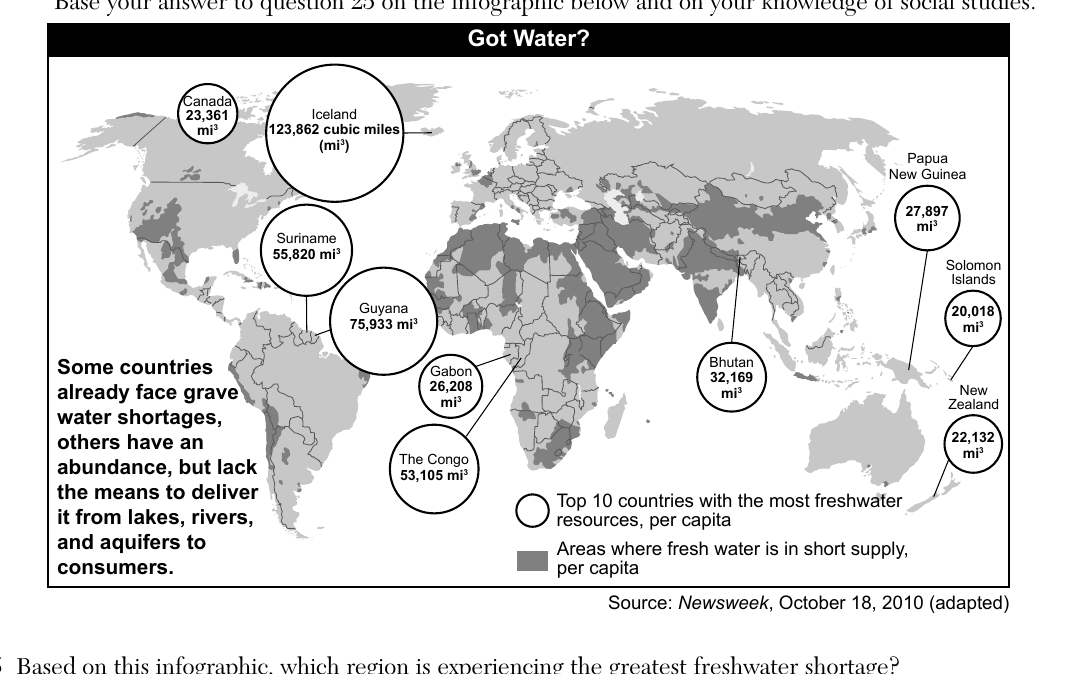
- (A) Eastern Europe
- (B) Southwest Asia ✓
- (C) South America
- (D) Australia
Worked solution
The map shading on the infographic identifies Southwest Asia as one of the most water-stressed regions, consistent with its arid climate and limited freshwater resources.
Based on the timeline of key moments in United Nations history shown (including the Universal Declaration of Human Rights, peacekeeping deployment, World Food Program, UNICEF, the Kyoto Protocol, and health missions), this timeline would be most useful to a person attempting to prove
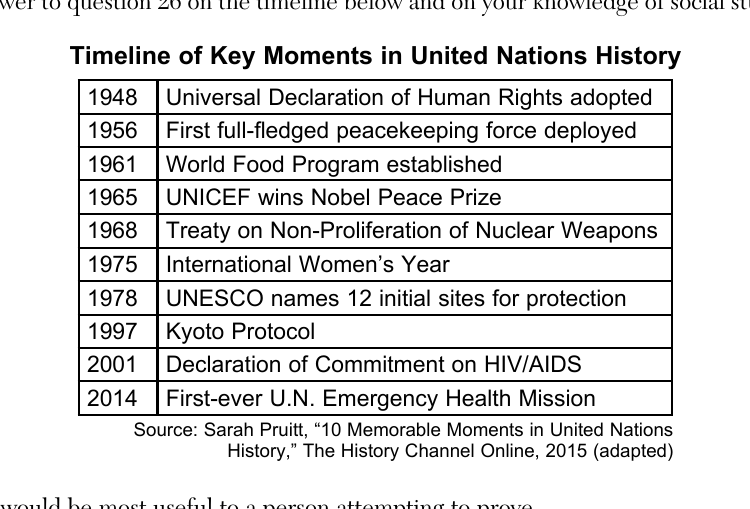
- (A) how effective the work of the United Nations has been in addressing epidemic disease outbreaks over time
- (B) the degree to which the United Nations has been able to promote women's rights in developing regions
- (C) the extent to which environmental policy has been supported by member states of the United Nations
- (D) the range of United Nations efforts maintaining peace and providing humanitarian aid ✓
Worked solution
The timeline spans many different types of UN initiatives (peacekeeping, food aid, health, human rights, environment), making it best suited to demonstrate the broad range of UN humanitarian and peacekeeping efforts rather than proving effectiveness in one narrow area.
Based on the 2018 New York Times article describing President Erdogan's desire to recast Turkey in his own image, in contrast to the secular nationalist legacy of Ataturk, what is the central issue described in this article?
Description of the stimulus, a 2018 New York Times article on Turkey: The article describes President Recep Tayyip Erdogan's effort to recast Turkey in his own image. For nearly a century, Turkey had followed the secular, Western-oriented path set by its founder, Mustafa Kemal Ataturk, who separated religion from public life. Erdogan, by contrast, has promoted a more religious and conservative vision of Turkish society, expanding religious education, elevating Islamic values in public life, and challenging the secular elite. The article portrays a nation divided between Ataturk's secular nationalist legacy and Erdogan's religious conservative vision, a struggle over what kind of country Turkey should be.
- (A) conflict over Turkey's cultural identity ✓
- (B) fighting between Kemal Ataturk and Turkey's President Erdogan
- (C) passing aggressive reforms to restore Turkey's democratic institutions
- (D) crackdown on protests by Turkish troops
Worked solution
The article centers on the clash between Ataturk's secular vision for Turkey and Erdogan's Islamist reshaping of society, representing a struggle over Turkey's cultural identity.
Based on the article describing President Erdogan's efforts to make Turkish society more religious and less secular, which event led to changes similar to those described in this article?
Same stimulus as the previous question. Description of the 2018 New York Times article on Turkey: President Erdogan has worked to move Turkish society away from the secular legacy of Ataturk and toward a more religious, conservative identity, expanding the role of Islam in education and public life.
- (A) the seizing of the Suez Canal by Gamal Nasser
- (B) the Islamic Revolution of 1979 in Iran ✓
- (C) the collapse of the Austrian Empire
- (D) the partition of India in 1948
Worked solution
Like Erdogan's push toward a more religious Turkish society, the 1979 Iranian Revolution replaced a secular government with an Islamist one, making it the most similar precedent.