June 2024 Global History Regents — Answer Key & Worked Solutions
Every question from the June 2024 Global History Regents exam, with the correct answer and a full step-by-step solution. Check your work, learn the method, then see how it's scored.
These are real questions from the June 2024 Global History New York State Regents examination, published by NYSED. Worked solutions are written by RegentsLab.
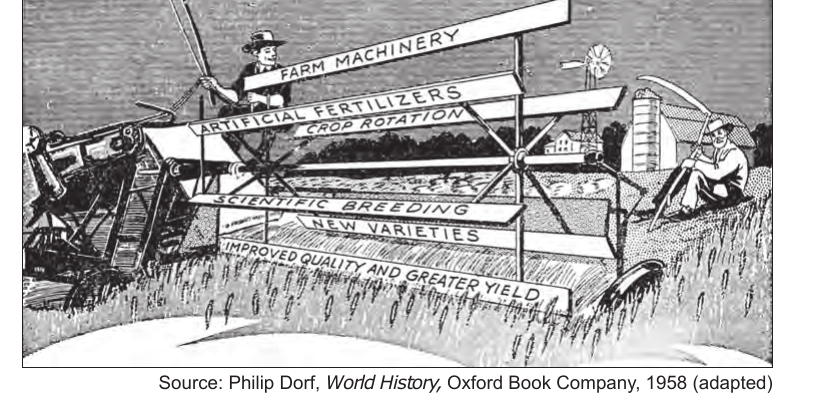
Based on the illustration shown, titled "The Agricultural Revolution" and depicting farm machinery, artificial fertilizers, crop rotation, scientific breeding, and new varieties leading to improved quality and greater yield, this illustration can best be used to
- (A) describe factors that hindered British industrialization
- (B) illustrate advances in agriculture ✓
- (C) explain the decline of Enclosure Movements
- (D) depict daily life of British urban workers
Worked solution
The illustration lists specific innovations (machinery, fertilizers, crop rotation, scientific breeding) that collectively describe advances made during the Agricultural Revolution.
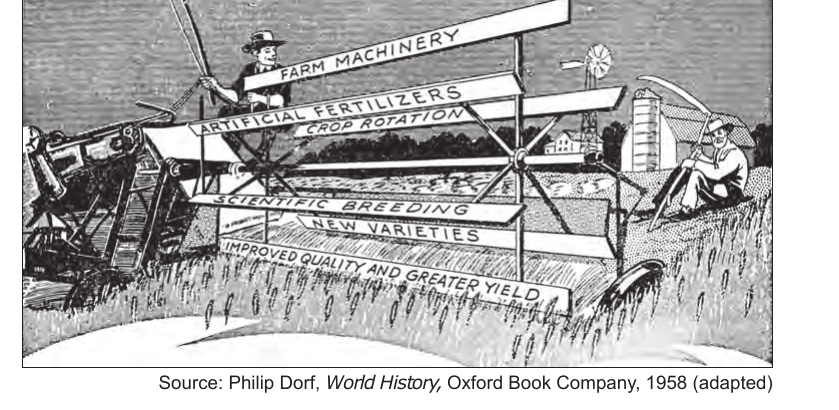
Based on the illustration shown, titled "The Agricultural Revolution" and depicting farm machinery, artificial fertilizers, crop rotation, scientific breeding, and new varieties leading to improved quality and greater yield, which claim is best supported by this illustration?
- (A) New technologies reduced the impact of farming on the environment.
- (B) Innovations in farming contributed to a drop in population.
- (C) Improved equipment decreased the amount of human labor of farmers. ✓
- (D) Changes in farming prevented the growth of large scale farms.
Worked solution
New farm machinery mechanized tasks previously done by hand, reducing the amount of human labor required on farms.
Base your answer on the following passage: ". . . The serf question is commonly seen as the acid test of Catherine's sincerity...She voiced her beliefs clearly and often, publicly and privately...On the other hand, when it came to putting her wishes into action, Catherine was faced with the almost unanimous disapproval of the nobility...Trapped in a historical process that was none of her making and which she could not control, Catherine was compelled to yield against her private judgment. Hence the paradox, that under the most enlightened Russian ruler of the century, the condition of the serfs underwent so marked and rapid a deterioration." (Source: A. Lentin, "Catherine the Great and Enlightened Despotism," History Today, March 1971). Based on this passage, what issue was debated but not changed during the reign of Catherine the Great?
- (A) abolishing noble titles
- (B) emancipating the serfs ✓
- (C) withholding pay from the nobility
- (D) increasing royal authority
Worked solution
Catherine the Great considered freeing the serfs but nobility opposition prevented any actual change, leaving serfdom intact and even worsened.
Base your answer on the same passage about Catherine the Great from A. Lentin, "Catherine the Great and Enlightened Despotism," History Today, March 1971. Which claim is best supported by this passage?
- (A) Political and social changes can be difficult to bring about. ✓
- (B) Monarchs rule with unquestioned authority.
- (C) Nobility rarely have an impact on royal decisions.
- (D) Inequality was not a concern of monarchs.
Worked solution
Despite Catherine's personal convictions and authority, entrenched noble opposition prevented reform, illustrating how difficult political and social change can be.
Base your answer on the passage below and on your knowledge of social studies: ". . . The Communists disdain to conceal their views and aims. They openly declare that their ends can be attained only by the forcible overthrow of all existing social conditions. Let the ruling classes tremble at a Communistic revolution. The proletarians have nothing to lose but their chains. They have a world to win. . . ." (Source: Karl Marx and Friedrich Engels, Manifesto of the Communist Party, 1848). What conditions inspired the writing of this passage?
- (A) economic inequality in industrial cities ✓
- (B) government reforms to protect worker's rights
- (C) rise of powerful labor unions
- (D) decline of urban populations
Worked solution
The Communist Manifesto emerged from the stark economic inequality and exploitation of industrial workers during the Industrial Revolution.
Base your answer on the same passage from Karl Marx and Friedrich Engels, Manifesto of the Communist Party, 1848. Which leader agreed with the philosophy in this passage?
- (A) Fidel Castro ✓
- (B) Augusto Pinochet
- (C) Jiang Jieshi [Chiang Kai-shek]
- (D) Maximilien Robespierre
Worked solution
Fidel Castro established a communist government in Cuba, directly aligning with the revolutionary communist philosophy of Marx and Engels.
Base your answer on the statement below and on your knowledge of social studies: ". . . Prussia's borders according to the Vienna Treaties [of 1814-15] are not favorable for a healthy, vital state; it is not by speeches and majority resolutions that the great questions of the time are decided, that was the big mistake of 1848 and 1849, but by iron and blood. . . ." (Source: Speech by Otto von Bismarck, 1862). This statement is most closely associated with which event?
- (A) Industrial Revolution
- (B) German Unification ✓
- (C) Berlin Conference
- (D) Ukrainian Holodomor
Worked solution
Bismarck's 'blood and iron' speech expressed his strategy of using military force, not diplomacy, to unify the German states under Prussian leadership.
Base your answer on the same statement by Otto von Bismarck, 1862. The opinion expressed in this statement was most likely influenced by
- (A) fascist goals
- (B) containment concerns
- (C) nationalistic feelings ✓
- (D) appeasement policies
Worked solution
Bismarck's willingness to use military force to unify German territories reflects the nationalist movement sweeping 19th-century Europe.
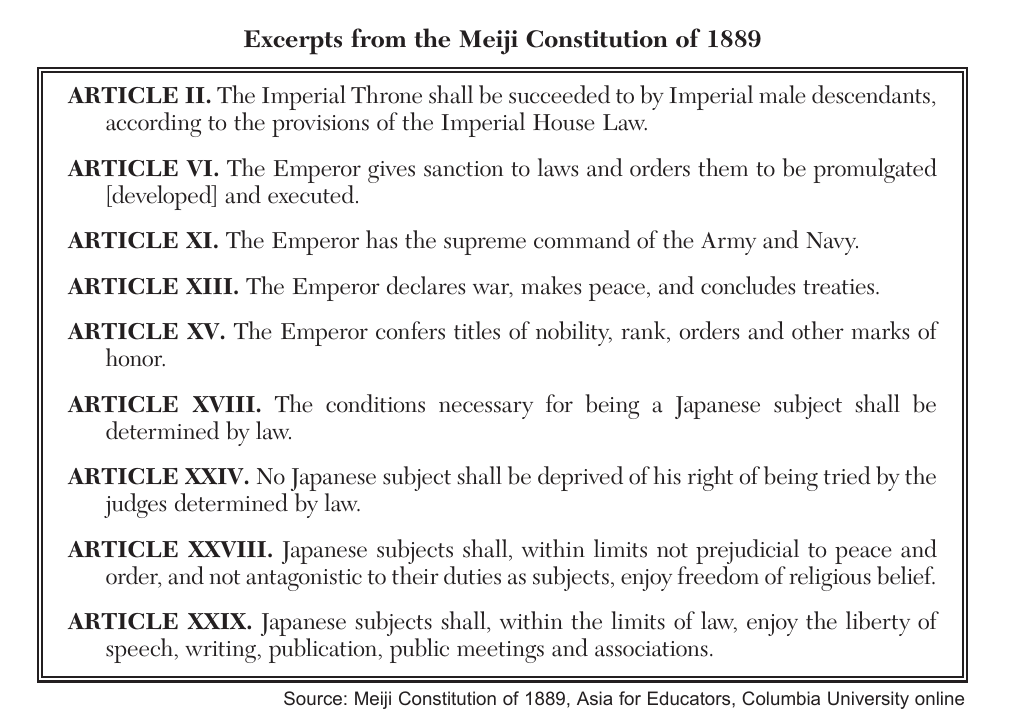
Based on the document shown, excerpts from the Meiji Constitution of 1889 (Articles II, VI, XI, XIII, XV, XVIII, XXIV, XXVIII, XXIX describing the Emperor's powers over succession, law, military, war and peace, titles, and limited subject rights to trial, religion, speech, and assembly), which statement about Japan is best supported by this document?
- (A) The people of Japan enjoyed great freedom while the power of the Emperor was quite limited.
- (B) The Japanese people could remove the Emperor if their rights were not protected.
- (C) The Emperor of Japan was required to seek counsel of the people before declaring war.
- (D) The rights of the Japanese people were protected under law but the Emperor held supreme authority. ✓
Worked solution
The Meiji Constitution granted subjects limited legal rights while reserving ultimate governmental and military authority for the Emperor.
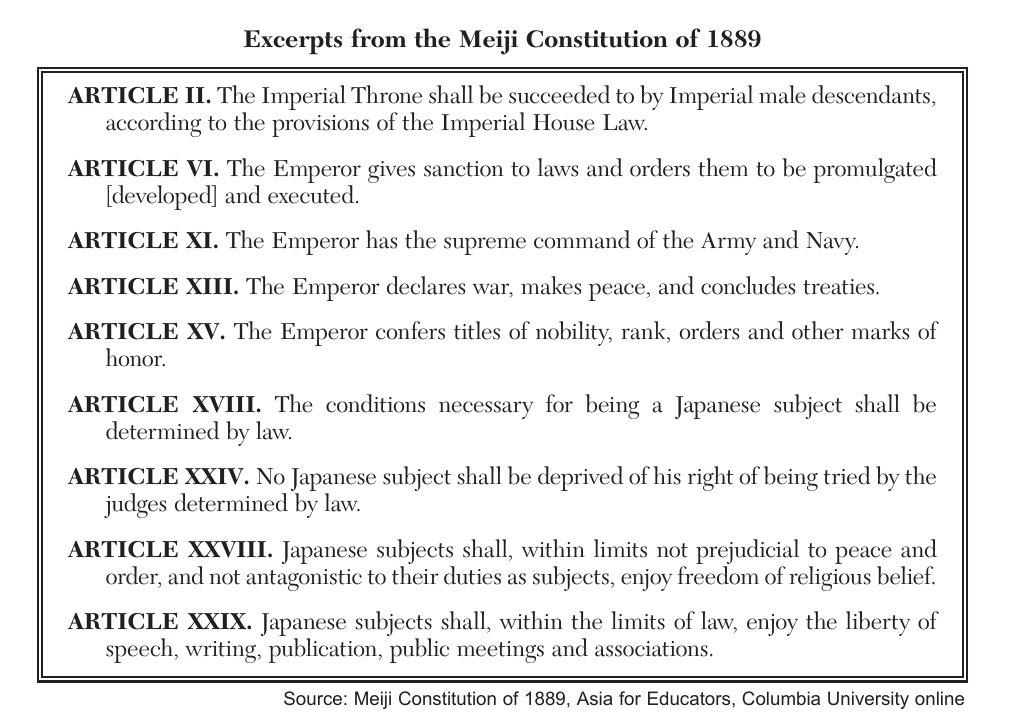
Based on the same document, excerpts from the Meiji Constitution of 1889 (p.5), what was a goal of Japan in the 19th century that most influenced the writing of this document?
- (A) expanding its trade networks by water from Asia to the Western Hemisphere
- (B) matching the technological and industrial advancements of the Western nations ✓
- (C) gaining worldwide recognition for its large empire
- (D) decreasing its cultural and economic ties throughout Asia
Worked solution
The Meiji Constitution was part of Japan's broader effort to modernize its government and society to rival Western industrial powers.
Base your answer on the passage below and on your knowledge of social studies: "XIII . . . An independent Polish state should be erected which should include the territories inhabited by indisputably Polish populations, which should be assured a free and secure access to the sea, and whose political and economic independence and territorial integrity should be guaranteed by international covenant [agreement]. XIV. A general association of nations must be formed under specific covenants for the purpose of affording mutual guarantees of political independence and territorial integrity to great and small states alike. . . ." (Source: President Woodrow Wilson's Fourteen Points, 1918). Which concept is best supported by the information in Article XIII?
- (A) religious tolerance
- (B) social contract
- (C) self-determination ✓
- (D) appeasement
Worked solution
Wilson's call for an independent Poland based on ethnic Polish populations reflects the principle of self-determination central to his Fourteen Points.
Base your answer on the same passage from President Woodrow Wilson's Fourteen Points, 1918. Which organization was formed in response to the concerns addressed in Article XIV?
- (A) European Union (EU)
- (B) League of Nations ✓
- (C) Warsaw Pact
- (D) World Trade Organization (WTO)
Worked solution
Wilson's Fourteen Points directly proposed the creation of a general association of nations, which became the League of Nations.
Base your answer on the passage below and on your knowledge of social studies: "My citizens, We have accomplished many and great tasks in a short time. The greatest of these is the Turkish Republic, the basis of which is the Turkish heroism and the great Turkish culture...We shall raise our country to the level of the most prosperous and civilized nations of the world. We shall endow our nation with the broadest means and sources of welfare. We shall raise our national culture above the contemporary level of civilization. . . ." (Source: Speech by Mustafa Kemal Ataturk, 1933). Which claim is being made by this passage?
- (A) Islamic law is the foundation of Turkish society.
- (B) The Turkish nation needs to remain isolated to survive.
- (C) Turkey has the potential to become a world leader. ✓
- (D) A policy of imperialism is essential if Turkey is to grow.
Worked solution
Ataturk expressed his vision of Turkey rising to a top position among prosperous, civilized nations, showing his belief in Turkey's potential as a leader.
Base your answer on the same passage, a speech by Mustafa Kemal Ataturk, 1933. Which concept is most closely associated with the ideas expressed in this passage?
- (A) westernization ✓
- (B) theocracy
- (C) socialism
- (D) nonalignment
Worked solution
Ataturk's reforms aimed to modernize and secularize Turkey along Western lines, a policy known as westernization.
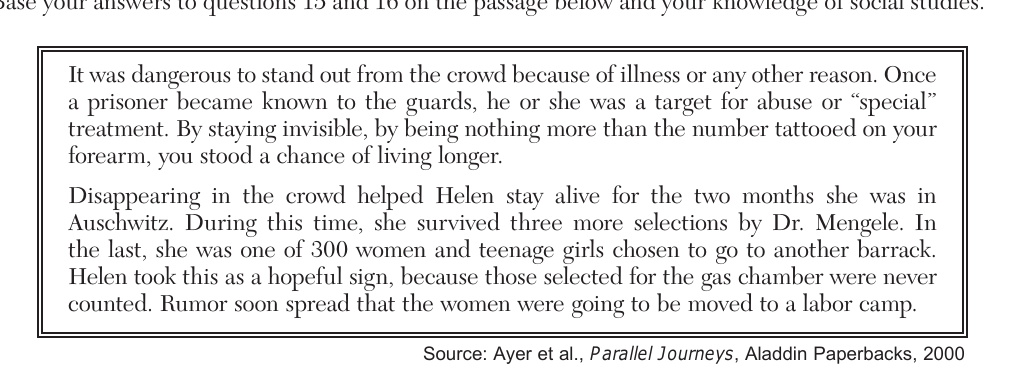
Based on the passage shown, in which an Auschwitz survivor describes staying invisible from guards and surviving selections by Dr. Mengele, the human rights violations discussed in the passage occurred during the
- (A) Holocaust ✓
- (B) Armenian Genocide
- (C) Rwandan Genocide
- (D) Amritsar Massacre
Worked solution
The details of Auschwitz, prisoner tattoos, Dr. Mengele, and gas chamber selections are unique markers of the Nazi Holocaust against European Jews.
Based on the passage shown, which course of action was taken in response to the atrocities described in the passage?
- (A) issuance of the Potsdam Declaration
- (B) creation of the policy of containment
- (C) holding of criminal trials at Nuremberg ✓
- (D) signing of the Treaty of Versailles
Worked solution
The international community responded to the Holocaust's atrocities by prosecuting Nazi leaders in the Nuremberg war crimes trials.
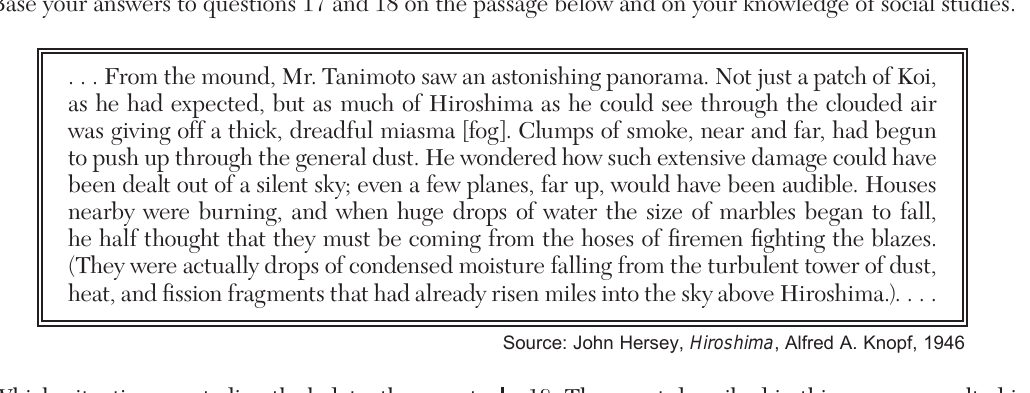
Based on the passage shown, an eyewitness account describing Mr. Tanimoto viewing the devastation of Hiroshima with smoke, dust, and falling drops of condensed moisture from the mushroom cloud, which situation most directly led to the event described in this passage?
- (A) German rejection of the Treaty of Versailles
- (B) Japanese aggression in the Pacific ✓
- (C) Russian demands that the Allies establish a second front
- (D) evacuation of Nationalist Chinese forces to Taiwan
Worked solution
The atomic bombing of Hiroshima was the direct result of the ongoing Pacific War caused by Japanese military aggression.
Based on the passage shown, the event described in this passage resulted in
- (A) the expansion of World War II into Asia
- (B) Hiroshima's emergence as an important center for trade
- (C) an international agreement banning chemical weapons
- (D) the development of a new type of arms race ✓
Worked solution
The atomic bombing of Hiroshima marked the start of the nuclear era, leading directly to the nuclear arms race of the Cold War.
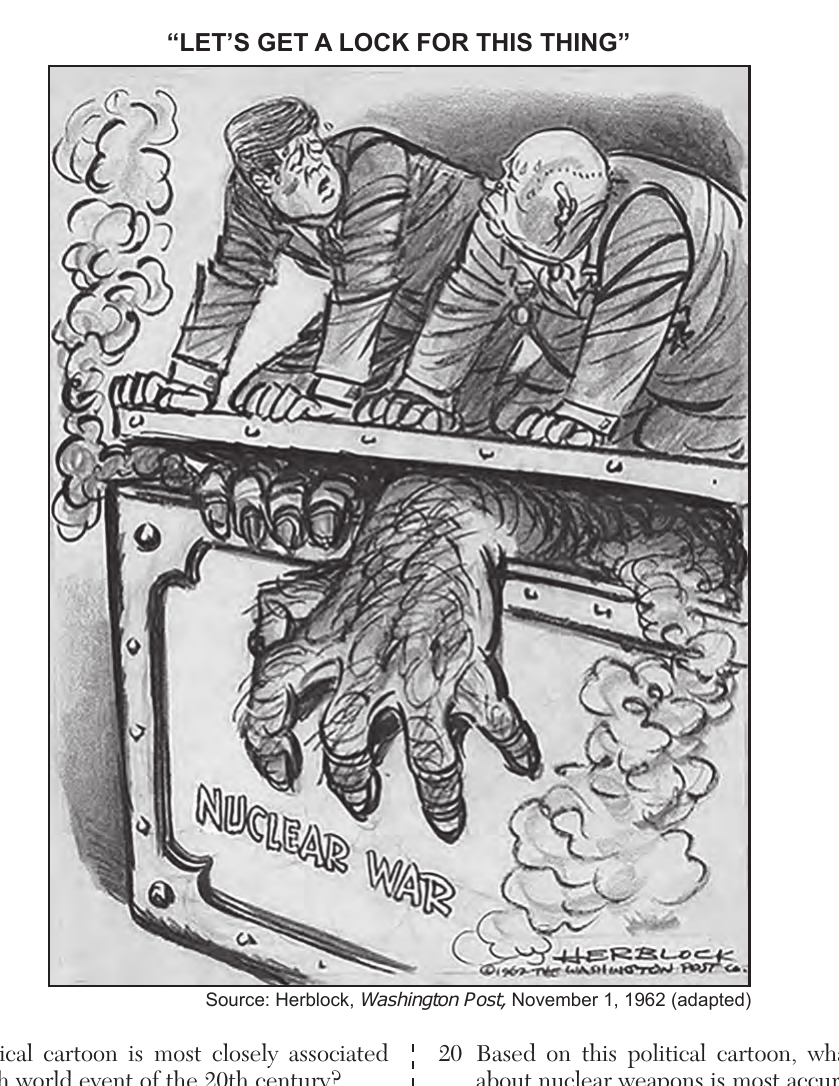
Based on the political cartoon shown, titled 'Let's Get a Lock for This Thing,' depicting two world leaders trying to seal a chest labeled 'Nuclear War,' this political cartoon is most closely associated with which world event of the 20th century?
- (A) the Korean War
- (B) the Cuban missile crisis ✓
- (C) the Soviet invasion of Afghanistan
- (D) the nuclear meltdown at Chernobyl
Worked solution
The cartoon's 1962 date and imagery of leaders desperately trying to contain nuclear war directly reference the Cuban Missile Crisis.
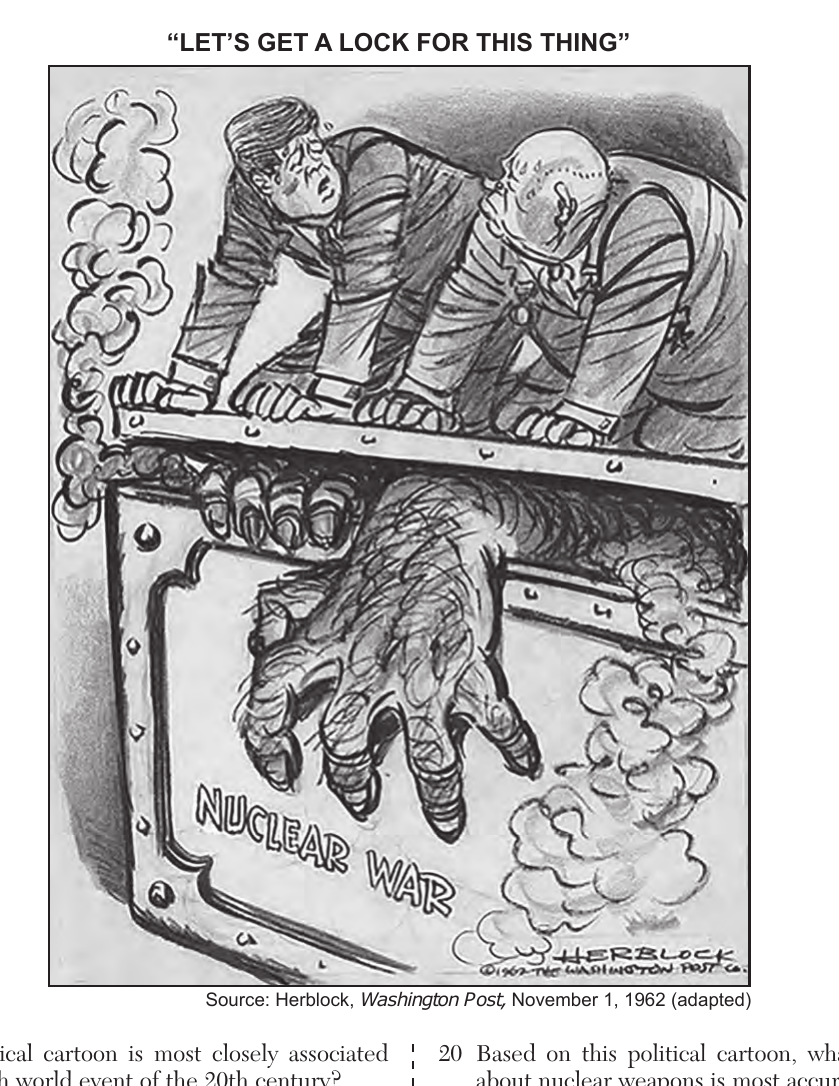
Based on the political cartoon shown, what statement about nuclear weapons is most accurate?
- (A) Nuclear weapons were largely ignored by countries' leaders in favor of conventional weapons.
- (B) Leaders of the world encouraged the use of nuclear weapons to solve conflict.
- (C) The dangers of nuclear weapons greatly concerned world leaders. ✓
- (D) The failure of nuclear weapons disappointed the leaders of many countries.
Worked solution
The straining, worried postures of the leaders in the cartoon convey genuine alarm over the threat of nuclear weapons.
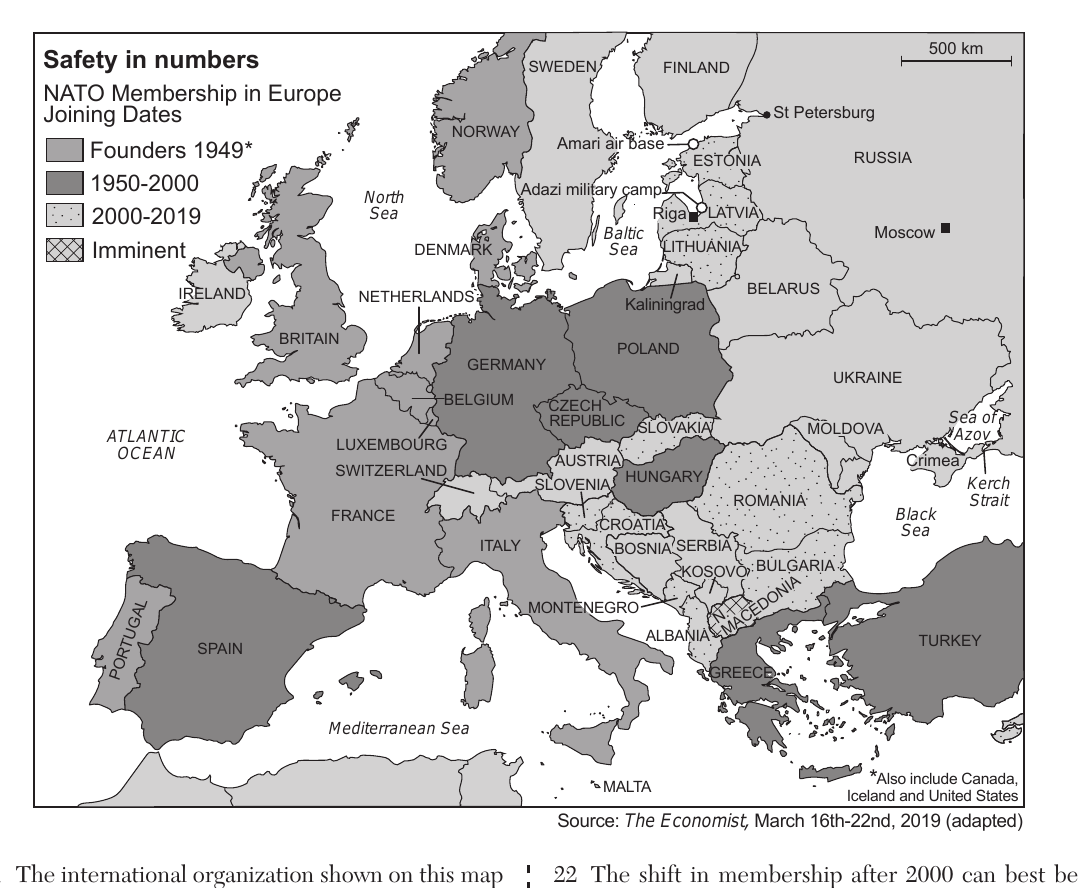
Based on the map shown, illustrating NATO membership in Europe by joining date, the international organization shown was originally established to improve its
- (A) defensive capabilities during the Cold War ✓
- (B) participation in the economic benefits of globalization
- (C) ability to counter the harmful effects of pollution and climate change
- (D) access to development loans by the International Monetary Fund
Worked solution
NATO was created as a mutual defense pact among Western nations to counter Soviet military threats during the Cold War.
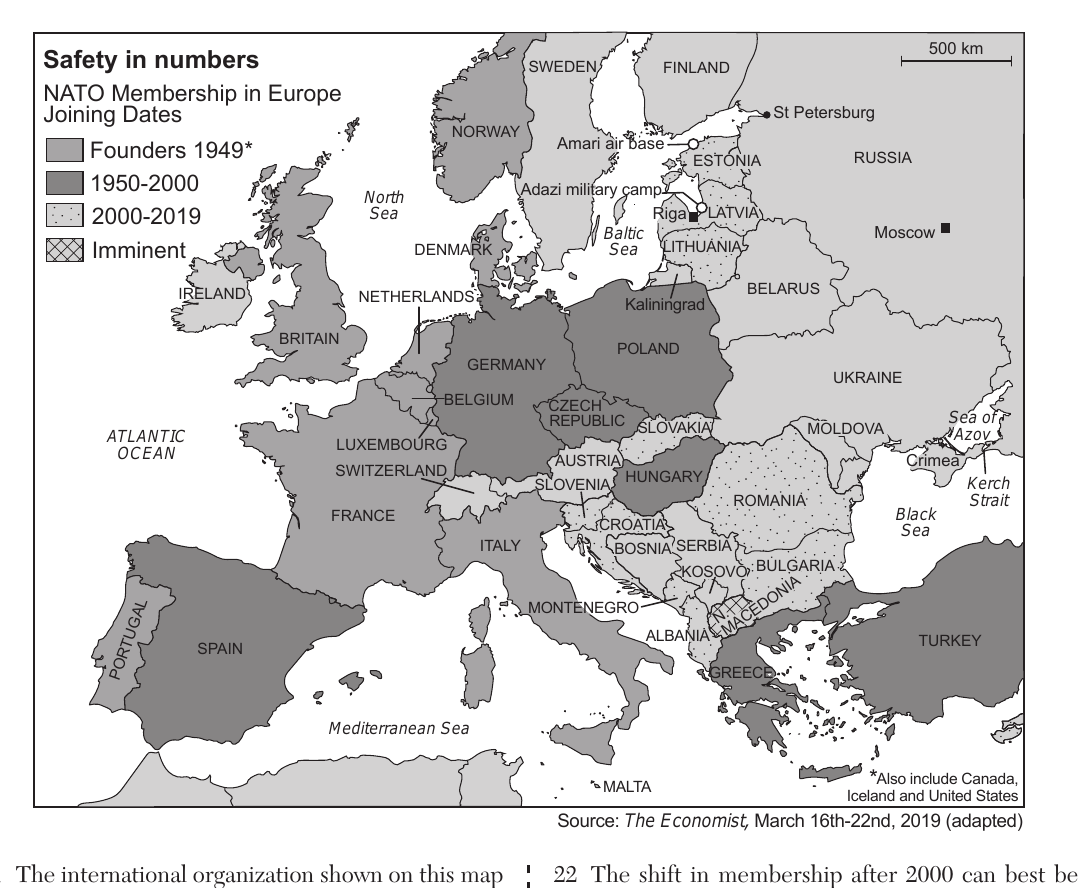
Based on the map shown, the shift in NATO membership after 2000 can best be explained as a response to the
- (A) construction of the Berlin Wall
- (B) formation of the United Nations
- (C) independence movements in Africa
- (D) collapse of the Soviet Union ✓
Worked solution
The wave of new NATO members after 2000 consists largely of former Soviet-bloc states seeking security following the USSR's collapse.
Based on the photograph shown, taken in Chile in 1988, of women holding pictures of missing relatives with signs reading '¿Dónde Están?' ('Where are they?'), this photograph shows women demanding information about their relatives who disappeared
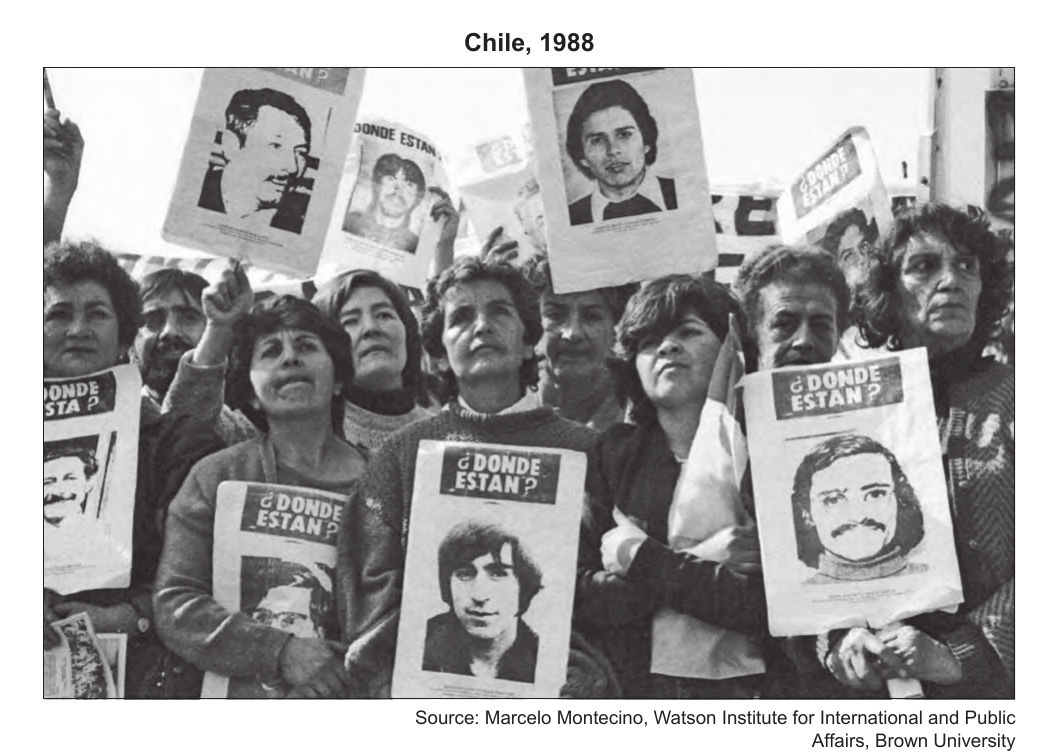
- (A) following a severe earthquake
- (B) while fighting in a war with Chile's neighbors
- (C) after a mass migration
- (D) during a time of political repression ✓
Worked solution
The Pinochet dictatorship in Chile used forced disappearances to suppress opposition, leading families to publicly demand information about missing relatives.
Based on the photograph shown, which group of women took similar actions for similar reasons?
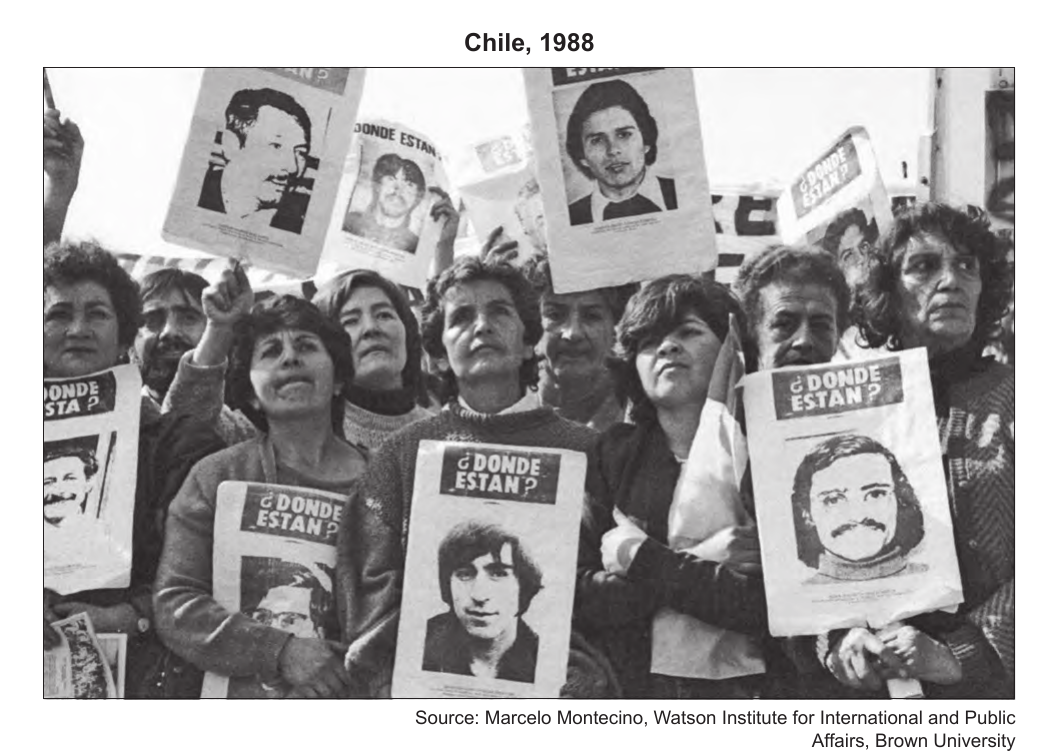
- (A) Mothers of the Plaza de Mayo in Argentina in the early 1980s ✓
- (B) British suffragists who marched in the early 1900s
- (C) Saudi women driving into cities in early 2013
- (D) activists protesting the World Bank in 2002
Worked solution
Both groups of women protested authoritarian regimes' forced disappearances of relatives, using photographs to demand answers.
Based on the passage shown, which describes Rwandan radio stations referring to Tutsis as 'cockroaches' and broadcasting anti-Tutsi rants before the genocide, one can infer that popular radio programming
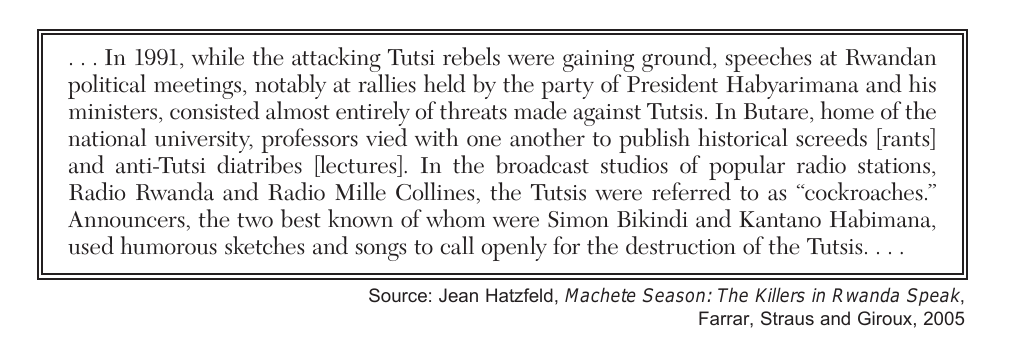
- (A) gave hope to the Tutsis during the genocide
- (B) was used to help end the genocide
- (C) was not well known in Rwanda
- (D) was a propaganda tool that led to the Tutsis being seen as inferior ✓
Worked solution
Radio broadcasts using dehumanizing language like 'cockroaches' functioned as propaganda that portrayed Tutsis as inferior, fueling genocidal violence.
Based on the passage shown, which situation in Rwanda led to the events described in this passage?
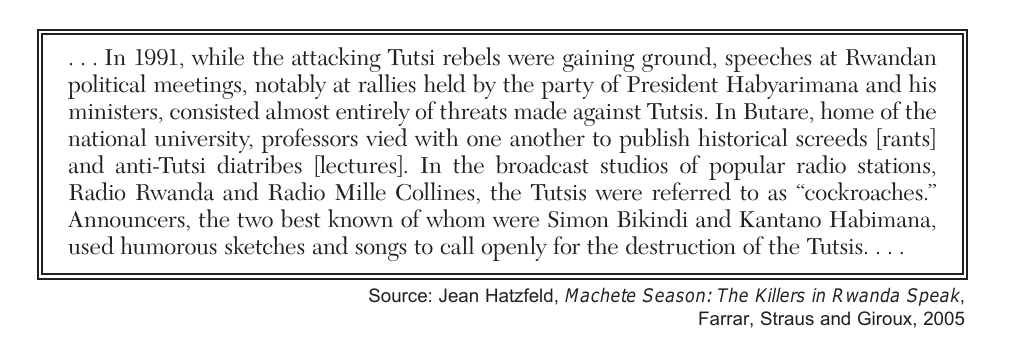
- (A) the establishment of a classless society
- (B) ethnic rivalries promoted by colonial favoritism ✓
- (C) famine caused by environmental disaster
- (D) a large influx of refugees
Worked solution
Belgian colonial policies that privileged Tutsis over Hutus deepened ethnic divisions that later fueled genocidal propaganda and violence.
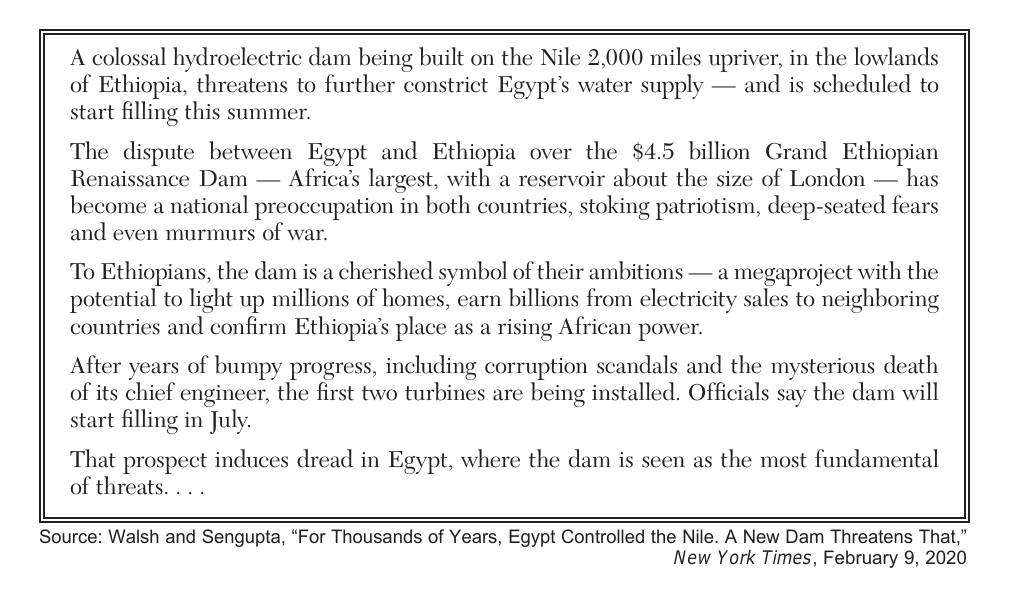
Based on the passage shown, which describes the dispute between Egypt and Ethiopia over the Grand Ethiopian Renaissance Dam on the Nile River, what is one concern expressed in this passage?
- (A) scarcity of resources ✓
- (B) outsourcing of labor
- (C) overproduction of agricultural products
- (D) widening income gap between top and bottom earners
Worked solution
The passage centers on fears that the dam will reduce Egypt's access to the Nile's water, a clear concern about scarce shared resources.
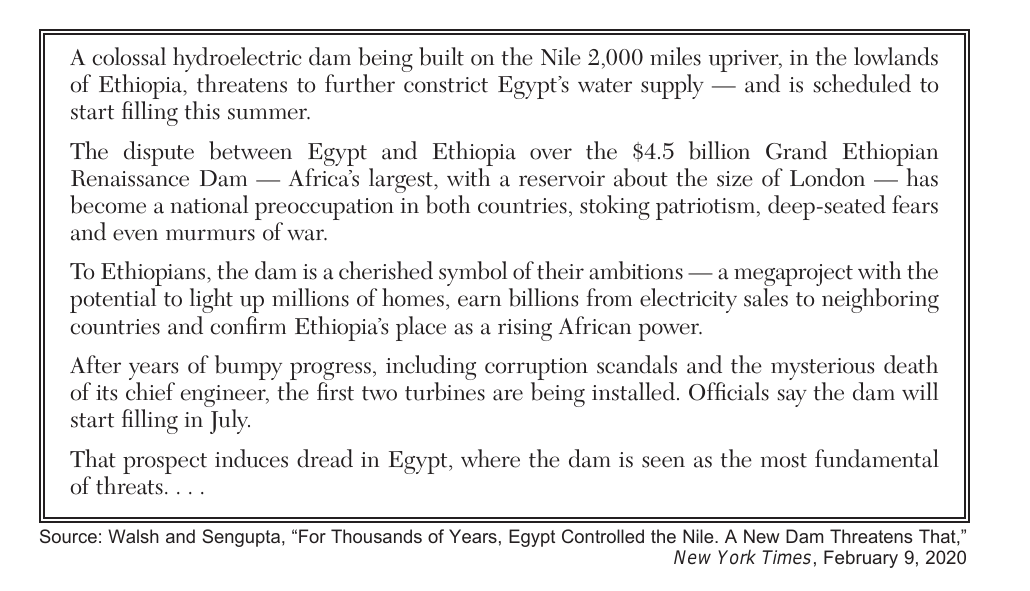
Based on the passage shown, which claim is best supported by this passage?
- (A) Infrastructure projects create jobs essential for development.
- (B) Modernization benefits some but presents challenges to others. ✓
- (C) Lack of technology has hindered development in Africa.
- (D) Sustainable agricultural production depends on the cultivation of cash crops.
Worked solution
The dam represents modernization that benefits Ethiopia economically while posing serious challenges and risks to Egypt's water security.