June 2023 Global History Regents — Answer Key & Worked Solutions
Every question from the June 2023 Global History Regents exam, with the correct answer and a full step-by-step solution. Check your work, learn the method, then see how it's scored.
These are real questions from the June 2023 Global History New York State Regents examination, published by NYSED. Worked solutions are written by RegentsLab.
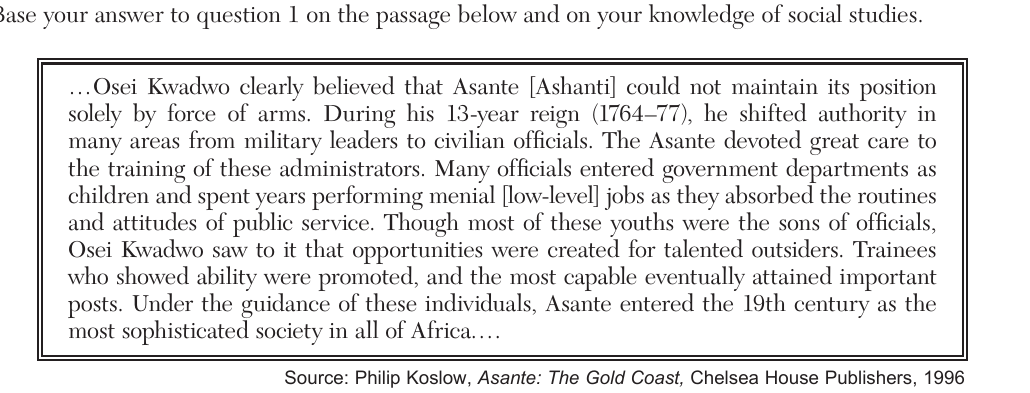
Based on the passage about Asante King Osei Kwadwo's reforms during his reign from 1764 to 1777 (shown on the exam), this passage would best be used for
- (A) explaining how the Asante king reformed his government ✓
- (B) recounting strategies used by officers in the Asante military
- (C) discussing a variety of childhood experiences within the Asante kingdom
- (D) justifying economic policies implemented under Asante leadership
Worked solution
The passage focuses on Osei Kwadwo's deliberate shift of power from military commanders to a trained civilian bureaucracy, illustrating governmental reform in the Asante kingdom.
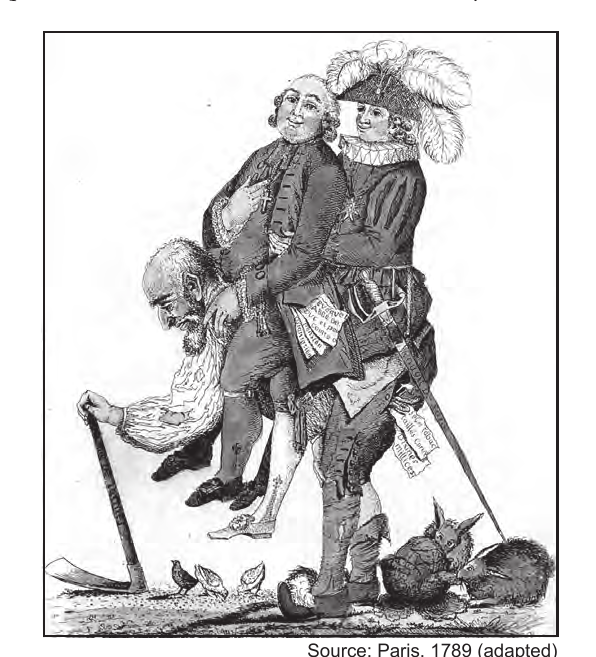
Based on the political cartoon showing a peasant carrying a member of the clergy and a member of the nobility on his back (Paris, 1789), which situation is being depicted in this cartoon?
- (A) beginning of an estate system where the majority holds power
- (B) creation of a classless society
- (C) revolution led by the nobility and clergy
- (D) existence of a rigid social class structure ✓
Worked solution
The image is a classic depiction of pre-Revolutionary France's rigid three-estate social hierarchy, in which the common people supported the privileged clergy and nobility.
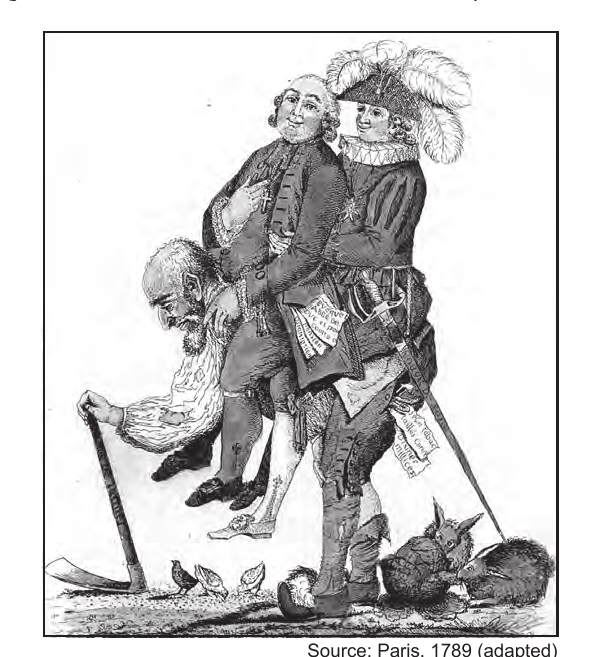
Based on the same 1789 political cartoon depicting the burdened peasant carrying the clergy and nobility, which event directly resulted from the situation shown in this cartoon?
- (A) Russian Revolution
- (B) Agricultural Revolution
- (C) French Revolution ✓
- (D) Cultural Revolution
Worked solution
The unfair treatment of the Third Estate under the estate system, as depicted in the cartoon, was a direct cause of the French Revolution that erupted in 1789.
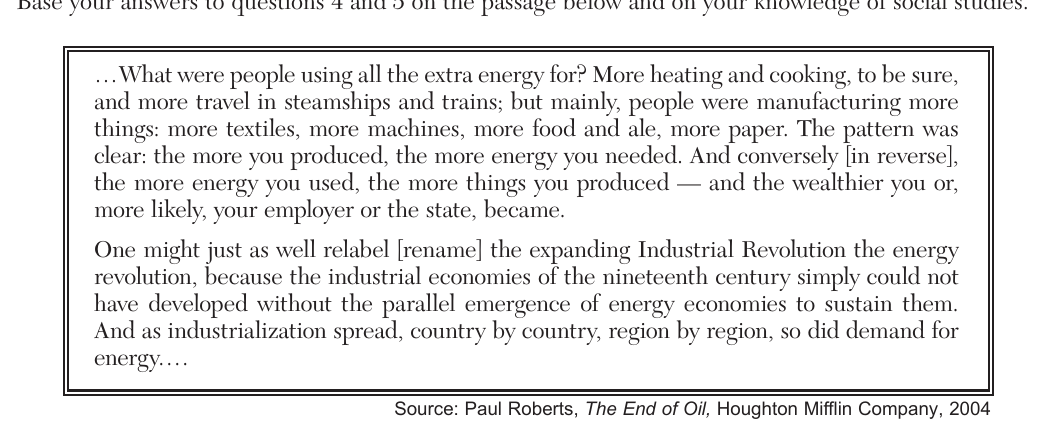
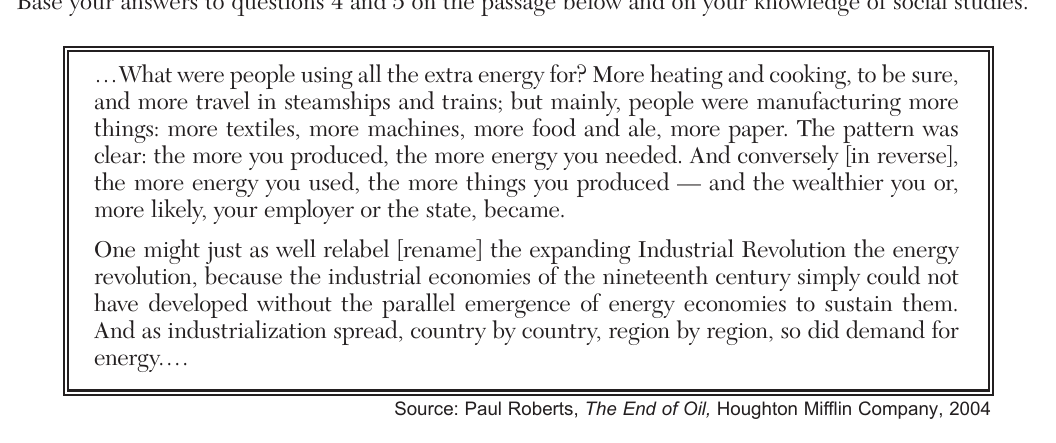
Based on the passage describing how people used increasing amounts of energy for heating, travel, and manufacturing during the Industrial Revolution, which economic concept best explains the relationship between energy and industrial production discussed in this passage?
- (A) supply and demand ✓
- (B) favorable trade balance
- (C) collectivization
- (D) scarcity
Worked solution
The author describes a self-reinforcing cycle in which increased industrial production drove up demand for energy, which in turn enabled even greater production, an illustration of supply and demand dynamics.
Based on the same passage from Paul Roberts' The End of Oil about energy and the Industrial Revolution, which statement best represents this author's point of view?
- (A) Pollution from energy sources hindered the expansion of railways.
- (B) New energy technologies reduced industrial production.
- (C) Reliance on traditional energy sources made industrialization more efficient.
- (D) Industrialization was dependent on increased energy production. ✓
Worked solution
The author explicitly states that industrial economies of the nineteenth century could not have developed without the parallel emergence of energy production to sustain them.
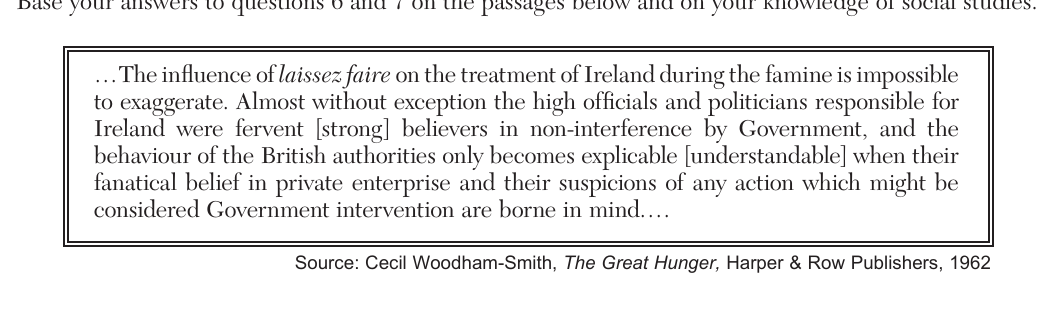
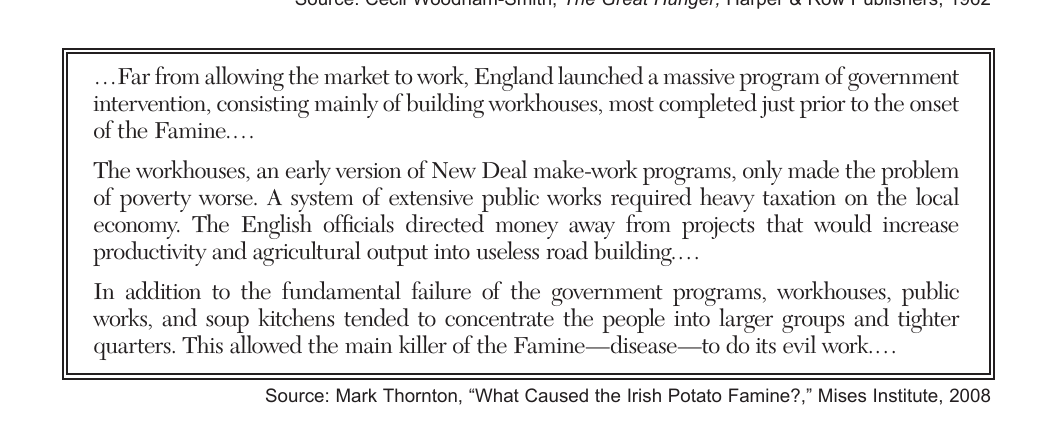
Based on the two passages presenting differing views on Britain's response to the Irish Potato Famine, one crediting laissez-faire non-interference and the other describing large-scale government workhouse programs, which conclusion about these passages is valid?
- (A) British officials disagreed about an appropriate response to economic problems. ✓
- (B) Irish peasants refused to accept government assistance during the famine.
- (C) Agricultural productivity increased as a result of British involvement.
- (D) Britain's long-term objective was to support Irish nationalism.
Worked solution
The two sources describe seemingly opposite British policies toward famine relief, laissez-faire versus active government workhouse programs, indicating disagreement among officials over the appropriate response.
Based on the same two passages about British policy during the Irish Potato Famine, what was a significant consequence of the events described in these passages?
- (A) A majority of the Irish people converted to Protestant Christianity.
- (B) Ireland became the most agriculturally diversified country in Europe.
- (C) Government intervention no longer took place in Ireland.
- (D) Approximately one million people emigrated from Ireland. ✓
Worked solution
The famine's devastation, worsened by ineffective relief programs, drove approximately one million Irish people to emigrate in search of survival and opportunity.
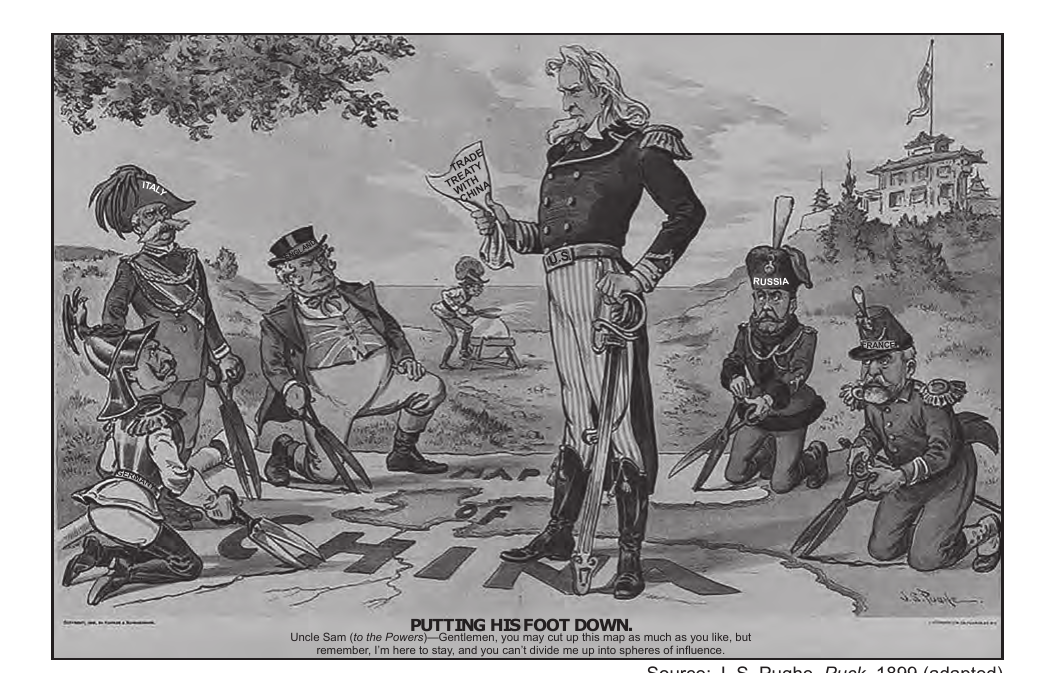
Based on the 1899 political cartoon 'Putting His Foot Down,' showing Uncle Sam standing on a map of China holding a 'Trade With China' document while European powers and Japan kneel around him, which development most likely influenced the action taken in this cartoon?
- (A) China's naval power posed a threat to the Western powers.
- (B) China had become stronger militarily than the Western powers.
- (C) The Western powers desired political means to control Japan.
- (D) The Western powers desired access to new markets in Asia. ✓
Worked solution
The cartoon depicts the U.S. Open Door Policy of 1899, in which Uncle Sam insists that all foreign powers should have equal access to Chinese markets rather than dividing China into closed colonial zones.
Based on the same 1899 'Putting His Foot Down' cartoon of Uncle Sam standing over a map of China while foreign powers kneel around him, which concept is depicted in this cartoon?
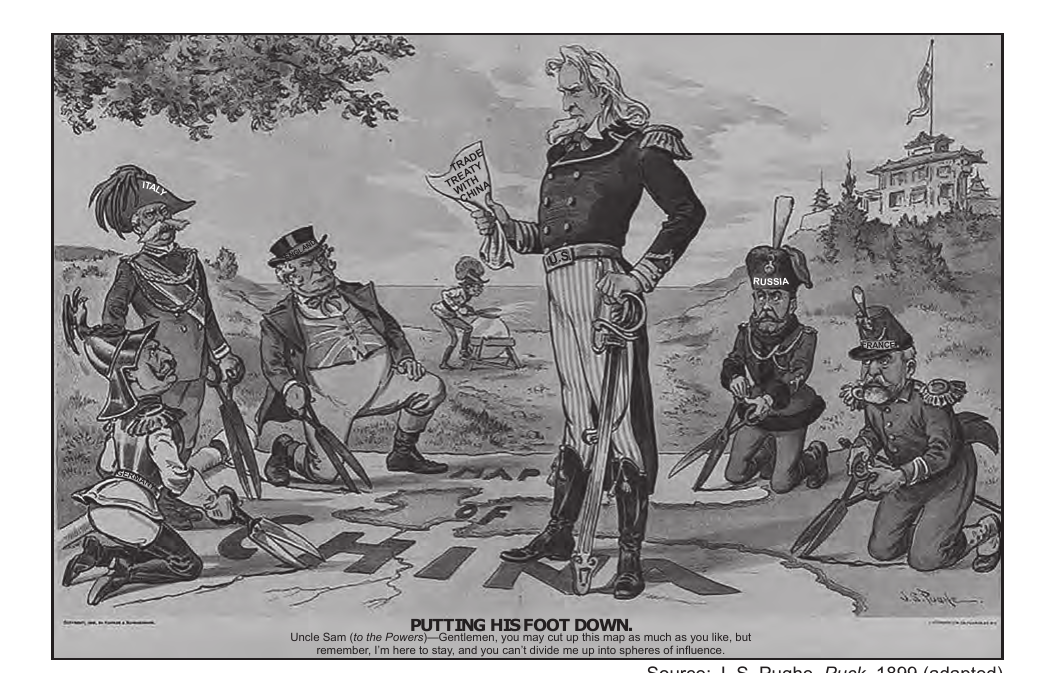
- (A) socialism
- (B) imperialism ✓
- (C) isolationism
- (D) pacifism
Worked solution
The cartoon illustrates the late-nineteenth-century imperialist scramble among Western powers and Japan to dominate and divide China for economic gain.
Based on Map A, which shows Austria labeled with the ethnic groups Czechs, Austrians, Hungarians, Rumanians, Italians, and Serbians surrounding a center marked 'Nationalism,' one reason for the situation shown in Map A was Austria's
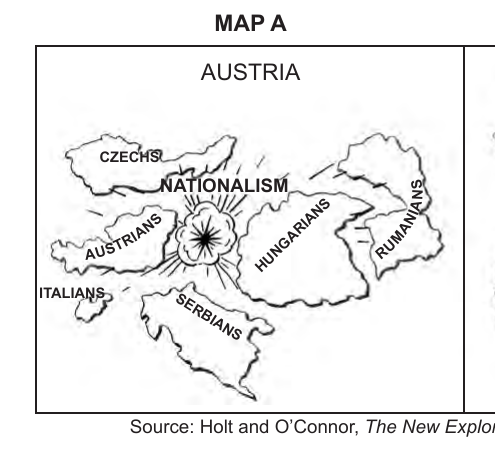
- (A) defeat by Germany in both World Wars
- (B) diverse ethnic composition ✓
- (C) loss of power after fighting the Ottoman Empire
- (D) location along key trade routes
Worked solution
The multi-ethnic Austro-Hungarian Empire contained many distinct nationalities, each developing its own nationalist movements, which strained and destabilized the empire.
Based on Map B, which shows Germany with states such as Hanover, Brandenburg, Westphalia, Saxony, and Prussia converging on a center marked 'Nationalism,' what led to the situation shown in Map B?
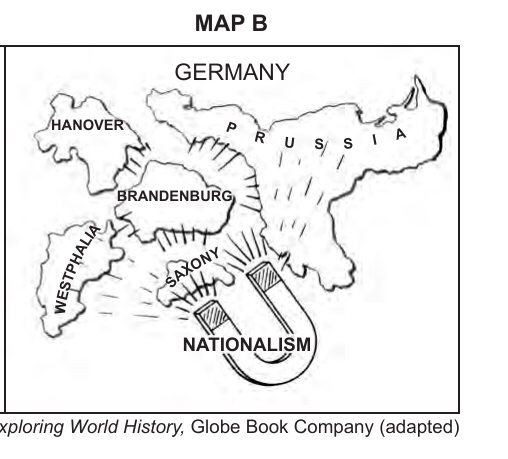
- (A) Prussian leaders appealing to a common German culture in wars against common enemies ✓
- (B) a president elected by male voters in German states
- (C) approval of German princes at a conference in Potsdam
- (D) proclamation of the Empress who was head of the German Confederation
Worked solution
German unification was driven by Prussian leadership under Bismarck, who appealed to a shared German cultural identity and used wars against common enemies to unite the separate German states.
Based on Maps A and B, which show nationalism both fragmenting multi-ethnic Austria and unifying the German states, which claim about nationalism is best supported by these maps?
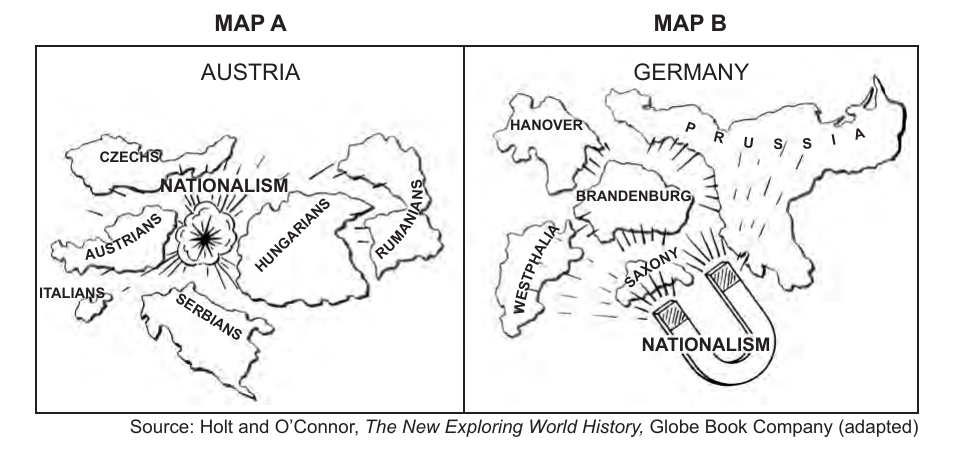
- (A) Nationalism only occurs in western European countries.
- (B) Nationalism has not been found to lead to military conflicts.
- (C) Nationalism is both a unifying and a dividing force. ✓
- (D) Nationalism has played a limited role in the political makeup of European countries.
Worked solution
Map A shows nationalism straining and dividing the multi-ethnic Austrian Empire, while Map B shows nationalism unifying separate German states, together illustrating nationalism's dual unifying and dividing effects.
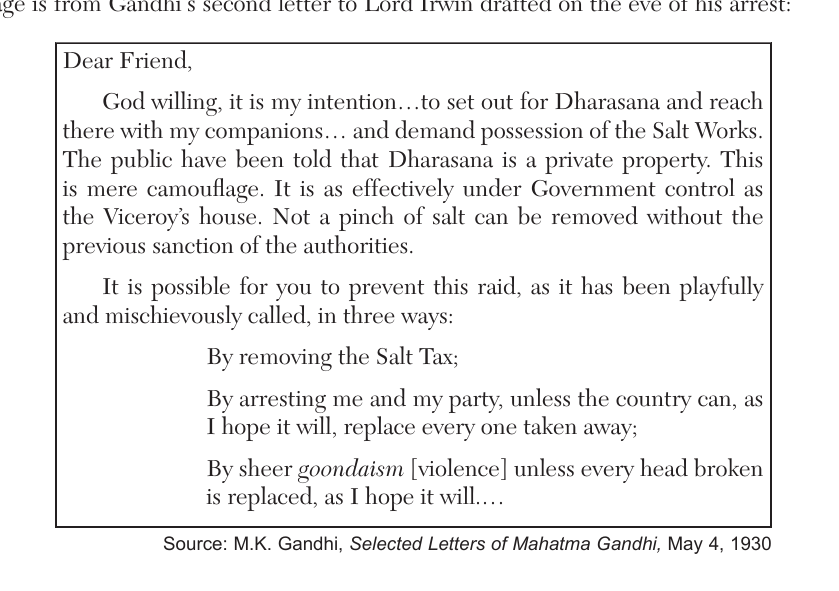
Based on Gandhi's second letter to Lord Irwin, written on the eve of his arrest, in which Gandhi announces his intention to march to Dharasana and seize the Salt Works because 'not a pinch of salt can be removed without the previous sanction of the authorities,' this letter was written primarily in response to the
- (A) partition of India and Pakistan
- (B) widespread boycott of British textiles
- (C) human rights violations at Amritsar
- (D) British monopoly of Indian resources ✓
Worked solution
Gandhi's letter directly addresses British government control over salt production and the salt tax, a clear example of Britain's monopoly over Indian resources that Gandhi sought to challenge through civil disobedience.
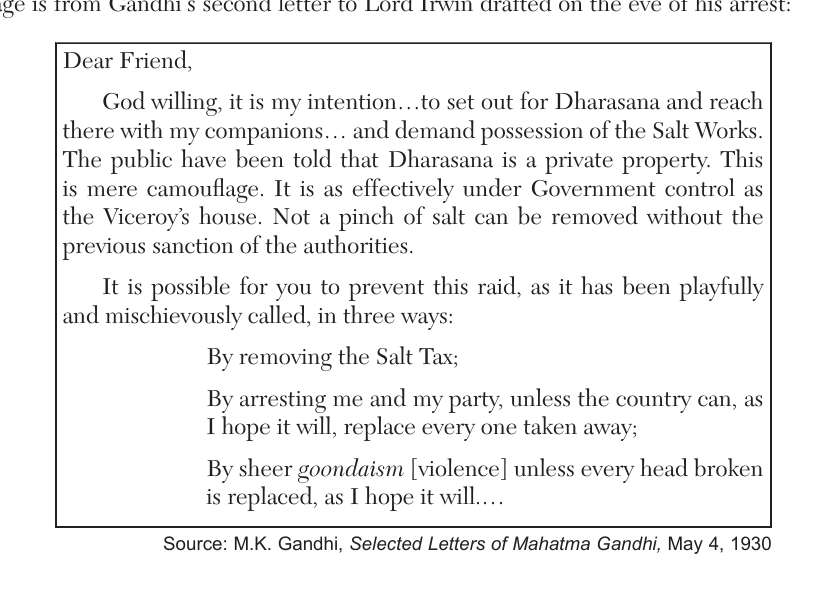
Based on the same letter from Gandhi to Lord Irwin announcing his plan to march on the Salt Works and calling for removal of the Salt Tax, the purpose of Gandhi's letter was to
- (A) notify the British government of his plan to continue his nationalist efforts ✓
- (B) inform the British viceroy that his home is considered private property
- (C) advocate for British control over salt production
- (D) explain how religion has influenced his fight for independence against Britain
Worked solution
Gandhi wrote directly to the Viceroy to announce, in advance, his intention to continue his campaign of nonviolent civil disobedience against British rule by raiding the Salt Works.
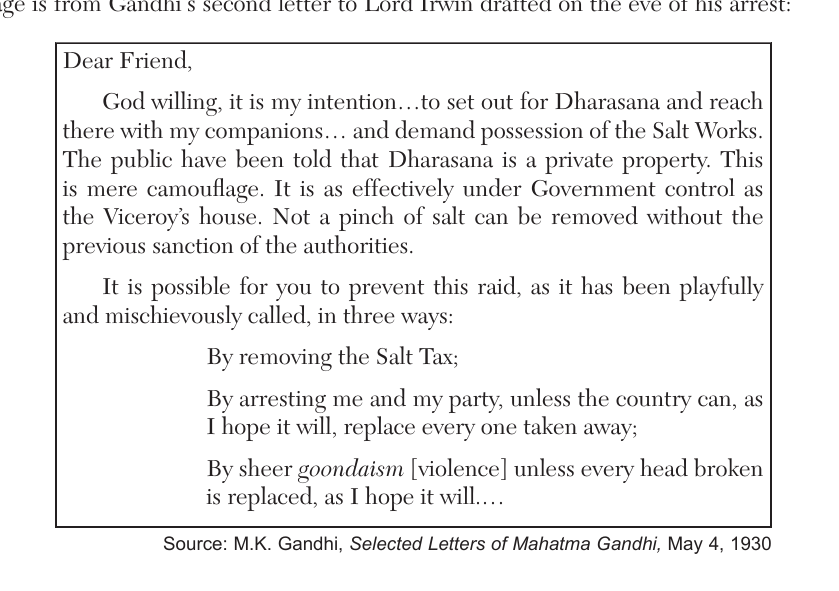
Based on the passage from Gandhi's second letter to Lord Irwin shown, which other document presented a message similar to this letter?
- (A) Mandela's Rivonia Trial Speech ✓
- (B) Germany's Nuremberg Laws
- (C) Mao's Little Red Book
- (D) France's Law of Suspects
Worked solution
Both Gandhi and Mandela used their statements/speeches to justify resistance against oppressive, discriminatory rule and to appeal for freedom and rights, making the Rivonia Trial Speech the closest parallel.
Base your answer on the headlines: "Stalin Solidifies Power for Communists," "Adolf Hitler Declares Third Reich," "Mussolini Establishes Fascist State." Which situation was most responsible for the rise of the political systems referred to in these headlines?
- (A) unification of Italy
- (B) conflicts between European nations over Africa
- (C) worldwide economic instability ✓
- (D) emergence of the United States as a world power
Worked solution
Widespread economic hardship after World War I and during the Great Depression undermined faith in weak democratic governments, allowing communist, Nazi, and fascist leaders to seize power promising stability and order.
Base your answer on the headlines: "Stalin Solidifies Power for Communists," "Adolf Hitler Declares Third Reich," "Mussolini Establishes Fascist State." What is a common characteristic of the political systems represented in these headlines?
- (A) multinationalism
- (B) capitalism
- (C) humanitarianism
- (D) totalitarianism ✓
Worked solution
Despite different ideologies (communism vs. fascism/Nazism), all three regimes were totalitarian, concentrating absolute power in the state and suppressing political opposition.
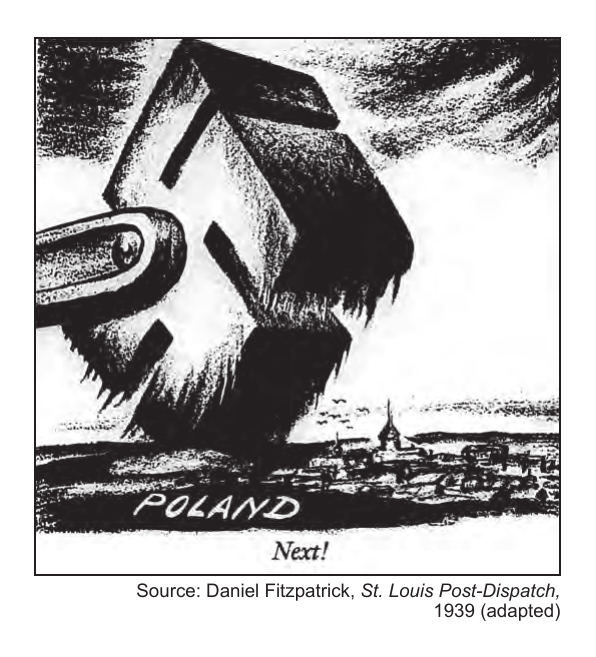
Based on the political cartoon shown (a giant swastika crushing a town labeled Poland, captioned "Next!"), which term is most closely associated with the event shown in this cartoon?
- (A) disarmament
- (B) blitzkrieg ✓
- (C) Holodomor
- (D) containment
Worked solution
The cartoon's date (1939) and imagery of an overwhelming Nazi force about to fall on Poland directly reference the German blitzkrieg invasion that began World War II in Europe.
Based on the political cartoon shown (soldiers taking down barriers between the British, USSR, and U.S.A. occupation zones in Germany, captioned "Down Barriers in Germany"), the situation shown in this cartoon is most closely associated with the
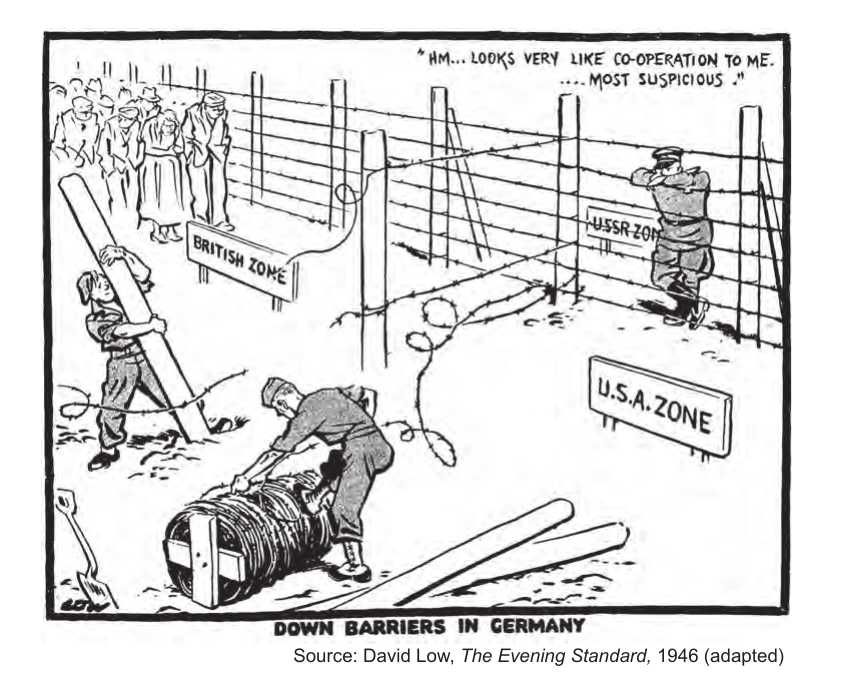
- (A) end of World War I
- (B) rise of fascism
- (C) Holocaust
- (D) Cold War ✓
Worked solution
The divided occupation zones and mutual suspicion between the Soviets and the Western Allies shown in this 1946 cartoon reflect the beginning of Cold War tensions in Germany.
Based on the passage from a speech given at the conclusion of the Asian-African Conference in Bandung, Indonesia, shown, Nehru's views in this passage can best be described as
Passage: excerpt from a speech by Jawaharlal Nehru of India at the conclusion of the Asian-African Conference, Bandung, Indonesia, 1955. In the excerpt, Nehru states that the newly assembled nations of Asia and Africa offer friendship to both East and West, that they refuse to be dominated by any country or continent, that colonialism in any form is unacceptable, and that the nations gathered at Bandung should act in a spirit of cooperation and toleration toward one another and the wider world.
- (A) imperialist
- (B) militarist
- (C) nationalist ✓
- (D) communist
Worked solution
Nehru's rejection of colonial domination and his call for equal partnership among nations, rather than allegiance to a bloc, reflects nationalist and non-aligned principles associated with the Bandung Conference.
Based on the passage from Kwame Nkrumah's 1963 speech given in Addis Ababa shown, the ideas expressed in this passage are most similar to the ideas of
Passage: excerpt from a speech by Kwame Nkrumah of Ghana, delivered in Addis Ababa, Ethiopia, in 1963. In the excerpt, Nkrumah warns that gaining political independence is only the beginning of a new and more difficult struggle, because former colonial powers still seek to control African nations economically and politically through neocolonialism. He argues that no single African state is strong enough to resist this pressure alone and calls on the independent nations of Africa to unite.
- (A) Simon Bolivar ✓
- (B) Winston Churchill
- (C) Deng Xiaoping
- (D) Mary Wollstonecraft
Worked solution
Both Nkrumah and Bolivar promoted regional unity among newly independent states as a means of resisting continued foreign domination, making Bolivar's ideas the closest parallel.
Based on the passage from Kwame Nkrumah's 1963 speech given in Addis Ababa shown, which statement best supports Kwame Nkrumah's point of view?
Passage: excerpt from a speech by Kwame Nkrumah of Ghana, delivered in Addis Ababa, Ethiopia, in 1963. In the excerpt, Nkrumah warns that gaining political independence is only the beginning of a new and more difficult struggle, because former colonial powers still seek to control African nations economically and politically through neocolonialism. He argues that no single African state is strong enough to resist this pressure alone and calls on the independent nations of Africa to unite.
- (A) Nations in Africa must be careful to avoid being conquered by Latin America.
- (B) Now that nations in Africa have gained independence, their struggle is over.
- (C) African nations must unite to protect themselves from neocolonialists. ✓
- (D) African nations were better off as colonies than they are as independent nations.
Worked solution
Nkrumah's passage directly argues that African nations must unite to guard against neocolonial domination, rejecting the idea that independence alone ends the struggle.
Based on the documents shown (an excerpt from F. W. de Klerk's 1991 opening statement to the Convention for a Democratic South Africa, and a 1993 photo of Nelson Mandela and F. W. de Klerk receiving the Nobel Peace Prize), which method is being used by Mandela and de Klerk to address the conflict in South Africa?
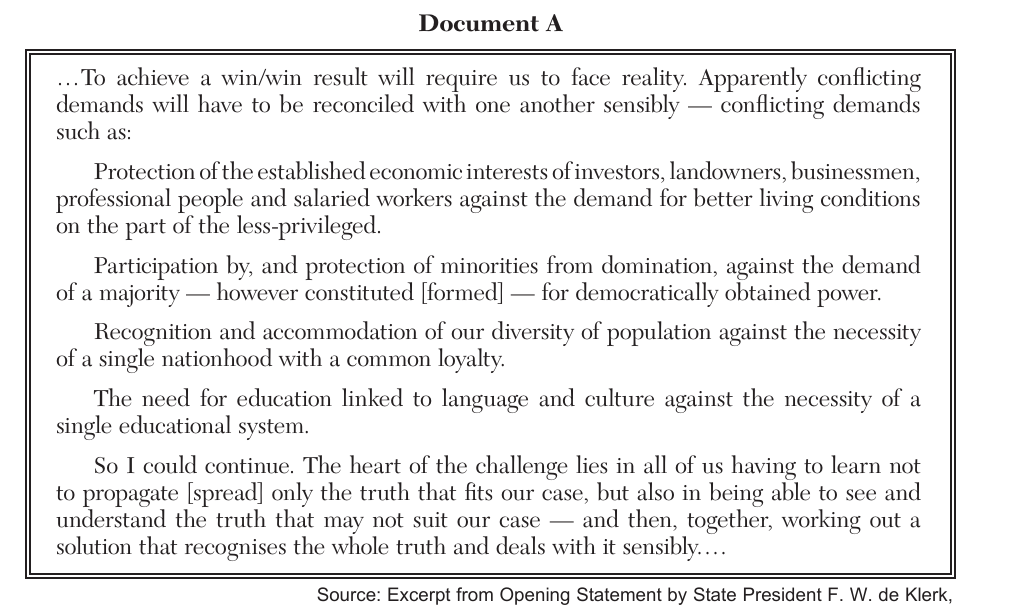
- (A) outside military intervention
- (B) political compromise ✓
- (C) a violent revolution
- (D) international economic sanctions
Worked solution
Both documents show Mandela and de Klerk pursuing a negotiated, peaceful transition, reflecting political compromise between the apartheid government and the anti-apartheid movement.
As shown in the 1993 photograph of Mandela and de Klerk receiving the Nobel Peace Prize, Mandela and de Klerk are being honored for agreeing to establish a political system that
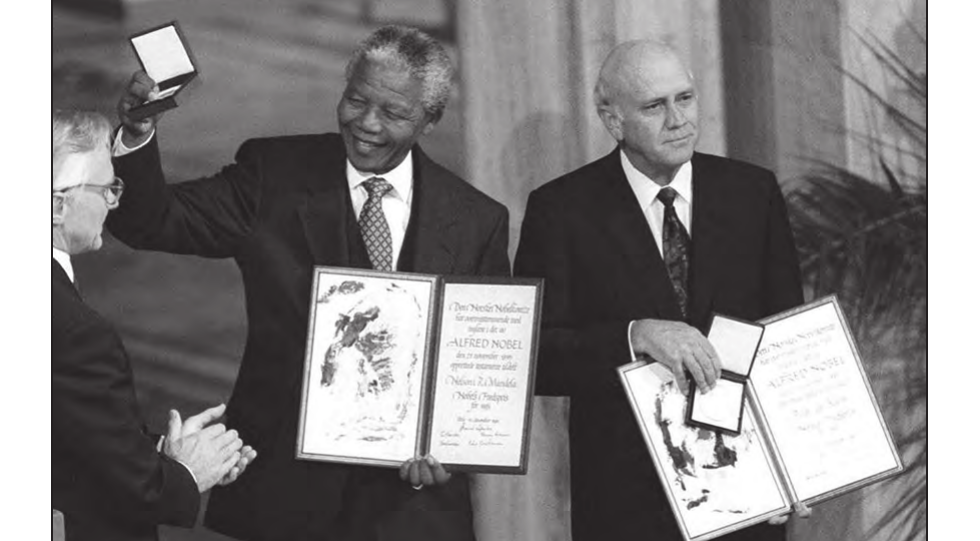
- (A) provided universal suffrage ✓
- (B) required complete separation of the races
- (C) allowed only a single political party
- (D) nationalized all the major industries
Worked solution
Mandela and de Klerk were honored for dismantling apartheid and establishing a democratic system granting universal suffrage, ending the racially restricted voting of the apartheid era.
Based on the passage about political discussion of blogs and social media during the Tunisian and Egyptian uprisings shown, which statement about the use of social media is best supported by this passage?
Passage: excerpt adapted from Catherine O'Donnell, "New Study Quantifies Use of Social Media in Arab Spring," UW Today, University of Washington, 2011. The excerpt reports that a study of blogs and Twitter during the 2011 uprisings found that online conversations about liberty, democracy, and revolution rose sharply on social media just before major protests took place in Tunisia and Egypt. Social media carried these ideas across borders, helped citizens organize, and spread inspiring stories of protest beyond the region, suggesting that social media played a central role in shaping the political debates of the Arab Spring.
- (A) The use of Twitter had little impact on the uprisings in Tunisia and Egypt.
- (B) Online discussions about political rights helped encourage mass demonstrations. ✓
- (C) Egyptian and Tunisian governments were successful in limiting social media access.
- (D) Leaders were able to use propaganda on social media to limit political reforms.
Worked solution
The passage's data on blog and Twitter activity preceding mass protests supports the conclusion that online discussion of political rights helped spur demonstrations during the Arab Spring.
Based on the passage about political discussion of blogs and social media during the Tunisian and Egyptian uprisings shown, how is social media use most likely to affect places with political conditions like those described in this passage?
Passage: excerpt adapted from Catherine O'Donnell, "New Study Quantifies Use of Social Media in Arab Spring," UW Today, University of Washington, 2011. The excerpt reports that a study of blogs and Twitter during the 2011 uprisings found that online conversations about liberty, democracy, and revolution rose sharply on social media just before major protests took place in Tunisia and Egypt. Social media carried these ideas across borders, helped citizens organize, and spread inspiring stories of protest beyond the region, suggesting that social media played a central role in shaping the political debates of the Arab Spring.
- (A) Repressive governments will have more difficulty maintaining power. ✓
- (B) Liberal democracies will see increased political participation.
- (C) Isolated societies will easily adopt more democratic practices.
- (D) Technologically advanced societies will actively encourage political corruption.
Worked solution
Since the passage describes social media fueling protests that toppled authoritarian leaders in Tunisia and Egypt, it implies that similar repressive governments will struggle to suppress social-media-driven dissent.
Based on the population graph shown, what is the approximate projected world population for 2050?
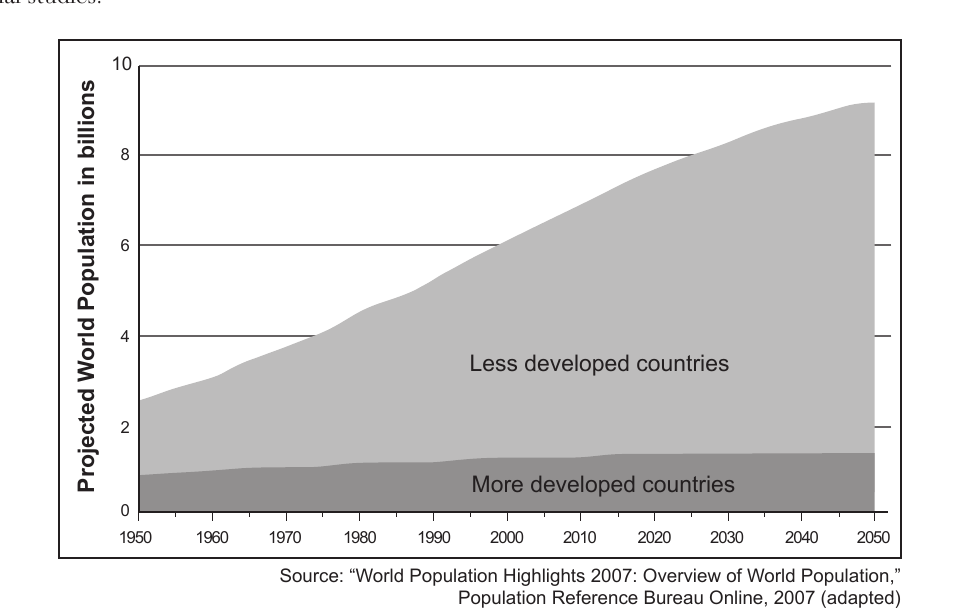
- (A) 1 billion
- (B) 3 billion
- (C) 9 billion ✓
- (D) 10 billion
Worked solution
Reading the graph's combined shaded areas at the year 2050 shows world population leveling off at approximately 9 billion people.
According to the National Geographic article shown about Norman Borlaug and the green revolution, why was Norman Borlaug awarded the Nobel Peace Prize?
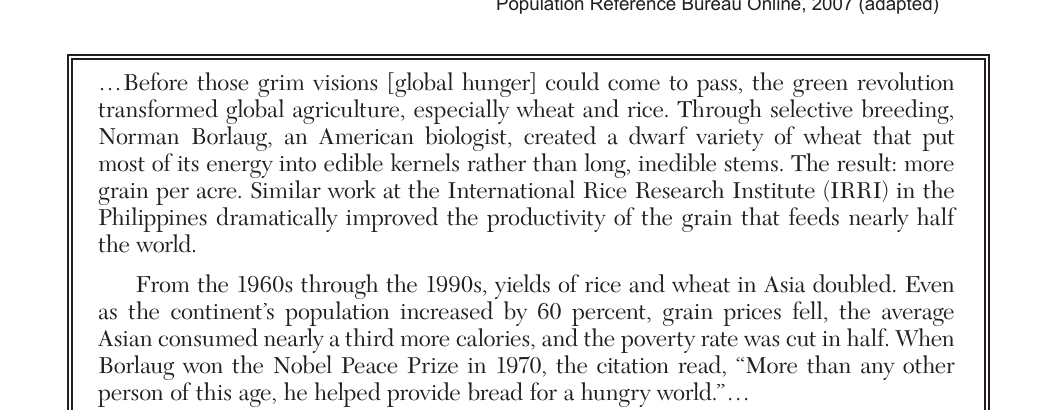
- (A) He transformed global agricultural production. ✓
- (B) He was able to decrease the surplus population in areas of famine.
- (C) He targeted poverty by providing food donations to the less fortunate.
- (D) He ended famines by moving the production of grains to the Philippines.
Worked solution
Borlaug's selective breeding of high-yield wheat and its adoption across Asia transformed global agricultural production, reducing hunger and poverty, which is why he was honored with the Nobel Peace Prize.