January 2025 Global History Regents — Answer Key & Worked Solutions
Every question from the January 2025 Global History Regents exam, with the correct answer and a full step-by-step solution. Check your work, learn the method, then see how it's scored.
These are real questions from the January 2025 Global History New York State Regents examination, published by NYSED. Worked solutions are written by RegentsLab.
Based on the passage describing the sankin kotai (alternate attendance) system under Tokugawa Japan, a historian would find this passage most useful for understanding the
Passage: ". . . To see to it that the daimyo obeyed bakufu [shogunate] orders, the shogun had his own inspectors. He also kept the daimyo under surveillance by requiring them to spend alternate years in residence in Edo. When they returned to their domains, they had to leave their wives and children behind. This system of alternate attendance (sankin kotai) forced the daimyo to spend large sums traveling back and forth with their retinues [attendants] and to maintain suitably elaborate residences in Edo. They were also called on to support public projects such as waterworks or the repair of the shogun's castle at Edo, but such extractions [demanded contributions] were not as burdensome as the constant expense of alternate attendance. This requirement turned Edo into the capital not only of the bakufu but of all Japan. . . ." Source: Schirokauer and Clark, Modern East Asia, Thomson Wadsworth, 2004
- (A) obligations of the daimyo under the Tokugawa shogun ✓
- (B) design of public projects in the Tokugawa period
- (C) inspections conducted by the daimyo during the Tokugawa period
- (D) foreign policy concerns of the Tokugawa shogun
Worked solution
The passage details the sankin kotai system and other requirements the shogun imposed on the daimyo, making it a primary source on daimyo obligations under Tokugawa rule.
Based on the passage describing the sankin kotai (alternate attendance) system under Tokugawa Japan, which claim can best be supported by this passage?
Passage: ". . . To see to it that the daimyo obeyed bakufu [shogunate] orders, the shogun had his own inspectors. He also kept the daimyo under surveillance by requiring them to spend alternate years in residence in Edo. When they returned to their domains, they had to leave their wives and children behind. This system of alternate attendance (sankin kotai) forced the daimyo to spend large sums traveling back and forth with their retinues [attendants] and to maintain suitably elaborate residences in Edo. They were also called on to support public projects such as waterworks or the repair of the shogun's castle at Edo, but such extractions [demanded contributions] were not as burdensome as the constant expense of alternate attendance. This requirement turned Edo into the capital not only of the bakufu but of all Japan. . . ." Source: Schirokauer and Clark, Modern East Asia, Thomson Wadsworth, 2004
- (A) Regulations established by the shogun limited the size of Edo.
- (B) The primary role of the daimyo was keeping the shogun under surveillance.
- (C) Service to the shogun often required personal sacrifice. ✓
- (D) The daimyo and the shogun were equal partners in the governance of Japan.
Worked solution
The passage emphasizes the heavy financial and personal costs daimyo bore to comply with shogunate demands, supporting the claim about sacrifice in service to the shogun.
Based on the passage describing eighteenth-century India, what impact did the situation described in this passage have on Mughal rule?
Passage: ". . . India, in the eighteenth century, was an empire ready to be conquered. This vast continent, so rich in resources of every kind, was divided into many states, colonized on the edges, and constantly rent [torn] by war. By the 1730s, the Mogul [Mughal] Empire, which had once ruled two-thirds of its land area, had collapsed; new states had arisen in great numbers; older states, once subordinated to the empire, had recovered their full independence. And then there were the foreigners. Some, like the Portuguese in Goa, really did not matter: they controlled a port and its immediate hinterland [back country] in order to trade, in spices, rice, ivory, precious stones, rare tropical woods, and silk, and that was the limit of their ambition. Others, like the French, had once hoped to have an empire in India, but Great Britain had defeated them during the Seven Years' War (1756-1763), and they had been left with a mere five ports. There remained the British, or rather that oddest of entities, the East India Company. . . ." Source: Olivier Bernier, The World in 1800, John Wiley & Sons, 2000
- (A) Mughal political and economic authority became more centralized.
- (B) Foreign influence in India led to the Mughals' loss of territorial control. ✓
- (C) The Mughals led successful resistance efforts against French interference.
- (D) Competition between European countries brought increased stability to the Mughals.
Worked solution
The passage shows the Mughal Empire disintegrating as European trading powers, especially the British East India Company, gained a foothold in India, undermining Mughal control.
Based on the passage describing eighteenth-century India, this passage could best be used by historians to address the
Passage: ". . . India, in the eighteenth century, was an empire ready to be conquered. This vast continent, so rich in resources of every kind, was divided into many states, colonized on the edges, and constantly rent [torn] by war. By the 1730s, the Mogul [Mughal] Empire, which had once ruled two-thirds of its land area, had collapsed; new states had arisen in great numbers; older states, once subordinated to the empire, had recovered their full independence. And then there were the foreigners. Some, like the Portuguese in Goa, really did not matter: they controlled a port and its immediate hinterland [back country] in order to trade, in spices, rice, ivory, precious stones, rare tropical woods, and silk, and that was the limit of their ambition. Others, like the French, had once hoped to have an empire in India, but Great Britain had defeated them during the Seven Years' War (1756-1763), and they had been left with a mere five ports. There remained the British, or rather that oddest of entities, the East India Company. . . ." Source: Olivier Bernier, The World in 1800, John Wiley & Sons, 2000
- (A) peaceful coexistence between Hindus and Muslims
- (B) social effects of urbanization and industrialization in India
- (C) relationship between European migration and the spread of disease
- (D) shifting balances of power and trade in India ✓
Worked solution
The passage centers on the decline of Mughal power and the emergence of competing European trading interests, making it a source for studying shifting power and trade dynamics in India.
Based on the political cartoon depicting Toussaint L'Ouverture and the Haitian Revolution, what influenced the actions of the Haitian people in this cartoon?
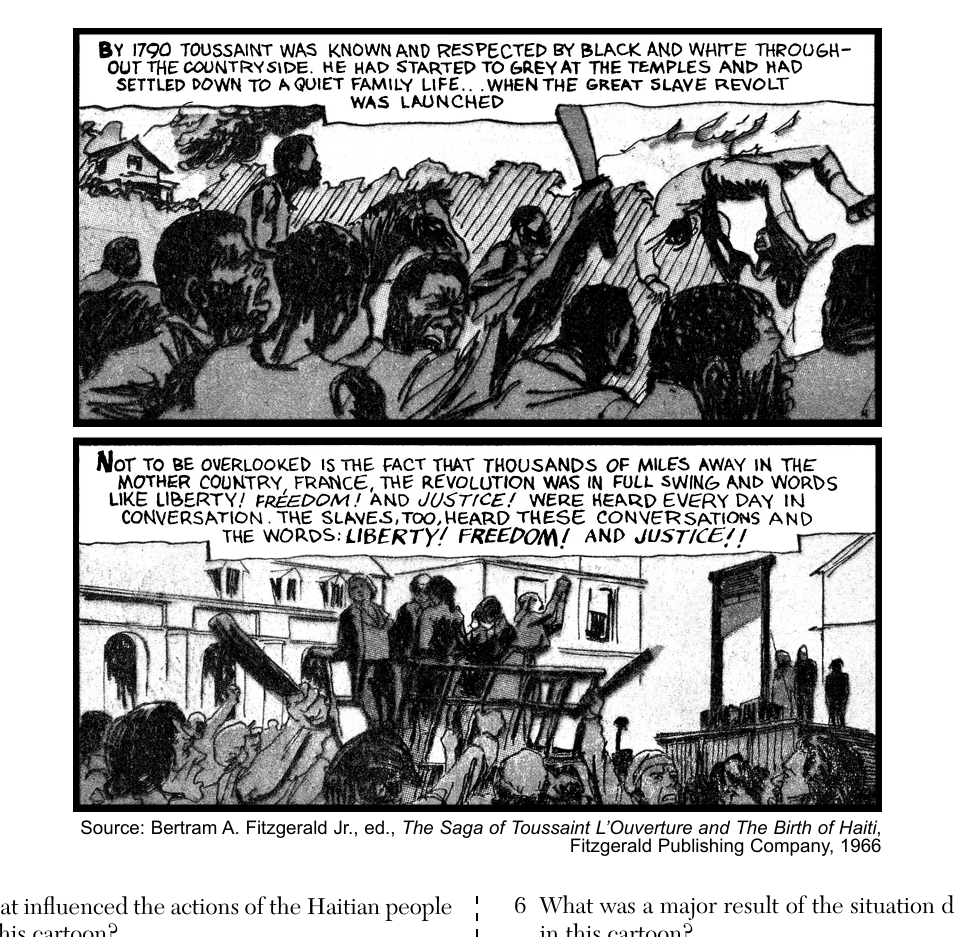
- (A) the adoption of Marxist ideas by revolutionaries in Haiti
- (B) the spread of Enlightenment ideas to Haiti ✓
- (C) the rebellions in the Spanish colonies led by Bolivar
- (D) the weakening of the Catholic Church in Latin America
Worked solution
The cartoon's panels directly connect the language of the French Revolution, rooted in Enlightenment ideals of liberty and justice, to the actions of enslaved Haitians who launched their revolt.
Based on the political cartoon depicting Toussaint L'Ouverture and the Haitian Revolution, what was a major result of the situation depicted in this cartoon?
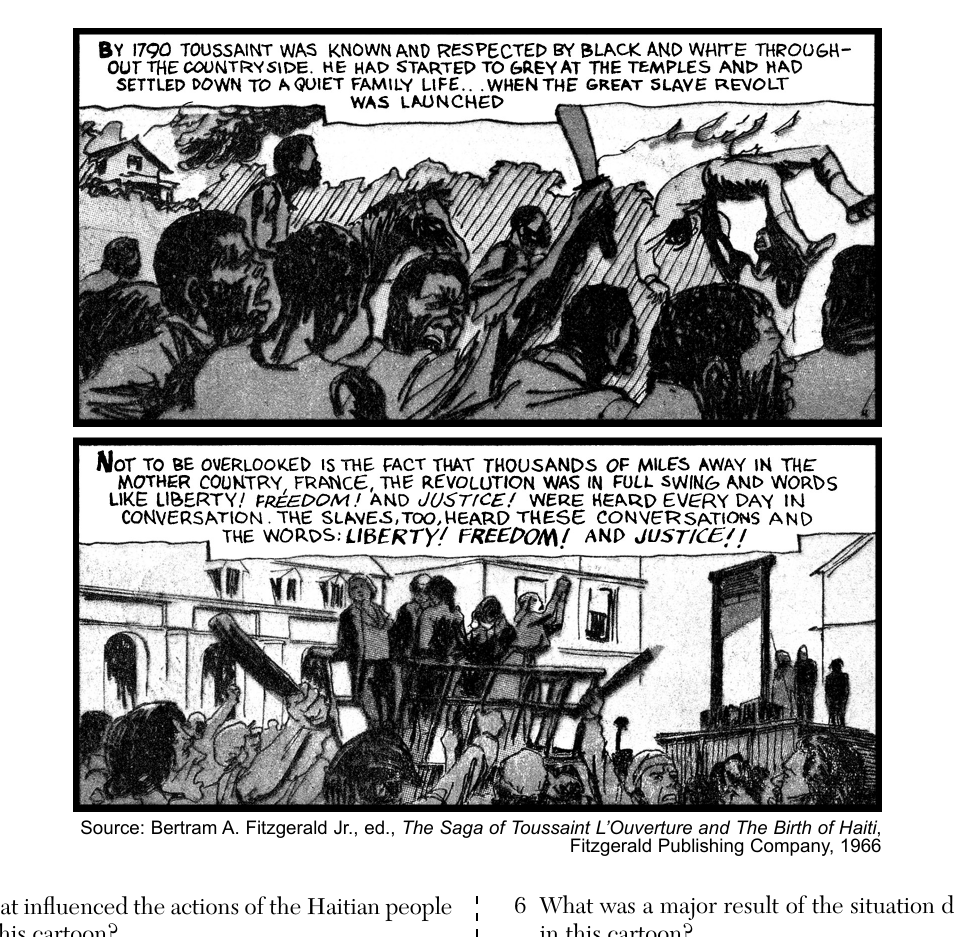
- (A) Toussaint L'Ouverture led a revolution to win independence for the people of Haiti. ✓
- (B) Napoleon formed an alliance with Toussaint L'Ouverture to jointly rule Haiti.
- (C) The French monarchy granted rights to Haiti without any blood being shed.
- (D) The French Whites in Haiti formed a new government that abolished slavery.
Worked solution
The Haitian Revolution, depicted in the cartoon, was led in significant part by Toussaint L'Ouverture and resulted in Haiti becoming an independent nation.
Based on the map showing the territorial expansion of Prussia into the North German Confederation and German Empire between 1866 and 1871, which concept most influenced the major changes shown on this map?
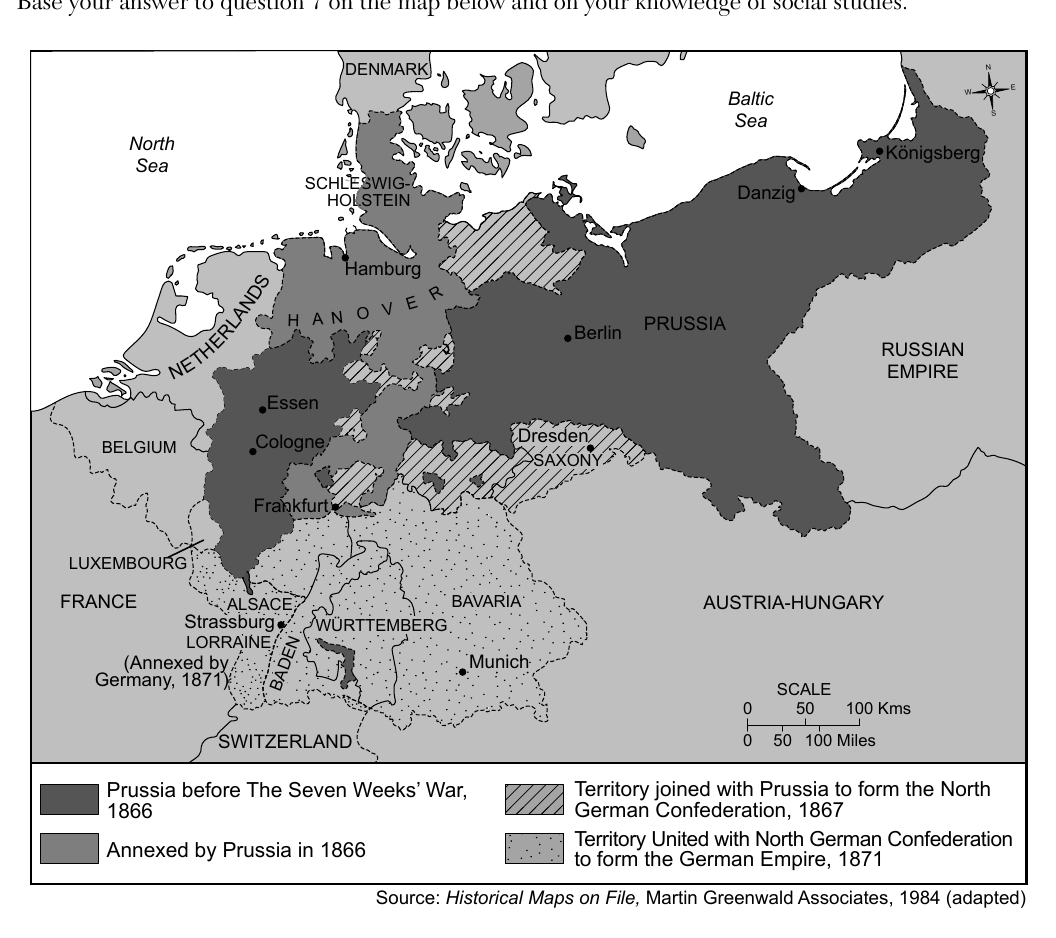
- (A) universal suffrage
- (B) isolationism
- (C) emancipation of serfs
- (D) nationalism ✓
Worked solution
The map depicts the process of German unification under Prussian leadership, a movement driven fundamentally by nationalist sentiment among German states.
Based on the passage comparing the advantages of England for manufactures, which claim is best supported by this passage?
Passage: "In comparing the advantages of England for manufactures with those of other countries, we can by no means overlook the excellent commercial position of the country, intermediate between the north and south of Europe; and its insular situation [island location], which, combined with the command of the seas, secures our territory from invasion or annoyance. The German ocean, the Baltic, and the Mediterranean are the regular highways for our ships; and our western ports command an unobstructed [clear] passage to the Atlantic, and to every quarter [part] of the world." Source: Edward Baines, History of the Cotton Manufacture in Great Britain, H. Fisher, R. Fisher, and P. Jackson, 1835
- (A) There are many diverse cultures in England because it is near the Atlantic Ocean.
- (B) The proximity of England to Germany makes it vulnerable to invasion.
- (C) England has many economic advantages because of its island location. ✓
- (D) England is isolated from overseas trade networks.
Worked solution
The passage credits England's geographic position as an island with commanding sea routes as a key economic advantage for its manufacturing and trade.
Based on the passage comparing the advantages of England for manufactures, which turning point is most closely associated with the geographic context described in this passage?
Passage: "In comparing the advantages of England for manufactures with those of other countries, we can by no means overlook the excellent commercial position of the country, intermediate between the north and south of Europe; and its insular situation [island location], which, combined with the command of the seas, secures our territory from invasion or annoyance. The German ocean, the Baltic, and the Mediterranean are the regular highways for our ships; and our western ports command an unobstructed [clear] passage to the Atlantic, and to every quarter [part] of the world." Source: Edward Baines, History of the Cotton Manufacture in Great Britain, H. Fisher, R. Fisher, and P. Jackson, 1835
- (A) the Industrial Revolution ✓
- (B) the Great Depression
- (C) the Russian Revolution
- (D) World War I
Worked solution
The passage's focus on manufacturing advantages and commercial shipping ties directly to the Industrial Revolution, which transformed England's economy starting in the late 1700s.
Based on the passage from Chinua Achebe's Things Fall Apart, in which a Nigerian character laments that the white man's religion has divided their clan, which event most influenced the situation being described in this passage?
Chinua Achebe was an author from Nigeria. "Does the white man understand our custom about land?" "How can he when he does not even speak our tongue? But he says that our customs are bad; and our own brothers who have taken up his religion also say that our customs are bad. How do you think we can fight when our own brothers have turned against us? The white man is very clever. He came quietly and peaceably with his religion. We were amused at his foolishness and allowed him to stay. Now he has won our brothers, and our clan can no longer act like one. He has put a knife on the things that held us together and we have fallen apart." Source: Chinua Achebe, Things Fall Apart, Anchor Books
- (A) the Berlin Conference ✓
- (B) World War II
- (C) the Congress of Vienna
- (D) the Treaty of Versailles
Worked solution
The Berlin Conference set the stage for European colonization of Africa, including Nigeria, resulting in the kind of cultural conflict and division Achebe depicts in Things Fall Apart.
Based on the passage from Chinua Achebe's Things Fall Apart, for which purpose could this passage best be used?
Chinua Achebe was an author from Nigeria. "Does the white man understand our custom about land?" "How can he when he does not even speak our tongue? But he says that our customs are bad; and our own brothers who have taken up his religion also say that our customs are bad. How do you think we can fight when our own brothers have turned against us? The white man is very clever. He came quietly and peaceably with his religion. We were amused at his foolishness and allowed him to stay. Now he has won our brothers, and our clan can no longer act like one. He has put a knife on the things that held us together and we have fallen apart." Source: Chinua Achebe, Things Fall Apart, Anchor Books
- (A) to show the perspective of indigenous people during the time period ✓
- (B) to provide a primary source of information to explain events during the Cold War
- (C) to give an example of resistance methods that can be modeled to other societies
- (D) to develop policies of religious toleration and consideration of traditional cultures
Worked solution
Achebe's novel gives voice to indigenous African perspectives on colonization, making this passage most valuable for understanding how colonized peoples experienced these changes.
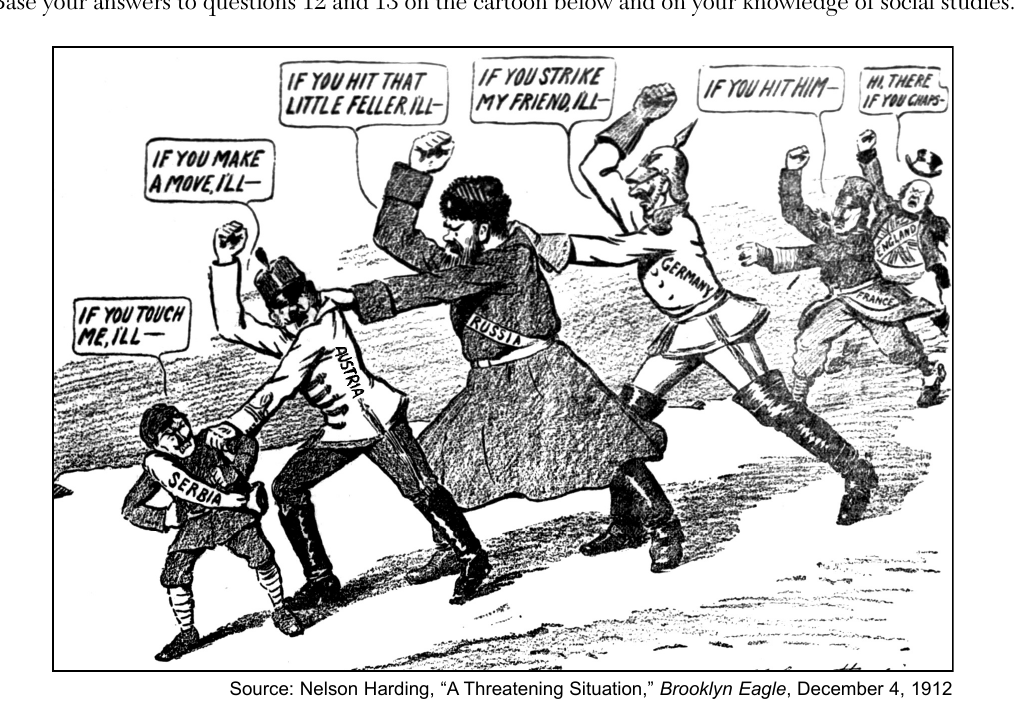
Based on the political cartoon showing Austria, Serbia, Russia, Germany, and other nations threatening one another before World War I, which event occurred as a result of the situation illustrated in this cartoon?
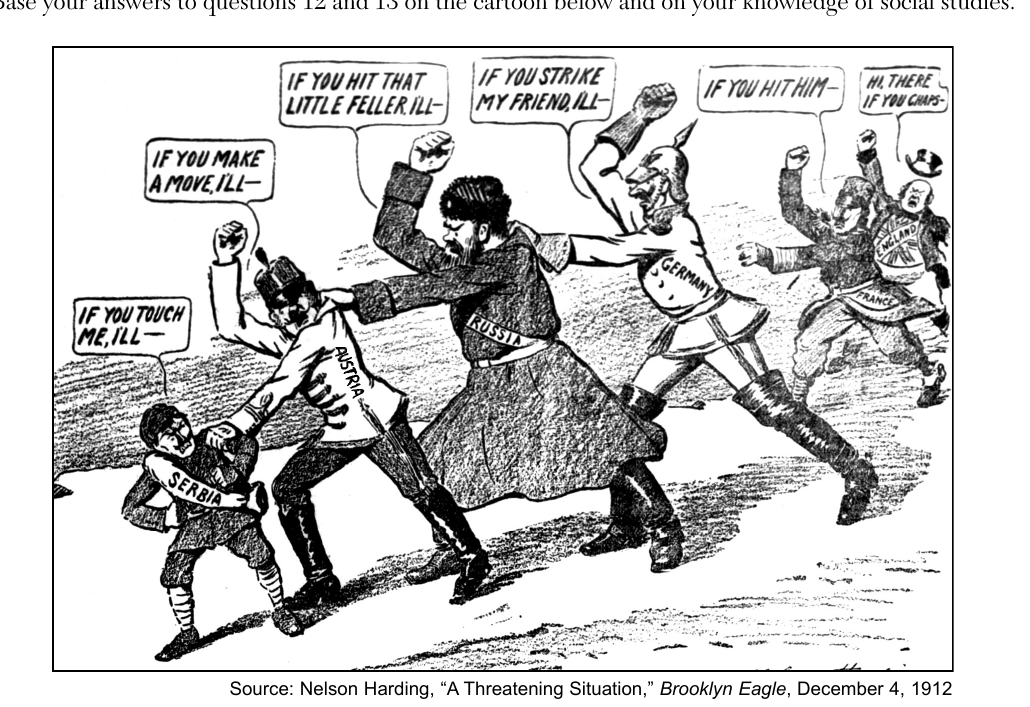
- (A) the sinking of unarmed ships by France
- (B) the installation of the Weimar government
- (C) the rejection of the Treaty of Versailles
- (D) the assassination of the archduke of Austria ✓
Worked solution
The cartoon depicts the alliance-driven tensions in Europe before World War I, which erupted into full conflict following the assassination of the Austrian archduke in Sarajevo.
Based on the political cartoon showing Austria, Serbia, Russia, Germany, and other nations threatening one another before World War I, which statement best describes the cartoonist's point of view?
- (A) European militarism prevented conflict.
- (B) European peace relied on collective security.
- (C) A system of European alliances caused the escalation of tension in Europe. ✓
- (D) Serbia was able to avoid getting involved with other European countries.
Worked solution
The cartoon visually represents the domino effect of European alliances, in which a conflict involving one small nation could draw in all the major powers, escalating tensions.
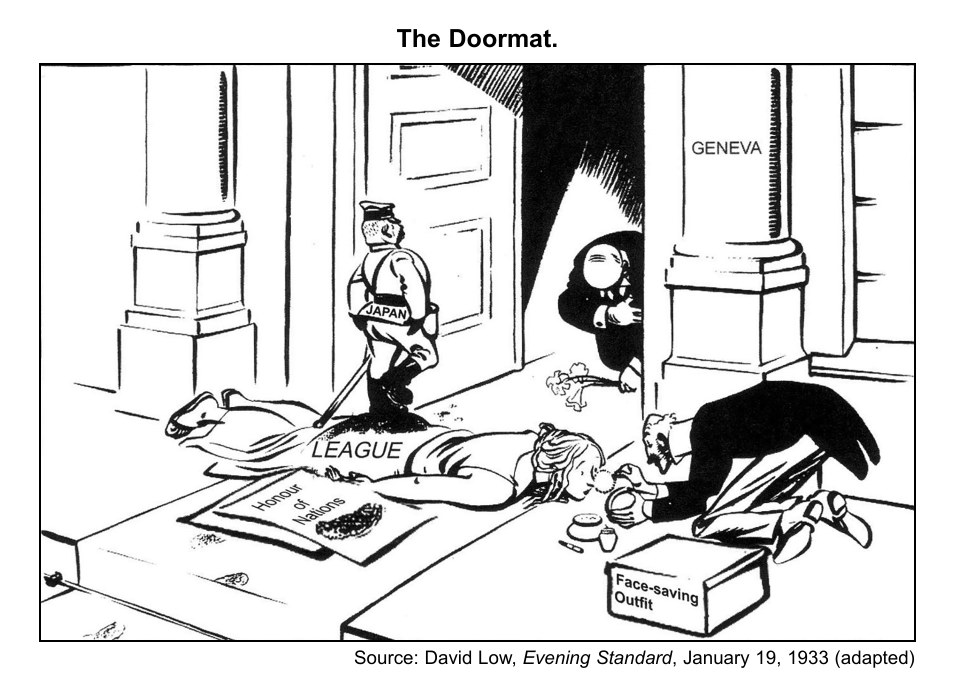
Based on the political cartoon 'The Doormat' showing Japan wiping its feet on a mat labeled 'League' outside the League of Nations building in Geneva, which situation is considered a cause of the events depicted in this cartoon?
- (A) the German invasion of Poland
- (B) the policy of self-determination stated by the League of Nations
- (C) the failure of secret treaties created after World War I
- (D) the League of Nations' inability to control aggressor nations ✓
Worked solution
David Low's cartoon criticizes the League of Nations' weakness and failure to stop aggressor nations like Japan, a key cause of the disrespectful scene depicted.
Based on the political cartoon titled "The Doormat," showing Japan wiping its feet on a doormat labeled "League" as it enters a building marked "Geneva" while a figure labeled "League of Nations" lies helpless nearby, which claim about the League is best supported by this cartoon?
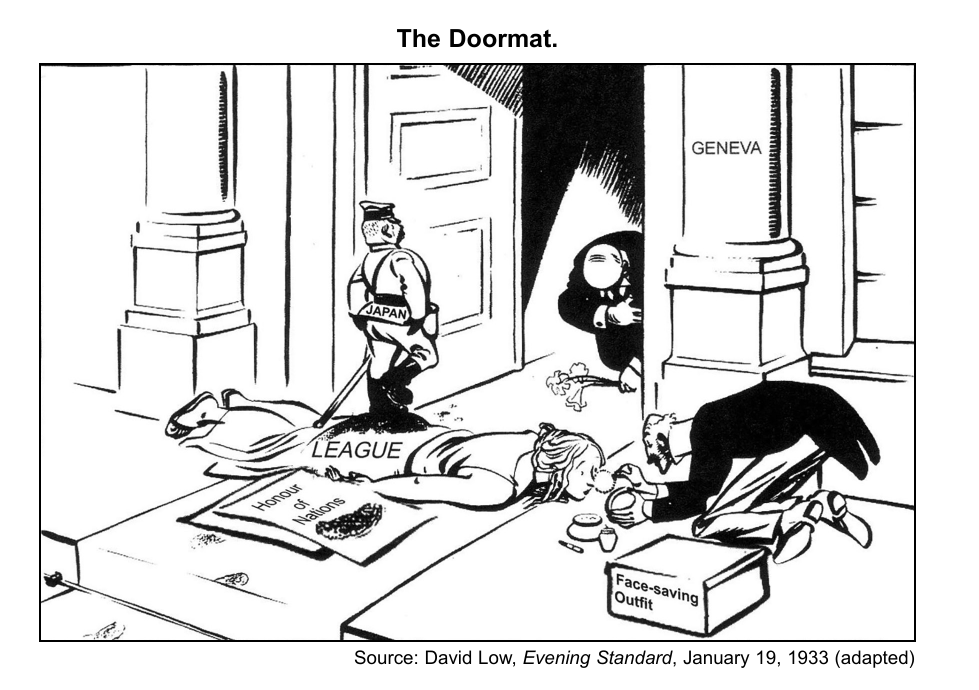
- (A) It allowed Japan to invade Manchuria without any form of retaliation. ✓
- (B) It supported Japan's invasion of Manchuria by supplying troops.
- (C) It attacked Japan after the invasion of Manchuria, but lost the battles.
- (D) It failed to include Great Britain in the original charter.
Worked solution
David Low's 1933 cartoon criticized the League of Nations for its impotence after Japan invaded Manchuria in 1931 and simply withdrew from the League rather than face any punishment.
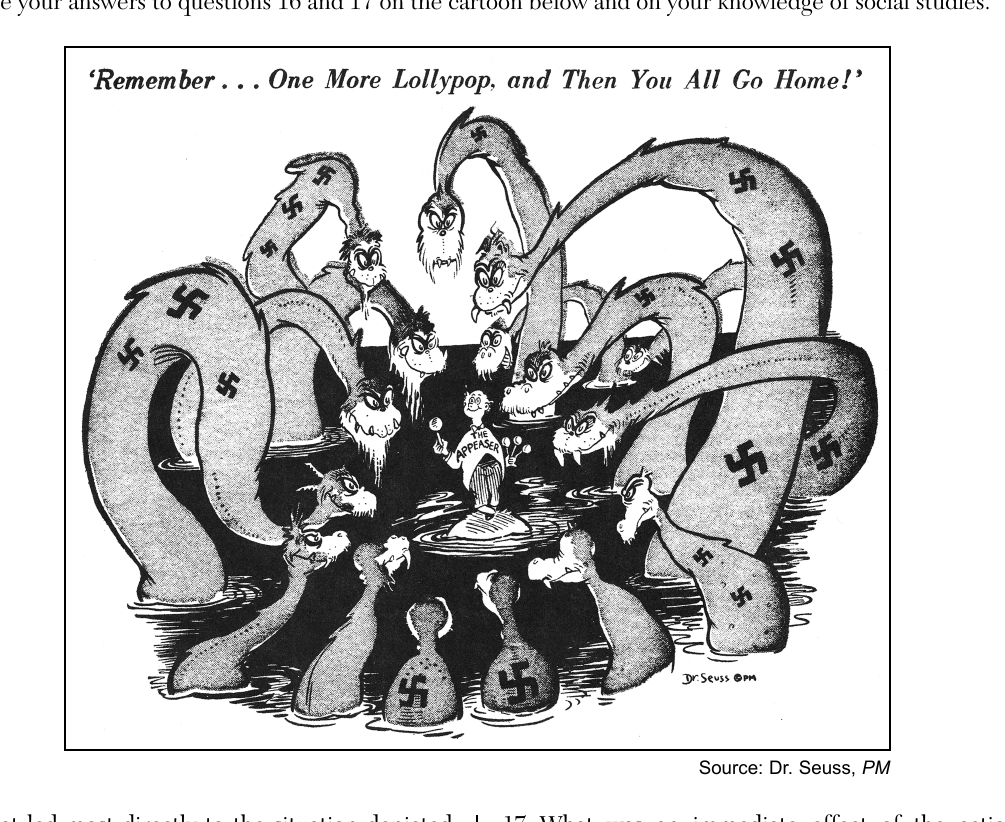
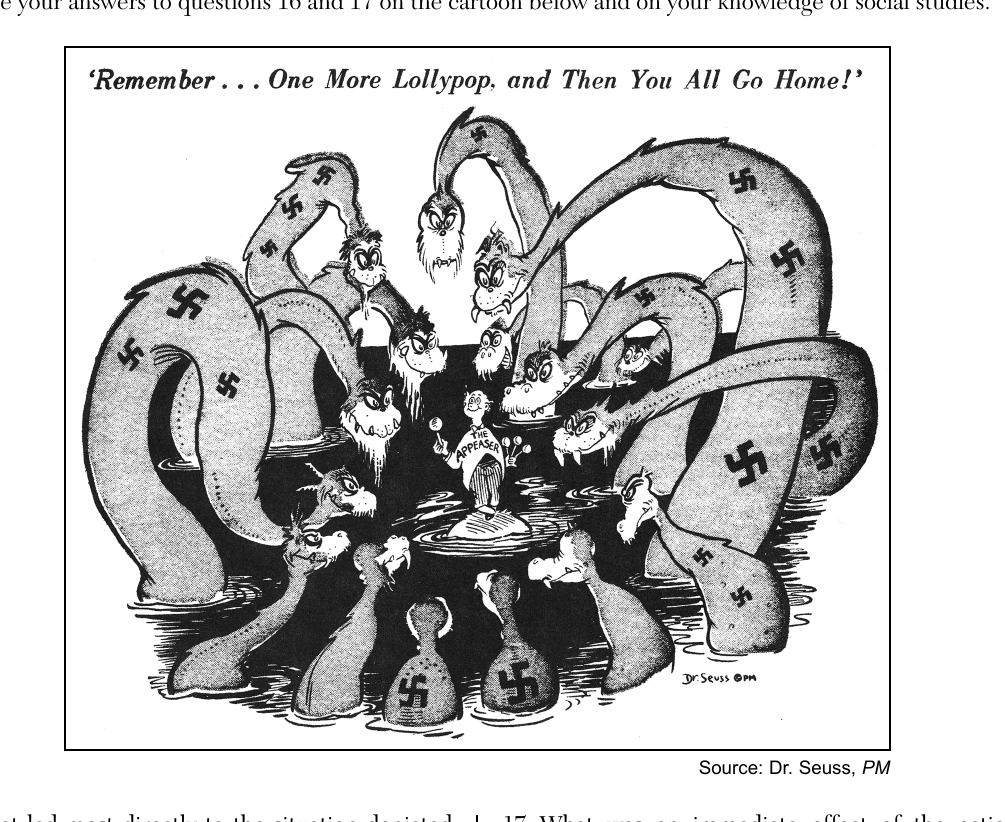
Based on the Dr. Seuss political cartoon captioned "Remember... One More Lollypop, and Then You All Go Home!" showing swastika-marked sea serpents surrounding a figure labeled "The Appeaser" giving out lollipops, what led most directly to the situation depicted in this cartoon?
- (A) the reluctance of Europeans to get drawn into another war ✓
- (B) international support for German militarism
- (C) the success of European peacemaking
- (D) the Allies' demand for German war reparations
Worked solution
Dr. Seuss satirized the policy of appeasement toward Nazi Germany in the late 1930s, which grew out of Britain and France's war-weariness and desire to avoid a repeat of World War I.
Based on the same Dr. Seuss cartoon showing an appeaser feeding demands to swastika-marked serpents, what was an immediate effect of the actions depicted in this cartoon?
- (A) The United States entered World War II.
- (B) The Nazis proceeded to take over new territory. ✓
- (C) Wilson's Fourteen Points allowed Germany to rebuild its military.
- (D) Nazi leaders were tried for crimes against humanity at Nuremberg.
Worked solution
Each act of appeasement was quickly followed by another German land grab, showing that giving in to Hitler's demands only encouraged further aggression rather than satisfying it.
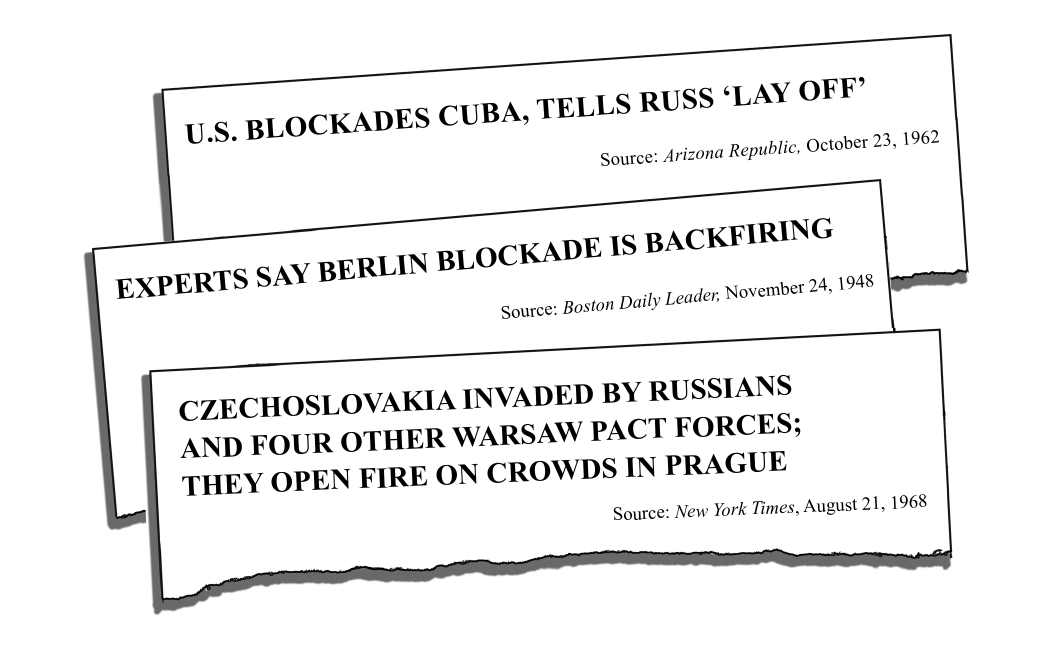
Based on three newspaper headlines shown, one on the U.S. blockade of Cuba (1962), one on the Berlin Blockade (1948), and one on the Warsaw Pact invasion of Czechoslovakia (1968), which generalization about the Cold War is best supported by these headlines?
- (A) It prevented outbreaks of violence.
- (B) It led to direct military conflict between the U.S. and the Soviet Union.
- (C) It impacted various countries and regions throughout the world. ✓
- (D) It required intervention by the United Nations.
Worked solution
The headlines about Berlin, Cuba, and Czechoslovakia illustrate how Cold War tensions between the United States and Soviet bloc played out in multiple, geographically distinct crises around the world.
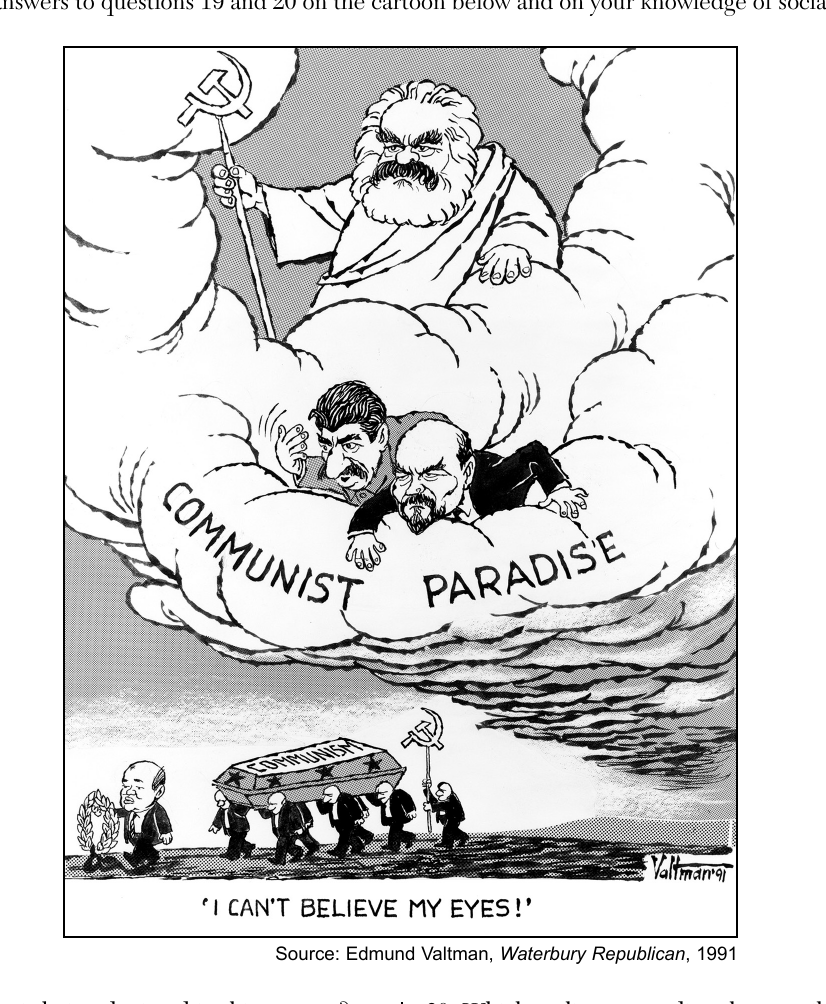
Based on the 1991 political cartoon showing Marx watching Stalin and Lenin drift away on a cloud labeled "Communist Paradise," while below a coffin labeled "Communism" is carried in a funeral procession, which event is being depicted in this cartoon?
- (A) the rule of Czar Nicholas II
- (B) the creation of the International Criminal Court
- (C) the collapse of the Soviet Union ✓
- (D) the decrease in the power of the Orthodox church
Worked solution
Edmund Valtman's 1991 cartoon marks the symbolic death of Soviet communism as the USSR collapsed, with founders Lenin and Stalin depicted floating away in a fictitious 'paradise' while communism is buried below.
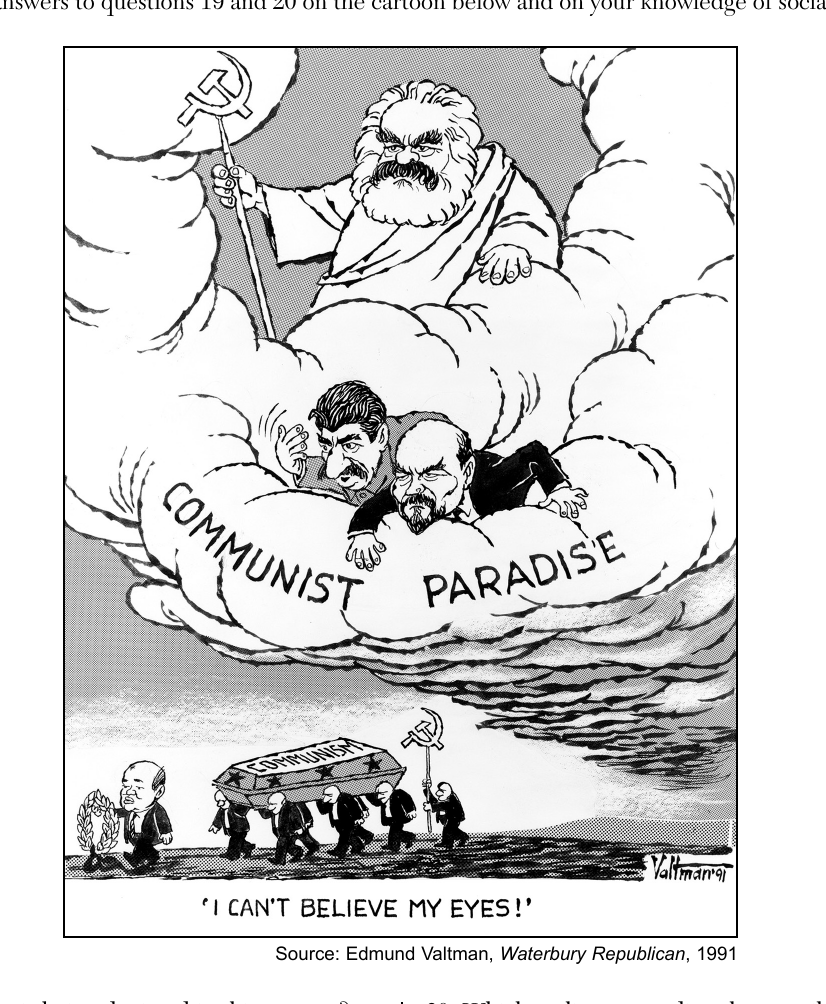
Based on the same 1991 cartoon depicting the funeral of Communism with Lenin and Stalin on a cloud, which policy most directly contributed to the situation shown in this cartoon?
- (A) Lenin's New Economic Policy
- (B) Stalin's Five-Year Plans
- (C) Deng's Four Modernizations
- (D) Gorbachev's policy of glasnost ✓
Worked solution
Gorbachev's glasnost opened Soviet society to open criticism and information, which accelerated unrest and hastened the political collapse of the Soviet Union depicted in the cartoon.
Based on a passage in which Kwame Nkrumah describes reminding his people that their land was their own and advocating strikes, boycotts, and non-cooperation rather than diplomacy with the British, which claim is most plausible based on the information in this passage?
Passage: ". . . I reminded the people that our land was our own and that we did not want to continue to live in slavery and under exploitation and oppression; that it was only under full self-government that we would be in a position to develop the country so that our people could enjoy the comforts and amenities of modern civilization. I explained to them the necessity for backing our demand for self-government with a programme of positive action employing legitimate agitation, newspaper and political educational campaigns and the application of strikes, boycotts and non-cooperation based on the principle of non-violence. I advised against diplomacy and deception as I pointed out to them that the British, as past masters themselves of diplomatic tactics, would far prefer to have from us frankness and firmness. A policy of collaboration and appeasement would get us nowhere in our struggle for immediate self-government. . . ." Source: Kwame Nkrumah, The Autobiography of Kwame Nkrumah, Thomas Nelson and Sons, 1957
- (A) Britain avoided diplomacy in dealing with Africans.
- (B) Kwame Nkrumah wanted independence from Britain. ✓
- (C) Self-government for European colonies only required education.
- (D) European powers encouraged colonial demands for freedom.
Worked solution
Kwame Nkrumah, leader of the Gold Coast's independence movement, used this passage to argue for immediate self-government and freedom from British colonial rule in what became Ghana.
Based on the same Nkrumah passage describing a programme of strikes, boycotts, and non-cooperation based on non-violence to demand self-government, which leader used similar methods as those described in this passage?
Passage: ". . . I reminded the people that our land was our own and that we did not want to continue to live in slavery and under exploitation and oppression; that it was only under full self-government that we would be in a position to develop the country so that our people could enjoy the comforts and amenities of modern civilization. I explained to them the necessity for backing our demand for self-government with a programme of positive action employing legitimate agitation, newspaper and political educational campaigns and the application of strikes, boycotts and non-cooperation based on the principle of non-violence. I advised against diplomacy and deception as I pointed out to them that the British, as past masters themselves of diplomatic tactics, would far prefer to have from us frankness and firmness. A policy of collaboration and appeasement would get us nowhere in our struggle for immediate self-government. . . ." Source: Kwame Nkrumah, The Autobiography of Kwame Nkrumah, Thomas Nelson and Sons, 1957
- (A) Ho Chi Minh
- (B) Mao Zedong
- (C) Mohandas Gandhi ✓
- (D) Ayatollah Khomeini
Worked solution
Nkrumah's strategy of non-violent strikes, boycotts, and non-cooperation directly echoed Mohandas Gandhi's methods of civil disobedience used against British colonial rule in India.
Based on a passage discussing India's partition and the two-nation theory, including Muhammad Ali Jinnah's claim that "Hindus and Muslims belong to two different religious philosophies, social customs and literary traditions... and indeed they belong to two different civilizations," which claim about the need to create Pakistan is best supported by this passage?
- (A) Concerns about the loss of shared Muslim and Hindu traditions need to be considered.
- (B) Local residents should determine whether Kashmir is controlled by Muslims or Hindus.
- (C) The cultural identity of Muslims is unique and separate from that of Hindus. ✓
- (D) Muslims and Hindus could not live in harmony without colonial assistance.
Worked solution
Jinnah's two-nation theory held that Muslims and Hindus formed distinct civilizations with irreconcilable differences, providing the ideological justification for the creation of Pakistan.
Based on the same passage on India's partition, which notes that modern thinkers seek an explanation for the subcontinent's divides in the British Raj, some modern thinkers believed the continuing tensions between Hindus and Muslims on the Indian subcontinent were caused by the
- (A) secular beliefs of India's leaders
- (B) policies of the British Raj ✓
- (C) philosophies of Buddhist Monks
- (D) social customs in Hindu temples
Worked solution
Some historians argue British colonial administration, including policies like separate electorates, deepened and hardened Hindu-Muslim divisions that contributed to the tensions surrounding partition.
Based on a passage describing Turkish reforms including the adoption of a new constitution, Western headgear, a Swiss-inspired civil code, the Latin alphabet, and the removal of Islam as the official state religion, what inference about Atatürk is best supported by this passage?
- (A) He was a strict believer of Adam Smith's ideas.
- (B) He supported westernization. ✓
- (C) He opposed secularization.
- (D) He based his ideas on key concepts of Sharia law.
Worked solution
Mustafa Kemal Atatürk's reforms deliberately replaced Ottoman and Islamic institutions with Western European models in law, dress, writing, and government to modernize the new Turkish Republic.
Based on the same passage describing Atatürk's reforms adopting a new constitution and abolishing Islam as the official state religion, the policies being described in this passage are a result of the
- (A) Iranian Revolution
- (B) fall of the Ottoman Empire ✓
- (C) Mughal victory during World War I
- (D) Mandate System following World War II
Worked solution
Atatürk's sweeping secularizing and westernizing reforms were only possible after the Ottoman Empire's collapse following World War I, which allowed him to found and reshape the new Turkish Republic.
Based on a 1995 political cartoon showing a large stone wall labeled "UN Peacekeeping" with a crowd of refugees gathered helplessly outside and a sign reading "Pull Cord for Service," which statement best describes this cartoonist's point of view of the United Nations (UN)?
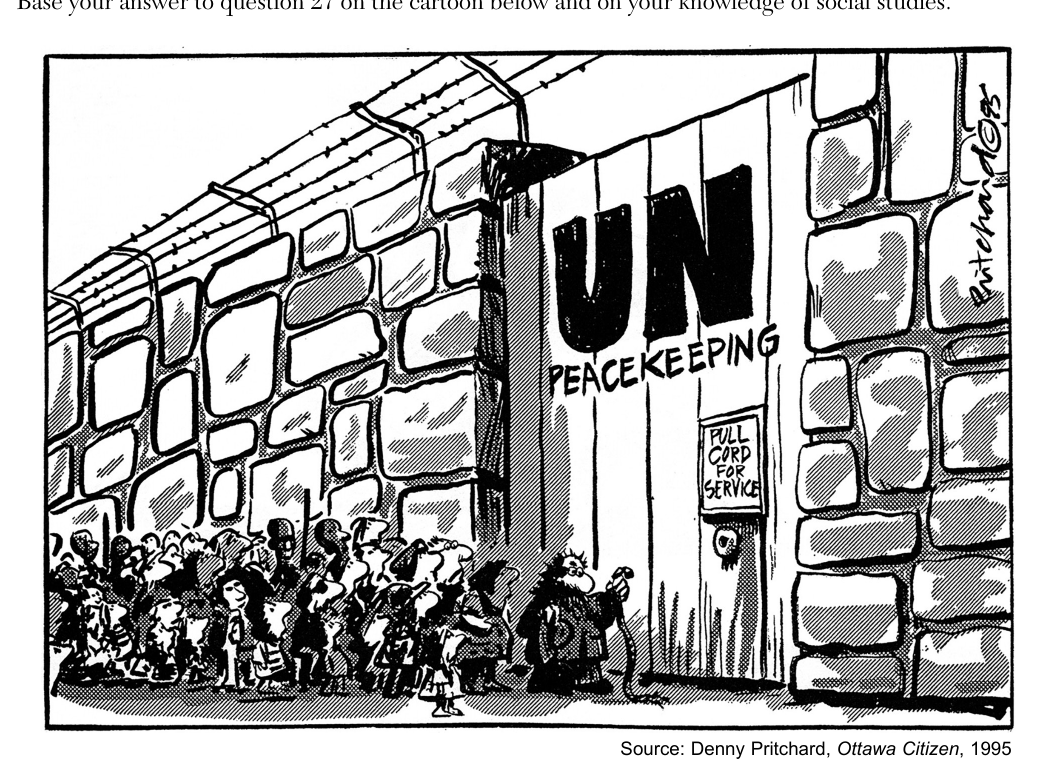
- (A) The United Nations peacekeeping system is broken. ✓
- (B) People are safe because of United Nations peacekeeping efforts.
- (C) Walls are the most effective United Nations peacekeeping tool.
- (D) United Nations peacekeeping efforts are supported by many people.
Worked solution
The cartoon criticizes UN peacekeeping in the 1990s (such as in Bosnia or Rwanda) as ineffective and unresponsive, depicting a wall that shuts out desperate civilians rather than protecting them.
Based on an article in which Wael Ghonim reflects that he once believed "if you want to liberate a society, all you need is the Internet," but concludes the Arab Spring showed "the same tool that united us to topple dictators eventually tore us apart," which claim about the internet can best be supported by this article?
- (A) It is slower than traditional means of communication.
- (B) It is only favored by young, urban individuals.
- (C) It is always an accurate source of information.
- (D) It can be used to promote different political ideologies. ✓
Worked solution
Wael Ghonim's reflection on the Arab Spring shows how social media and the internet could both unite people around a revolutionary cause and later be exploited to spread division and opposing political ideologies.