June 2025 Geometry Regents — Answer Key & Worked Solutions
Every question from the June 2025 Geometry Regents exam, with the correct answer and a full step-by-step solution. Check your work, learn the method, then convert your raw score.
These are real questions from the June 2025 Geometry New York State Regents examination, published by NYSED. Worked solutions are written by RegentsLab.
The perimeter of a triangle is 18. What is the perimeter of a similar triangle after a dilation with a scale factor of 3?
- (A) 6
- (B) 18
- (C) 54 ✓
- (D) 162
Worked solution
A dilation multiplies every linear dimension, including perimeter, by the scale factor.
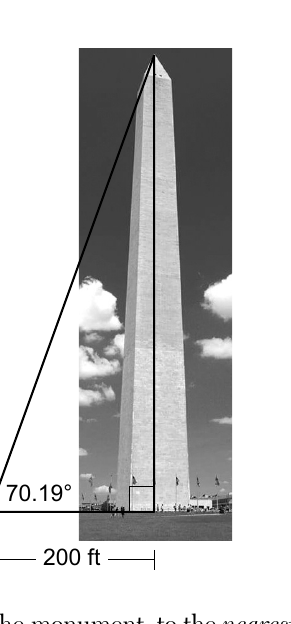
The Washington Monument, shown below, is in Washington, D.C. At a point on the ground 200 feet from the center of the base of the monument, the angle of elevation to the top of the monument is 70.19°. What is the height of the monument, to the nearest foot?
- (A) 188
- (B) 213
- (C) 555 ✓
- (D) 590
Worked solution
The height is the side opposite the angle of elevation, and the 200 ft distance is adjacent, so tangent relates them.
On the set of axes below, △EQA and △SUL are graphed. Which sequence of transformations shows that △EQA ≅ △SUL?
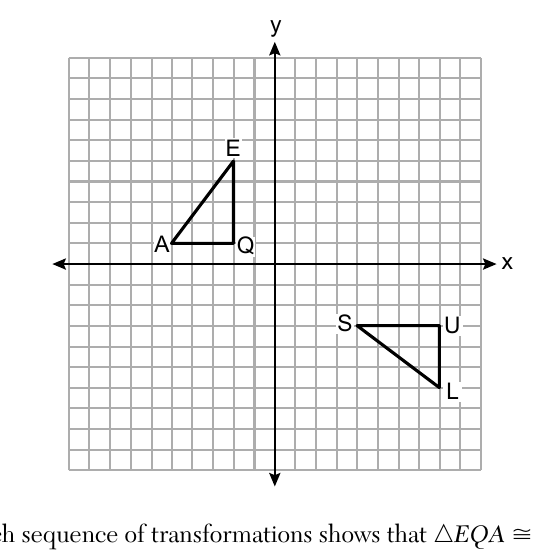
- (A) Rotate △EQA 90° counterclockwise about the origin and then translate 9 units right and 1 unit down. ✓
- (B) Rotate △EQA 90° counterclockwise about the origin and then reflect over the line $x = 4$.
- (C) Reflect △EQA over the x-axis and then rotate 90° clockwise about the origin.
- (D) Translate △EQA 10 units right and then reflect over the line $x = -1$.
Worked solution
Tracing the vertices of △EQA through a 90° counterclockwise rotation about the origin followed by the given translation lands exactly on the corresponding vertices of △SUL, and both are rigid motions so congruence is preserved.
If two sides of a triangle have lengths of 2 and 8, the length of the third side could be
- (A) 10
- (B) 7 ✓
- (C) 6
- (D) 4
Worked solution
By the Triangle Inequality Theorem the third side must be strictly between the difference and sum of the other two sides; only 7 satisfies 6 < x < 10.
A regular octagon is rotated about its center. Which angle measure will carry the octagon onto itself?
- (A) 36°
- (B) 90° ✓
- (C) 144°
- (D) 160°
Worked solution
A regular n-gon maps onto itself under rotations that are multiples of 360°/n; for an octagon that is multiples of 45°, and 90° is the only such multiple among the choices.
An equation of a circle is $x^2 + y^2 - 6x + 2y = 14$. What are the coordinates of the center and the length of the radius of this circle?
- (A) $(-3,1)$ and $r = 5$
- (B) $(3,-1)$ and $r = 5$
- (C) $(-3,1)$ and $r = \sqrt{24}$
- (D) $(3,-1)$ and $r = \sqrt{24}$ ✓
Worked solution
Completing the square puts the equation in standard form, revealing center (3,-1) and radius √24.
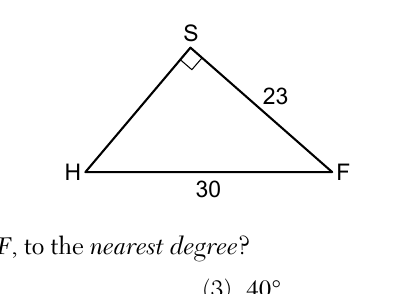
In △HSF below, m∠S = 90°, HF = 30, and FS = 23. What is m∠F, to the nearest degree?
- (A) 53°
- (B) 50°
- (C) 40° ✓
- (D) 37°
Worked solution
Since angle S is the right angle, HF is the hypotenuse and FS is adjacent to angle F, so cosine relates them.
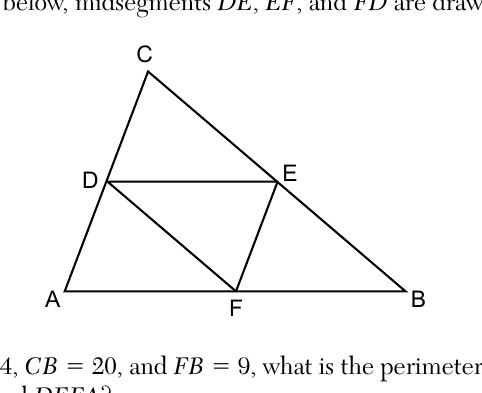
In △CAB below, midsegments $\overline{DE}$, $\overline{EF}$, and $\overline{FD}$ are drawn. If CA = 14, CB = 20, and FB = 9, what is the perimeter of quadrilateral DEFA?
- (A) 26
- (B) 32 ✓
- (C) 44
- (D) 52
Worked solution
Each midsegment is half the length of the side it is parallel to, so DE = 9, EF = 7, and with AD = 7 and FA = 9 the quadrilateral's perimeter is 32.
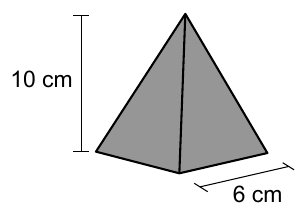
A candle can be modeled by a pyramid with a square base, as shown below. The height of the candle is 10 cm, and each side of the base measures 6 cm. If the candle wax burns at a rate of 3.5 cubic centimeters per hour, what is the approximate number of hours this candle could burn?
- (A) 103
- (B) 51
- (C) 34 ✓
- (D) 11
Worked solution
Compute the pyramid's volume, then divide by the burn rate to find approximate burn time.
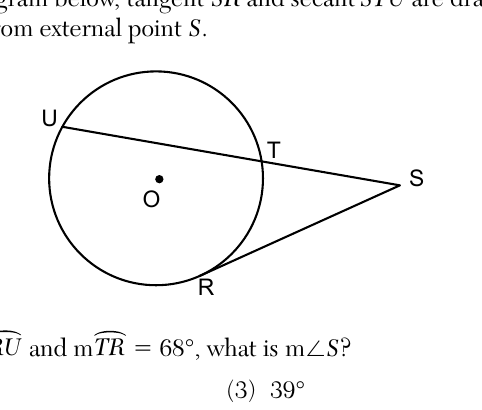
In the diagram below, tangent $\overline{SR}$ and secant $\overline{STU}$ are drawn to circle O from external point S. If $\widehat{TU} \cong \widehat{RU}$ and $m\widehat{TR} = 68°$, what is m∠S?
- (A) 22°
- (B) 34°
- (C) 39° ✓
- (D) 78°
Worked solution
The tangent-secant angle equals half the difference of the intercepted arcs; using the arc relationships given, the far arc RU is 146° and the near arc TR is 68°.
Triangle RST has m∠S = 33°, RS = 7, and ST = 12. What is the area of △RST, to the nearest tenth?
- (A) 22.9 ✓
- (B) 27.3
- (C) 35.2
- (D) 45.7
Worked solution
Use the SAS area formula, which requires two sides and the included angle.
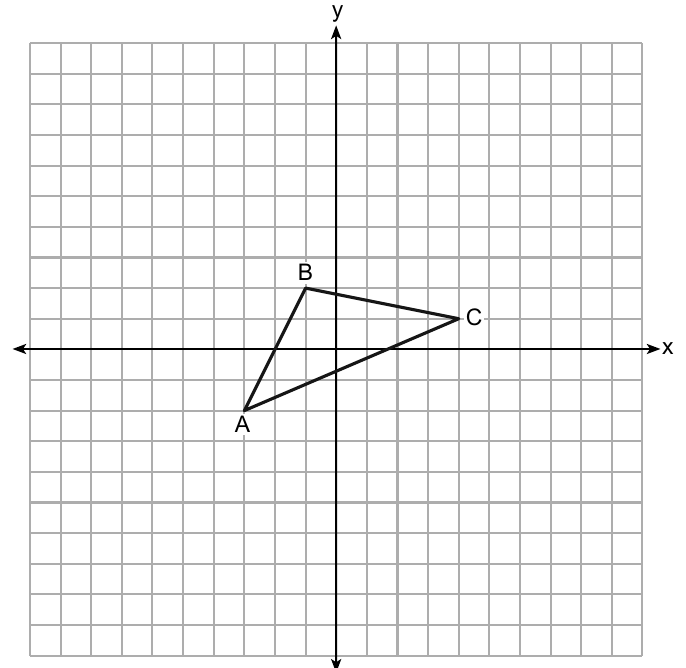
Triangle ABC, with vertices whose coordinates are A(-3,-2), B(-1,2), and C(4,1), is graphed on the set of axes below. Triangle A'B'C', whose vertices have coordinates A'(-6,-2), B'(-2,2), and C'(8,1), is the image of △ABC. The transformation that maps △ABC onto △A'B'C' is a
- (A) dilation
- (B) translation
- (C) vertical stretch
- (D) horizontal stretch ✓
Worked solution
Every x-coordinate doubles while every y-coordinate stays the same, which is a horizontal stretch (not a uniform dilation, since x and y scale differently).
Which equation represents a line parallel to the line represented by $y = 4x + 6$ and passing through the point (-3,2)?
- (A) $y - 2 = 4(x + 3)$ ✓
- (B) $y + 3 = 4(x - 2)$
- (C) $y - 2 = -\frac{1}{4}(x + 3)$
- (D) $y + 3 = -\frac{1}{4}(x - 2)$
Worked solution
Parallel lines share the same slope, so using point-slope form with slope 4 and point (-3,2) gives the correct equation.
Which two-dimensional figure is always formed when a plane intersects a right cylinder perpendicular to its base?
- (A) circle
- (B) triangle
- (C) rhombus
- (D) rectangle ✓
Worked solution
A vertical cross-section (perpendicular to the base) of a right cylinder always produces a rectangle, bounded by two parallel vertical segments equal to the height and two parallel chords of the circular bases.
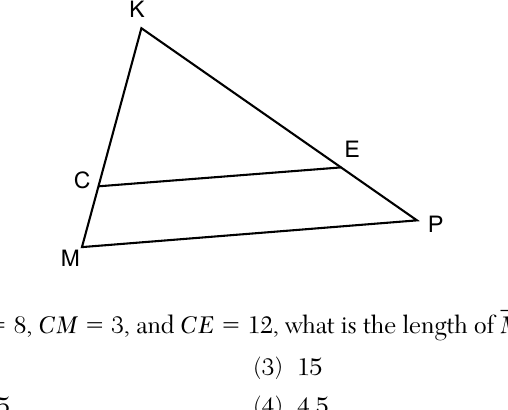
In △KMP below, $\overline{CE}$ is drawn parallel to $\overline{MP}$. If KC = 8, CM = 3, and CE = 12, what is the length of $\overline{MP}$?
- (A) 24
- (B) 16.5 ✓
- (C) 15
- (D) 4.5
Worked solution
Since CE is parallel to MP, triangles KCE and KMP are similar, giving a proportion between corresponding sides.
A parallelogram must be a rectangle if its diagonals
- (A) are perpendicular
- (B) bisect each other
- (C) bisect its angles
- (D) are congruent ✓
Worked solution
All parallelograms have diagonals that bisect each other, but only a rectangle's diagonals are also congruent.
Point O divides $\overline{COA}$ such that CO:OA = 1:4. If C has coordinates (-2,-9) and A has coordinates (3,6), the coordinates of O are
- (A) (2,3)
- (B) (1,0)
- (C) (0,-3)
- (D) (-1,-6) ✓
Worked solution
Since CO:OA = 1:4, point O partitions segment CA in a 1:4 ratio, located 1/5 of the way from C to A.
A spherical balloon is fully inflated with helium to a diameter of 1.7 feet. If helium costs $0.80 per cubic foot, what is the cost to completely fill the balloon with helium?
- (A) $2.06 ✓
- (B) $2.42
- (C) $3.22
- (D) $16.46
Worked solution
Compute the sphere's volume from its radius, then multiply by the cost per cubic foot.
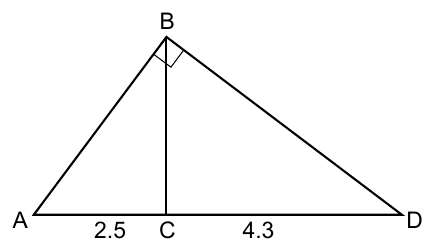
In right triangle ABD below, altitude $\overline{BC}$ is drawn to hypotenuse $\overline{AD}$, AC = 2.5, and CD = 4.3. What is the length of $\overline{BA}$, to the nearest tenth?
- (A) 3.3
- (B) 3.4
- (C) 4.1 ✓
- (D) 5.4
Worked solution
The leg adjacent to the smaller segment equals the geometric mean of that segment and the whole hypotenuse.
Trapezoid ZOYD has parallel sides $\overline{ZO}$ and $\overline{DY}$. If m∠Z = 141° and m∠Y = 73°, what is m∠D?
- (A) 39° ✓
- (B) 73°
- (C) 107°
- (D) 141°
Worked solution
Angles Z and D lie on the same leg (transversal) between the two parallel sides, so they are supplementary co-interior angles.
Triangle ABC is translated 5 units to the left and 2 units up to map onto $\triangle PQR$. Which statement is not always true?
- (A) $\triangle PQR \cong \triangle ABC$
- (B) $\angle A \cong \angle Q$ ✓
- (C) $BQ = \sqrt{29}$
- (D) $RQ = CB$
Worked solution
A translation is a rigid motion, so it preserves distances and maps corresponding parts (A to P, B to Q, C to R) onto each other; angle A corresponds to angle P, not angle Q, so that statement fails.
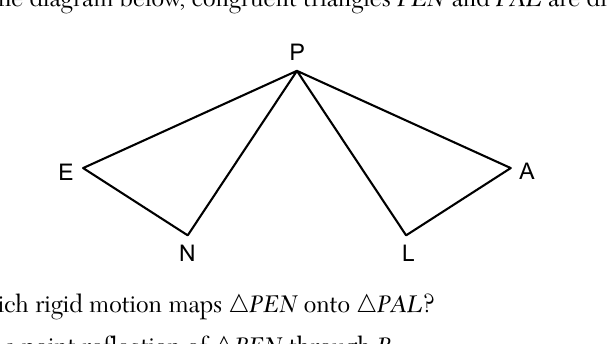
In the diagram below, congruent triangles PEN and PAL are drawn. Which rigid motion maps $\triangle PEN$ onto $\triangle PAL$?
- (A) a point reflection of $\triangle PEN$ through P
- (B) a reflection of $\triangle PEN$ over the angle bisector of $\angle EPA$ ✓
- (C) a rotation of $\triangle PEN$ about point P, mapping $\overline{PE}$ onto $\overline{PA}$
- (D) a translation of $\triangle PEN$ along $\overline{EA}$, mapping point E onto A
Worked solution
Since PE = PA and PN = PL with the triangles arranged symmetrically about the vertex P, the line that maps one onto the other is the angle bisector of angle EPA, which is a line of reflection, not a rotation or point reflection center.
A cone has a height of 8 inches and volume of 75.4 cubic inches. What is the diameter of the cone, to the nearest inch?
- (A) 9
- (B) 2
- (C) 3
- (D) 6 ✓
Worked solution
Solving the cone volume formula for radius gives r approximately 3 inches, so the diameter is about 6 inches.
The line represented by the equation 5x - 2y = 10 is transformed by a dilation centered at (2,0) with a scale factor of 2. The image of the line
- (A) is the original line ✓
- (B) passes through the point (4,0)
- (C) passes through the point (0,-10)
- (D) is perpendicular to the original line
Worked solution
A dilation centered at a point that lies on a line maps that line onto itself, regardless of scale factor, since every point on the line dilates to another point on the same line through the center.
In the year 2020, the village of Depew, New York had an area of 5.1 square miles and a population of 15,069. In the same year, the village of Lancaster, New York had an area of 2.7 square miles and a population of 10,087. Which village had the larger population density in 2020? Justify your answer.
Worked solution
Population density equals population divided by area; comparing the two computed densities shows Lancaster is denser than Depew.
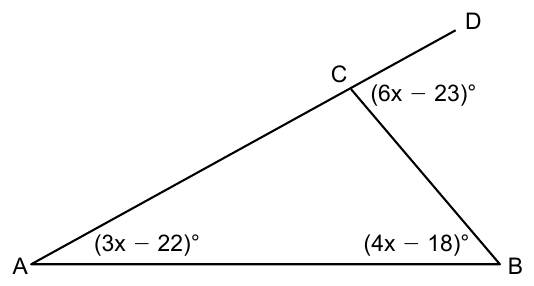
In $\triangle ABC$ below, $\overline{AC}$ is extended through C to D, $m\angle A = (3x-22)^{\circ}$, $m\angle B = (4x-18)^{\circ}$, and $m\angle BCD = (6x-23)^{\circ}$. Determine and state $m\angle ACB$.
Worked solution
The exterior angle of a triangle equals the sum of the two remote interior angles, which gives x = 17; angle ACB is supplementary to exterior angle BCD since they form a linear pair along line ACD.
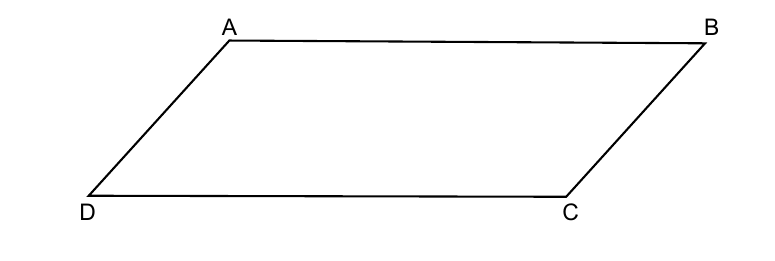
Parallelogram ABCD is shown below. Using a compass and straightedge, construct the altitude from point A to side $\overline{DC}$. Leave all construction marks.
Worked solution
This is a classic compass-and-straightedge construction of a perpendicular from an external point to a line, which produces the altitude from vertex A to side DC of the parallelogram.
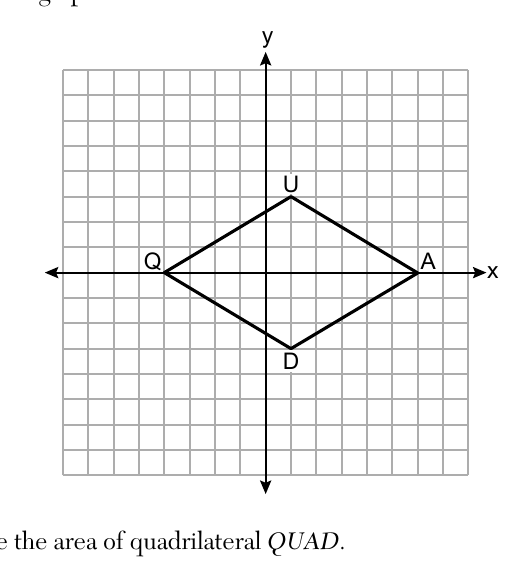
Quadrilateral QUAD is graphed on the set of axes below. Determine and state the area of quadrilateral QUAD.
Worked solution
QUAD's diagonals lie on the x- and y-axes; reading their lengths from the grid and applying the diagonals-of-a-rhombus area formula gives the area.
In a right triangle, the acute angles have the relationship $\sin(3x-7)^{\circ} = \cos(x+1)^{\circ}$. Determine and state the value of $x$.
Worked solution
Sine and cosine of complementary angles are equal, so the two given angle expressions must sum to 90 degrees; solving that linear equation gives x = 24.
In circle A, $m\angle BAM = 36^{\circ}$. If $AB = 20$, determine and state the length of $\widehat{MB}$. Leave your answer in terms of $\pi$.
Worked solution
The central angle BAM equals the measure of its intercepted arc MB; the arc length is that fraction of the full circumference (2 pi r).
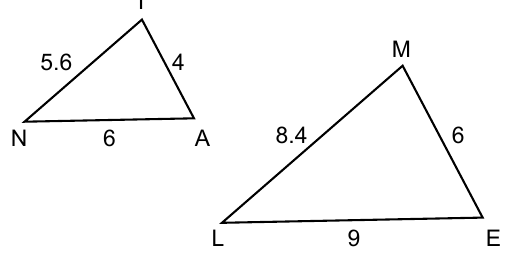
In triangles ANT and ELM below, AN = 6, NT = 5.6, TA = 4, EL = 9, LM = 8.4, and ME = 6. Explain why $\triangle ANT \sim \triangle ELM$.
Worked solution
Since the ratios of all three pairs of corresponding sides (AN to EL, NT to LM, TA to ME) are equal, the SSS similarity theorem guarantees the triangles are similar.
A store sells colored craft sand in the three different containers below. Container 1: A square prism with a base length of 4 inches and a height of 7.5 inches. Container 2: A cylinder with a diameter of 5 inches and a height of 6 inches. Container 3: A cone with a diameter of 7.5 inches and a height of 8.5 inches. If the containers are filled to the top, which container will hold the most sand? Justify your answer.
Worked solution
Computing each solid's volume with the appropriate formula (square prism, cylinder, cone) shows the cone (Container 3) has the greatest volume and therefore holds the most sand.
Quadrilateral MIKE has vertices with coordinates M(-1,-3), I(-3,3), K(5,4), and E(7,-2). Prove MIKE is a parallelogram, and prove MIKE is not a rhombus.
Worked solution
A quadrilateral is a parallelogram if its diagonals bisect each other, which is shown by the equal midpoints of MK and IE; since a rhombus requires all sides congruent, showing two adjacent sides have different lengths proves MIKE is not a rhombus.
A park ranger needs to secure two different trees with wire. A wire is to be attached from a stake in the ground to each tree. The wire is attached at two different heights and two different angles of elevation, as indicated in the model: one tree has height 4 ft with the wire making a 24 degree angle of elevation from the stake, and the other tree has height 3 ft with the wire making an 11.6 degree angle of elevation from the stake. The park ranger has 20 feet of wire. Does the park ranger have enough wire to secure both trees? Justify your answer.
Worked solution
Each wire is the hypotenuse of a right triangle where the tree height is opposite the angle of elevation at the stake, so wire length = height divided by sine of the angle; summing both required lengths and comparing to the available 20 feet shows the ranger falls short.
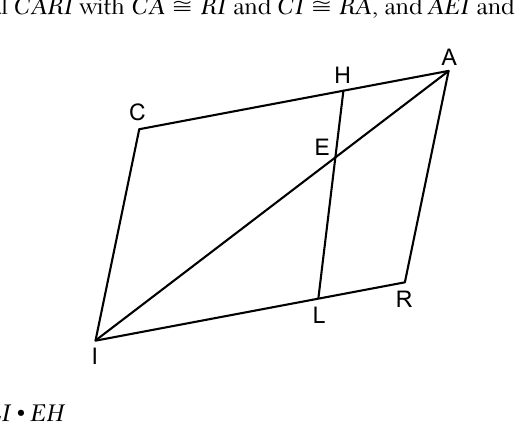
Given: Quadrilateral CARI with $\overline{CA} \cong \overline{RI}$ and $\overline{CI} \cong \overline{RA}$, and $\overline{AEI}$ and $\overline{LEH}$ are drawn. Prove: $HA \cdot EL = LI \cdot EH$
Worked solution
Because both pairs of opposite sides are congruent, CARI is a parallelogram, making CA parallel to IR (and therefore HA parallel to LI); this parallelism, together with the vertical angles at E where diagonals AI and LH cross, establishes triangle AEH similar to triangle IEL by AA, whose proportional sides directly yield the desired product equality.