June 2024 Geometry Regents — Answer Key & Worked Solutions
Every question from the June 2024 Geometry Regents exam, with the correct answer and a full step-by-step solution. Check your work, learn the method, then convert your raw score.
These are real questions from the June 2024 Geometry New York State Regents examination, published by NYSED. Worked solutions are written by RegentsLab.
In the diagram below, $\triangle BRI$ is the image of $\triangle JOE$ after a translation. Triangle $CAT$ is the image of $\triangle BRI$ after a line reflection. Which statement is always true?
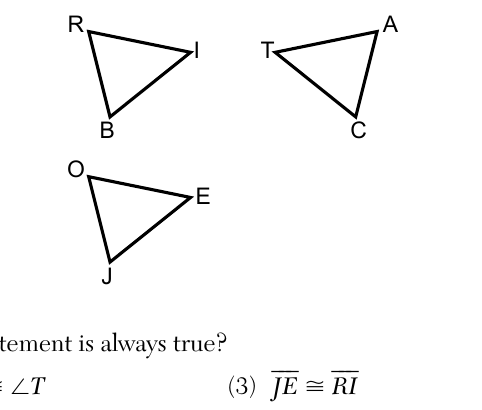
- (A) $\angle R \cong \angle T$
- (B) $\angle J \cong \angle A$
- (C) $\overline{JE} \cong \overline{RI}$
- (D) $\overline{OE} \cong \overline{AT}$ ✓
Worked solution
Tracking the vertex correspondence through both isometries shows O maps to A and E maps to T, and translations/reflections preserve segment length, so OE is congruent to AT.
A right cylinder is cut parallel to its base. The shape of this cross section is a
- (A) cone
- (B) circle ✓
- (C) triangle
- (D) rectangle
Worked solution
Slicing a cylinder with a plane parallel to its circular base always produces a circular cross section.
What is the minimum number of degrees that a regular hexagon must rotate about its center to carry it onto itself?
- (A) $45°$
- (B) $72°$
- (C) $60°$ ✓
- (D) $120°$
Worked solution
A regular n-gon maps onto itself under a rotation of 360/n degrees, and for a hexagon n = 6, giving 60 degrees as the minimum rotation.
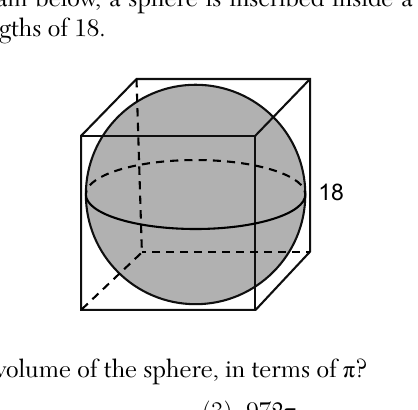
In the diagram below, a sphere is inscribed inside a cube. The cube has edge lengths of 18. What is the volume of the sphere, in terms of $\pi$?
- (A) $108\pi$
- (B) $432\pi$
- (C) $972\pi$ ✓
- (D) $7776\pi$
Worked solution
The sphere's diameter equals the cube's edge length of 18, so the radius is 9, and substituting into the sphere volume formula gives 972 pi.
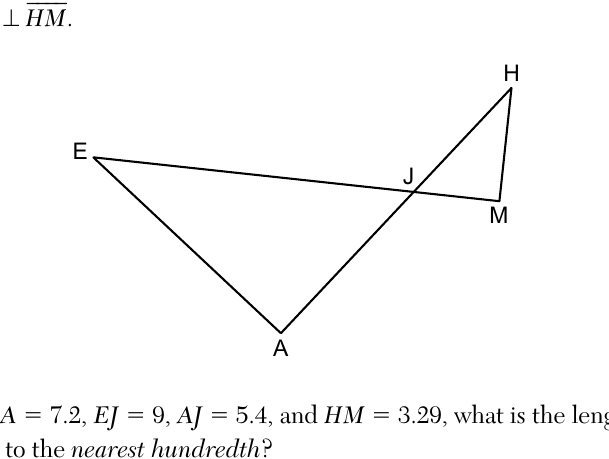
In the diagram below, $\overline{EM}$ intersects $\overline{HA}$ at $J$, $\overline{EA} \perp \overline{HA}$, and $\overline{EM} \perp \overline{HM}$. If $EA = 7.2$, $EJ = 9$, $AJ = 5.4$, and $HM = 3.29$, what is the length of $\overline{MJ}$, to the nearest hundredth?
- (A) $2.47$ ✓
- (B) $2.63$
- (C) $4.11$
- (D) $4.39$
Worked solution
The two right triangles sharing vertical angles at J are similar by AA, so setting up the proportion between corresponding legs and solving for MJ gives approximately 2.47.
Which equation represents the line that passes through the point $(2,-7)$ and is perpendicular to the line whose equation is $y = \frac{3}{4}x + 4$?
- (A) $y + 7 = \frac{3}{4}(x-2)$
- (B) $y - 7 = \frac{3}{4}(x+2)$
- (C) $y + 7 = -\frac{4}{3}(x-2)$ ✓
- (D) $y - 7 = -\frac{4}{3}(x+2)$
Worked solution
Perpendicular lines have slopes that are negative reciprocals, so the slope 3/4 becomes -4/3, and substituting the given point into point-slope form yields the equation.
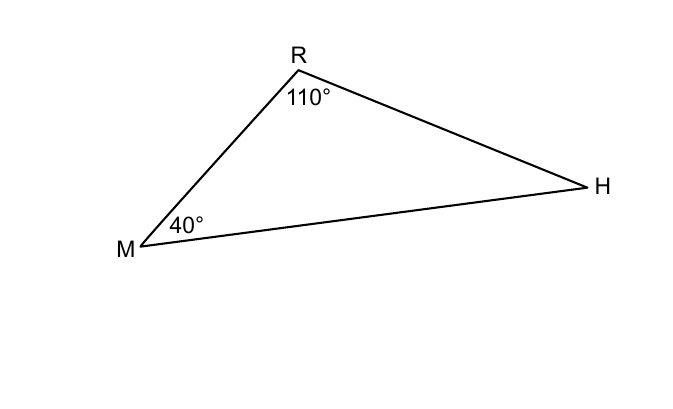
In $\triangle RHM$ below, $m\angle R = 110°$ and $m\angle M = 40°$. If $\triangle RHM$ is reflected over side $\overline{HM}$ to form quadrilateral $RHR'M$, which statement is always true?
- (A) Quadrilateral $RHR'M$ is a parallelogram.
- (B) $m\angle MHR' = 40°$
- (C) $m\angle HMR' = 40°$ ✓
- (D) $\overline{MR} \cong \overline{HR'}$
Worked solution
Because the reflection line HM is fixed, the angle between HM and the reflected side MR' equals the original angle between HM and MR, which is 40 degrees.
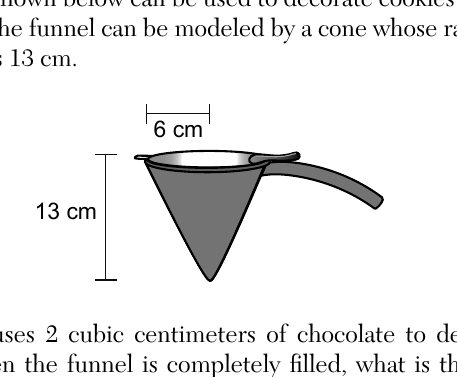
The funnel shown below can be used to decorate cookies with melted chocolate. The funnel can be modeled by a cone whose radius is 6 cm and height is 13 cm. The baker uses 2 cubic centimeters of chocolate to decorate each cookie. When the funnel is completely filled, what is the maximum number of cookies that can be decorated with the melted chocolate?
- (A) $78$
- (B) $245$ ✓
- (C) $490$
- (D) $735$
Worked solution
Compute the cone's volume with the formula one-third pi r squared h, then divide by 2 cubic centimeters per cookie and round down since only whole cookies can be decorated.
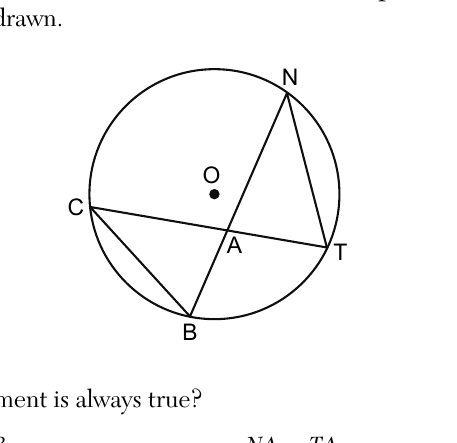
In circle $O$ below, chords $\overline{CT}$ and $\overline{BN}$ intersect at point $A$. Chords $\overline{CB}$ and $\overline{NT}$ are drawn. Which statement is always true?
- (A) $\frac{NT}{TA} = \frac{CB}{BA}$ ✓
- (B) $\angle BAC \cong \angle ATN$
- (C) $\frac{NA}{AB} = \frac{TA}{AC}$
- (D) $\angle BCA \cong \angle NTA$
Worked solution
The intersecting chords create two triangles that are similar by AA (vertical angles plus equal inscribed angles subtending the same arc), so their corresponding sides are proportional as shown in choice 1.
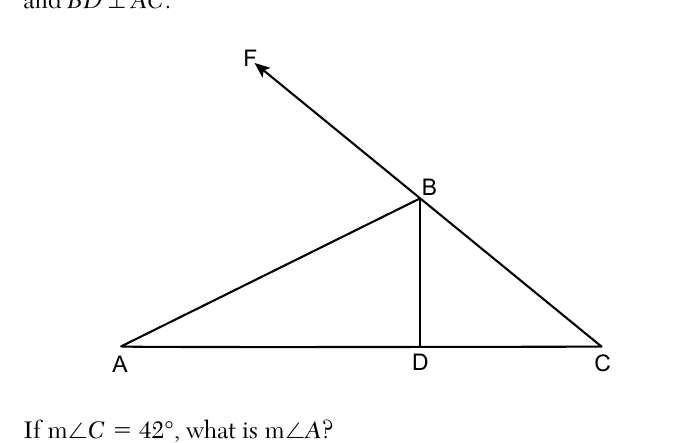
In the diagram below of $\triangle ABC$, $\overrightarrow{CBF}$ is drawn, $\overrightarrow{AB}$ bisects $\angle FBD$, and $\overline{BD} \perp \overline{AC}$. If $m\angle C = 42°$, what is $m\angle A$?
- (A) $24°$ ✓
- (B) $33°$
- (C) $48°$
- (D) $66°$
Worked solution
Using the right triangle formed by the altitude BD and the fact that ray AB bisects angle FBD along the straight line CBF, working backward from angle C gives angle A equal to 24 degrees.
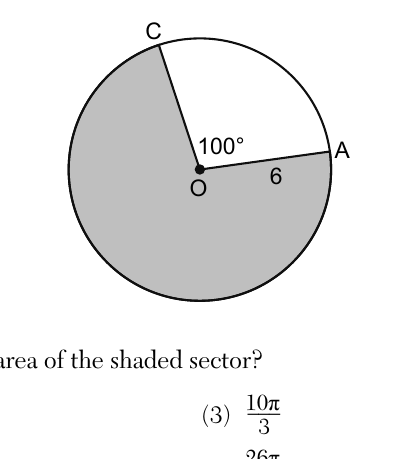
In circle $O$ below, $OA = 6$, and $m\angle COA = 100°$. What is the area of the shaded sector?
- (A) $10\pi$
- (B) $26\pi$ ✓
- (C) $\frac{10\pi}{3}$
- (D) $\frac{26\pi}{3}$
Worked solution
The shaded region is the major sector with central angle 260 degrees, so applying the sector area formula with radius 6 gives 26 pi.
In rectangle $ABCD$, diagonal $\overline{AC}$ is drawn. The measure of $\angle ACD$ is $37°$ and the length of $\overline{BC}$ is 7.6 cm. What is the length of $\overline{AC}$, to the nearest tenth of a centimeter?
- (A) $4.6$
- (B) $9.5$
- (C) $10.1$
- (D) $12.6$ ✓
Worked solution
Since ABCD is a rectangle, angle D is a right angle and side AD equals BC, so the diagonal AC can be found using sine of the given angle in right triangle ACD.
A peanut butter manufacturer would like to use a cylindrical jar with a volume of 1180 $cm^3$. The jar has a height of 10 cm. What is the diameter of the jar, to the nearest tenth of a centimeter?
- (A) $3.8$
- (B) $6.1$
- (C) $10.9$
- (D) $12.3$ ✓
Worked solution
Solving the cylinder volume formula for radius using the given volume and height, then doubling to get the diameter, gives approximately 12.3 cm.
Triangle $KLM$ is dilated by a scale factor of 3 to map onto triangle $DRS$. Which statement is not always true?
- (A) $\angle K \cong \angle D$
- (B) $KM = \frac{1}{3}DS$
- (C) The area of $\triangle DRS$ is 3 times the area of $\triangle KLM$. ✓
- (D) The perimeter of $\triangle DRS$ is 3 times the perimeter of $\triangle KLM$.
Worked solution
A dilation by scale factor k multiplies lengths and perimeter by k but multiplies area by k squared, so claiming the area only triples is false since it should increase by a factor of 9.
A rectangle with dimensions of 4 feet by 7 feet is continuously rotated about one of its 4-foot sides. The resulting three-dimensional object is a
- (A) cylinder with a height of 7 feet and a base radius of 4 feet.
- (B) cylinder with a height of 4 feet and a base radius of 7 feet. ✓
- (C) cone with a height of 7 feet and a base radius of 7 feet.
- (D) cone with a height of 4 feet and a base radius of 7 feet.
Worked solution
Rotating a rectangle about one of its sides fixes that side as the axis of rotation, so the 4-foot side becomes the cylinder's height. The perpendicular 7-foot side sweeps out a full circle at every point along that axis, forming the base with radius 7 feet.
In right triangle $ABC$, altitude $\overline{CD}$ is drawn to hypotenuse $\overline{AB}$. If $AD = 4$ and $CD = 8$, the length of $\overline{BD}$ is
Right triangle ABC has its right angle at C. Hypotenuse AB is horizontal, and altitude CD is drawn from C perpendicular to AB, meeting AB at point D between A and B. Segment AD = 4 and altitude CD = 8; BD is the remaining piece of the hypotenuse from D to B.
- (A) $\sqrt{48}$
- (B) $\sqrt{80}$
- (C) $12$
- (D) $16$ ✓
Worked solution
The altitude to the hypotenuse is the geometric mean of the two segments it creates, so squaring CD and dividing by AD gives BD equal to 16.
If $ABCD$ is a parallelogram, which additional information is sufficient to prove that $ABCD$ is a rectangle?
- (A) $\overline{AB} \cong \overline{BC}$
- (B) $\overline{AB} \parallel \overline{CD}$
- (C) $\overline{AC} \cong \overline{BD}$ ✓
- (D) $\overline{AC} \perp \overline{BD}$
Worked solution
A key theorem states a parallelogram is a rectangle if and only if its diagonals are congruent, which is exactly what choice 3 provides.
Line segment $APB$ has endpoints $A(-5,4)$ and $B(7,-4)$. What are the coordinates of $P$ if $AP:PB$ is in the ratio $1:3$?
- (A) $(-2,2)$ ✓
- (B) $(-1,1.3)$
- (C) $(1,0)$
- (D) $(4,-2)$
Worked solution
Since AP:PB = 1:3, point P divides AB one-fourth of the way from A to B, so applying the section formula gives P equal to (-2, 2).
In the diagram below, $\overline{AB}$ and $\overline{CD}$ intersect at $E$, and $\overline{CA}$ and $\overline{DB}$ are drawn. If $\overline{CA} \parallel \overline{BD}$, which statement is always true?
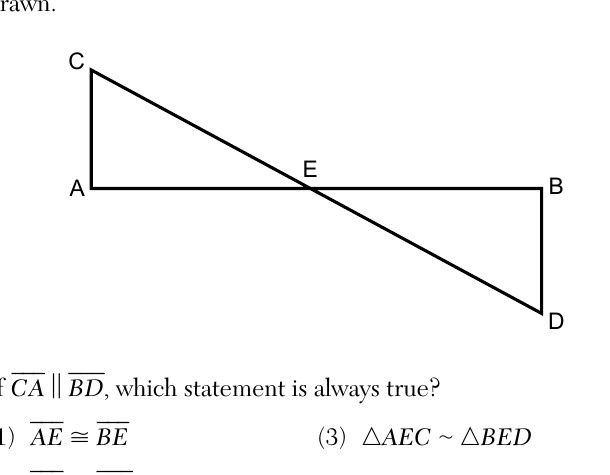
- (A) $\overline{AE} \cong \overline{BE}$
- (B) $\overline{CA} \cong \overline{DB}$
- (C) $\triangle AEC \sim \triangle BED$ ✓
- (D) $\triangle AEC \cong \triangle BED$
Worked solution
With CA parallel to BD, the alternate interior angles at A and B are congruent, and the angles at E are vertical angles, so the two triangles are similar by AA, but nothing guarantees congruence.
If $\sin(3x+9)° = \cos(5x-7)°$, what is the value of $x$?
- (A) $8$
- (B) $11$ ✓
- (C) $33$
- (D) $42$
Worked solution
Sine and cosine of complementary angles are equal, so the two given angle expressions must sum to 90 degrees, which solves to x equals 11.
Which set of integers could represent the lengths of the sides of an isosceles triangle?
- (A) {1, 1, 3}
- (B) {2, 2, 5}
- (C) {3, 3, 6}
- (D) {4, 4, 7} ✓
Worked solution
Only {4,4,7} satisfies the triangle inequality (the sum of the two smaller sides must exceed the third side), so it is the only valid isosceles triangle.
In the diagram shown below, altitude $\overline{CD}$ is drawn to the hypotenuse of right triangle $ABC$. Which equation can always be used to find the length of $\overline{AC}$?
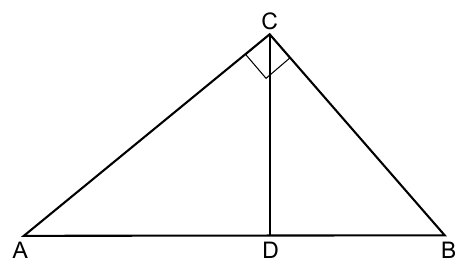
- (A) $\frac{AC}{CD}=\frac{CD}{AD}$
- (B) $\frac{CD}{AC}=\frac{AC}{AB}$
- (C) $\frac{AC}{CD}=\frac{CD}{BC}$
- (D) $\frac{AB}{AC}=\frac{AC}{AD}$ ✓
Worked solution
The altitude to the hypotenuse divides the right triangle into two triangles similar to the original, making AC the geometric mean between the hypotenuse AB and adjacent segment AD.
Which congruence statement is sufficient to prove parallelogram MARK is a rhombus?
- (A) $\overline{MA}\cong\overline{MK}$ ✓
- (B) $\overline{MA}\cong\overline{KR}$
- (C) $\angle K\cong\angle A$
- (D) $\angle R\cong\angle A$
Worked solution
MA and MK are the two adjacent sides that meet at vertex M; since opposite sides of a parallelogram are already congruent, proving these adjacent sides congruent forces all four sides equal, making it a rhombus.
A line whose equation is $y=-2x+3$ is dilated by a scale factor of 4 centered at $(0,3)$. Which equation represents the image of the line after the dilation?
- (A) $y=-2x+3$ ✓
- (B) $y=-2x+12$
- (C) $y=-8x+3$
- (D) $y=-8x+12$
Worked solution
Since the center of dilation (0,3) lies on the line, the line maps onto itself under any scale factor, leaving the equation unchanged.
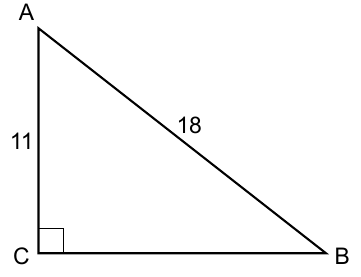
In $\triangle ABC$ below, $m\angle C=90°$, $AC=11$, and $AB=18$. Determine and state the measure of angle $A$, to the nearest degree.
Worked solution
Using the cosine ratio (adjacent over hypotenuse) in the right triangle and taking the inverse cosine gives the measure of angle A.
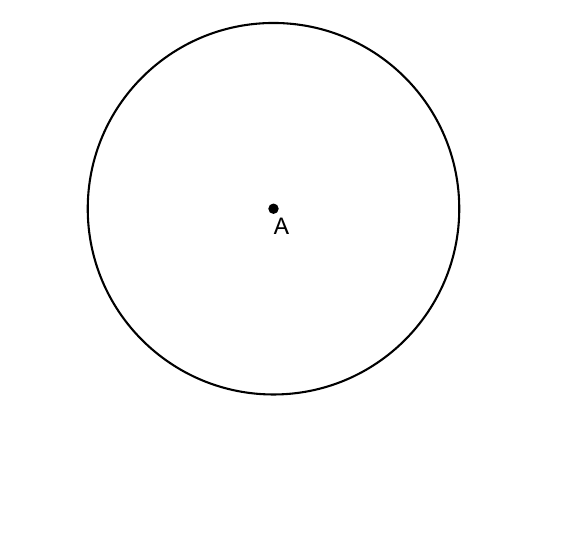
Use a compass and straightedge to construct an equilateral triangle inscribed in circle $A$ below. Leave all construction marks.
Worked solution
Using the circle's radius as the compass width steps off six points spaced 60° apart around the circle; connecting alternating points among these six produces an equilateral triangle inscribed in the circle.
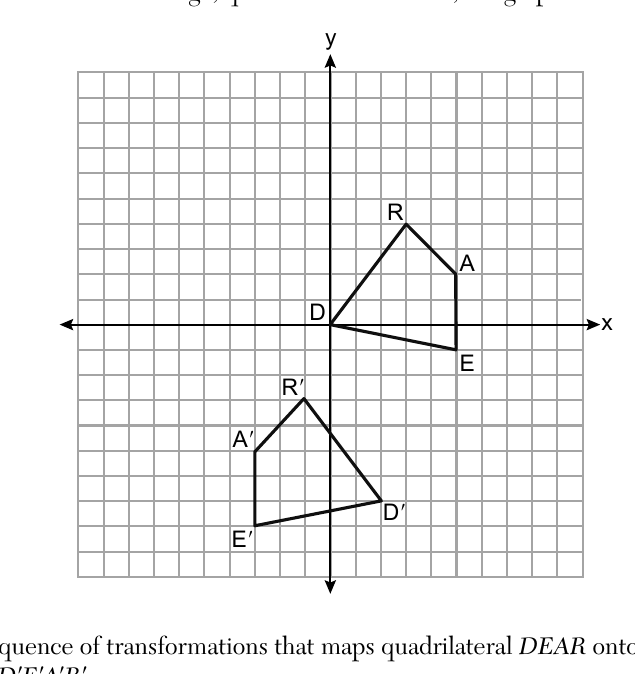
Quadrilateral DEAR and its image, quadrilateral D'E'A'R', are graphed on the set of axes below. Describe a sequence of transformations that maps quadrilateral DEAR onto quadrilateral D'E'A'R'.
Worked solution
Since D'E'A'R' appears below the x-axis in a mirrored orientation relative to DEAR, reflecting over the x-axis (which negates y-coordinates) and then translating the resulting figure into position carries DEAR exactly onto D'E'A'R', since reflections and translations both preserve distance and angle measure.
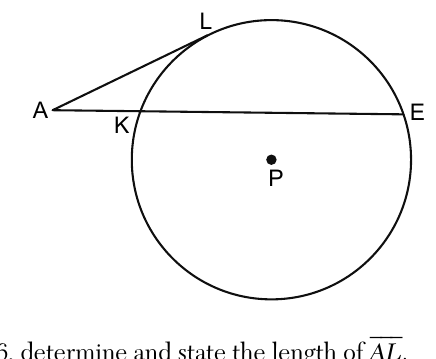
In circle $P$ below, tangent $\overline{AL}$ and secant $\overline{AKE}$ are drawn. If $AK=12$ and $KE=36$, determine and state the length of $\overline{AL}$.
Worked solution
By the tangent-secant power of a point theorem, the square of the tangent segment equals the product of the whole secant length and its external segment.
The equation of a circle is $x^2+y^2+8x-6y+7=0$. Determine and state the coordinates of the center and the length of the radius of the circle.
Worked solution
Completing the square on both x and y terms converts the equation to standard circle form, revealing the center and radius.
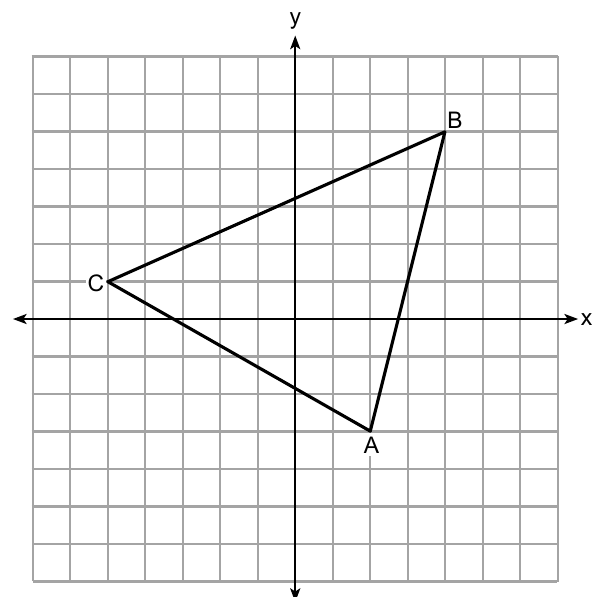
On the set of axes below, $\triangle ABC$ is drawn with vertices that have coordinates $A(2,-3)$, $B(4,5)$, and $C(-5,1)$. Determine and state the area of $\triangle ABC$.
Worked solution
Applying the coordinate (shoelace) area formula for a triangle with the given vertices yields an area of 32 square units.
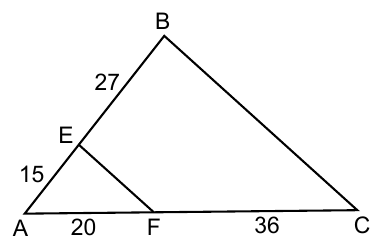
In the diagram below, $AE=15$, $EB=27$, $AF=20$, and $FC=36$. Explain why $\overline{EF}\parallel\overline{BC}$.
Worked solution
When a segment divides two sides of a triangle into proportional parts, that segment must be parallel to the third side, by the converse of the side-splitter (triangle proportionality) theorem.
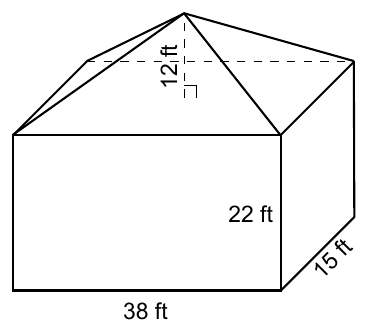
A building is composed of a rectangular pyramid on top of a rectangular prism, as shown in the diagram below. The rectangular prism has a length of 38 feet, a width of 15 feet, and a height of 22 feet. The rectangular pyramid sits directly on top of the rectangular prism, and its height is 12 feet. An air purification filter was installed that will clean all the air in the building at a rate of 2400 cubic feet per minute. Determine and state how long it will take, to the nearest tenth of a minute, for the filter to clean the air contained in the building.
Worked solution
The total volume of the building is the sum of the prism's and pyramid's volumes; dividing this by the filtration rate gives the time to clean all the air.
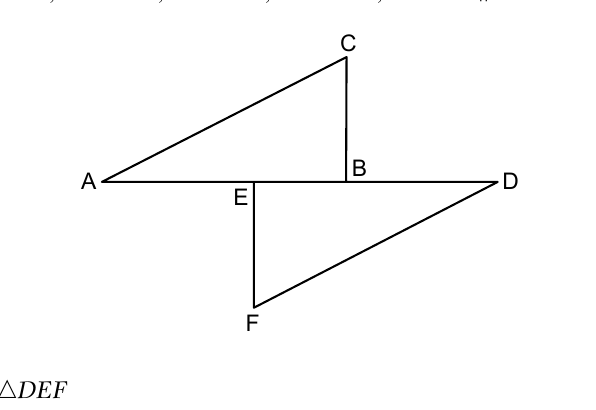
Given: $\triangle ABC$, $\triangle DEF$, $\overline{AB}\perp\overline{BC}$, $\overline{DE}\perp\overline{EF}$, $\overline{AE}\cong\overline{DB}$, and $\overline{AC}\parallel\overline{FD}$. Prove: $\triangle ABC\cong\triangle DEF$.
Worked solution
The perpendicular segments give a pair of congruent right angles, the parallel segments give a pair of congruent alternate interior angles, and segment addition using the given congruent segments AE and DB shows AB≅DE; these three congruent parts satisfy ASA, proving the triangles congruent.
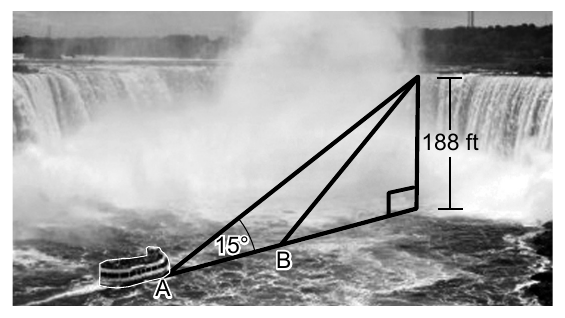
In the diagram below, a boat at point $A$ is traveling toward the most powerful waterfall in North America, the Horseshoe Falls. The Horseshoe Falls has a vertical drop of 188 feet. The angle of elevation from point $A$ to the top of the waterfall is 15°. After the boat travels toward the falls, the angle of elevation at point $B$ to the top of the waterfall is 23°. Determine and state, to the nearest foot, the distance the boat traveled from point $A$ to point $B$.
Worked solution
Two right triangles share the vertical height of the falls; using the tangent ratio for each angle of elevation gives the horizontal distances from A and B to the base of the falls, and their difference is the distance the boat traveled.
Triangle JOE has vertices whose coordinates are $J(4,6)$, $O(-2,4)$, and $E(6,0)$. Prove that $\triangle JOE$ is isosceles. Point $Y(2,2)$ is on $\overline{OE}$. Prove that $\overline{JY}$ is the perpendicular bisector of $\overline{OE}$.
Worked solution
Computing side lengths with the distance formula shows JO and JE are equal, proving triangle JOE isosceles; showing Y is the midpoint of OE and that the slopes of JY and OE are negative reciprocals proves JY is the perpendicular bisector of OE.