June 2023 Geometry Regents — Answer Key & Worked Solutions
Every question from the June 2023 Geometry Regents exam, with the correct answer and a full step-by-step solution. Check your work, learn the method, then convert your raw score.
These are real questions from the June 2023 Geometry New York State Regents examination, published by NYSED. Worked solutions are written by RegentsLab.
A square pyramid is intersected by a plane passing through the vertex and perpendicular to the base. Which two-dimensional shape describes this cross section?
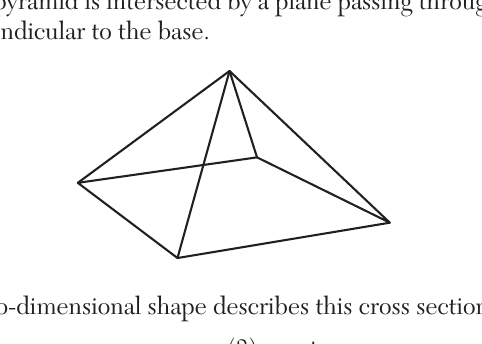
- (A) square
- (B) triangle ✓
- (C) pentagon
- (D) rectangle
Worked solution
A plane through the apex of a square pyramid, perpendicular to the base, cuts through the apex and two opposite base edges, producing a triangular cross section.
Trapezoid $ABCD$ is drawn such that $\overline{AB} \parallel \overline{DC}$. Trapezoid $A'B'C'D'$ is the image of trapezoid $ABCD$ after a rotation of $110°$ counterclockwise about point $P$. Which statement is always true?
- (A) $\angle A \cong \angle D'$
- (B) $\overline{AC} \cong \overline{B'D'}$
- (C) $\overline{A'B'} \parallel \overline{D'C'}$ ✓
- (D) $\overline{B'A'} \cong \overline{C'D'}$
Worked solution
Rotations are rigid motions that preserve parallelism, so since AB is parallel to DC, their images A'B' and D'C' must also be parallel.
What is the volume of a right circular cone that has a height of 7.2 centimeters and a radius of 2.5 centimeters, to the nearest tenth of a cubic centimeter?
- (A) 37.7
- (B) 47.1 ✓
- (C) 113.1
- (D) 141.4
Worked solution
Substitute the radius and height into the cone volume formula and evaluate.
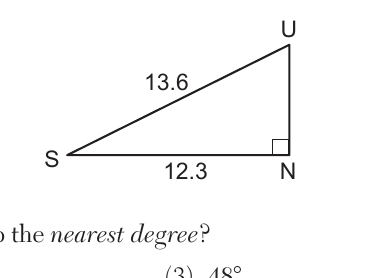
In the diagram below of right triangle $SUN$, where $\angle N$ is a right angle, $SU = 13.6$ and $SN = 12.3$. What is $m\angle S$, to the nearest degree?
- (A) 25° ✓
- (B) 42°
- (C) 48°
- (D) 65°
Worked solution
SN is adjacent to angle S and SU is the hypotenuse, so use cosine and take the inverse cosine.
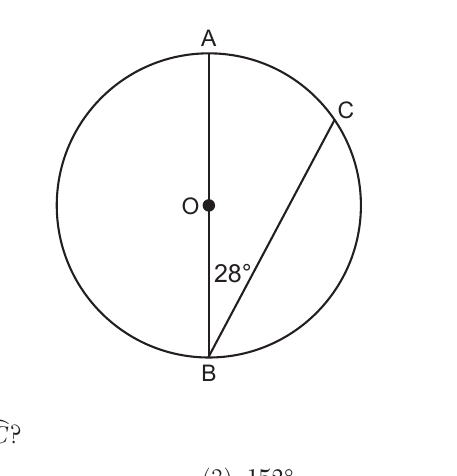
In the diagram below of circle $O$, diameter $\overline{AOB}$ and chord $\overline{CB}$ are drawn, and $m\angle B = 28°$. What is $m\widehat{BC}$?
- (A) 56°
- (B) 124° ✓
- (C) 152°
- (D) 166°
Worked solution
Since AB is a diameter, inscribed angle ACB is 90 degrees; angle A is then found from the triangle angle sum, and the inscribed angle at A doubles to give arc BC.
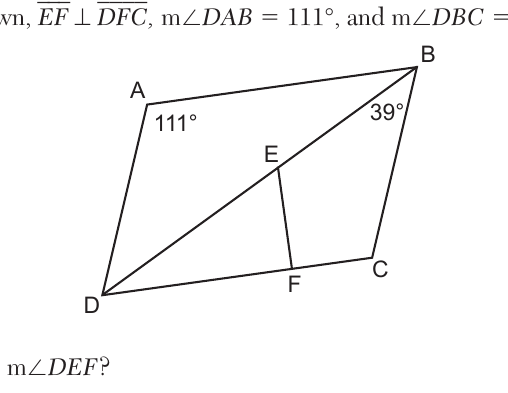
In the diagram below of parallelogram $ABCD$, diagonal $\overline{BED}$ and $\overline{EF}$ are drawn, $\overline{EF} \perp \overline{DFC}$, $m\angle DAB = 111°$, and $m\angle DBC = 39°$. What is $m\angle DEF$?
- (A) 30°
- (B) 51°
- (C) 60° ✓
- (D) 120°
Worked solution
Using parallel sides and parallelogram angle relationships, angle BDC is found to be 30 degrees, and since EF is perpendicular to DC, the remaining angle in the right triangle DEF is 60 degrees.
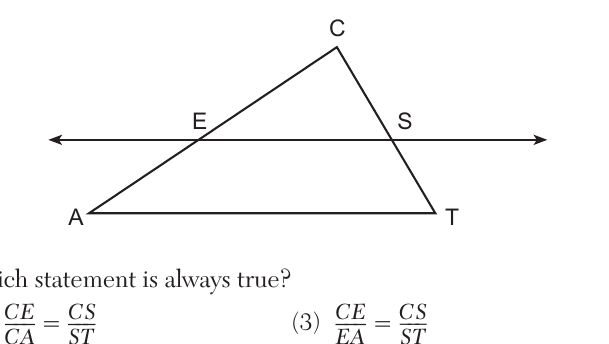
In the diagram below of $\triangle ACT$, $\overline{ES}$ is drawn parallel to $\overline{AT}$ such that $E$ is on $\overline{CA}$ and $S$ is on $\overline{CT}$. Which statement is always true?
- (A) $\frac{CE}{CA} = \frac{CS}{ST}$
- (B) $\frac{CE}{ES} = \frac{EA}{AT}$
- (C) $\frac{CE}{EA} = \frac{CS}{ST}$ ✓
- (D) $\frac{CE}{ST} = \frac{EA}{CS}$
Worked solution
By the Triangle Proportionality Theorem, a line parallel to one side of a triangle divides the other two sides proportionally.
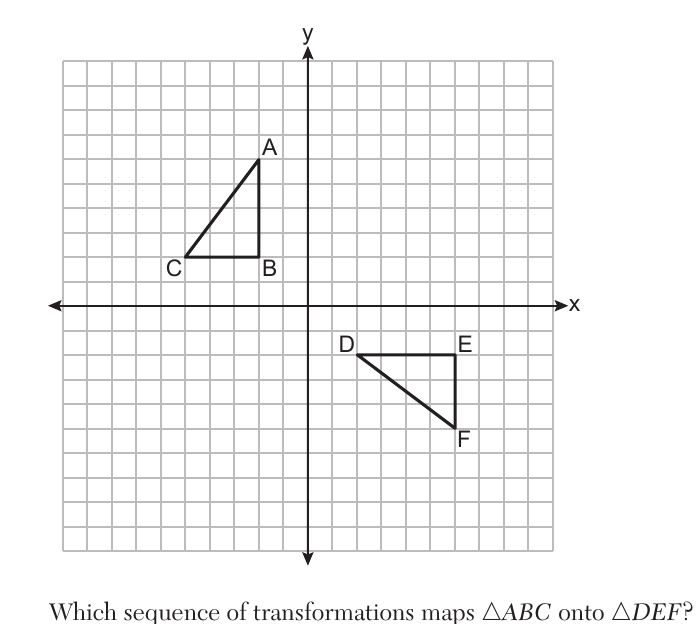
On the set of axes below, congruent triangles $ABC$ and $DEF$ are drawn. Which sequence of transformations maps $\triangle ABC$ onto $\triangle DEF$?
- (A) A counterclockwise rotation of 90 degrees about the origin, followed by a translation 8 units to the right. ✓
- (B) A counterclockwise rotation of 90 degrees about the origin, followed by a reflection over the y-axis.
- (C) A counterclockwise rotation of 90 degrees about the origin, followed by a translation 4 units down.
- (D) A clockwise rotation of 90 degrees about the origin, followed by a reflection over the x-axis.
Worked solution
Applying the 90 degree counterclockwise rotation rule to the coordinates of triangle ABC and then testing each remaining transformation shows only the translation 8 units right completes the mapping onto triangle DEF.
An equation of circle $M$ is $x^2 + y^2 + 6x - 2y + 1 = 0$. What are the coordinates of the center and the length of the radius of circle $M$?
- (A) center (3,-1) and radius 9
- (B) center (3,-1) and radius 3
- (C) center (-3,1) and radius 9
- (D) center (-3,1) and radius 3 ✓
Worked solution
Completing the square on both x and y terms converts the equation to standard circle form, revealing the center and radius.
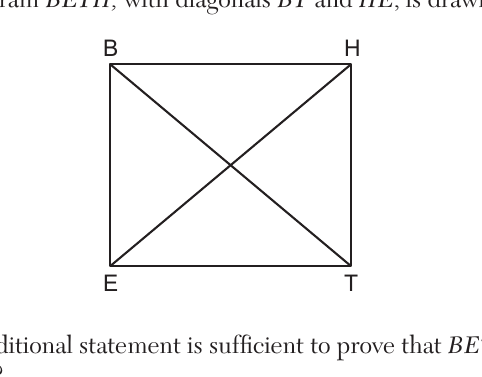
Parallelogram $BETH$, with diagonals $\overline{BT}$ and $\overline{HE}$, is drawn below. Which additional statement is sufficient to prove that $BETH$ is a rectangle?
- (A) $\overline{BT} \perp \overline{HE}$
- (B) $\overline{BE} \parallel \overline{HT}$
- (C) $\overline{BT} \cong \overline{HE}$ ✓
- (D) $\overline{BE} \cong \overline{ET}$
Worked solution
A key theorem states a parallelogram is a rectangle exactly when its diagonals are congruent, so proving BT congruent to HE is sufficient.
A gardener wants to buy enough mulch to cover a rectangular garden that is 3 feet by 10 feet. One bag contains 2 cubic feet of mulch and costs $3.66. How much will the minimum number of bags cost to cover the garden with mulch 3 inches deep?
- (A) $3.66
- (B) $10.98
- (C) $14.64 ✓
- (D) $29.28
Worked solution
Compute the required volume of mulch, divide by the volume per bag and round up to a whole number of bags, then multiply by the price per bag.
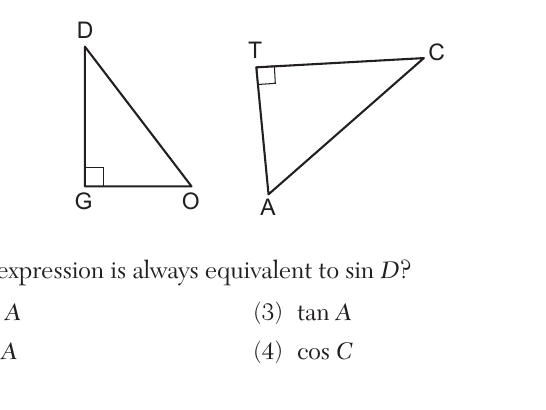
In the diagram below, $\triangle DOG \sim \triangle CAT$, where $\angle G$ and $\angle T$ are right angles. Which expression is always equivalent to $\sin D$?
- (A) $\cos A$ ✓
- (B) $\sin A$
- (C) $\tan A$
- (D) $\cos C$
Worked solution
Since angle D and angle O are complementary in right triangle DOG, sin D equals cos O, and because angle O corresponds to angle A in the similar triangle, sin D equals cos A.
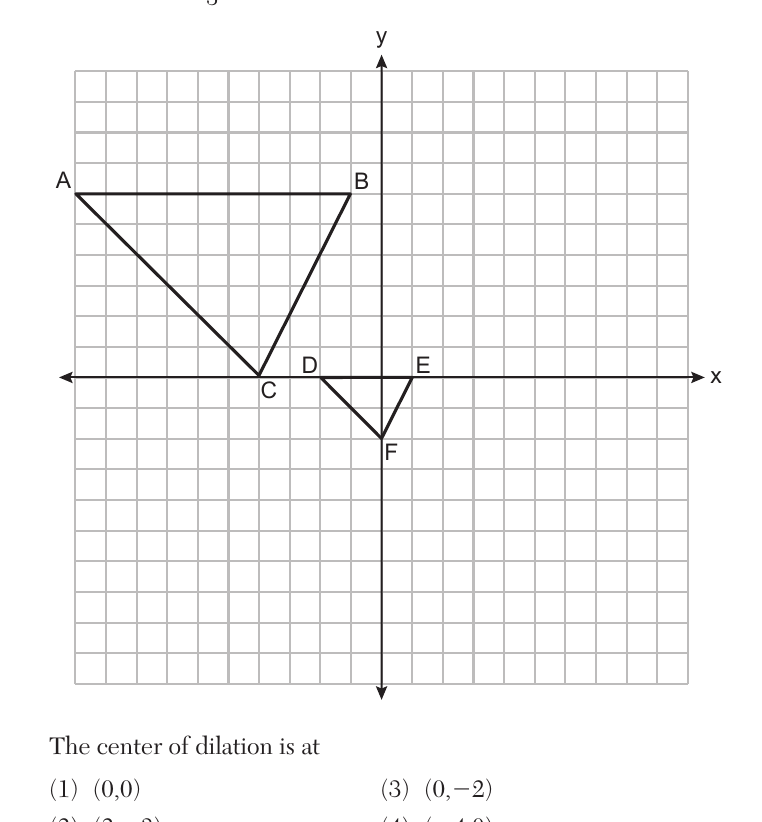
On the set of axes below, $\triangle DEF$ is the image of $\triangle ABC$ after a dilation of scale factor $\frac{1}{3}$. The center of dilation is at
- (A) (0,0)
- (B) (2,-3) ✓
- (C) (0,-2)
- (D) (-4,0)
Worked solution
The center of dilation is the common intersection point of the lines through each pair of corresponding vertices, read from the graph as (2,-3).
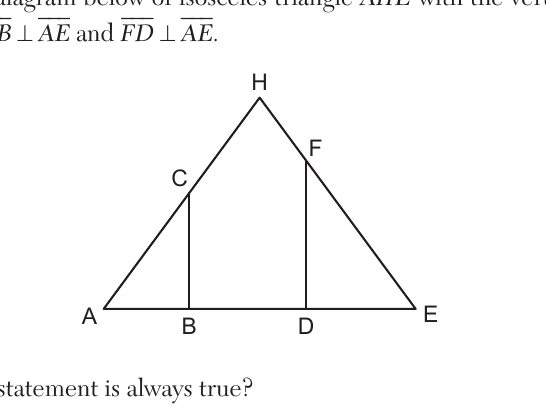
In the diagram below of isosceles triangle $AHE$ with the vertex angle at $H$, $\overline{CB} \perp \overline{AE}$ and $\overline{FD} \perp \overline{AE}$. Which statement is always true?
- (A) $\frac{AH}{AC} = \frac{EH}{EF}$
- (B) $\frac{AC}{EF} = \frac{AB}{ED}$ ✓
- (C) $\frac{AB}{ED} = \frac{CB}{FE}$
- (D) $\frac{AD}{AB} = \frac{BE}{DE}$
Worked solution
Triangle ABC is similar to triangle EDF by AA (equal base angles of the isosceles triangle and equal right angles), so corresponding sides are proportional.
Rectangle $ABCD$ has two vertices at coordinates $A(-1,-3)$ and $B(6,5)$. The slope of $\overline{BC}$ is
- (A) $-\frac{7}{8}$ ✓
- (B) $\frac{7}{8}$
- (C) $-\frac{8}{7}$
- (D) $\frac{8}{7}$
Worked solution
In a rectangle adjacent sides are perpendicular, so the slope of BC is the negative reciprocal of the slope of AB.
In right triangle $ABC$, $m\angle A = 90°$, $m\angle B = 18°$, and $AC = 8$. To the nearest tenth, the length of $\overline{BC}$ is
- (A) 2.5
- (B) 8.4
- (C) 24.6
- (D) 25.9 ✓
Worked solution
AC is opposite angle B and BC is the hypotenuse, so sine relates them; solve for BC.
The measure of one of the base angles of an isosceles triangle is 42°. The measure of an exterior angle at the vertex of the triangle is
- (A) 42°
- (B) 84° ✓
- (C) 96°
- (D) 138°
Worked solution
An exterior angle of a triangle equals the sum of the two non-adjacent (remote) interior angles, which here are the two equal base angles.
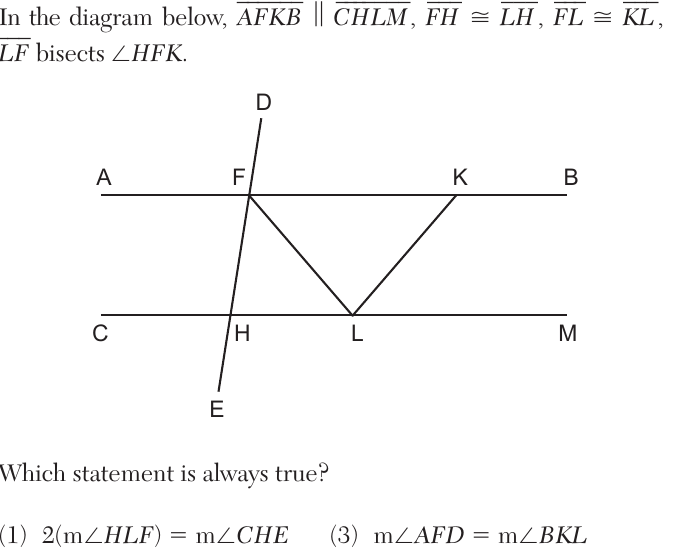
In the diagram below, $\overline{AFKB} \parallel \overline{CHLM}$, $\overline{FH} \cong \overline{LH}$, $\overline{FL} \cong \overline{KL}$, and $\overline{LF}$ bisects $\angle HFK$. Which statement is always true?
- (A) $2(m\angle HLF) = m\angle CHE$
- (B) $2(m\angle FLK) = m\angle LKB$
- (C) $m\angle AFD = m\angle BKL$
- (D) $m\angle DFK = m\angle KLF$ ✓
Worked solution
Using the isosceles triangles formed by the congruent segments and the angle bisector, the supplementary angle DFK works out algebraically to equal the vertex angle KLF of triangle FKL.
The line whose equation is $6x + 3y = 3$ is dilated by a scale factor of 2 centered at the point (0,0). An equation of its image is
- (A) $y = -2x + 1$
- (B) $y = -2x + 2$ ✓
- (C) $y = -4x + 1$
- (D) $y = -4x + 2$
Worked solution
Since the line does not pass through the center of dilation, its image is a parallel line (same slope) with the y-intercept and constant scaled appropriately, found by substitution.
Which figure will not carry onto itself after a 120-degree rotation about its center?
- (A) equilateral triangle
- (B) regular hexagon
- (C) regular octagon ✓
- (D) regular nonagon
Worked solution
A regular octagon's rotational symmetries occur only at multiples of 45 degrees, and 120 is not a multiple of 45, so it does not map onto itself.
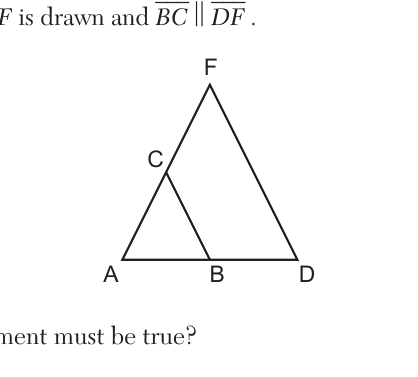
Triangle ADF is drawn and $\overline{BC} \parallel \overline{DF}$.
- (A) $\frac{AB}{BC} = \frac{BD}{DF}$
- (B) $BC = \frac{1}{2}DF$
- (C) $AB:AD = AC:CF$
- (D) $\angle ACB \cong \angle AFD$ ✓
Worked solution
Since BC is parallel to DF and line AF is a transversal cutting both, the corresponding angles at C and F must be congruent regardless of exact side lengths, so this is the statement that must always be true.
In $\triangle ABC$, M is the midpoint of $\overline{AB}$ and N is the midpoint of $\overline{AC}$. If $MN = x+13$ and $BC = 5x-1$, what is the length of $\overline{MN}$?
- (A) 3.5
- (B) 9
- (C) 16.5
- (D) 22 ✓
Worked solution
MN is a midsegment of triangle ABC connecting the midpoints of two sides, so it equals half of BC; solving the resulting equation gives x = 9 and MN = 22.
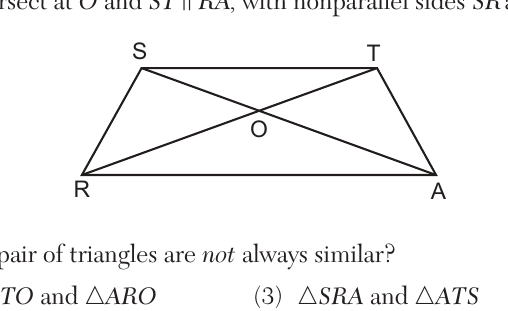
In the diagram below of isosceles trapezoid STAR, diagonals $\overline{AS}$ and $\overline{RT}$ intersect at O and $\overline{ST} \parallel \overline{RA}$, with nonparallel sides $\overline{SR}$ and $\overline{TA}$. Which pair of triangles are not always similar?
- (A) $\triangle STO$ and $\triangle ARO$
- (B) $\triangle SOR$ and $\triangle TOA$
- (C) $\triangle SRA$ and $\triangle ATS$ ✓
- (D) $\triangle SRT$ and $\triangle TAS$
Worked solution
The other three pairs are always similar (two by AA from the parallel sides and vertical angles, and one pair is actually always congruent by SSS using the equal legs and equal diagonals of an isosceles trapezoid), but SRA and ATS do not have a relationship that forces similarity in general.
The endpoints of $\overline{AB}$ are $A(0,4)$ and $B(-4,6)$. Which equation of a line represents the perpendicular bisector of $\overline{AB}$?
- (A) $y = -\frac{1}{2}x + 4$
- (B) $y = -2x + 1$
- (C) $y = 2x + 8$
- (D) $y = 2x + 9$ ✓
Worked solution
Find the midpoint of AB and the negative reciprocal of AB's slope, then write the point-slope equation of the line through the midpoint with that perpendicular slope.
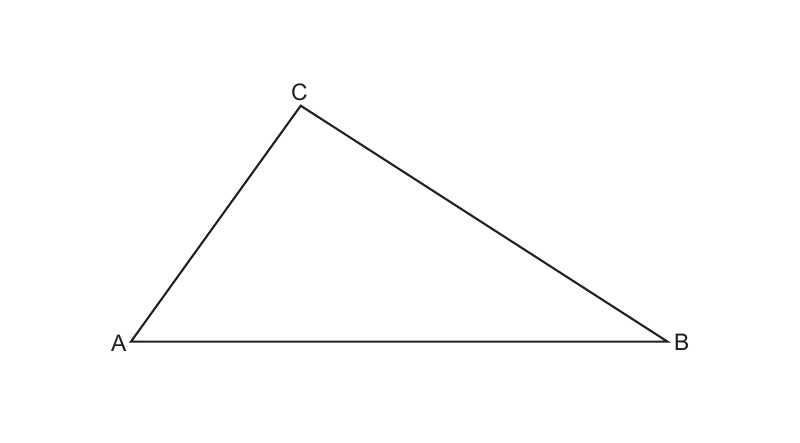
In $\triangle ABC$ below, use a compass and straightedge to construct the altitude from C to $\overline{AB}$. [Leave all construction marks.]
Worked solution
The altitude from C is constructed by finding a point equidistant from two points on AB using compass arcs, which produces the perpendicular from C to line AB by the perpendicular-construction method.
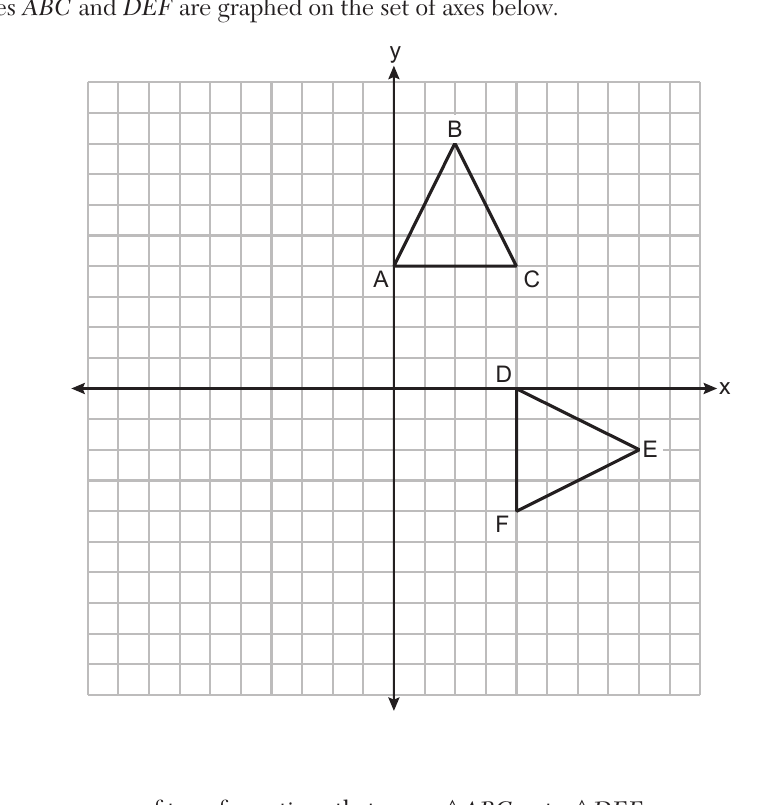
Triangles ABC and DEF are graphed on the set of axes below. Describe a sequence of transformations that maps $\triangle ABC$ onto $\triangle DEF$.
Worked solution
Comparing the orientation of the two triangles (ABC points up, DEF points right, and both appear the same size, so the map is a rigid motion, not a dilation) shows the sequence is a 90-degree rotation followed by a translation; the exact center and translation vector should be read directly off the grid using the vertices' coordinates.
Line segment PQ has endpoints $P(-5,1)$ and $Q(5,6)$, and point R is on $\overline{PQ}$. Determine and state the coordinates of R, such that $PR:RQ = 2:3$.
Worked solution
Using the partition (section) formula, R is located 2/5 of the way from P to Q along the segment, giving R = (-1, 3).
A circle has a radius of 6.4 inches. Determine and state, to the nearest square inch, the area of a sector whose arc measures $80°$.
Worked solution
The sector area is the fraction of the full circle's area corresponding to its 80-degree central angle out of 360 degrees.
A large snowman is made of three spherical snowballs with radii of 1 foot, 2 feet, and 3 feet, respectively. Determine and state the amount of snow, in cubic feet, that is used to make the snowman. [Leave your answer in terms of $\pi$.]
Worked solution
Add the volumes of the three spheres using the sphere volume formula, keeping the answer in terms of pi as instructed.
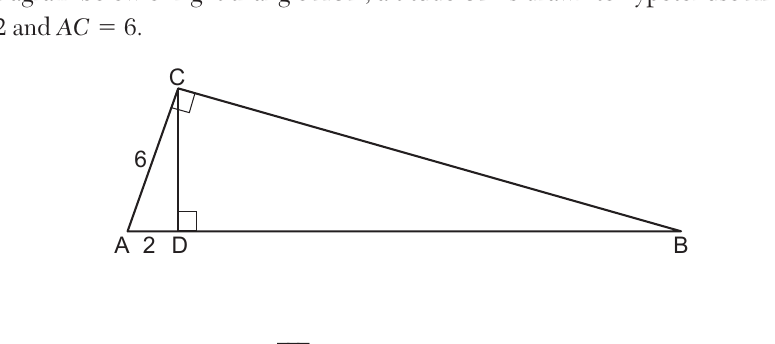
In the diagram below of right triangle ACB, altitude $\overline{CD}$ is drawn to hypotenuse $\overline{AB}$, $AD = 2$ and $AC = 6$. Determine and state the length of $\overline{AB}$.
Worked solution
The altitude to the hypotenuse creates the geometric mean relationship AC^2 = AD times AB, which is solved directly for AB.
Triangle RST has vertices with coordinates $R(-3,-2)$, $S(3,2)$ and $T(4,-4)$. Determine and state an equation of the line parallel to $\overline{RT}$ that passes through point S.
Worked solution
Find the slope of RT, then use point-slope form through S with that same slope since parallel lines share slope.
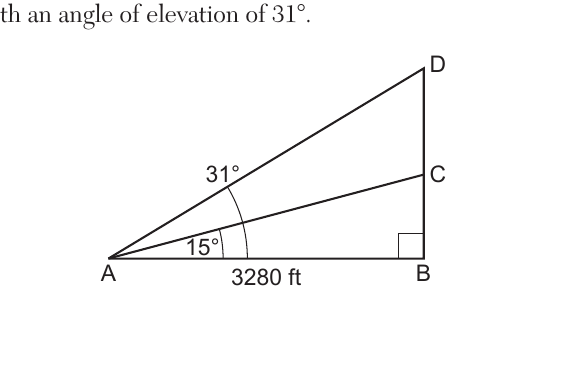
Cape Canaveral, Florida is where NASA launches rockets into space. As modeled in the diagram below, a person views the launch of a rocket from observation area A, 3280 feet away from launch pad B. After launch, the rocket was sighted at C with an angle of elevation of $15°$. The rocket was later sighted at D with an angle of elevation of $31°$. Determine and state, to the nearest foot, the distance the rocket traveled between the two sightings, C and D.
Worked solution
Since B, C, and D lie on the same vertical line above the launch pad, the vertical heights BC and BD can be found using the tangent ratio in the two right triangles, and the distance CD is simply the difference of those two heights.
A small can of soup is a right circular cylinder with a base diameter of 7 cm and a height of 9 cm. A large container is also a right circular cylinder with a base diameter of 9 cm and a height of 13 cm. Determine and state the volume of the small can and the volume of the large container to the nearest cubic centimeter. What is the minimum number of small cans that must be opened to fill the large container? Justify your answer.
Worked solution
Compute each cylinder's volume with V = pi r^2 h, then compare multiples of the small can's volume to the large container's volume to find the least whole number of cans whose total volume is at least as large.
Parallelogram MATH has vertices $M(-7,-2)$, $A(0,4)$, $T(9,2)$, and $H(2,-4)$. Prove that parallelogram MATH is a rhombus. Determine and state the area of MATH.
Worked solution
Using the distance formula on all four sides shows they are each length sqrt(85), proving the parallelogram is a rhombus; the area then follows from the rhombus diagonal-product formula (or equivalently the cross-product of adjacent side vectors), giving 68 square units.
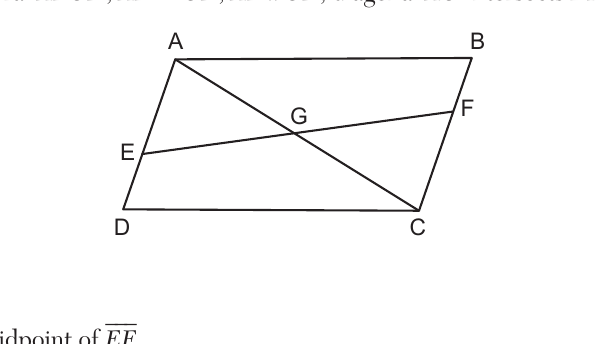
Given: Quadrilateral ABCD, $\overline{AB} \cong \overline{CD}$, $\overline{AB} \parallel \overline{CD}$, diagonal $\overline{AC}$ intersects $\overline{EF}$ at G, and $\overline{DE} \cong \overline{BF}$. Prove: G is the midpoint of $\overline{EF}$.
Worked solution
Because AB is both congruent and parallel to CD, ABCD is a parallelogram, which makes AD parallel and congruent to BC; combined with the given DE congruent to BF, this yields AE congruent to CF, and the resulting AAS congruence of triangles AEG and CFG (using alternate interior angles and vertical angles at G) proves EG congruent to FG, so G bisects EF.