January 2025 Geometry Regents — Answer Key & Worked Solutions
Every question from the January 2025 Geometry Regents exam, with the correct answer and a full step-by-step solution. Check your work, learn the method, then convert your raw score.
These are real questions from the January 2025 Geometry New York State Regents examination, published by NYSED. Worked solutions are written by RegentsLab.
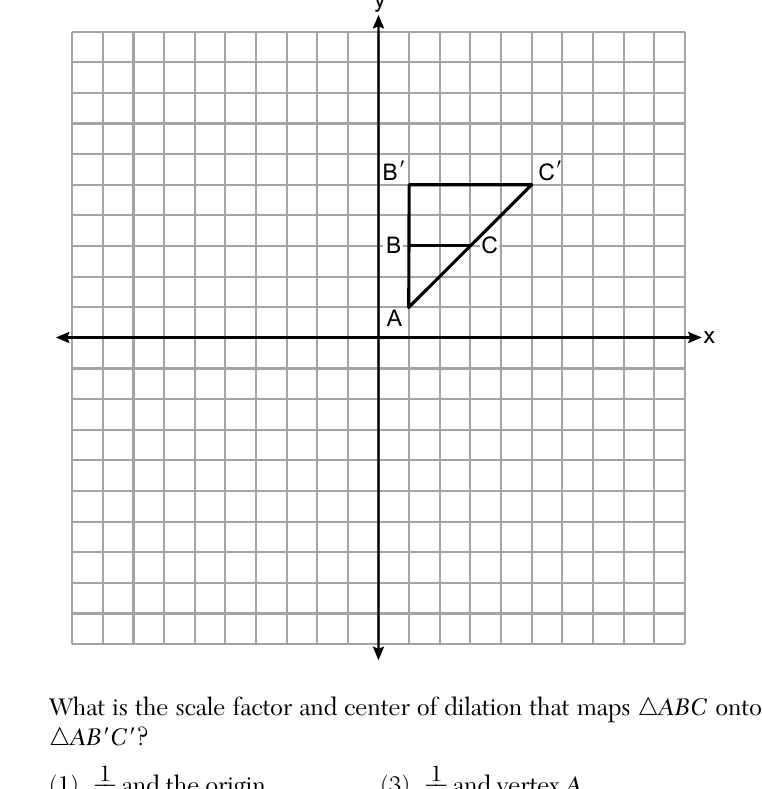
On the set of axes below, $\triangle AB'C'$ is the image of $\triangle ABC$. What is the scale factor and center of dilation that maps $\triangle ABC$ onto $\triangle AB'C'$?
- (A) $\frac{1}{2}$ and the origin
- (B) 2 and the origin
- (C) $\frac{1}{2}$ and vertex $A$
- (D) 2 and vertex $A$ ✓
Worked solution
Since point A is shared by both triangles it must be the center of dilation, and since the image is larger than the preimage the scale factor is 2, not 1/2.
Line segment $PAQ$ has endpoints whose coordinates are $P(-2,6)$ and $Q(3,-4)$. What are the coordinates of point $A$, such that $PA:AQ = 2:3$?
- (A) $(1,0)$
- (B) $(2,-2)$
- (C) $(-1,4)$
- (D) $(0,2)$ ✓
Worked solution
Since PA:AQ = 2:3, A divides PQ in the ratio 2:5 measured from P, so the section formula gives A = P + (2/5)(Q-P).
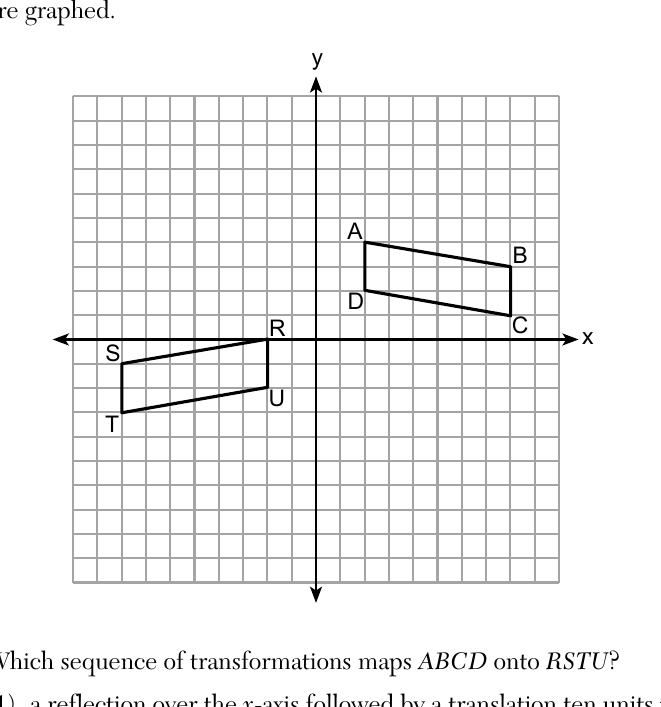
On the set of axes below, congruent parallelograms $ABCD$ and $RSTU$ are graphed. Which sequence of transformations maps $ABCD$ onto $RSTU$?
- (A) a reflection over the x-axis followed by a translation ten units to the left and one unit up
- (B) a translation four units down followed by a reflection over the y-axis ✓
- (C) a reflection over the y-axis followed by a translation of two units down
- (D) a translation ten units to the left followed by a reflection over the x-axis
Worked solution
Tracking a representative vertex (such as A) through the translation and then the reflection shows it lands exactly on R, confirming this is the correct composition among the choices given.
Triangle $ABC$ has a right angle at $C$. If $AC = 7.7$ and $m\angle B = 24°$, what is $AB$, to the nearest tenth?
- (A) 18.9 ✓
- (B) 17.3
- (C) 8.4
- (D) 3.1
Worked solution
AC is opposite angle B and AB is the hypotenuse, so the sine ratio directly relates them.
Given $\triangle PQR$ and $\triangle LMN$ with $\overline{PQ} \cong \overline{LM}$, which additional statement is sufficient to always prove $\triangle PQR \cong \triangle LMN$?
- (A) $\overline{QR} \cong \overline{MN}$ and $\angle R \cong \angle N$
- (B) $\overline{QR} \cong \overline{MN}$ and $\angle Q \cong \angle M$ ✓
- (C) $\overline{QR} \cong \overline{MN}$ and $\angle P \cong \angle L$
- (D) $\overline{QR} \cong \overline{MN}$ and $\angle P \cong \angle M$
Worked solution
Only this option gives a congruent angle that is included between the two congruent given sides, satisfying the SAS congruence postulate; the other options do not place the angle between the matching sides.
The equation of a circle is $x^2 + 6y = 4x - y^2 + 12$. What are the coordinates of the center and the length of the radius?
- (A) center $(2,-3)$ and radius 5 ✓
- (B) center $(-2,3)$ and radius 5
- (C) center $(2,-3)$ and radius 25
- (D) center $(-2,3)$ and radius 25
Worked solution
Completing the square in x and y converts the equation to standard circle form, revealing center (2,-3) and radius $\sqrt{25}=5$.
A square with a side length of 3 is continuously rotated about one of its sides. The resulting three-dimensional object is a
- (A) cube with a volume of 9.
- (B) cube with a volume of 27.
- (C) cylinder with a volume of $27\pi$. ✓
- (D) cylinder with a volume of $54\pi$.
Worked solution
Rotating a rectangle (here a square) about one of its sides always produces a cylinder with radius and height equal to the two side lengths.
Line $k$ is represented by the equation $4y + 3 = 7x$. Which equation represents a line that is perpendicular to line $k$ and passes through the point $(-5,2)$?
- (A) $y+2=\frac{4}{7}(x-5)$
- (B) $y-2=\frac{4}{7}(x+5)$
- (C) $y+2=-\frac{4}{7}(x-5)$
- (D) $y-2=-\frac{4}{7}(x+5)$ ✓
Worked solution
The perpendicular slope is the negative reciprocal of line k's slope, and the equation must be written through the given point (-5,2).
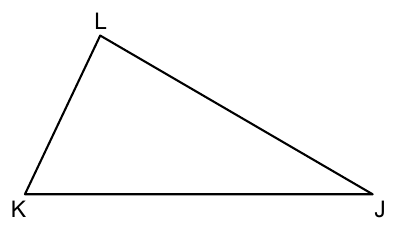
Scalene triangle $JKL$ is drawn below. If median $\overline{LM}$ is drawn to side $\overline{KJ}$, which statement is always true?
- (A) $LM=KM$
- (B) $KM=\frac{1}{2}KJ$ ✓
- (C) $\overline{LM}\perp \overline{KJ}$
- (D) $\angle KLM \cong \angle JLM$
Worked solution
By definition of a median, M must be the midpoint of KJ, giving KM = 1/2 KJ; the other statements only hold in special (e.g. isosceles or right) triangles, not in a general scalene triangle.
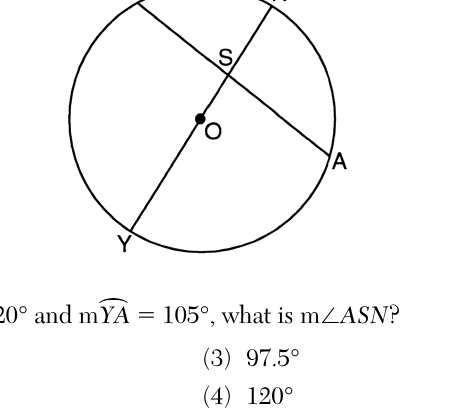
In circle $O$, chord $\overline{KA}$ intersects diameter $\overline{YN}$ at $S$. If $m\widehat{YK} = 120°$ and $m\widehat{YA} = 105°$, what is $m\angle ASN$?
- (A) 22.5°
- (B) 75°
- (C) 97.5° ✓
- (D) 120°
Worked solution
The measure of an angle formed by two chords intersecting inside a circle equals half the sum of the arc it intercepts and the arc intercepted by its vertical angle.
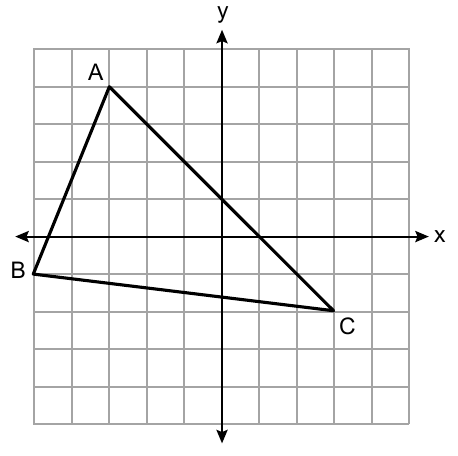
Triangle $ABC$ is graphed on the set of axes below. The vertices of $\triangle ABC$ have coordinates $A(-3,4)$, $B(-5,-1)$, and $C(3,-2)$. What is the area of $\triangle ABC$?
- (A) 16
- (B) 20
- (C) 21 ✓
- (D) 24
Worked solution
The shoelace formula computes the area of a triangle directly from its vertex coordinates.
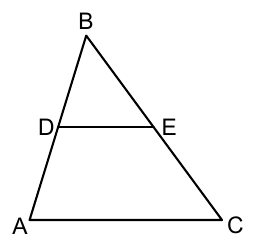
In $\triangle ABC$ below, $\overline{DE}$ is a midsegment, and $\overline{BD} \cong \overline{DE}$. Which statement is always true?
- (A) $\triangle ABC$ is isosceles ✓
- (B) $\triangle ABC$ is scalene
- (C) $\overline{BD}\cong \overline{BE}$
- (D) $\overline{DA}\cong \overline{EC}$
Worked solution
The midsegment theorem gives BD = 1/2 AB and DE = 1/2 AC; setting BD equal to DE forces AB = AC, which makes triangle ABC isosceles.
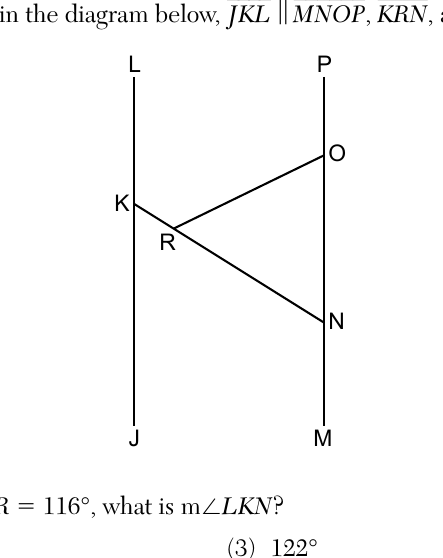
As shown in the diagram below, $\overline{JKL} \parallel \overline{MNOP}$, $\overline{KRN}$, and $\overline{OR} \cong \overline{ON}$. If $m\angle POR = 116°$, what is $m\angle LKN$?
- (A) 58°
- (B) 116°
- (C) 122° ✓
- (D) 128°
Worked solution
Working through the isosceles triangle formed at O and N, then applying the co-interior angle relationship created by the transversal KN across the two parallel lines, gives 122°.
The ratio of similarity of square $ABCD$ to square $WXYZ$ is 2:5. If $AB = x + 3$ and $WX = 3x + 5$, then the perimeter of $ABCD$ is
- (A) 8
- (B) 20
- (C) 32 ✓
- (D) 80
Worked solution
Setting up the similarity ratio as a proportion and solving for x gives the side length, which is multiplied by 4 for the perimeter of the square.
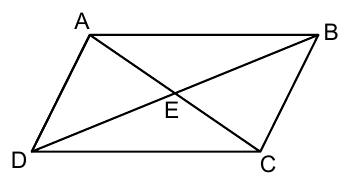
In parallelogram $ABCD$ below, diagonals $\overline{AC}$ and $\overline{BD}$ intersect at $E$. Which transformation would map $\triangle ABC$ onto $\triangle CDA$?
- (A) a reflection over $\overline{AC}$
- (B) a reflection over $\overline{DB}$
- (C) a clockwise rotation of 90° about point $E$
- (D) a clockwise rotation of 180° about point $E$ ✓
Worked solution
Because the diagonals of a parallelogram bisect each other at E, a 180 degree rotation about E swaps each vertex with its opposite vertex, mapping triangle ABC exactly onto triangle CDA.
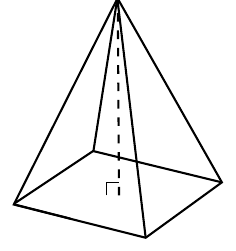
The square pyramid drawn below has a volume of 175. If the height of the pyramid is 21, what is the perimeter of the base?
- (A) 5
- (B) 10
- (C) 20 ✓
- (D) 25
Worked solution
Solve the pyramid volume formula for the base area, take the square root to get the side length of the square base, then multiply by 4 for the perimeter.
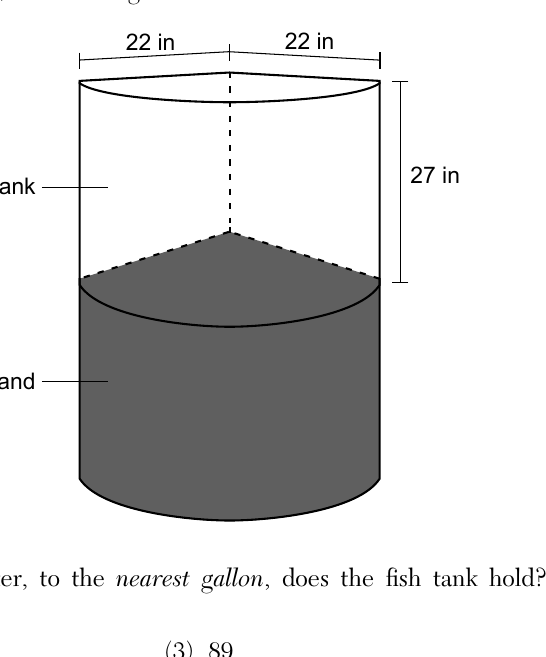
A glass fish tank is designed to be placed on a stand in the corner of a room with perpendicular walls. The tank can be modeled using part of a cylinder, as shown below. The inner length of the fish tank along the wall is 22 inches, and the height of the tank is 27 inches. How much water, to the nearest gallon, does the fish tank hold? $[1\text{ gal} = 231\text{ in}^3]$
- (A) 44 ✓
- (B) 59
- (C) 89
- (D) 178
Worked solution
The tank occupies one quarter of a full cylinder because it fits into a 90 degree corner; computing that volume and converting cubic inches to gallons gives about 44 gallons.
Line $m$, whose equation is $y = -2x + 8$, is dilated by a scale factor of $\frac{1}{2}$ centered at the origin. Which equation represents the image of line $m$?
- (A) $y=-x+4$
- (B) $y=-2x+4$ ✓
- (C) $y=-x+8$
- (D) $y=-2x+8$
Worked solution
Dilating a line about the origin keeps it parallel to the original (same slope) while its y-intercept is multiplied by the scale factor.
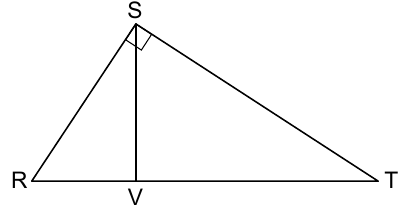
In right triangle $RST$ below, altitude $\overline{SV}$ is drawn to hypotenuse $\overline{RT}$. Which statement is always true?
- (A) $\frac{RT}{ST}=\frac{ST}{VT}$ ✓
- (B) $\frac{VR}{VT}=\frac{VT}{VS}$
- (C) $\frac{RV}{SV}=\frac{SV}{RT}$
- (D) $\frac{TR}{VR}=\frac{VR}{SR}$
Worked solution
This is the standard right-triangle altitude relation: each leg is the geometric mean between the hypotenuse and the segment of the hypotenuse adjacent to that leg.
What is the measure, in radians, of a central angle that intercepts an arc length of $12\pi$ cm in a circle with a diameter of 36 cm?
- (A) $\frac{\pi}{6}$
- (B) $\frac{\pi}{3}$
- (C) $\frac{2\pi}{3}$ ✓
- (D) $\frac{3\pi}{2}$
Worked solution
The radian measure of a central angle equals the intercepted arc length divided by the radius.
A regular nonagon has a center point, $P$. What degree of rotation about point $P$ will carry the nonagon onto itself?
- (A) $60°$
- (B) $90°$
- (C) $180°$
- (D) $200°$ ✓
Worked solution
A regular n-gon maps onto itself under rotations that are multiples of 360/n degrees; for a nonagon that unit angle is 40°, and 200° is the only listed choice divisible by 40.
If two sides of a triangle have lengths of 2 and 7, the length of the third side could be
- (A) 9
- (B) 8 ✓
- (C) 5
- (D) 4
Worked solution
The third side of a triangle must be strictly between the difference and the sum of the other two sides, so only 8 works here.
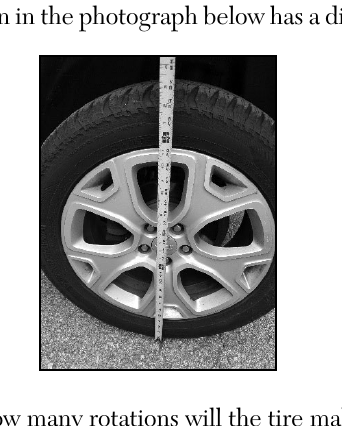
The car tire shown in the photograph below has a diameter of $2\frac{1}{4}$ feet. Approximately how many rotations will the tire make in one mile?
- (A) 373
- (B) 747 ✓
- (C) 1328
- (D) 2347
Worked solution
Each rotation of the tire covers one circumference of distance, so dividing the number of feet in a mile by the tire's circumference gives the number of rotations.
In quadrilateral $TOWN$, $\overline{OW} \cong \overline{TN}$ and $\overline{OT} \cong \overline{WN}$. Which additional information is sufficient to prove quadrilateral $TOWN$ is a rhombus?
- (A) $\overline{ON} \perp \overline{TW}$ ✓
- (B) $\overline{TO} \perp \overline{OW}$
- (C) $\overline{OW} \parallel \overline{TN}$
- (D) $\overline{ON}$ and $\overline{TW}$ bisect each other.
Worked solution
Given congruent opposite sides, the quadrilateral is already known to be a parallelogram; adding that its diagonals are perpendicular upgrades it to a rhombus, while the other choices either restate parallelogram conditions or don't guarantee equal side lengths.
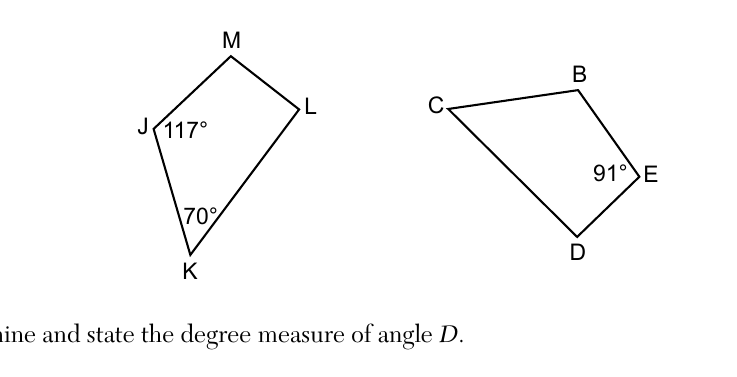
In the diagram below, quadrilateral $BCDE$ maps onto quadrilateral $JKLM$ using a sequence of rigid motions. In quadrilateral $JKLM$, angle $J = 117°$ and angle $K = 70°$. In quadrilateral $BCDE$, angle $E = 91°$. Determine and state the degree measure of angle $D$.
Worked solution
Rigid motions preserve angle measure, so angle E corresponds to angle M (91°); using the quadrilateral angle sum of 360° with the two given angles of JKLM gives angle L, which corresponds to angle D.
Given $\overline{AB}$ below, use a compass and a straightedge to construct a segment that is $\frac{1}{4}AB$. Leave all construction marks.

Worked solution
Bisecting AB gives a half-length segment, and bisecting that half again gives a quarter-length segment, all done with compass-and-straightedge arcs left visible.
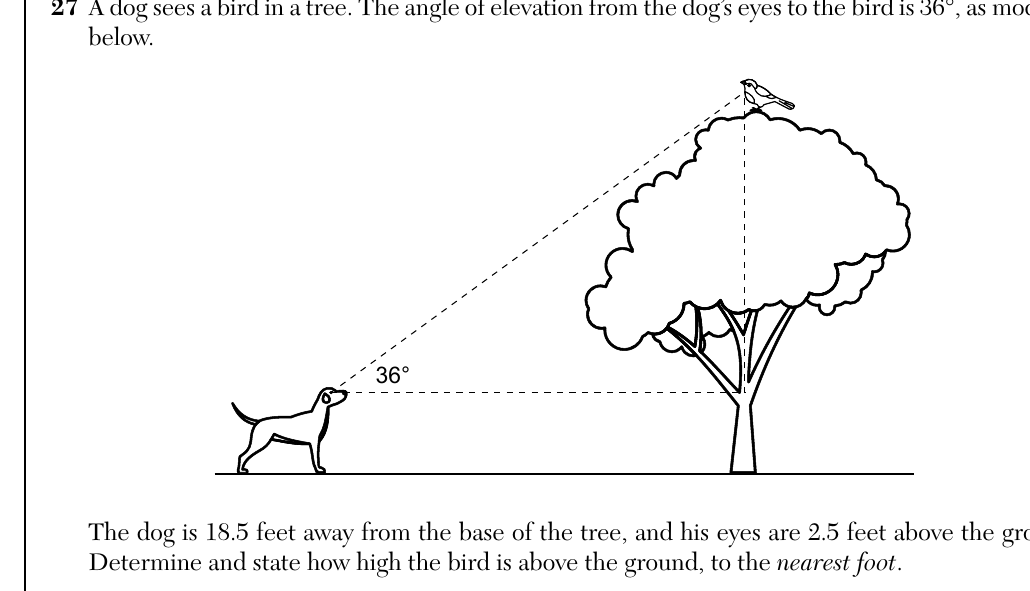
A dog sees a bird in a tree. The angle of elevation from the dog's eyes to the bird is $36°$, as modeled below. The dog is 18.5 feet away from the base of the tree, and his eyes are 2.5 feet above the ground. Determine and state how high the bird is above the ground, to the nearest foot.
Worked solution
Using the right triangle formed by the dog's line of sight, the horizontal distance, and the vertical rise to the bird, tangent of the elevation angle gives the rise above eye level, to which the dog's eye height is added.
Pure silver has a density of 10.5 g/cm$^3$. Samantha has a pure silver charm on her necklace in the shape of a sphere. The radius of the charm is 0.5 cm. Determine and state the mass of the charm, to the nearest tenth of a gram.
Worked solution
The mass of the charm equals its density times its volume, and the volume of a sphere is found with the formula (4/3)πr³.
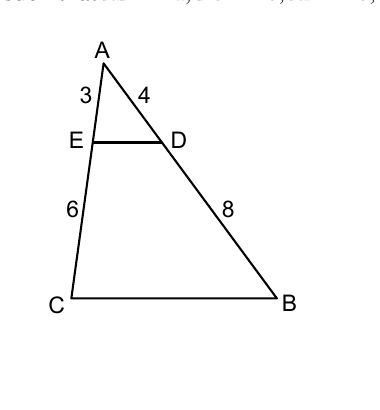
In $\triangle ABC$ below, $\overline{DE}$ is drawn such that $AD = 4$, $DB = 8$, $AE = 3$, and $EC = 6$. Explain why $\triangle ADE \sim \triangle ABC$.
Worked solution
Since AD/AB equals AE/AC (both ratios equal 1/3) and angle A is shared by both triangles, the two triangles are similar by the SAS Similarity Theorem.
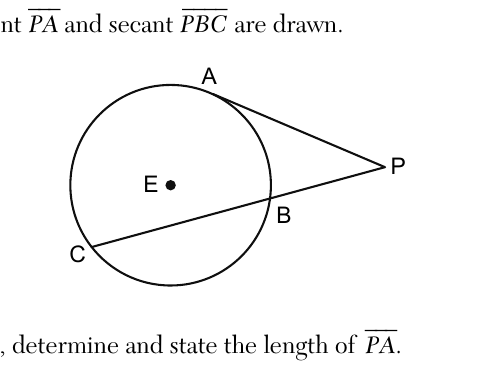
In circle $E$ below, tangent $\overline{PA}$ and secant $\overline{PBC}$ are drawn. If $PB = 9$ and $BC = 16$, determine and state the length of $\overline{PA}$.
Worked solution
For a tangent and secant drawn from the same external point, the square of the tangent length equals the product of the whole secant length and its external segment.
In a right triangle, $\sin(4x + 3)° = \cos(2x - 9)°$. Determine and state the value of $x$.
Worked solution
In a right triangle the sine of one acute angle equals the cosine of the other because the two acute angles are complementary, so their expressions must sum to 90.
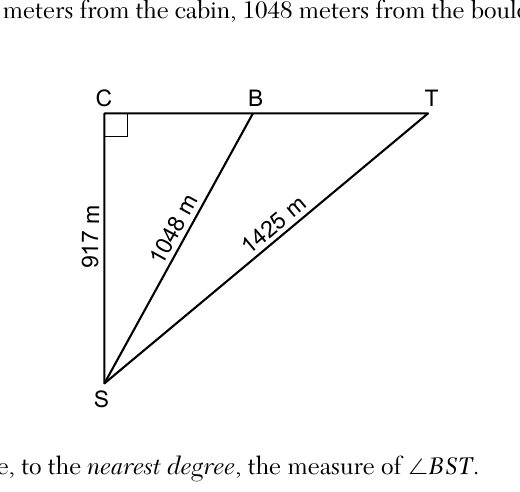
Modeled by right triangles below, a surveyor $(S)$ is taking land measurements using a cabin $(C)$, a boulder $(B)$, and a tree $(T)$ as fixed points of reference. The cabin, boulder, and tree are collinear. The surveyor is 917 meters from the cabin, 1048 meters from the boulder, and 1425 meters from the tree. Determine and state, to the nearest degree, the measure of $\angle BST$.
Worked solution
Since C, B, T are collinear and the right angle sits at C, the angle at S to each collinear point can be found with cosine (adjacent over hypotenuse), and subtracting the smaller angle to B from the larger angle to T isolates angle BST.
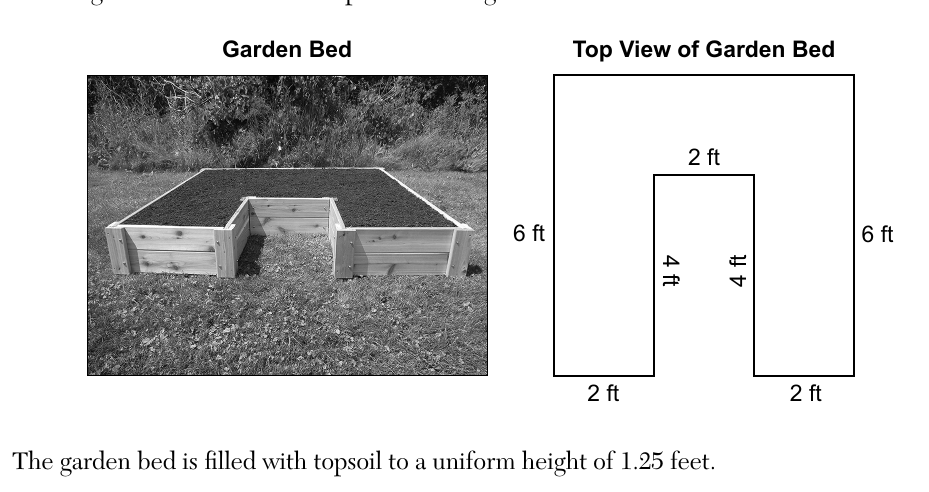
A garden bed, pictured below, is a square prism with a rectangular prism taken out. The inside length of the square prism is 6 feet. The rectangular prism taken out has a width of 2 feet and a length of 4 feet. The diagram below shows the top view of the garden bed with its inside measurements: an outer square 6 ft by 6 ft, with two notches cut into one side, each notch 2 ft wide and 4 ft deep, separated by a 2 ft wide section of remaining material. The garden bed is filled with topsoil to a uniform height of 1.25 feet. Determine and state the volume of the topsoil, in cubic feet. Each bag of topsoil sells for $3.68 and contains 2 cubic feet of topsoil. Determine and state the total cost of the bags of topsoil that must be purchased to fill the garden.
Worked solution
The garden bed's footprint is the 6 by 6 foot square minus the two 2 by 4 foot notches, giving the base area that gets multiplied by the fill height for volume, then the volume is divided by the bag size and rounded up to whole bags to find cost.
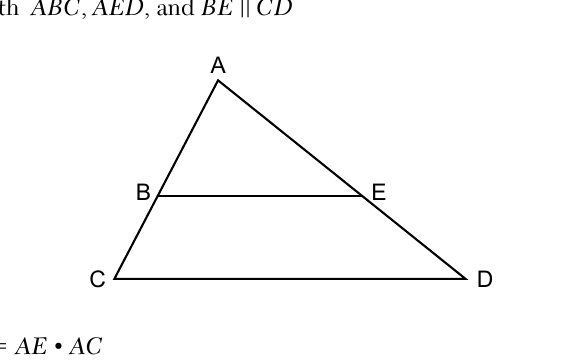
Given: $\triangle ACD$ with $\overline{ABC}, \overline{AED}$, and $\overline{BE} \parallel \overline{CD}$. Prove: $AB \cdot AD = AE \cdot AC$
Worked solution
Because B lies on AC and E lies on AD with BE parallel to CD, triangle ABE is similar to triangle ACD by AA (shared angle A, corresponding angles from the parallel lines), and cross-multiplying the resulting proportion of corresponding sides gives the required product equality.
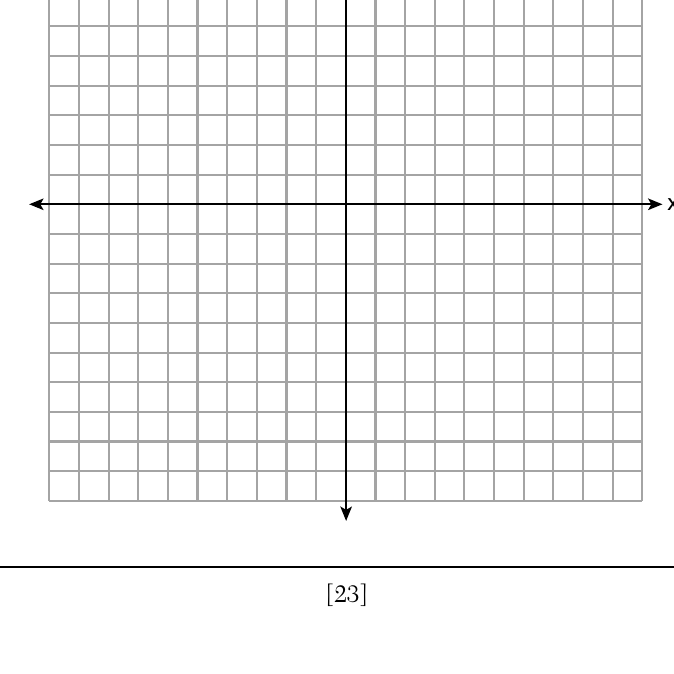
Triangle $PET$ has vertices with coordinates $P(-6,4)$, $E(6,8)$, and $T(-4,-2)$. Prove $\triangle PET$ is a right triangle. State the coordinates of $N$, the image of $P$, after a $180°$ rotation centered at $(1,3)$. Prove $PENT$ is a rectangle.
Worked solution
The right angle in triangle PET is confirmed because the slopes of PE and PT multiply to negative one; N is found by doubling the center and subtracting P's coordinates for a 180° rotation; and PENT is shown to be a rectangle because its diagonals PN and ET share the same midpoint (parallelogram) and are equal in length (rectangle).