June 2025 Chemistry Regents — Answer Key & Worked Solutions
Every question from the June 2025 Chemistry Regents exam, with the correct answer and a full step-by-step solution. Check your work, learn the method, then convert your raw score.
These are real questions from the June 2025 Chemistry New York State Regents examination, published by NYSED. Worked solutions are written by RegentsLab.
Which sequence of historic developments led to the modern model of the atom?
- (A) electrons in shells outside a nucleus, hard sphere, mostly empty space
- (B) electrons in shells outside a nucleus, mostly empty space, hard sphere
- (C) hard sphere, electrons in shells outside a nucleus, mostly empty space
- (D) hard sphere, mostly empty space, electrons in shells outside a nucleus ✓
Worked solution
The historical order of atomic models is Dalton's solid sphere, then Rutherford's mostly empty space with a dense nucleus, then Bohr's electrons in shells.
Which statement compares the energy of an electron in the third shell of a rubidium atom to the energy of an electron in a different shell of the same atom?
- (A) An electron in the third shell has less energy than an electron in the second shell.
- (B) An electron in the third shell has less energy than an electron in the first shell.
- (C) An electron in the third shell has more energy than an electron in the first shell. ✓
- (D) An electron in the third shell has more energy than an electron in the fifth shell.
Worked solution
Electron energy increases with increasing shell number (principal quantum number), so the third shell has more energy than the first shell.
When an electron in an atom returns from a higher energy state to a lower energy state
- (A) the atom becomes a negative ion
- (B) the atom becomes a positive ion
- (C) a specific amount of energy is emitted ✓
- (D) a specific amount of energy is absorbed
Worked solution
When an electron drops to a lower energy level, it releases a quantized amount of energy, often as a photon.
The atomic mass of chlorine is the weighted average of the atomic masses of the
- (A) radioactive isotopes of chlorine
- (B) naturally occurring isotopes of chlorine ✓
- (C) artificially produced isotopes of chlorine
- (D) radioactive and artificial isotopes of chlorine
Worked solution
Atomic mass values on the periodic table reflect the weighted average of naturally occurring isotopes of an element.
The elements on the Periodic Table are arranged in order of increasing
- (A) atomic mass
- (B) atomic number ✓
- (C) ionization energy
- (D) electronegativity
Worked solution
The modern periodic table is organized by increasing atomic number (number of protons).
Which element symbol represents a metalloid?
- (A) Ba
- (B) Cs
- (C) Te ✓
- (D) Xe
Worked solution
Tellurium is located along the zigzag line on the Periodic Table that separates metals from nonmetals, classifying it as a metalloid.
Which term identifies a chemical property that can be used to differentiate a sample of sodium from a sample of gold?
- (A) density
- (B) mass
- (C) reactivity ✓
- (D) temperature
Worked solution
Reactivity is a chemical property (describes how a substance reacts with other substances), whereas density, mass, and temperature are physical properties.
Which term identifies the type of matter that is composed of two or more different elements chemically combined in a fixed ratio?
- (A) solution
- (B) compound ✓
- (C) homogeneous mixture
- (D) heterogeneous mixture
Worked solution
A compound is a substance made of two or more elements chemically combined in a fixed, definite ratio.
The coefficients in a balanced equation represent the
- (A) atomic numbers of each element in the reaction
- (B) mass numbers of the reactants and products
- (C) mass ratio of substances in the reaction
- (D) mole ratio of substances in the reaction ✓
Worked solution
Coefficients in a balanced chemical equation indicate the relative number of moles of each reactant and product.
Given the equation representing a reaction: $Br + Br \rightarrow Br_2$. Which statement describes what occurs during this reaction?
- (A) Energy is released as bonds are formed. ✓
- (B) Energy is released as bonds are broken.
- (C) Energy is absorbed as bonds are formed.
- (D) Energy is absorbed as bonds are broken.
Worked solution
Forming a chemical bond (as two Br atoms combine into Br2) is an exothermic process that releases energy.
Which term represents a property used to determine the degree of polarity in the bond between two atoms?
- (A) conductivity
- (B) electronegativity ✓
- (C) joule
- (D) pascal
Worked solution
The difference in electronegativity between two bonded atoms determines the degree of polarity of the bond.
Which sample of matter has proportions of components that can be varied?
- (A) solid iodine
- (B) gaseous iodine
- (C) liquid ammonia
- (D) aqueous ammonia ✓
Worked solution
Aqueous ammonia is a solution (mixture), so the ratio of ammonia to water can vary; the other choices are pure substances with fixed composition.
Which term identifies a form of energy?
- (A) pascal
- (B) molarity
- (C) temperature
- (D) electromagnetic ✓
Worked solution
Electromagnetic (radiant) energy is a form of energy, while pascal, molarity, and temperature are units or measurements, not energy forms.
According to the kinetic molecular theory, which statement describes the particles of an ideal gas?
- (A) The force of attraction between the particles is strong.
- (B) The particles are arranged in a regular, geometric pattern.
- (C) The particles move in random, constant, straight-line motion. ✓
- (D) The collisions between particles result in a net loss of energy.
Worked solution
The kinetic molecular theory assumes ideal gas particles are in continuous, random, straight-line motion with negligible attractive forces and elastic collisions.
A reaction most likely occurs when particles collide with proper energy and
- (A) mass
- (B) density
- (C) volume
- (D) orientation ✓
Worked solution
For a reaction to occur, colliding particles need both sufficient energy and the correct orientation (collision theory).
At STP, 2.0 liters of $N_2(g)$ and 2.0 liters of $O_2(g)$ have the same
- (A) density
- (B) boiling point
- (C) melting point
- (D) number of molecules ✓
Worked solution
By Avogadro's principle, equal volumes of different gases at the same temperature and pressure (STP) contain the same number of molecules.
Which phrase describes a factor that determines the physical state of a molecular substance?
- (A) arrangement of the molecules ✓
- (B) decay mode of the molecules
- (C) conductivity of the molecules
- (D) solubility of the molecules
Worked solution
The physical state of a substance is determined by the arrangement and spacing of its particles (molecules), which affects whether it is solid, liquid, or gas.
Which combination of reactants will result in the fastest rate of reaction of a 1.0-gram sample of Zn(s) and 30. milliliters of HCl(aq) at 25°C?
- (A) 1.0-g cube of Zn(s) with 1.0 M HCl(aq)
- (B) 1.0-g cube of Zn(s) with 2.0 M HCl(aq)
- (C) 1.0-g powdered Zn(s) with 1.0 M HCl(aq)
- (D) 1.0-g powdered Zn(s) with 2.0 M HCl(aq) ✓
Worked solution
Powdered zinc has more surface area than a cube, and higher acid concentration increases collision frequency, so both factors combined give the fastest rate.
Which term represents the energy absorbed or released during a chemical change?
- (A) heat of fusion
- (B) heat of reaction ✓
- (C) heat of vaporization
- (D) heat capacity
Worked solution
The heat of reaction is the amount of energy absorbed or released during a chemical reaction.
In terms of energy and disorder, systems in nature have a tendency to undergo changes toward
- (A) lower energy and greater disorder ✓
- (B) lower energy and less disorder
- (C) higher energy and greater disorder
- (D) higher energy and less disorder
Worked solution
Natural systems tend to move toward states of lower energy and increased entropy (disorder).
A molecule of which straight chain hydrocarbon contains nine carbon atoms?
- (A) butane
- (B) hexane
- (C) nonane ✓
- (D) propane
Worked solution
The prefix "non-" indicates nine carbon atoms, so nonane is the straight chain hydrocarbon with nine carbons.
Which compound is an unsaturated hydrocarbon?
- (A) 1-heptanol
- (B) 2-butyne ✓
- (C) octane
- (D) ethanal
Worked solution
2-butyne is an alkyne, containing a carbon-carbon triple bond, making it an unsaturated hydrocarbon; the others are either alcohols/aldehydes (not hydrocarbons) or saturated (octane).
What is the number of electrons shared between the carbon atoms in an ethene molecule?
- (A) 6
- (B) 2
- (C) 3
- (D) 4 ✓
Worked solution
Ethene contains a carbon-carbon double bond, which consists of two shared electron pairs, totaling four shared electrons.
Which two terms represent types of organic reactions?
- (A) solidification and polymerization
- (B) solidification and vaporization
- (C) substitution and polymerization ✓
- (D) substitution and vaporization
Worked solution
Solidification and vaporization are physical phase changes; substitution and polymerization are classic organic reaction types.
In an operating electrolytic cell, oxidation occurs at the
- (A) anode ✓
- (B) cathode
- (C) salt bridge
- (D) switch
Worked solution
By definition, oxidation (electron loss) always occurs at the anode of any electrochemical cell, whether voltaic or electrolytic.
An Arrhenius base yields which negative ions in an aqueous solution?
- (A) hydronium ions
- (B) hydroxide ions ✓
- (C) ammonium ions
- (D) peroxide ions
Worked solution
By the Arrhenius definition, a base is a substance that produces hydroxide ions, OH-, as the only negative ion when dissolved in water.
Which change in the concentration of $H_3O^+$ ions results in a decrease of one unit in the pH value for an aqueous solution?
- (A) a decrease in the concentration of $H_3O^+$ by a factor of 10
- (B) a decrease in the concentration of $H_3O^+$ by a factor of 1
- (C) an increase in the concentration of $H_3O^+$ by a factor of 10 ✓
- (D) an increase in the concentration of $H_3O^+$ by a factor of 1
Worked solution
Because pH is a negative log-base-10 scale, each one-unit decrease in pH corresponds to a tenfold increase in hydronium ion concentration.
Based on Table $N$, which phrase describes the half-lives and the decay modes of uranium-235 and uranium-238?
From Reference Table N (Selected Radioisotopes): | Nuclide | Half-Life | Decay Mode | |---|---|---| | U-235 | 7.04 x 10^8 y | alpha | | U-238 | 4.47 x 10^9 y | alpha |
- (A) the same half-life but different decay modes
- (B) the same half-life and the same decay mode
- (C) different half-lives and different decay modes
- (D) different half-lives but the same decay mode ✓
Worked solution
Reference Table N lists U-235 and U-238 as both undergoing alpha decay, but their half-lives are very different (about 7.0x10^8 years vs 4.5x10^9 years).
Nuclear fission reactions result in the net conversion of
- (A) mass to energy ✓
- (B) energy to mass
- (C) beta particles to alpha particles
- (D) alpha particles to beta particles
Worked solution
Nuclear fission converts a small amount of mass defect into a large amount of energy, consistent with Einstein's mass-energy equivalence.
What is a risk associated with the production of energy in a nuclear power plant?
- (A) chemical tracing
- (B) radioactive dating
- (C) detection of disease
- (D) long-term storage of waste ✓
Worked solution
Nuclear power plants produce radioactive waste that remains hazardous for extremely long periods, making its long-term storage a major risk of nuclear energy production.
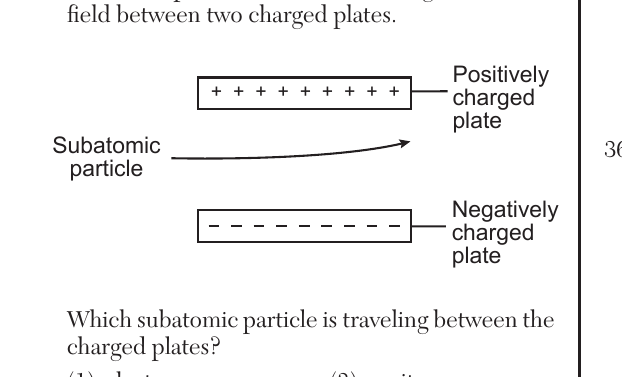
The diagram below represents the path of a subatomic particle as it travels through an electric field between two charged plates. A subatomic particle enters from the left between two horizontal plates and follows a curved path that bends upward toward the positively charged plate (top plate, marked with plus signs) and away from the negatively charged plate (bottom plate, marked with minus signs). Which subatomic particle is traveling between the charged plates?
- (A) electron ✓
- (B) neutron
- (C) positron
- (D) proton
Worked solution
Since the particle's path bends toward the positive plate, it must carry a negative charge; among the choices, only the electron is negatively charged (neutrons are neutral, positrons and protons are positive).
Which electron configuration represents the electrons in a neon atom in an excited state?
- (A) 2-7
- (B) 2-8
- (C) 2-6-1
- (D) 2-7-1 ✓
Worked solution
Neon has 10 electrons with a ground-state configuration of 2-8; the configuration 2-7-1 also totals 10 electrons but is not the lowest-energy (ground state) arrangement, making it an excited state.
Element $X$ reacts with chlorine to form the compound $XCl_3$. In which group on the Periodic Table of the Elements is element $X$ located?
- (A) Group 1
- (B) Group 2
- (C) Group 13 ✓
- (D) Group 18
Worked solution
Since chlorine has a -1 charge and three chlorine atoms combine with one X atom, X must have a +3 oxidation state, characteristic of Group 13 elements.
What is the number of moles of calcium oxide in a 238-gram sample of CaO? (gram-formula mass of CaO = 56.1 g/mol)
- (A) 0.236 mol
- (B) 4.24 mol ✓
- (C) 182 mol
- (D) 294 mol
Worked solution
Dividing the given mass by the gram-formula mass of CaO gives the number of moles present in the sample.
What is the molarity of an aqueous solution that contains 0.60 mole of KCl dissolved in 3.5 liters of solution?
- (A) 0.17 M ✓
- (B) 0.60 M
- (C) 2.1 M
- (D) 5.8 M
Worked solution
Molarity is calculated by dividing moles of solute by liters of solution, giving approximately 0.17 M.
Which statement describes the freezing point of a solution prepared by dissolving $NH_4Cl(s)$ in water at 25°C?
- (A) The solution has a freezing point lower than 0°C. ✓
- (B) The solution has a freezing point equal to 0°C.
- (C) The solution has a freezing point equal to 25°C.
- (D) The solution has a freezing point higher than 25°C.
Worked solution
Dissolving an ionic solute like NH4Cl in water lowers the freezing point of the solution below that of pure water (0°C), a colligative property called freezing-point depression.
At which temperature and pressure will a sample of a real gas behave most like an ideal gas?
- (A) 250. K and 100. atm
- (B) 500. K and 10. atm
- (C) 750. K and 1 atm
- (D) 1000. K and 0.1 atm ✓
Worked solution
Real gases most closely approximate ideal gas behavior under conditions of high temperature and low pressure, which minimizes intermolecular attractions and particle volume effects.
In a sealed, rigid cylinder with a movable piston, a sample of $H_2$ gas occupies 30.0 L at 50.0 kPa and 200. K. What is the pressure of the gas if the volume is changed to 60.0 L and the gas is heated to 300. K?
- (A) 16.7 kPa
- (B) 37.5 kPa ✓
- (C) 66.7 kPa
- (D) 150. kPa
Worked solution
Applying the combined gas law with the given initial and final volumes and temperatures gives a final pressure of 37.5 kPa.
Which statement explains why a catalyzed reaction occurs at a faster rate than the same reaction when uncatalyzed?
- (A) The catalyst provides a different reaction pathway for the reaction with a lower activation energy. ✓
- (B) The catalyst provides a different reaction pathway for the reaction with a higher activation energy.
- (C) The catalyst uses the same reaction pathway for the reaction with a lower activation energy.
- (D) The catalyst uses the same reaction pathway for the reaction with a higher activation energy.
Worked solution
A catalyst speeds up a reaction by offering a new, alternate reaction pathway that has a lower activation energy than the uncatalyzed pathway.
At standard pressure, which 10.0-gram sample of nitrogen has the greatest entropy?
- (A) nitrogen at 30. K
- (B) nitrogen at 50. K
- (C) nitrogen at 70. K
- (D) nitrogen at 90. K ✓
Worked solution
Entropy increases with increasing temperature because particles have more kinetic energy and greater disorder; of the given samples, the one at 90. K has the greatest entropy.
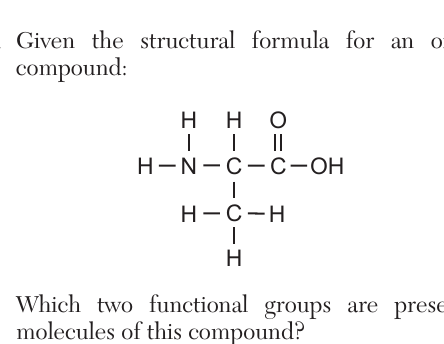
Given the structural formula for an organic compound: a central carbon chain where a nitrogen atom bonded to two hydrogen atoms (H-N-H) is bonded to a carbon atom (bearing one hydrogen and a CH3 branch shown as H-C-H below it), which is in turn bonded to a carbonyl carbon (C=O) that is bonded to an -OH group. Which two functional groups are present in molecules of this compound?
- (A) amine and aldehyde
- (B) amine and organic acid ✓
- (C) amide and aldehyde
- (D) amide and organic acid
Worked solution
The nitrogen in this structure is bonded to a carbon that is not a carbonyl carbon, making it an amine, while the terminal carbon bonded to both a double-bonded oxygen and a hydroxyl group is a carboxylic (organic) acid group.
Given the equation representing a reaction: $Fe + CuCl_2 \rightarrow FeCl_2 + Cu$. When the iron atoms lose 2 moles of electrons, the copper ions in $CuCl_2$
- (A) lose 1 mole of electrons
- (B) lose 2 moles of electrons
- (C) gain 1 mole of electrons
- (D) gain 2 moles of electrons ✓
Worked solution
In a redox reaction, the number of electrons lost by the oxidized species must equal the number gained by the reduced species; since Fe loses 2 moles of electrons, Cu2+ must gain 2 moles of electrons.
Given the equation representing a reaction: $4Al(s) + 3O_2(g) \rightarrow 2Al_2O_3(s)$. What is the change in oxidation state for aluminum in this reaction?
- (A) 0 to +3 ✓
- (B) 0 to +6
- (C) +3 to 0
- (D) +6 to 0
Worked solution
Elemental aluminum has an oxidation state of 0; in aluminum oxide, Al2O3, aluminum has an oxidation state of +3 to balance the -2 charge of oxygen, so aluminum is oxidized from 0 to +3.
Sulfuric acid, $H_2SO_4(aq)$, can neutralize an aqueous solution of calcium hydroxide, $Ca(OH)_2(aq)$. What is the formula for the salt produced by this neutralization reaction?
- (A) $Ca_2SO_4$
- (B) $Ca(SO_2)_2$
- (C) $CaSO_3$
- (D) $CaSO_4$ ✓
Worked solution
Neutralization of sulfuric acid with calcium hydroxide produces the salt calcium sulfate, CaSO4, and water, since Ca2+ and SO4 2- combine in a 1:1 ratio to balance charges.
Given the equation representing a reaction: $^{15}_{8}O \rightarrow\ ^{0}_{1}e + \ ^{15}_{7}N$ Which type of reaction is represented by this equation?
- (A) synthesis
- (B) esterification
- (C) substitution
- (D) transmutation ✓
Worked solution
Any nuclear change in which one element is converted into a different element (here oxygen becomes nitrogen through positron emission) is classified as transmutation.
Which equation represents nuclear fission?
- (A) $UO_2 + 4HCl \rightarrow UCl_4 + 2H_2O$
- (B) $U + 2Br_2 \rightarrow UBr_4$
- (C) $^{235}_{92}U \rightarrow\ ^{4}_{2}He + \ ^{231}_{90}Th$
- (D) $^{235}_{92}U + \ ^{1}_{0}n \rightarrow\ ^{141}_{56}Ba + \ ^{92}_{36}Kr + 3\ ^{1}_{0}n$ ✓
Worked solution
Nuclear fission is the splitting of a large, heavy nucleus into two smaller nuclei (plus neutrons), as shown when a uranium-235 nucleus absorbs a neutron and splits into barium and krypton.
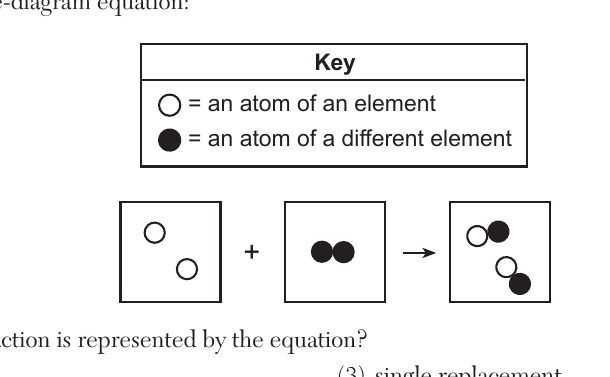
Given the particle-diagram equation shown below, which type of reaction is represented by the equation?
- (A) synthesis ✓
- (B) decomposition
- (C) single replacement
- (D) double replacement
Worked solution
The diagram shows two different elements, each starting as separate diatomic molecules, combining to form a new compound made of both kinds of atoms, which is a synthesis reaction.
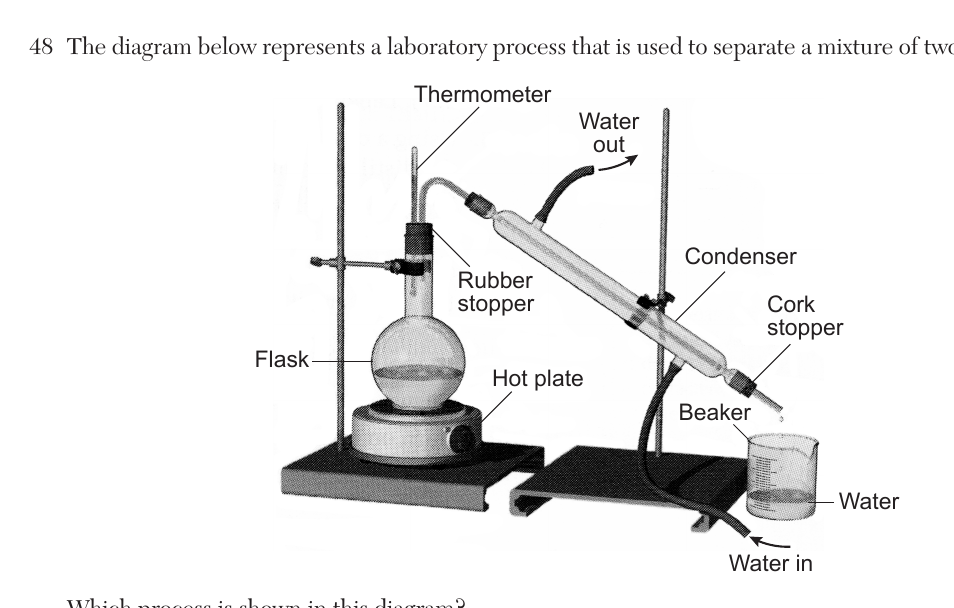
The diagram below represents a laboratory process that is used to separate a mixture of two different liquids. It shows a flask on a hot plate with a thermometer, connected through a rubber stopper to a condenser with water flowing in and out, leading to a beaker collecting liquid. Which process is shown in this diagram?
- (A) crystallization
- (B) distillation ✓
- (C) filtration
- (D) titration
Worked solution
Heating a mixture of liquids and condensing the vapor in a separate container to collect a purified liquid is the process of distillation, which separates substances by differences in boiling point.
Given the equation representing a system at equilibrium: $CO_3^{2-}(aq) + H_2O(\ell) \rightleftharpoons HCO_3^-(aq) + OH^-(aq)$ Which statement describes the base in the forward reaction?
- (A) The $H_2O(\ell)$ is the base because it accepts an $H^+$ ion.
- (B) The $H_2O(\ell)$ is the base because it donates an $H^+$ ion.
- (C) The $CO_3^{2-}(aq)$ is the base because it accepts an $H^+$ ion. ✓
- (D) The $CO_3^{2-}(aq)$ is the base because it donates an $H^+$ ion.
Worked solution
In this forward reaction water donates a hydrogen ion (acting as the acid) while carbonate ion accepts that hydrogen ion to become bicarbonate, so carbonate ion is the base.
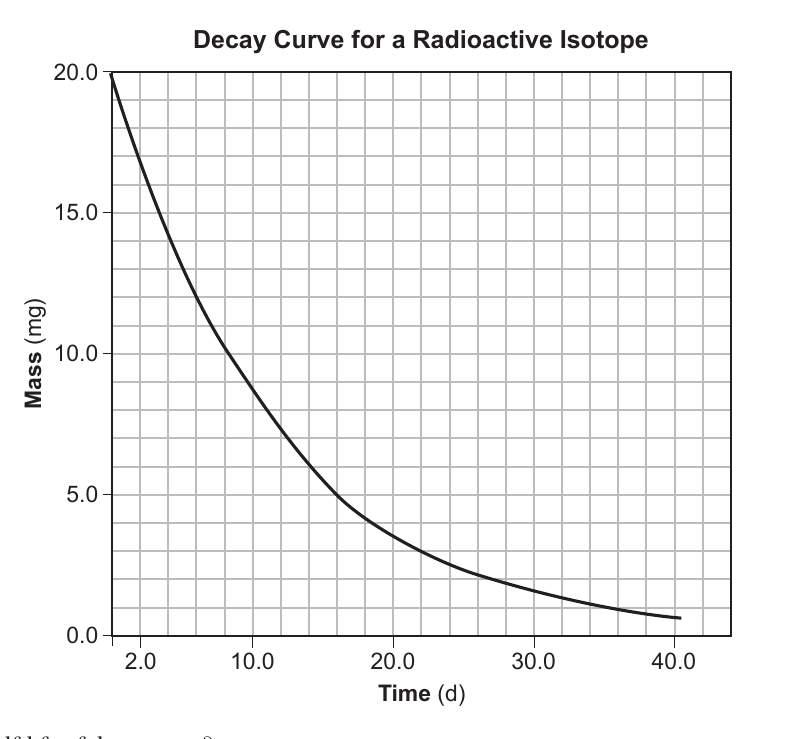
The graph below shows the decay curve for a 20.0-milligram sample of a radioactive isotope, titled "Decay Curve for a Radioactive Isotope," with Mass (mg) on the vertical axis (0 to 20.0) and Time (d) on the horizontal axis (0 to 40.0+). The curve starts near 20.0 mg at time near 0 and decreases, passing through approximately 10 mg around 8 d, and continuing to decrease toward smaller mass values as time increases. What is the half-life of this isotope?
- (A) 5.0 d
- (B) 8.0 d ✓
- (C) 8.7 d
- (D) 10.0 d
Worked solution
The half-life is the time needed for the mass to drop to half its original value; the curve shows the sample falling from 20.0 mg to 10.0 mg in about 8.0 days.
Based on Table F, identify one positive ion that forms an insoluble compound with iodide ions in an aqueous solution.
Worked solution
According to the solubility guidelines in Table F, silver ion (Ag+, also Pb2+, Cu+, or Hg2^2+) forms an insoluble compound with iodide ions.
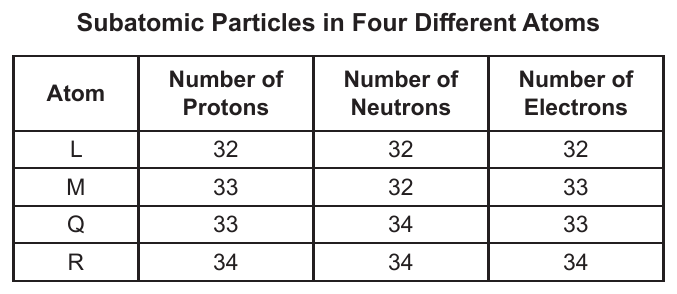
Base your answer on the table below showing the number of subatomic particles in four different atoms, represented by the letters L, M, Q, and R. State the number of valence electrons in an atom of M in the ground state.
Worked solution
Atom M has 33 protons, making it arsenic, an element in Group 15 of the Periodic Table, which has 5 valence electrons.
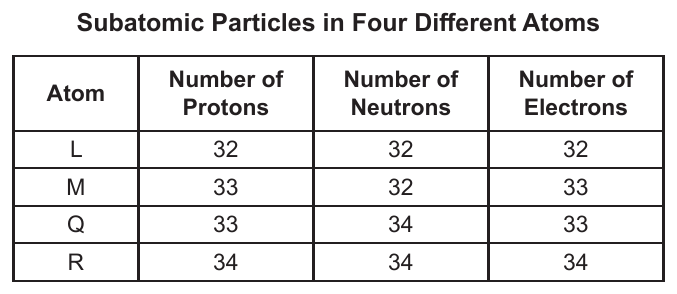
Base your answer on the table below showing the number of subatomic particles in four different atoms, represented by the letters L, M, Q, and R. Compare the mass of a proton in atom R to the mass of an electron in atom R.
Worked solution
A proton has a mass roughly 1836 times greater than the mass of an electron; the electron's mass is essentially negligible by comparison.
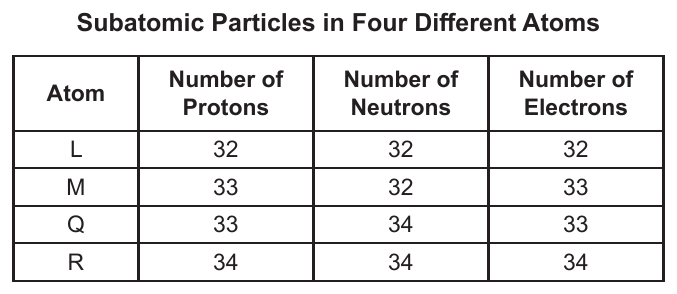
Base your answer on the table below showing the number of subatomic particles in four different atoms, represented by the letters L, M, Q, and R. Write the two letters, from this table, that represent atoms that are isotopes of the same element.
Worked solution
Atoms M and Q both have 33 protons (same element, arsenic) but different numbers of neutrons (32 vs 34), making them isotopes of each other.
Potassium and bromine react to form the ionic compound potassium bromide. Compare the radius of a potassium ion in the ground state to the radius of a potassium atom in the ground state.
Worked solution
When a potassium atom loses its one valence electron to form K+, it loses its outer occupied electron shell, so the resulting ion has a smaller radius than the neutral atom.
Potassium and bromine react to form the ionic compound potassium bromide. Identify the noble gas that has atoms in the ground state with the same electron configuration as a potassium ion, K+, in the ground state.
Worked solution
A potassium ion (K+) has 18 electrons with configuration 2-8-8, which is identical to the ground-state electron configuration of the noble gas argon.
In the space in your answer booklet, draw a Lewis electron-dot diagram of a bromide ion, $Br^-$.
Worked solution
Bromine has 7 valence electrons and gains one more to form Br-, so the correct Lewis dot diagram shows the Br symbol surrounded by 4 lone pairs (8 dots) enclosed in brackets with a 1- charge.
Potassium and bromine react to form the ionic compound potassium bromide. Identify the type of bonding in a sample of solid potassium.
Worked solution
A sample of pure solid potassium consists only of metal atoms held together by metallic bonding, in which valence electrons are delocalized among the potassium ions.
Hydrogen sulfide, $H_2S$, and water, $H_2O$, are both molecular compounds. State, in terms of valence electrons, why the bonds in a molecule of hydrogen sulfide are covalent.
Worked solution
In H2S, the hydrogen and sulfur atoms are nonmetals that achieve stable electron configurations by sharing pairs of valence electrons, which is what makes the bonds covalent rather than ionic.
Hydrogen sulfide, $H_2S$, and water, $H_2O$, are both molecular compounds. Explain, in terms of charge distribution, why a molecule of $H_2S$ is a polar molecule.
Worked solution
Because H2S is bent rather than linear, the polar H-S bonds do not cancel each other, leaving an uneven distribution of charge across the molecule and making it polar.
An equilibrium system in a sealed, rigid container is represented by the equation below. $H_2(g) + I_2(g) + heat \rightleftharpoons 2HI(g)$ Compare the rate of the forward reaction to the rate of the reverse reaction in this system.
Worked solution
At chemical equilibrium, the forward and reverse reactions occur at equal rates, which is why the concentrations of reactants and products remain constant.
An equilibrium system in a sealed, rigid container is represented by the equation below. $H_2(g) + I_2(g) + heat \rightleftharpoons 2HI(g)$ State the effect on the concentration of iodine gas when hydrogen gas is added to this equilibrium system.
Worked solution
Adding H2 shifts the equilibrium to the right according to Le Chatelier's principle, consuming I2 in the process and decreasing its concentration.
An equilibrium system in a sealed, rigid container is represented by the equation below. $H_2(g) + I_2(g) + heat \rightleftharpoons 2HI(g)$ Draw a potential energy diagram on the labeled axes in your answer booklet for the forward reaction.

Worked solution
Since heat appears as a reactant, the forward reaction is endothermic, so the correct potential energy diagram shows the reactants starting low, rising over an activation-energy peak, and ending at a products energy level that is higher than the reactants' energy level.
Radon-222 and radon-223 are two radioactive isotopes of radon. Radon-222 emits alpha particles when it decays and radon-223 emits beta particles when it decays. Complete the nuclear equation in your answer booklet for the decay of radon-222 by writing a notation for the missing product.
Worked solution
In alpha decay, radon-222 (Z=86, A=222) emits an alpha particle (helium-4 nucleus), leaving a daughter nucleus with mass number 218 and atomic number 84, which is polonium-218.
Radon-222 and radon-223 are two radioactive isotopes of radon. Radon-222 emits alpha particles when it decays and radon-223 emits beta particles when it decays. Determine the time required for a sample of radon-222 to decay until only $\frac{1}{4}$ of the original sample remains unchanged.
Worked solution
Since 1/4 remaining corresponds to exactly two half-lives, and the half-life of radon-222 (from Table N) is 3.82 days, the total time elapsed is 2 x 3.82 = 7.64 days.
Chlorine, phosphorus, and sulfur are three elements located in Period 3 on the Periodic Table that have been used to produce important compounds for agriculture. Identify the element classification of these three elements.
Worked solution
Chlorine, phosphorus, and sulfur are all classified as nonmetals on the Periodic Table.
Base your answers to questions 67 through 69 on the information below and on your knowledge of chemistry. Chlorine, phosphorus, and sulfur are three elements located in Period 3 on the Periodic Table that have been used to produce important compounds for agriculture. 67 Determine the mass number of an atom of sulfur that contains 18 neutrons.
Worked solution
The mass number of an atom equals the sum of its protons and neutrons. Sulfur's atomic number (16 protons) plus the given 18 neutrons gives a mass number of 34.
Base your answers to questions 67 through 69 on the information below and on your knowledge of chemistry. Chlorine, phosphorus, and sulfur are three elements located in Period 3 on the Periodic Table that have been used to produce important compounds for agriculture. 68 State the trend in atomic radius as these three Period 3 elements on the Periodic Table are considered in order of increasing atomic number.
Worked solution
Moving left to right across a period, increasing nuclear charge pulls the same-shell electrons in more tightly, so atomic radius decreases.
Base your answers to questions 67 through 69 on the information below and on your knowledge of chemistry. Chlorine, phosphorus, and sulfur are three elements located in Period 3 on the Periodic Table that have been used to produce important compounds for agriculture. 69 Identify which of these three elements is a gas at STP.
Worked solution
According to the Periodic Table reference tables, chlorine exists as a diatomic gas at standard temperature and pressure, while phosphorus and sulfur are solids.
Base your answers to questions 70 through 72 on the information below and on your knowledge of chemistry. Silicon carbide, SiC, is a compound used for making sandpaper and for cutting and polishing metals and glass. The balanced equation below represents the production of silicon carbide. $SiO_2 + 3C + \text{heat} \rightarrow SiC + 2CO$ 70 Show a numerical setup for calculating the gram-formula mass of silicon dioxide.
Worked solution
The gram-formula mass of SiO2 is found by adding the atomic mass of silicon to twice the atomic mass of oxygen.
Base your answers to questions 70 through 72 on the information below and on your knowledge of chemistry. Silicon carbide, SiC, is a compound used for making sandpaper and for cutting and polishing metals and glass. The balanced equation below represents the production of silicon carbide. $SiO_2 + 3C + \text{heat} \rightarrow SiC + 2CO$ 71 Write a chemical name for the product, CO, in the equation.
Worked solution
CO is a binary molecular compound named using prefixes; with one carbon and one oxygen atom, it is named carbon monoxide.
Base your answers to questions 70 through 72 on the information below and on your knowledge of chemistry. Silicon carbide, SiC, is a compound used for making sandpaper and for cutting and polishing metals and glass. The balanced equation below represents the production of silicon carbide. $SiO_2 + 3C + \text{heat} \rightarrow SiC + 2CO$ 72 Determine the number of moles of carbon that are required to produce 4.0 moles of silicon carbide, SiC.
Worked solution
Using the mole ratio from the balanced equation (3 mol C per 1 mol SiC), 4.0 moles of SiC requires 12 moles of carbon.
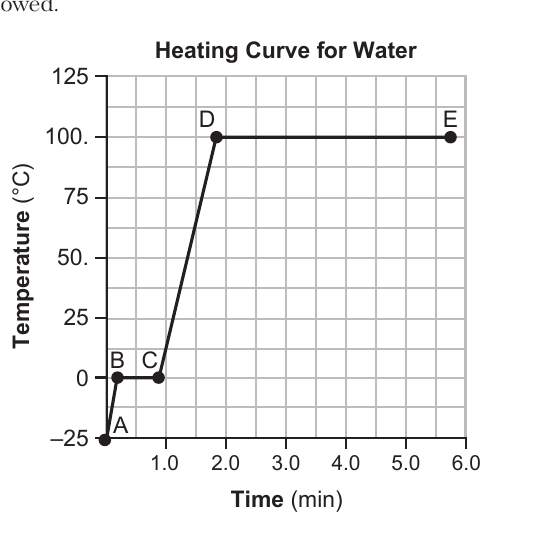
Base your answers to questions 73 through 75 on the information below and on your knowledge of chemistry. At standard pressure, a student heated a 120.-gram sample of H2O(s) at -25°C until the entire sample boiled for four minutes. This process is represented by the heating curve below. During this laboratory activity appropriate safety equipment was used and safety procedures were followed. 73 Identify the physical change that takes place during interval BC of the heating curve.
Worked solution
A flat segment on a heating curve indicates a phase change at constant temperature; at 0 degrees Celsius this is melting of ice to liquid water.
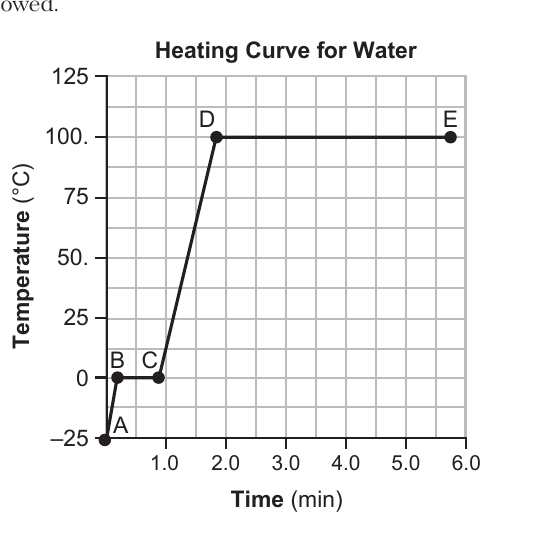
Base your answers to questions 73 through 75 on the information below and on your knowledge of chemistry. At standard pressure, a student heated a 120.-gram sample of H2O(s) at -25°C until the entire sample boiled for four minutes. This process is represented by the heating curve below. During this laboratory activity appropriate safety equipment was used and safety procedures were followed. 74 State what happens to the average kinetic energy of the molecules in the H2O sample during interval CD.
Worked solution
Since temperature is a direct measure of average kinetic energy, and interval CD shows a rising temperature (liquid water warming), the average kinetic energy of the molecules increases.
Base your answers to questions 73 through 75 on the information below and on your knowledge of chemistry. At standard pressure, a student heated a 120.-gram sample of H2O(s) at -25°C until the entire sample boiled for four minutes. This process is represented by the heating curve below. During this laboratory activity appropriate safety equipment was used and safety procedures were followed. 75 Determine the quantity of heat absorbed when the 120.-gram sample of water boils away completely at its boiling point.
Worked solution
The heat absorbed during boiling (a phase change at constant temperature) is calculated using q = m×Hv, where Hv is the heat of vaporization of water from the reference tables, 2260 J/g.
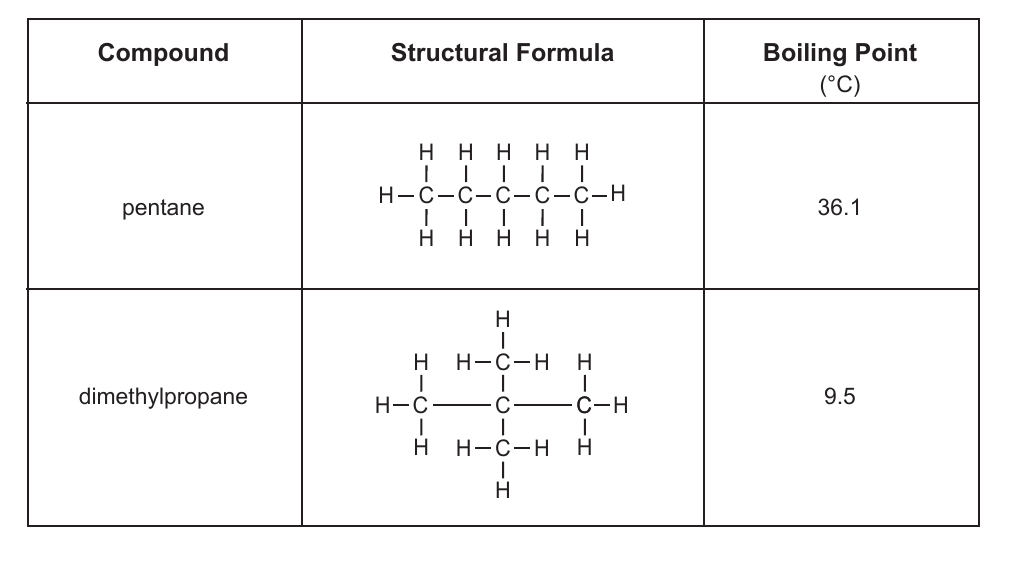
Base your answers to questions 76 through 78 on the information below and on your knowledge of chemistry. The structural formulas of two of the three isomers of pentane and their boiling points at standard pressure are shown below. 76 Write the general formula of the homologous series to which these compounds belong.
Worked solution
Pentane and dimethylpropane are both saturated hydrocarbons (alkanes) with only single bonds, which belong to the homologous series with general formula CnH2n+2.
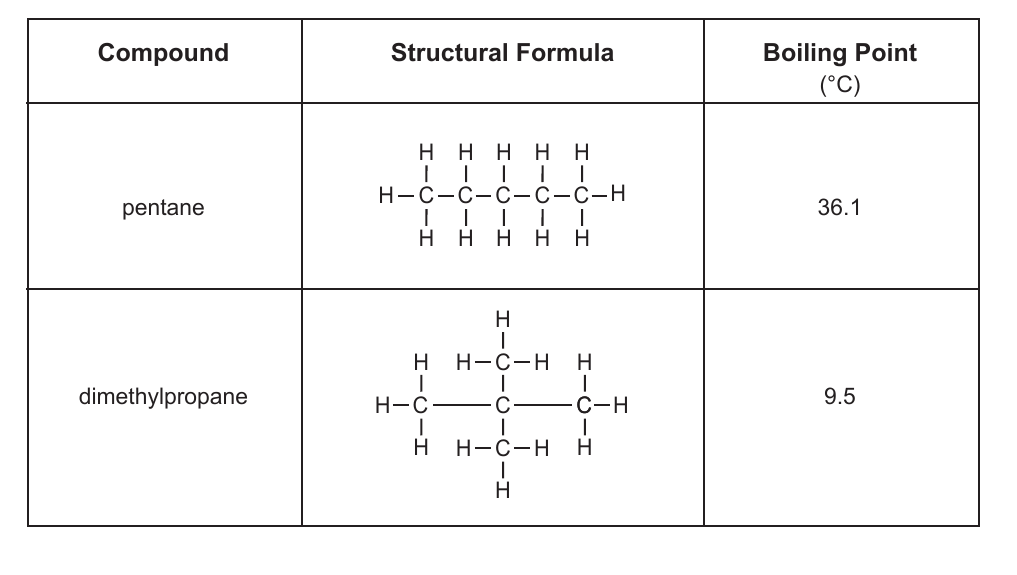
Base your answers to questions 76 through 78 on the information below and on your knowledge of chemistry. The structural formulas of two of the three isomers of pentane and their boiling points at standard pressure are shown below (pentane, boiling point 36.1°C; dimethylpropane, boiling point 9.5°C). 77 State, in terms of strength of intermolecular forces, why the boiling point of dimethylpropane is lower than the boiling point of pentane.
Worked solution
Both are nonpolar molecules held together by London dispersion forces. The more spherical, branched shape of dimethylpropane has less surface area in contact between neighboring molecules than the straight chain of pentane, resulting in weaker intermolecular forces and thus a lower boiling point.
Base your answers to questions 76 through 78 on the information below and on your knowledge of chemistry. The structural formulas of two of the three isomers of pentane and their boiling points at standard pressure are shown (pentane and dimethylpropane). 78 In the space in your answer booklet, draw a structural formula of the third pentane isomer, 2-methylbutane.
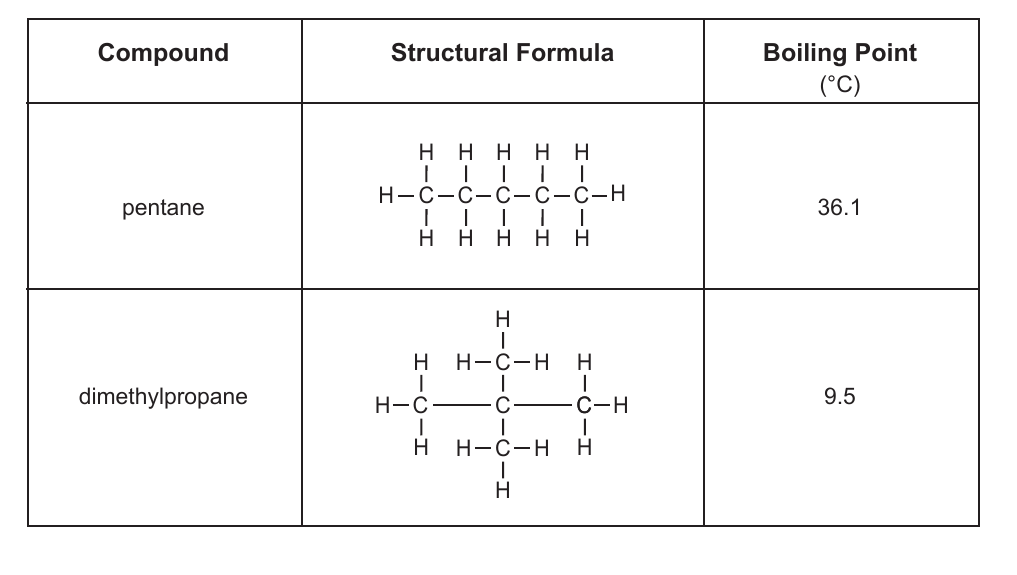
Worked solution
2-methylbutane is drawn as a four-carbon chain (butane) with a methyl group branching off the second carbon, giving each carbon the correct number of hydrogens to satisfy four bonds, and the overall molecular formula C5H12.
Base your answers to questions 79 through 81 on the information below and on your knowledge of chemistry. In a laboratory activity, a student constructs an electrochemical cell. The diagram and the ionic equation below represent this cell and the reaction that occurs. During this laboratory activity appropriate safety equipment is used and safety procedures are followed. Voltaic Cell diagram: A voltmeter (V) connects via wires to a Zn(s) electrode in a beaker of Zn2+(aq) and a Mg(s) electrode in a beaker of Mg2+(aq), joined by a salt bridge. $Zn^{2+}(aq) + Mg(s) \rightarrow Zn(s) + Mg^{2+}(aq)$ 79 State the form of energy that is converted to electrical energy in this type of cell.
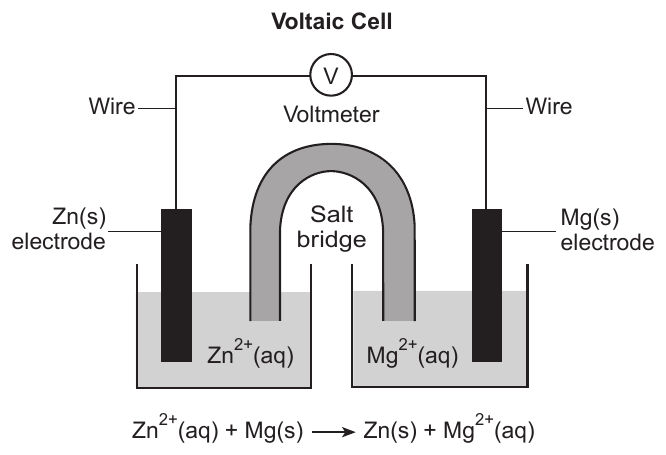
Worked solution
A voltaic cell uses a spontaneous chemical reaction (the redox reaction between Zn2+ and Mg) to generate electricity, converting chemical energy into electrical energy.
Base your answers to questions 79 through 81 on the information below and on your knowledge of chemistry. In a laboratory activity, a student constructs an electrochemical cell represented by the ionic equation: $Zn^{2+}(aq) + Mg(s) \rightarrow Zn(s) + Mg^{2+}(aq)$ The cell has a Zn(s) electrode in Zn2+(aq) and a Mg(s) electrode in Mg2+(aq), connected by wires through a voltmeter, with a salt bridge joining the two half-cells. 80 State, in terms of the electrodes, the direction of electron flow in the external circuit when the cell is operating.
Worked solution
Mg is oxidized and loses electrons at the Mg electrode (anode), while Zn2+ is reduced at the Zn electrode (cathode); electrons therefore flow through the external wire from the Mg electrode to the Zn electrode.
Base your answers to questions 79 through 81 on the information below and on your knowledge of chemistry. The cell is represented by the ionic equation: $Zn^{2+}(aq) + Mg(s) \rightarrow Zn(s) + Mg^{2+}(aq)$ 81 Write a balanced equation for the reduction half-reaction that occurs in this cell.
Worked solution
Reduction involves a gain of electrons; in this cell Zn2+ ions gain two electrons to form solid zinc, which is the reduction half-reaction.
Base your answers to questions 82 through 85 on the information below and on your knowledge of chemistry. During a titration, 11.1 mL of hydrochloric acid, HCl(aq), is exactly neutralized by 33.3 mL of 0.10 M sodium hydroxide, NaOH(aq). During this laboratory activity, appropriate safety equipment is used and safety procedures are followed. 82 Identify the positive ion present in the HCl(aq).
Worked solution
HCl is an Arrhenius acid that dissociates in water to yield hydrogen ions (commonly represented as hydronium ions, H3O+) and chloride ions.
Base your answers to questions 82 through 85 on the information below and on your knowledge of chemistry. During a titration, 11.1 mL of hydrochloric acid, HCl(aq), is exactly neutralized by 33.3 mL of 0.10 M sodium hydroxide, NaOH(aq). During this laboratory activity, appropriate safety equipment is used and safety procedures are followed. 83 Determine the concentration of the HCl(aq) using the titration data.
Worked solution
Using the titration relationship MacidVacid = MbaseVbase and solving for the unknown acid concentration gives 0.30 M HCl.
Base your answers to questions 82 through 85 on the information below and on your knowledge of chemistry. During a titration, 11.1 mL of hydrochloric acid, HCl(aq), is exactly neutralized by 33.3 mL of 0.10 M sodium hydroxide, NaOH(aq). During this laboratory activity, appropriate safety equipment is used and safety procedures are followed. 84 State the color of bromcresol green if it is added to a sample of the sodium hydroxide solution.
Worked solution
Sodium hydroxide solution is basic, and according to the indicator reference table, bromcresol green turns blue in basic solutions.
Base your answers to questions 82 through 85 on the information below and on your knowledge of chemistry. During a titration, 11.1 mL of hydrochloric acid, HCl(aq), is exactly neutralized by 33.3 mL of 0.10 M sodium hydroxide, NaOH(aq). During this laboratory activity, appropriate safety equipment is used and safety procedures are followed. 85 State, in terms of ions, why a sample of the 0.10 M NaOH is a good conductor of electricity.
Worked solution
NaOH is a strong electrolyte that dissociates completely into Na+ and OH- ions in water; these freely moving, charged ions allow the solution to conduct an electric current.