June 2024 Chemistry Regents — Answer Key & Worked Solutions
Every question from the June 2024 Chemistry Regents exam, with the correct answer and a full step-by-step solution. Check your work, learn the method, then convert your raw score.
These are real questions from the June 2024 Chemistry New York State Regents examination, published by NYSED. Worked solutions are written by RegentsLab.
Which description of the atom is based on the results of the gold foil experiment in the early 1900s?
- (A) Atoms are small, dense, indivisible spheres.
- (B) Atoms are composed of protons, electrons, and neutrons.
- (C) Atoms have small, dense, positively charged nuclei. ✓
- (D) Atoms have electrons with wavelike properties.
Worked solution
Rutherford's gold foil experiment showed that most of an atom's mass and positive charge is concentrated in a tiny, dense nucleus.
According to the electron cloud model, which term is defined as the most probable location of an electron in an atom?
- (A) configuration
- (B) nucleus
- (C) orbital ✓
- (D) spectrum
Worked solution
An orbital represents the region of space around the nucleus where there is the highest probability of finding an electron.
Which change occurs when an electron returns from a higher energy state to a lower energy state?
- (A) An ionic compound is formed, and energy is emitted.
- (B) An ionic compound is formed, and energy is absorbed.
- (C) A specific amount of energy is absorbed.
- (D) A specific amount of energy is emitted. ✓
Worked solution
Dropping to a lower energy level releases a fixed quantum of energy, often as light, corresponding to the exact energy difference between states.
Which phrase describes the different isotopes of an element?
- (A) same number of electrons and a different number of protons
- (B) same number of protons and a different number of electrons
- (C) same number of protons and a different number of neutrons ✓
- (D) same number of neutrons and a different number of protons
Worked solution
Isotopes are atoms of the same element (same proton count) that have different numbers of neutrons, giving them different mass numbers.
Which statement describes a chemical property of sodium?
- (A) It is silver in color.
- (B) It has a density of 0.97 g/cm$^3$ at room temperature.
- (C) It has atoms with an atomic radius of 160 pm.
- (D) It is highly reactive with water. ✓
Worked solution
A chemical property describes a substance's tendency to undergo a chemical change, such as sodium reacting vigorously with water; the others are physical properties.
Oxygen can exist as diatomic oxygen gas, $O_2(g)$, or ozone, $O_3(g)$. These two forms of oxygen have
- (A) the same molecular structure and the same properties
- (B) different molecular structures and different properties ✓
- (C) the same molecular structure and different properties
- (D) different molecular structures and the same properties
Worked solution
O2 and O3 are allotropes with different numbers of atoms bonded together, resulting in different molecular structures and different properties.
Which formula contains a polyatomic ion?
- (A) KCN ✓
- (B) K$_2$S
- (C) AlBr$_3$
- (D) Al$_2$O$_3$
Worked solution
KCN is composed of the K+ ion and the polyatomic cyanide ion CN-; the other choices contain only monatomic ions.
What information about C$_4$H$_{10}$ can be determined from its structural formula, but not determined from its molecular formula?
- (A) physical state
- (B) molar mass
- (C) ratio of different atoms
- (D) arrangement of the atoms ✓
Worked solution
A molecular formula only tells the number of each type of atom, while a structural formula also shows how those atoms are connected and arranged, distinguishing isomers.
Which quantity is conserved in all chemical reactions?
- (A) charge ✓
- (B) density
- (C) moles
- (D) volume
Worked solution
Charge (like mass) is always conserved in chemical reactions, while quantities such as moles, density, and volume of the reacting substances can change.
What do the coefficients in a balanced chemical equation indicate about the substances in the equation?
- (A) mass ratios
- (B) mole ratios ✓
- (C) empirical formulas
- (D) molecular formulas
Worked solution
Coefficients in a balanced equation represent the mole (particle) ratios in which reactants and products react and form.
At STP, which substance has metallic bonding?
- (A) argon
- (B) barium chloride
- (C) sulfur dioxide
- (D) titanium ✓
Worked solution
Titanium is a metallic element, so its atoms are held together by metallic bonding, unlike argon (no bonding), barium chloride (ionic), or sulfur dioxide (covalent).
How many pairs of electrons are shared between the nitrogen atoms in a molecule of N$_2$?
- (A) 1
- (B) 2
- (C) 3 ✓
- (D) 4
Worked solution
The nitrogen molecule N2 is held together by a triple covalent bond, which consists of three shared pairs of electrons.
Which formula represents a molecule with an asymmetrical distribution of charge?
- (A) Cl$_2$
- (B) CO$_2$
- (C) CH$_4$
- (D) H$_2$O ✓
Worked solution
Water's bent molecular geometry gives it an uneven (asymmetrical) distribution of charge, making it a polar molecule, unlike the symmetrical, nonpolar Cl2, CO2, and CH4.
Given the equation representing a reaction: $I_2 \rightarrow I + I$ What occurs during this reaction?
- (A) Energy is released and a bond is formed.
- (B) Energy is released and a bond is broken.
- (C) Energy is absorbed and a bond is broken. ✓
- (D) Energy is absorbed and a bond is formed.
Worked solution
The single covalent bond in I2 is being broken to form two separate iodine atoms, and breaking a bond always requires energy input.
The electronegativity difference between the atoms in a molecule of HF can be used to determine the
- (A) energy of the molecule
- (B) functional group of molecule
- (C) polarity of the bond in the molecule ✓
- (D) volume of the atoms in the molecule
Worked solution
The difference in electronegativity between the two bonded atoms is used to classify and determine how polar a covalent bond is.
Which sample of matter is classified as a mixture?
- (A) NaCl(s)
- (B) CH$_3$OH($\ell$)
- (C) SO$_2$(g)
- (D) KNO$_3$(aq) ✓
Worked solution
The (aq) notation indicates KNO3 dissolved in water, which is a homogeneous mixture (solution), while the other choices are single pure compounds.
At STP, which property of tungsten remains the same for all samples of tungsten?
- (A) density ✓
- (B) mass
- (C) surface area
- (D) thermal energy
Worked solution
Density is an intensive physical property that stays constant for a pure substance at given conditions regardless of how much of the sample you have, unlike mass, surface area, or thermal energy.
An element is composed of atoms that must have
- (A) the same atomic mass
- (B) the same atomic number ✓
- (C) a different number of protons
- (D) a different number of electrons
Worked solution
All atoms of a given element share the same atomic number (number of protons), which is the defining characteristic of an element.
Compared to a 2.0 M aqueous solution of KI at 1.0 atm, water at 1.0 atm has a
- (A) lower boiling point and a lower freezing point
- (B) lower boiling point and a higher freezing point ✓
- (C) higher boiling point and a lower freezing point
- (D) higher boiling point and a higher freezing point
Worked solution
Adding solute to water raises the boiling point and lowers the freezing point of the solution, so pure water has a lower boiling point and higher freezing point than the KI solution.
Which statement describes the particles of an ideal gas, based on the kinetic molecular theory?
- (A) The particles have attractive forces between them.
- (B) The particles move in random, constant, straight-line motion. ✓
- (C) The particles collide, increasing the total energy of the system.
- (D) The particles are separated by distances that are small compared to their size.
Worked solution
Kinetic molecular theory describes ideal gas particles as moving randomly in constant straight-line motion between elastic collisions, with negligible attractive forces and large distances relative to particle size.
Chemical reactions are most likely to occur when reacting particles collide with the
- (A) proper energy and proper orientation ✓
- (B) proper first ionization energy and proper molecular symmetry
- (C) same mass and the same number of electrons
- (D) same number of valence electrons and the same number of electron shells
Worked solution
According to collision theory, an effective (reaction-producing) collision requires both sufficient energy (activation energy) and the correct geometric orientation of colliding particles.
At STP, a 2.0-liter sample of nitrogen gas and a 2.0-liter sample of oxygen gas have equal
- (A) atomic masses
- (B) numbers of molecules ✓
- (C) densities
- (D) boiling points
Worked solution
By Avogadro's principle, equal volumes of any gas at the same temperature and pressure (STP) contain equal numbers of molecules, regardless of the identity of the gas.
Based on Table $H$, which compound has the weakest intermolecular forces at 75°C?
From Reference Table H (Vapor Pressure of Four Liquids): at every temperature shown, the vapor pressure curves rank, from highest to lowest, propanone > ethanol > water > ethanoic acid. Reading the curves at 75 degrees C gives approximately: | Liquid | Vapor pressure at 75 C (kPa, approx.) | |---|---| | propanone | about 185 (highest) | | ethanol | about 89 | | water | about 39 | | ethanoic acid | about 24 (lowest) | Higher vapor pressure at a given temperature indicates weaker intermolecular forces.
- (A) ethanoic acid
- (B) ethanol
- (C) propanone ✓
- (D) water
Worked solution
On Table H, the curve for propanone lies highest at 75 degrees C, meaning it has the greatest vapor pressure and therefore the weakest intermolecular forces of the four liquids.
Which term identifies a force of attraction that exists between molecules of water?
- (A) covalent bonding
- (B) hydrogen bonding ✓
- (C) ionic bonding
- (D) metallic bonding
Worked solution
Hydrogen bonding is the strong intermolecular attraction between the partially positive H of one water molecule and the partially negative O of an adjacent water molecule.
Which process results in an increase in disorder?
- (A) the condensation of water vapor
- (B) the freezing of liquid ethanol
- (C) the sublimation of solid iodine ✓
- (D) the solidification of melted sodium chloride
Worked solution
Sublimation takes a substance from the highly ordered solid phase directly to the highly disordered gas phase, so it is the only listed process that increases disorder.
Systems in nature tend to undergo changes that result in
- (A) an increase in both energy and entropy
- (B) a decrease in both energy and entropy
- (C) an increase in energy and a decrease in entropy
- (D) a decrease in energy and an increase in entropy ✓
Worked solution
Spontaneous natural processes tend to minimize energy while maximizing disorder, matching a decrease in energy paired with an increase in entropy.
What is the general formula for the homologous series that includes ethyne?
- (A) $C_nH_n$
- (B) $C_nH_{2n}$
- (C) $C_nH_{2n+2}$
- (D) $C_nH_{2n-2}$ ✓
Worked solution
Ethyne (acetylene) is the simplest alkyne, and all alkynes follow the general formula CnH2n-2.
Given the equation representing a reaction: $2KI + F_2 \rightarrow 2KF + I_2$ When 2.0 moles of electrons are gained by fluorine, how many moles of electrons are lost by iodine?
- (A) 1.0 mol
- (B) 2.0 mol ✓
- (C) 3.0 mol
- (D) 4.0 mol
Worked solution
By conservation of charge in a redox reaction, the total moles of electrons lost must equal the total moles gained, so iodine loses 2.0 mol of electrons.
Which compound is an Arrhenius base?
- (A) $H_2SO_4$
- (B) NaCl
- (C) $Ca(OH)_2$ ✓
- (D) $KNO_3$
Worked solution
Calcium hydroxide dissociates in water to release hydroxide ions, the defining characteristic of an Arrhenius base.
Which statement describes a benefit of fission?
- (A) Fission produces nuclear power. ✓
- (B) Fission increases the possibility of nuclear accidents.
- (C) Fission increases the possibility of biological exposure.
- (D) Fission produces waste products that need long-term storage.
Worked solution
Generating nuclear power is a benefit, while accidents, biological exposure, and long-term radioactive waste storage are all risks or drawbacks of fission.
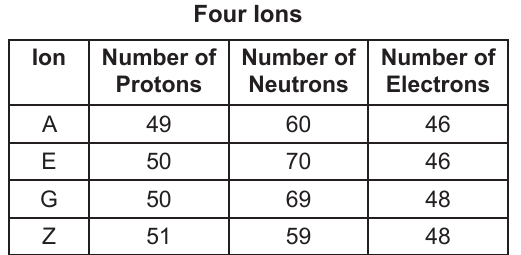
The numbers of protons, neutrons, and electrons in each of four different ions are shown in the table below. Which ion has the greatest mass?
- (A) A
- (B) E ✓
- (C) G
- (D) Z
Worked solution
Mass is determined by protons plus neutrons; ion E has the highest total (120), giving it the greatest mass.
The mass of a sample of nickel is determined to be 20.40 grams. How many significant figures are used to express this mass?
- (A) 1
- (B) 2
- (C) 3
- (D) 4 ✓
Worked solution
In 20.40, every digit including both zeros counts as significant because one zero is sandwiched between nonzero digits and the other is a trailing zero after a decimal point, giving 4 significant figures.
What is a chemical name for the compound $PbO_2$?
- (A) lead(I) oxide
- (B) lead(II) oxide
- (C) lead(III) oxide
- (D) lead(IV) oxide ✓
Worked solution
Since PbO2 contains two O2- ions (total charge -4), the lead ion must be Pb4+, named lead(IV) oxide.
Which formula is the empirical formula for ethane, $C_2H_6$?
- (A) CH
- (B) $CH_3$ ✓
- (C) $C_2H_6$
- (D) $C_4H_{12}$
Worked solution
Dividing both subscripts in C2H6 by their greatest common divisor (2) gives the simplest whole-number ratio, CH3.
Given a balanced equation representing a reaction: $2CO(g) + O_2(g) \rightarrow 2CO_2(g) + \text{energy}$ Which mass of $O_2(g)$ reacts completely with 5.6 grams of $CO(g)$ to produce 8.8 grams of $CO_2(g)$?
- (A) 1.6 g
- (B) 2.8 g
- (C) 3.2 g ✓
- (D) 14.4 g
Worked solution
Using conservation of mass, the mass of oxygen gas needed equals the mass of product minus the mass of the given reactant, 8.8 g minus 5.6 g, which is 3.2 g.
Which numerical setup can be used to calculate the formula mass of $C_9H_{11}NO_2$?
- (A) $9\text{ u} + 11\text{ u} + 1\text{ u} + 2\text{ u}$
- (B) $12\text{ u} + 1\text{ u} + 14\text{ u} + 16\text{ u}$
- (C) $9(6\text{ u}) + 11(1\text{ u}) + 1(7\text{ u}) + 2(8\text{ u})$
- (D) $9(12\text{ u}) + 11(1\text{ u}) + 1(14\text{ u}) + 2(16\text{ u})$ ✓
Worked solution
Formula mass requires multiplying each element's atomic mass (C=12, H=1, N=14, O=16) by its subscript and summing, which matches choice 4.
Based on Table $F$, which compound is most soluble in water?
- (A) calcium bromide ✓
- (B) lead(II) sulfate
- (C) silver carbonate
- (D) tin(II) hydroxide
Worked solution
According to the solubility guidelines in Table F, calcium bromide is soluble, while lead(II) sulfate, silver carbonate, and tin(II) hydroxide are all classified as insoluble or only slightly soluble.
Based on Table $G$, which combination of solute and solvent will form a saturated solution when thoroughly mixed at 20.°C?
From Reference Table G (Solubility Curves at Standard Pressure), solubility in grams of solute per 100. g of H2O at 20. degrees C, read from the curves: | Solute | Solubility at 20 C (g per 100. g H2O, approx.) | |---|---| | KClO3 | about 10 | | KCl | about 34 | | NaCl | about 36 | | KI | about 144 | A solution is saturated (or holds undissolved excess) when the amount of solute added equals or exceeds the solubility value.
- (A) 15 grams $KClO_3$ in 100. grams $H_2O$ ✓
- (B) 20. grams KCl in 100. grams $H_2O$
- (C) 30. grams NaCl in 100. grams $H_2O$
- (D) 35 grams KI in 100. grams $H_2O$
Worked solution
At 20 degrees C, the solubility of KClO3 on Table G is only about 8 g per 100 g of water, so the 15 g sample exceeds it and cannot all dissolve, giving a saturated solution with excess solid. The KCl, NaCl, and KI amounts are all below their Table G values, so they dissolve completely and remain unsaturated.
A solution has a mass of 2000. grams and contains 0.050 gram of dissolved solute. What is the concentration in parts per million of this solution?
- (A) 5.0 ppm
- (B) 25 ppm ✓
- (C) 50. ppm
- (D) 100. ppm
Worked solution
Dividing the mass of solute by the mass of solution and multiplying by one million gives 25 parts per million.
A person with a body temperature of 37°C holds a cup of hot water in their hand. The temperature of the cup is 44°C. The air temperature is 22°C. Which phrase describes a heat transfer that occurs in this system?
- (A) from the air to the cup
- (B) from the hand to the cup
- (C) from the air to the hand
- (D) from the cup to the hand ✓
Worked solution
Because the cup (44 degrees C) is warmer than the hand (37 degrees C), heat naturally transfers from the higher-temperature cup to the lower-temperature hand.
What is the amount of heat absorbed to completely melt 26.2 grams of $H_2O(s)$ at 0°C?
- (A) $8.75 \times 10^3$ J ✓
- (B) $3.66 \times 10^4$ J
- (C) $5.92 \times 10^4$ J
- (D) $2.48 \times 10^5$ J
Worked solution
Using q = mHf with water's heat of fusion of 334 J/g, melting 26.2 g of ice requires about 8.75 times 10 to the 3 joules.
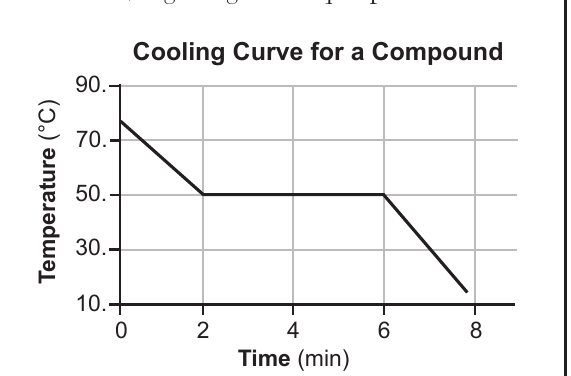
The graph below shows a compound being cooled, beginning in the liquid phase. Cooling Curve for a Compound: the y-axis is Temperature (°C) ranging from 10 to 90, and the x-axis is Time (min) ranging from 0 to 8. The line starts at about 78°C at time 0 and decreases steadily to 50.°C at time 2 min. The temperature then remains constant (flat) at 50.°C from time 2 min to time 6 min. After 6 min, the temperature decreases steadily again, reaching about 12°C at time 8 min. Which statement describes the average kinetic energy and the potential energy between minute 2 and minute 6?
- (A) Average kinetic energy and potential energy both decrease.
- (B) Average kinetic energy and potential energy both remain constant.
- (C) Average kinetic energy remains constant and potential energy increases.
- (D) Average kinetic energy remains constant and potential energy decreases. ✓
Worked solution
The flat plateau on a cooling curve represents a phase change at constant temperature, so average kinetic energy stays the same while potential energy decreases as the substance solidifies.
Which formula represents a saturated hydrocarbon?
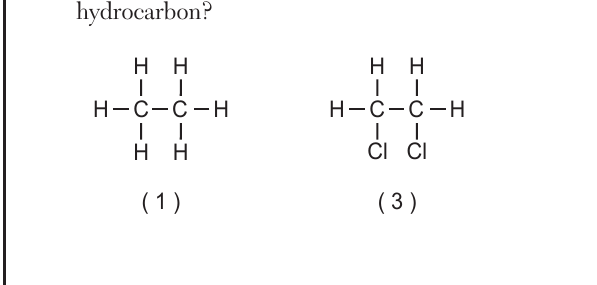
- (A) Structure (1): all single C-C and C-H bonds, atoms are only carbon and hydrogen ✓
- (B) Structure (2): contains a carbon-carbon double bond
- (C) Structure (3): all single bonds but contains chlorine atoms
- (D) Structure (4): contains an oxygen atom (an ether)
Worked solution
Only structure (1), with exclusively single bonds and only carbon and hydrogen atoms, meets the definition of a saturated hydrocarbon.
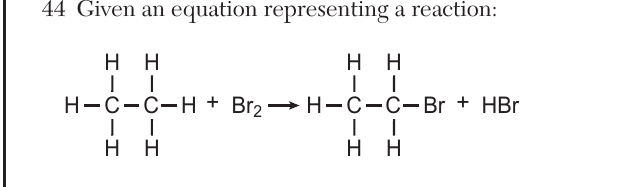
Given an equation representing a reaction: (structural formula of a two-carbon molecule with H, H on each carbon, i.e. ethane) $+ Br_2 \rightarrow$ (structural formula of the same two-carbon chain with one H replaced by Br on one carbon) $+ HBr$ Which type of organic reaction is represented by this equation?
- (A) addition
- (B) polymerization
- (C) fermentation
- (D) substitution ✓
Worked solution
Because the starting hydrocarbon is already saturated, bromine cannot add across a double bond; instead a hydrogen atom is substituted by a bromine atom, identifying this as a substitution reaction.
In which compound does sulfur have an oxidation state of +4?
- (A) K$_2$S
- (B) CaS
- (C) SO$_2$ ✓
- (D) SO$_3$
Worked solution
In SO2 the two oxygen atoms contribute a total charge of -4, so sulfur must be +4 to make the neutral molecule balance.
Which solution is the best conductor of electricity?
- (A) 0.0010 M CaCl$_2$(aq)
- (B) 0.010 M CaCl$_2$(aq)
- (C) 0.10 M CaCl$_2$(aq)
- (D) 1.0 M CaCl$_2$(aq) ✓
Worked solution
Electrical conductivity of an electrolyte solution increases as the concentration of dissolved ions increases, so the most concentrated CaCl2 solution conducts best.
Given the incomplete equation representing a neutralization reaction: $Sr(OH)_2 + 2HNO_3 \rightarrow X + 2H_2O$ What is the formula of the missing product X?
- (A) SrO
- (B) SrO$_2$
- (C) Sr(NO$_2$)$_2$
- (D) Sr(NO$_3$)$_2$ ✓
Worked solution
Neutralizing the base Sr(OH)2 with the acid HNO3 produces the salt strontium nitrate, Sr(NO3)2, and water.
Given the equation representing a reversible reaction: $NH_3(aq) + H_2O(\ell) \rightleftharpoons NH_4^+(aq) + OH^-(aq)$ The water molecule acts as an acid because it
- (A) accepts a hydrogen ion
- (B) accepts a hydroxide ion
- (C) donates a hydrogen ion ✓
- (D) donates a hydroxide ion
Worked solution
Water acts as a Bronsted-Lowry acid here because it donates a hydrogen ion to ammonia, becoming OH- while NH3 becomes NH4+.
Which nuclear equation represents beta decay?
- (A) $^{81}_{37}Rb + ^{0}_{-1}e \rightarrow ^{81}_{36}Kr$
- (B) $^{13}_{4}Be \rightarrow ^{12}_{4}Be + ^{1}_{0}n$
- (C) $^{14}_{7}N + ^{1}_{0}n \rightarrow ^{14}_{6}C + ^{1}_{1}H$
- (D) $^{14}_{6}C \rightarrow ^{14}_{7}N + ^{0}_{-1}e$ ✓
Worked solution
Choice (4) shows carbon-14 decaying into nitrogen-14 with emission of an electron, the defining signature of beta decay.
Given the equations A and B: Equation A: $^{2}_{1}H + ^{3}_{1}H \rightarrow ^{4}_{2}He + ^{1}_{0}n$ Equation B: $^{235}_{92}U + ^{1}_{0}n \rightarrow ^{90}_{38}Sr + ^{143}_{54}Xe + 3^{1}_{0}n$ Which type of nuclear reaction do these equations represent?
- (A) Both A and B are fission.
- (B) Both A and B are fusion.
- (C) A is fission and B is fusion.
- (D) A is fusion and B is fission. ✓
Worked solution
A combines two light hydrogen isotopes into helium (fusion), while B splits a uranium-235 nucleus into two lighter nuclei (fission).
Compounds that contain the element boron, such as boric acid and sodium borate, produce a green flame when a sample of one of these compounds is placed in a laboratory burner flame. If this flame is viewed through a spectroscope, a bright-line spectrum is seen. State how the bright-line spectra of known elements can be used to identify an unknown element whose bright-line spectrum was viewed through a spectroscope.
Worked solution
Every element has a unique bright-line spectrum, so comparing an unknown spectrum to known reference spectra identifies the element that matches.
State, in terms of electrons in shells, why the electron configuration 2-2-1 is an excited state electron configuration of a boron atom.
Worked solution
An electron occupies the third shell even though the second shell, which can hold up to 8 electrons, still has room, so this is an excited-state configuration.
Draw a Lewis electron-dot diagram for an atom of silicon in the ground state.
Worked solution
Silicon, in Group 14, has 4 valence electrons, which in the ground state are drawn as one unpaired dot on each side of the element symbol.
Compare the energy of an electron in the first shell of a silicon atom to the energy of an electron in the third shell of the same atom.
Worked solution
Electrons closer to the nucleus (first shell) are held more tightly and have lower energy than electrons farther away (third shell), which have higher energy.
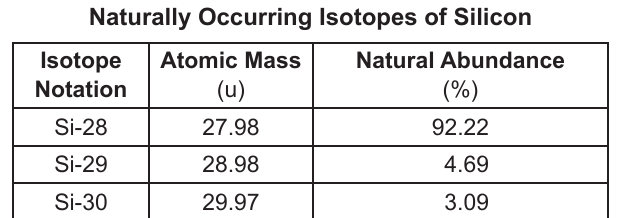
Silicon is an element in Group 14 on the Periodic Table. The atomic mass and natural abundance for the three naturally occurring isotopes of silicon are shown in the table below. Show a numerical setup for calculating the atomic mass of the element silicon.
Worked solution
The atomic mass of an element is the weighted average of its isotopes' masses, each multiplied by its fractional natural abundance.
The unbalanced equation below shows a reaction between nitrogen monoxide gas and oxygen gas to produce nitrogen dioxide gas. $NO(g) + O_2(g) \rightarrow NO_2(g)$ State, in terms of reactants and product, why this reaction is a synthesis reaction.
Worked solution
A synthesis reaction is defined by two substances combining into a single compound, exactly as NO and O2 combine to form NO2.
Balance the equation in your answer booklet for the reaction, using the smallest whole-number coefficients. $NO(g) + O_2(g) \rightarrow NO_2(g)$
Worked solution
Placing a coefficient of 2 in front of NO and NO2 balances both nitrogen (2 = 2) and oxygen (2+2 = 4) atoms.
Determine the percent composition by mass of oxygen in the product, NO$_2$ (gram-formula mass = 46 g/mol).
Worked solution
Percent composition of oxygen equals the total mass of oxygen atoms (2 x 16 u) divided by the gram-formula mass (46 g/mol), times 100%.
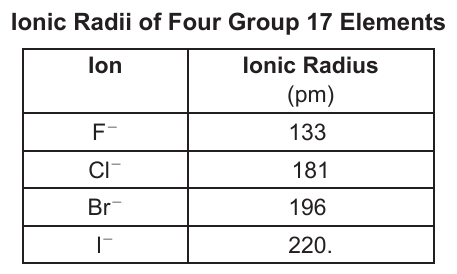
The ionic radii of four Group 17 elements are given in the table below. Identify the noble gas that has atoms in the ground state with the same electron configuration as a Br$^-$ ion in the ground state.
Worked solution
A Br- ion has gained one electron, giving it 36 electrons, the same electron configuration as neutral krypton (atomic number 36).
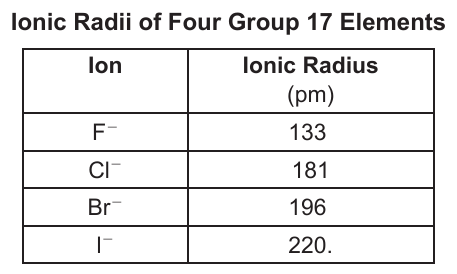
The ionic radii of four Group 17 elements are given in the table below. State, in terms of electrons, why the ionic radius of a Group 17 element is larger than the atomic radius for the same element.
Worked solution
Adding an extra electron to form the anion increases repulsion among the electrons without adding protons to pull them in, so the ion is larger than the neutral atom.
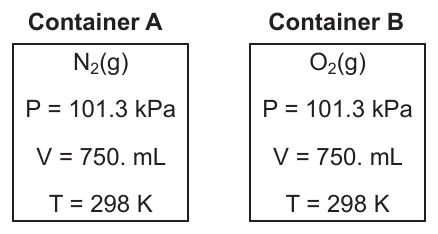
The diagram below represents two sealed, rigid containers and the conditions of pressure, volume, and temperature for each container. Container A is filled with N$_2$(g) and container B is filled with O$_2$(g). Container A: N$_2$(g), P = 101.3 kPa, V = 750. mL, T = 298 K Container B: O$_2$(g), P = 101.3 kPa, V = 750. mL, T = 298 K Explain, in terms of the strength of intermolecular forces, why the gas in container B at standard pressure has a higher boiling point than the gas in container A at standard pressure.
Worked solution
Because O2 molecules are larger and have stronger London dispersion forces than N2 molecules, more energy is needed to separate them into the gas phase, giving O2 the higher boiling point.
The diagram below represents two sealed, rigid containers and the conditions of pressure, volume, and temperature for each container. Container A is filled with N$_2$(g) and container B is filled with O$_2$(g). Container A: N$_2$(g), P = 101.3 kPa, V = 750. mL, T = 298 K Container B: O$_2$(g), P = 101.3 kPa, V = 750. mL, T = 298 K In the space in your answer booklet, show a numerical setup for calculating the pressure if the gas in container B is cooled to standard temperature.
Worked solution
Since volume is constant, Gay-Lussac's law (P/T = constant) is used with standard temperature 273 K to solve for the new pressure.
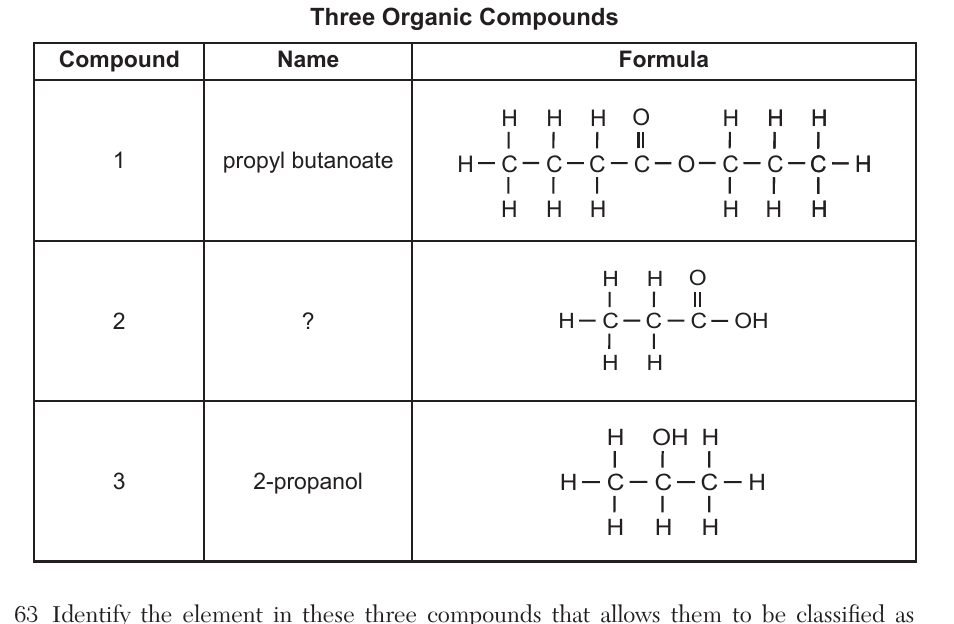
The table below shows the formulas of three organic compounds, and a chemical name for two of the compounds. Three Organic Compounds Compound 1: propyl butanoate, formula is an ester: H-C-C-C-C(=O)-O-C-C-C-H chain (propyl butanoate structure) Compound 2: (unnamed), formula: H-C-C-C(=O)-OH chain with H's on carbons 1 and 2 Compound 3: 2-propanol, formula: H-C-C(OH)-C-H chain (2-propanol structure) Identify the element in these three compounds that allows them to be classified as organic compounds.
Worked solution
All organic compounds contain the element carbon, which is present in all three structures shown.
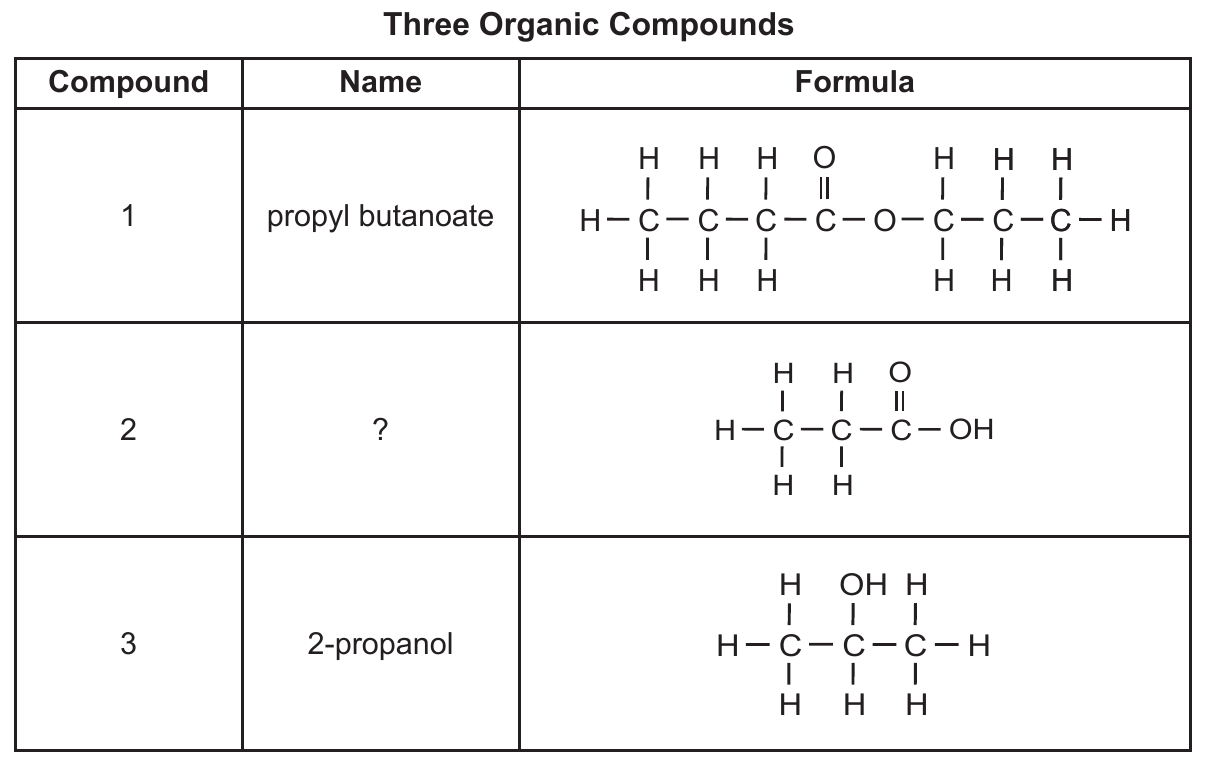
The table below shows the formulas of three organic compounds, and a chemical name for two of the compounds. Three Organic Compounds Compound 1: propyl butanoate, formula is an ester: H-C-C-C-C(=O)-O-C-C-C-H chain (propyl butanoate structure) Compound 2: (unnamed), formula: H-C-C-C(=O)-OH chain with H's on carbons 1 and 2 Compound 3: 2-propanol, formula: H-C-C(OH)-C-H chain (2-propanol structure) Identify the class of organic compound to which compound 1 belongs.
Worked solution
Compound 1, propyl butanoate, contains the carbon-oxygen-carbon ester linkage (-COO-) characteristic of esters, formed from an acid and an alcohol.
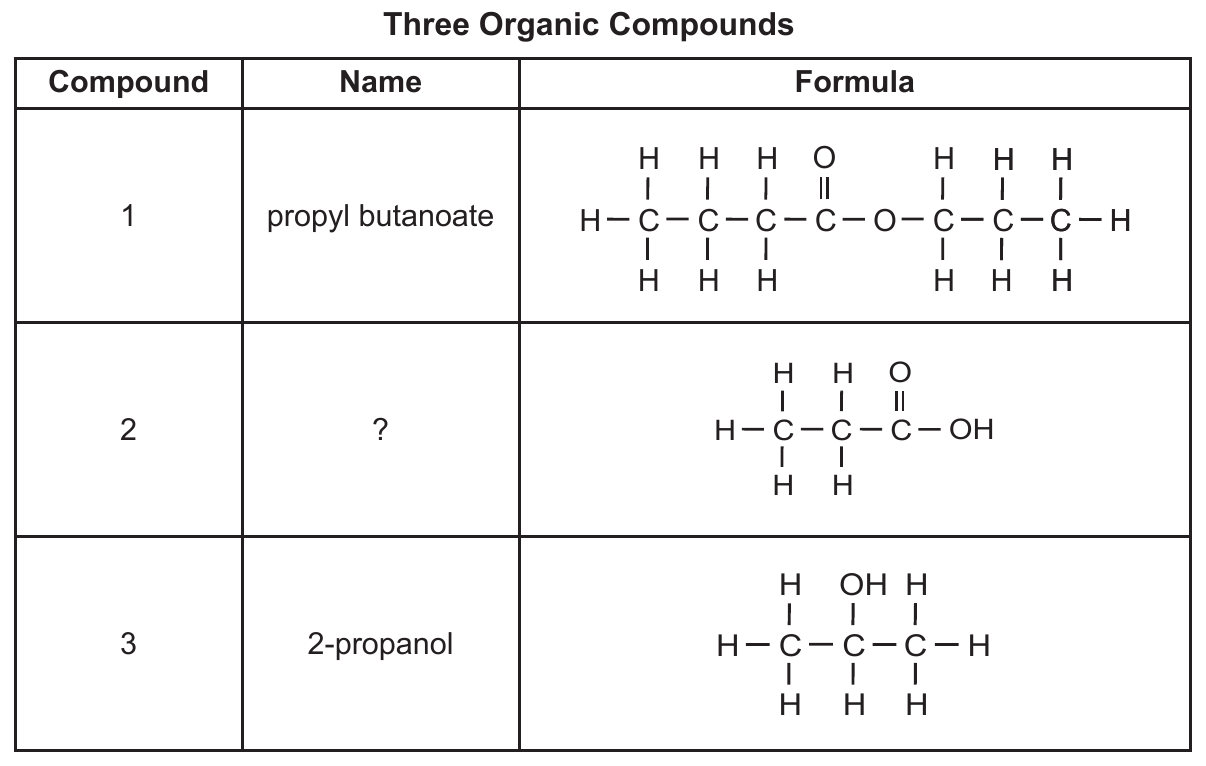
The table below shows the formulas of three organic compounds, and a chemical name for two of the compounds. Three Organic Compounds Compound 1: propyl butanoate, formula is an ester: H-C-C-C-C(=O)-O-C-C-C-H chain (propyl butanoate structure) Compound 2: (unnamed), formula: H-C-C-C(=O)-OH chain, three carbons ending in a carboxylic acid group, with H's on carbons 1 and 2 Compound 3: 2-propanol, formula: H-C-C(OH)-C-H chain (2-propanol structure) Write a chemical name for compound 2.
Worked solution
Compound 2 is a three-carbon chain terminating in a carboxylic acid (-COOH) group, which is named propanoic acid.
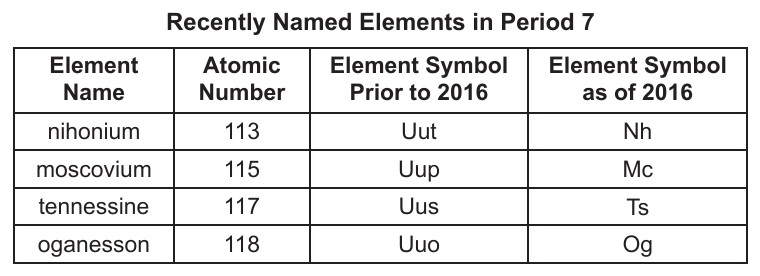
The Periodic Table of the Elements has changed over the past 150 years. During this time, many elements have been added as they were discovered. The elements 113, 115, 117, and 118 in Period 7 were named in 2016. Their official names have been approved by the International Union of Pure and Applied Chemistry (IUPAC). The table below lists the names, symbols, and atomic numbers for these four elements. Identify the element in this table that is located on the Periodic Table of the Elements in the group classified as noble gases.
Worked solution
Oganesson, with atomic number 118, is located in Group 18 of the Periodic Table, the group classified as the noble gases.
Explain, in terms of valence electrons, why the elements nihonium and tennessine would be expected to differ in their chemical properties.
Worked solution
Chemical properties of an element are determined largely by its number of valence electrons, which corresponds to its group number on the Periodic Table; since nihonium and tennessine are in different groups, they have different valence electron counts and thus different chemical behavior.
Describe the general trend in first ionization energy values as the five elements above moscovium in Group 15 on the Periodic Table of the Elements are considered in order of increasing atomic number.
Worked solution
Down any group, increasing atomic radius and electron shielding make the outermost electron easier to remove, so first ionization energy generally decreases as atomic number increases.
State, in terms of protons, why tennessine is listed before oganesson in Period 7 on the Periodic Table of the Elements.
Worked solution
The Periodic Table lists elements in order of increasing atomic number, i.e., increasing number of protons, and tennessine has one fewer proton than oganesson.
Compare the rate of the forward reaction to the rate of the reverse reaction for the equilibrium system at equilibrium represented by equation 1. Equation 1: $\text{CH}_4(g) + \text{H}_2\text{O}(g) + 210\text{ kJ} \rightleftharpoons \text{CO}(g) + 3\text{H}_2(g)$
Worked solution
By definition of chemical equilibrium, the forward and reverse reactions occur at equal rates so concentrations remain constant.
State how the equilibrium shifts when the temperature of the equilibrium system at equilibrium represented by equation 1 is increased. Equation 1: $\text{CH}_4(g) + \text{H}_2\text{O}(g) + 210\text{ kJ} \rightleftharpoons \text{CO}(g) + 3\text{H}_2(g)$
Worked solution
Since the forward reaction absorbs energy (endothermic), adding heat by raising the temperature shifts the equilibrium to the right, favoring formation of more CO and H2.
State, in terms of activation energy, why the catalyst increases the rate of the forward reaction represented in equation 1.
Worked solution
A catalyst lowers the activation energy needed for the forward reaction, so a greater fraction of colliding particles have enough energy to react, speeding up the reaction.
On the labeled axes in your answer booklet, draw a potential energy diagram for the forward reaction represented in equation 2. Equation 2: $\text{CO}(g) + \text{H}_2\text{O}(g) \rightleftharpoons \text{CO}_2(g) + \text{H}_2(g) + \text{energy}$
Worked solution
Because equation 2 releases energy in the forward direction, the potential energy diagram must show the products at a lower energy level than the reactants, with a hump above the reactants representing the activation energy.
State the form of energy that is converted to electrical energy during the operation of this voltaic cell.
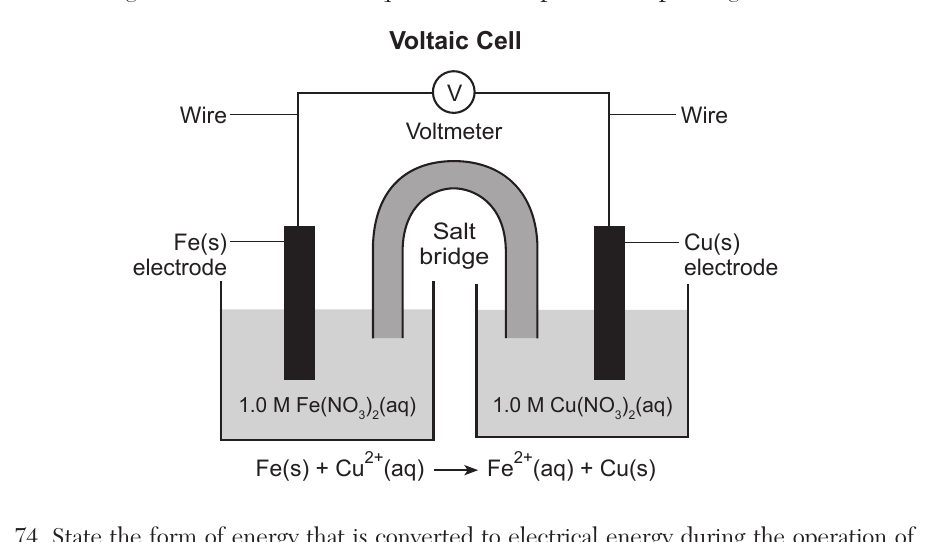
Worked solution
In a voltaic cell, the spontaneous redox reaction between Fe(s) and Cu2+(aq) releases chemical energy, which is converted into electrical energy that powers the voltmeter/circuit.
Identify one metal from Table J that is more easily oxidized than copper and less easily oxidized than iron.
Excerpt from Reference Table J, Activity Series of Metals (most easily oxidized at the top, least easily oxidized at the bottom): | Metals (most active to least active) | |---| | ... | | Zn | | Cr | | Fe | | Co | | Ni | | Sn | | Pb | | H2 | | Cu | | Ag | | Au |
Worked solution
Table J's activity series lists metals from most to least easily oxidized; any metal appearing between iron and copper on that list (such as lead, tin, nickel, cobalt, or cadmium) is more easily oxidized than copper but less easily oxidized than iron.
State the purpose of the salt bridge in completing the circuit in this cell.
Worked solution
The salt bridge permits the flow of ions between the two half-cells, which maintains electrical neutrality in each half-cell and completes the internal circuit of the voltaic cell.
Write a balanced equation for the half-reaction that occurs in the copper half-cell.
A copper electrode in Cu(NO3)2(aq) is connected by a wire and salt bridge to an iron electrode in Fe(NO3)2(aq), forming a voltaic cell. Copper is less active than iron, so reduction occurs at the copper electrode.
Worked solution
In the overall reaction, copper(II) ions gain two electrons to form solid copper at the copper electrode, which is the reduction half-reaction occurring in the copper half-cell.
State the color of the indicator litmus in a sample of the original NaOH(aq) solution.
Worked solution
Since the NaOH solution has a pH of 12.00 (basic), litmus indicator turns blue in this solution.
Determine the pH value of a solution that has a hydronium ion concentration 100 times greater than the original NaOH(aq) solution.
The original NaOH(aq) solution has a pH of 12.00.
Worked solution
Increasing the hydronium ion concentration by a factor of 100 (10^2) lowers the pH by 2 units, so the new pH is 12.00 minus 2, or 10.00.
Identify the positive ion in the original HCl(aq) solution.
Worked solution
HCl is an Arrhenius acid that ionizes in water to produce hydronium ions (H3O+) as the positive ion and chloride ions as the negative ion.
Determine the molarity of the HCl(aq) solution using the titration data.
Titration data: a 10.0 mL sample of the HCl(aq) is exactly neutralized by 20.0 mL of 0.010 M NaOH(aq).
Worked solution
Using the titration formula MaVa = MbVb with the given volumes of acid and base and the known base molarity, the HCl molarity is calculated to be 0.020 M.
The half-life of Am-241 is 432.7 years. Determine the fraction of Am-241 remaining from an original sample after 865.4 years.
Worked solution
Dividing the elapsed time by the half-life of Am-241 gives exactly 2 half-lives, so the fraction of the original sample remaining is (1/2)^2 = 1/4.
Compare the penetrating power of the alpha particles to the penetrating power of the gamma radiation.
Worked solution
Alpha particles are relatively large and charged, so they penetrate matter poorly, while gamma radiation is high-energy electromagnetic radiation with much greater penetrating power.
Complete the nuclear equation for the alpha decay of Pu-238 by writing a notation for the missing nuclide.
Worked solution
In alpha decay, the parent nuclide loses a helium-4 nucleus, reducing its mass number by 4 and atomic number by 2; for Pu-238 this yields U-234 as the missing nuclide.
Compare the energy released by the radioactive decay of 1.0 kilogram of Pu-238 in this nuclear power source to the energy released by 1.0 kilogram of chemical reactants in a battery.
Worked solution
Nuclear decay releases energy from changes within the nucleus itself, which is orders of magnitude greater per given mass than the energy released by chemical reactions, which involve only electron/bond rearrangements.