June 2023 Chemistry Regents — Answer Key & Worked Solutions
Every question from the June 2023 Chemistry Regents exam, with the correct answer and a full step-by-step solution. Check your work, learn the method, then convert your raw score.
These are real questions from the June 2023 Chemistry New York State Regents examination, published by NYSED. Worked solutions are written by RegentsLab.
Which phrase describes the nucleus of any atom?
- (A) has an overall positive charge ✓
- (B) has an overall negative charge
- (C) contains negative electrons
- (D) contains positive electrons
Worked solution
The nucleus contains protons (positive) and neutrons (neutral), so it always carries an overall positive charge; electrons reside outside the nucleus.
Which two particles each have a mass of approximately one atomic mass unit?
- (A) an electron and a proton
- (B) an electron and a positron
- (C) a neutron and a proton ✓
- (D) a neutron and a positron
Worked solution
Protons and neutrons each have a mass of about 1 atomic mass unit, while electrons and positrons have negligible mass in comparison.
The wave-mechanical model of the atom describes the location of electrons
- (A) as loosely packed in the nucleus of an atom
- (B) as densely packed in the nucleus of an atom
- (C) in circular paths around the nucleus
- (D) in orbitals outside the nucleus ✓
Worked solution
Unlike the Bohr model's fixed circular paths, the wave-mechanical model places electrons in orbitals, regions of highest probability, outside the nucleus.
When a ground state electron in an atom moves to an excited state, the electron
- (A) absorbs energy as it moves to a higher energy state ✓
- (B) absorbs energy as it moves to a lower energy state
- (C) releases energy as it moves to a higher energy state
- (D) releases energy as it moves to a lower energy state
Worked solution
Moving from ground to excited state requires the electron to gain (absorb) energy as it rises to a higher energy level.
Which statement describes a chemical property of iron?
- (A) Iron is malleable.
- (B) Iron conducts electricity.
- (C) Iron reacts with nitric acid. ✓
- (D) Iron has a high melting point.
Worked solution
Malleability, conductivity, and melting point are physical properties; reacting with nitric acid describes a chemical change/property, since a new substance forms.
Diamond and graphite are two forms of solid carbon. These two forms of carbon have
- (A) different crystal structures and different properties ✓
- (B) different crystal structures and the same properties
- (C) the same crystal structure and different properties
- (D) the same crystal structure and the same properties
Worked solution
Diamond and graphite are allotropes of carbon with different crystal structures (tetrahedral vs. layered), which give them different physical properties such as hardness and conductivity.
Which substance can be broken down by a chemical change?
- (A) cobalt
- (B) ethane ✓
- (C) krypton
- (D) manganese
Worked solution
Cobalt, krypton, and manganese are elements and cannot be chemically decomposed further, whereas ethane is a compound made of carbon and hydrogen that can be broken down chemically.
Based on Table I, which equation represents conservation of mass and energy? $CH_4(g) + O_2(g) + 890.4\ kJ \rightarrow CO_2(g) + H_2O(\ell)$ $CH_4(g) + O_2(g) \rightarrow CO_2(g) + H_2O(\ell)$ $CH_4(g) + 2O_2(g) + 890.4\ kJ \rightarrow CO_2(g) + 2H_2O(\ell)$ $CH_4(g) + 2O_2(g) \rightarrow CO_2(g) + 2H_2O(\ell) + 890.4\ kJ$
- (A) $CH_4(g) + O_2(g) + 890.4\ kJ \rightarrow CO_2(g) + H_2O(\ell)$
- (B) $CH_4(g) + O_2(g) \rightarrow CO_2(g) + H_2O(\ell)$
- (C) $CH_4(g) + 2O_2(g) + 890.4\ kJ \rightarrow CO_2(g) + 2H_2O(\ell)$
- (D) $CH_4(g) + 2O_2(g) \rightarrow CO_2(g) + 2H_2O(\ell) + 890.4\ kJ$ ✓
Worked solution
The equation must be atom-balanced (needs 2O2 and 2H2O) and since methane combustion releases energy, the 890.4 kJ belongs on the product side, matching Table I data.
At STP, which property can be used to differentiate a 10.-gram sample of NaCl(s) from a 10.-gram sample of NaNO$_3$(s)?
- (A) mass of the sample
- (B) temperature of the sample
- (C) solubility in water ✓
- (D) phase at STP
Worked solution
Since both samples have the same mass, temperature, and phase (solid) at STP, only solubility in water, a property unique to each substance, can distinguish them.
What is the number of electrons shared between the two atoms in an O$_2$ molecule?
- (A) 6
- (B) 2
- (C) 3
- (D) 4 ✓
Worked solution
An oxygen molecule has a double covalent bond between the two O atoms, consisting of two shared pairs, or 4 shared electrons.
Which changes in both charge and radius occur when an atom loses an electron?
- (A) A negative ion is formed with a smaller radius than the atom.
- (B) A negative ion is formed with a larger radius than the atom.
- (C) A positive ion is formed with a smaller radius than the atom. ✓
- (D) A positive ion is formed with a larger radius than the atom.
Worked solution
Losing an electron produces a positively charged ion, and with fewer electrons the electron cloud contracts, making the ionic radius smaller than the original atom.
Which statement describes what occurs when two iodine atoms react to produce an iodine molecule?
- (A) A bond forms and energy is absorbed.
- (B) A bond forms and energy is released. ✓
- (C) A bond breaks and energy is absorbed.
- (D) A bond breaks and energy is released.
Worked solution
Forming a covalent bond between two atoms is an exothermic process, so a bond forms and energy is released as the more stable I2 molecule is produced.
Which process can be used to separate a mixture of two liquids having different boiling points?
- (A) deposition
- (B) distillation ✓
- (C) filtration
- (D) sublimation
Worked solution
Distillation separates liquids based on differences in boiling point, since the more volatile liquid vaporizes first and can be collected separately.
Which statement describes a solution of sodium chloride in water?
- (A) The mixture is heterogeneous, the solute is NaCl and the solvent is H$_2$O.
- (B) The mixture is heterogeneous, the solute is H$_2$O and the solvent is NaCl.
- (C) The mixture is homogeneous, the solute is NaCl and the solvent is H$_2$O. ✓
- (D) The mixture is homogeneous, the solute is H$_2$O and the solvent is NaCl.
Worked solution
A salt water solution is a uniform, homogeneous mixture where sodium chloride is the solute dissolved in water, the solvent.
At STP, which property would be the same for 1.0 liter of helium and 1.0 liter of argon?
- (A) boiling point
- (B) density
- (C) mass
- (D) number of atoms ✓
Worked solution
By Avogadro's principle, equal volumes of any gas at STP contain the same number of moles (particles); since He and Ar are monatomic, this means the same number of atoms, while mass and density differ due to different molar masses.
The melting of an ice cube is an example of an
- (A) endothermic, chemical change
- (B) endothermic, physical change ✓
- (C) exothermic, chemical change
- (D) exothermic, physical change
Worked solution
Melting is a phase change (physical, no new substance forms) that requires absorbing heat energy, making it endothermic.
Which statement explains the low boiling point of hydrogen, H$_2$, at standard pressure?
- (A) Hydrogen has strong covalent bonds.
- (B) Hydrogen has weak covalent bonds.
- (C) Hydrogen has strong intermolecular forces.
- (D) Hydrogen has weak intermolecular forces. ✓
Worked solution
Boiling point is determined by the strength of intermolecular (between-molecule) forces, not the intramolecular covalent bonds; H2 has very weak intermolecular forces, giving it a low boiling point.
In chemical reactions, which term is defined as the difference between the potential energy of the products and the potential energy of the reactants?
- (A) heat of fusion
- (B) heat of reaction ✓
- (C) thermal conductivity
- (D) electrical conductivity
Worked solution
The heat of reaction is defined as the difference between the potential energy of the products and reactants in a chemical reaction.
Which phrase describes what happens to the reaction pathway and activation energy of a reaction to which a catalyst is added?
- (A) the same pathway with the same activation energy
- (B) the same pathway with a lower activation energy
- (C) a different pathway with the same activation energy
- (D) a different pathway with a lower activation energy ✓
Worked solution
A catalyst provides an alternate reaction pathway that has a lower activation energy, speeding up the reaction without being consumed.
An atom of which element is bonded to the carbon atom in the amide functional group?
- (A) iodine
- (B) nitrogen ✓
- (C) phosphorus
- (D) sulfur
Worked solution
The amide functional group consists of a carbonyl carbon bonded to a nitrogen atom, so nitrogen is the element bonded to the carbon.
Which statement describes the two isomers of butane?
- (A) They have the same molecular formula but different structural formulas. ✓
- (B) They have the same molecular formula and the same structural formula.
- (C) They have different molecular formulas and different structural formulas.
- (D) They have different molecular formulas but the same structural formula.
Worked solution
Isomers by definition share the same molecular formula (C4H10 for butane) but differ in the arrangement of atoms, giving different structural formulas.
Which term represents an organic reaction that produces soap?
- (A) esterification
- (B) fermentation
- (C) saponification ✓
- (D) solidification
Worked solution
Saponification is the reaction of a fat or oil with a base to produce soap and glycerol.
In which part of an electrochemical cell does reduction occur?
- (A) anode
- (B) cathode ✓
- (C) wire
- (D) voltmeter
Worked solution
In any electrochemical cell (voltaic or electrolytic), reduction (gain of electrons) always takes place at the cathode, while oxidation occurs at the anode.
Which energy change occurs in an operating voltaic cell?
- (A) chemical energy to electrical energy ✓
- (B) chemical energy to nuclear energy
- (C) electrical energy to chemical energy
- (D) electrical energy to nuclear energy
Worked solution
A voltaic (galvanic) cell uses a spontaneous chemical redox reaction to generate an electric current, converting chemical energy into electrical energy.
Which substance is an Arrhenius base?
- (A) $HNO_3$
- (B) $KNO_3$
- (C) $LiOH$ ✓
- (D) $CH_3COOH$
Worked solution
LiOH dissociates in water to release hydroxide ions, OH-, which is the defining property of an Arrhenius base; HNO3 and CH3COOH are Arrhenius acids, and KNO3 is a salt.
Which statement represents neutralization?
- (A) An Arrhenius acid and an Arrhenius base react to produce water and a salt. ✓
- (B) An Arrhenius acid and a salt react to produce water and an Arrhenius base.
- (C) Water and an Arrhenius acid react to produce an Arrhenius base and a salt.
- (D) Water and a salt react to produce an Arrhenius base and an Arrhenius acid.
Worked solution
Neutralization is defined as the reaction of an Arrhenius acid with an Arrhenius base to produce water and a salt.
A tenfold increase in hydronium ion concentration is represented by
- (A) a decrease of one unit of pH ✓
- (B) a decrease of 10 units of pH
- (C) an increase of one unit of pH
- (D) an increase of 10 units of pH
Worked solution
Because pH is a base-10 logarithmic scale, every tenfold increase in hydronium ion concentration corresponds to a decrease of exactly one pH unit.
Based on Table N, which particle is emitted by the radioactive decay of francium-220?
- (A) an alpha particle ✓
- (B) a beta particle
- (C) a positron
- (D) a neutron
Worked solution
Reference Table N (Selected Radioisotopes) lists francium-220 as decaying by alpha emission, releasing an alpha particle (a helium-4 nucleus).
Which type of reaction releases the greatest amount of energy per kilogram of reactant?
- (A) acid-base reaction
- (B) fission reaction ✓
- (C) organic reaction
- (D) redox reaction
Worked solution
Nuclear fission reactions convert a measurable amount of mass directly into energy, releasing vastly more energy per kilogram of reactant than any ordinary chemical reaction.
Which risk is related to the radioactive isotopes used to generate electricity?
- (A) depletion of fossil fuels
- (B) depletion of atmospheric ozone
- (C) exposure to acid rain
- (D) exposure to nuclear emissions ✓
Worked solution
The principal risk associated with using radioactive isotopes for electricity generation is human exposure to nuclear (radioactive) emissions from the fuel, waste, or an accident, not fossil fuel depletion, ozone loss, or acid rain, which are linked to fossil fuel combustion.
Which Lewis electron-dot diagram represents an atom of nitrogen in the ground state?
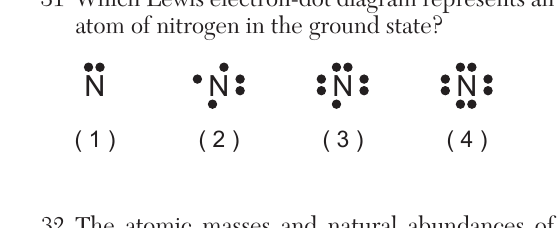
- (A) Diagram (1): N symbol with one pair of dots (two dots) above it only, 2 dots total
- (B) Diagram (2): N symbol with one pair of dots (a lone pair) on one side and three single, unpaired dots placed individually on the remaining three sides ✓
- (C) Diagram (3): N symbol with three pairs of dots and one single dot (7 dots total)
- (D) Diagram (4): N symbol surrounded by four pairs of dots (8 dots total, a full octet)
Worked solution
Ground-state nitrogen has 5 valence electrons: one pair is already filled (2s^2) and the three 2p electrons remain unpaired, so the correct Lewis dot diagram shows one paired lone pair and three single unpaired dots around the symbol N.
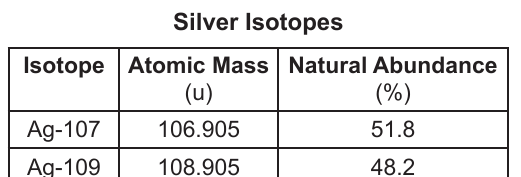
The atomic masses and natural abundances of the two naturally occurring isotopes of silver are shown in the table below. Which numerical setup can be used to calculate the atomic mass of silver?
- (A) $(106.905\ u)(51.8) + (108.905\ u)(48.2)$
- (B) $(106.905\ u)(51.8\%) + (108.905\ u)(48.2\%)$ ✓
- (C) $(106.905\ u)(48.2) + (108.905\ u)(51.8)$
- (D) $(106.905\ u)(48.2\%) + (108.905\ u)(51.8\%)$
Worked solution
The weighted average atomic mass is found by multiplying each isotope's mass by its own correct percent (fractional) natural abundance and summing the products, matching Ag-107 with 51.8% and Ag-109 with 48.2%.
A potassium atom has a mass number of 37. What is the number of neutrons in this atom?
- (A) 15
- (B) 18 ✓
- (C) 22
- (D) 37
Worked solution
Potassium always has 19 protons; subtracting this from the given mass number of 37 leaves 18 neutrons.
At room temperature, a student determines the density of a sample of nickel to be 9.79 g/cm^3. Based on Table S, what is the student's percent error for the density of nickel?
- (A) 0.091%
- (B) 0.10%
- (C) 9.1%
- (D) 10.% ✓
Worked solution
Using the accepted density of nickel from Table S (8.90 g/cm^3), the percent error between the measured 9.79 g/cm^3 and the accepted value works out to 10.%.
Compared to the metals in Period 2, the nonmetals in Period 2 have
- (A) lower first ionization energies and lower electronegativity values
- (B) lower first ionization energies and higher electronegativity values
- (C) higher first ionization energies and lower electronegativity values
- (D) higher first ionization energies and higher electronegativity values ✓
Worked solution
Both first ionization energy and electronegativity generally increase across a period from metals toward nonmetals, so Period 2 nonmetals have higher values for both properties than Period 2 metals.
Which formula represents calcium hydride?
- (A) $CaH$
- (B) $CaH_2$ ✓
- (C) $CaOH$
- (D) $Ca(OH)_2$
Worked solution
Calcium forms a 2+ ion and hydride is H-, so two hydride ions are needed to balance one calcium ion's charge, giving the formula CaH2.
What is the number of moles in a 78.8-gram sample of $MgCO_3$ (gram-formula mass = 84.3 g/mol)?
- (A) 0.949 mol
- (B) 0.935 mol ✓
- (C) 0.843 mol
- (D) 1.070 mol
Worked solution
Dividing the given mass of MgCO3 by its gram-formula mass yields the number of moles present, approximately 0.935 mol.
Given the equation representing a reaction: $F_2(g) + 2KCl(aq) \rightarrow 2KF(aq) + Cl_2(g)$ Which type of chemical reaction is represented by the equation?
- (A) synthesis
- (B) decomposition
- (C) single replacement ✓
- (D) double replacement
Worked solution
A free halogen element, F2, displaces chlorine from the compound KCl, producing a new compound (KF) and a different free element (Cl2), which is the defining pattern of a single replacement reaction.
Based on Table H, which compound has the strongest intermolecular forces at 60 kPa?
- (A) ethanoic acid ✓
- (B) ethanol
- (C) propanone
- (D) water
Worked solution
Reference Table H's vapor pressure curves show ethanoic acid reaching 60 kPa vapor pressure at a higher temperature than ethanol, propanone, or water, indicating it has the strongest intermolecular forces (hydrogen bonding plus dimer formation) of the four.
Which particle diagram represents a sample of xenon at STP? Key: open circle = atom of xenon
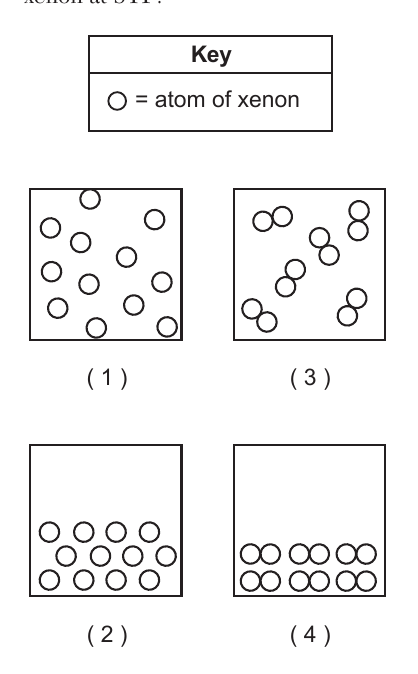
- (A) Diagram (1): a box containing about 9 single circles spread apart with open space between them, unevenly but individually distributed, no touching or pairing ✓
- (B) Diagram (2): a box containing circles arranged in tightly packed, touching rows filling most of the box
- (C) Diagram (3): a box containing about 9 circles, several of which are touching/paired together in twos
- (D) Diagram (4): a box containing circles arranged as touching pairs in tightly packed rows
Worked solution
Xenon exists as separate, unbonded individual atoms, and as a gas at STP its particles are spread apart with large amounts of empty space between them, matching the diagram showing individual, well-separated circles rather than paired or tightly packed particles.
Based on Table G, which compound is less soluble in water as the temperature increases from 0°C to 100°C?
- (A) $KNO_3$
- (B) $NH_3$ ✓
- (C) $KClO_3$
- (D) $NH_4Cl$
Worked solution
Ammonia, NH3, is a gas, and the solubility of gases in water decreases as temperature increases, unlike the three ionic solids listed whose solubility curves in Table G rise with increasing temperature.
How many moles of KI are needed to make 0.50 L of a 0.20 M aqueous solution?
- (A) 0.10 mol ✓
- (B) 0.25 mol
- (C) 0.40 mol
- (D) 0.70 mol
Worked solution
Multiplying molarity by volume in liters gives the number of moles of solute needed: 0.20 mol/L times 0.50 L equals 0.10 mol.
A solution is prepared using 9.80 grams of $NaHCO_3$ in enough water to make 1500. grams of total solution. What is the concentration of the solution expressed in parts per million?
- (A) $6.49 \times 10^{-3}$ ppm
- (B) $6.53 \times 10^{-3}$ ppm
- (C) $6.49 \times 10^{3}$ ppm
- (D) $6.53 \times 10^{3}$ ppm ✓
Worked solution
Parts per million is calculated as the mass of solute divided by the total mass of solution, multiplied by one million, giving approximately 6.53 x 10^3 ppm.
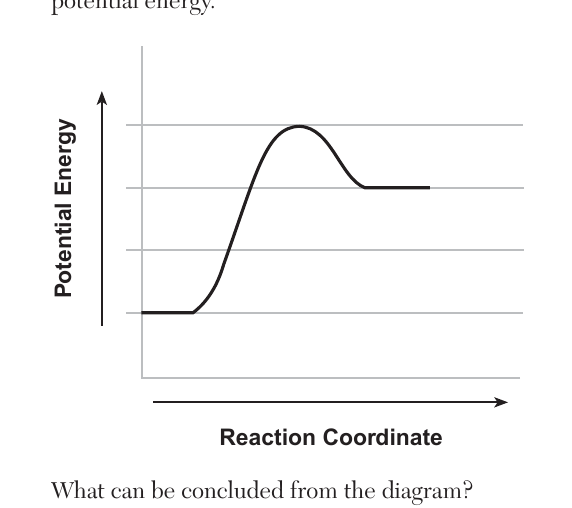
A potential energy diagram for a chemical reaction is given below. Each interval on the potential energy axis represents 100. kilojoules of potential energy. What can be concluded from the diagram?
- (A) The reaction is endothermic, and the heat of reaction is $-200.$ kJ.
- (B) The reaction is endothermic, and the heat of reaction is $+200.$ kJ. ✓
- (C) The reaction is exothermic, and the heat of reaction is $-200.$ kJ.
- (D) The reaction is exothermic, and the heat of reaction is $+200.$ kJ.
Worked solution
Since the final product energy level sits two 100.-kJ intervals above the starting reactant level, the products have higher potential energy than the reactants, making the reaction endothermic with a heat of reaction of +200. kJ.
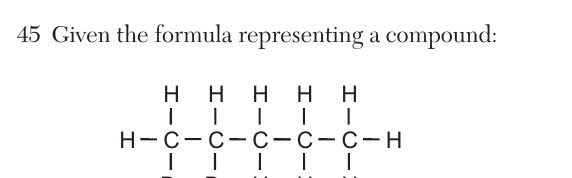
Given the formula representing a compound: $$\begin{array}{ccccccccccc} & H & & H & & H & & H & & H & \\ & | & & | & & | & & | & & | & \\ H-&C&-&C&-&C&-&C&-&C&-H \\ & | & & | & & | & & | & & | & \\ & Br & & Br & & H & & H & & H & \end{array}$$ What is a chemical name of this compound?
- (A) 1,1-dibromopentane
- (B) 2,2-dibromopentane
- (C) 1,2-dibromopentane ✓
- (D) 4,5-dibromopentane
Worked solution
The parent chain has 5 carbons (pentane), and bromine atoms are substituted on carbons 1 and 2, giving the name 1,2-dibromopentane.
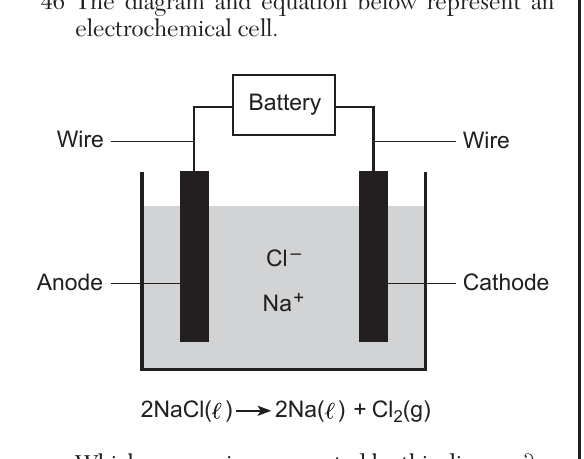
The diagram and equation below represent an electrochemical cell. A battery is connected by wires to two electrodes immersed in a container of molten NaCl. In this electrolytic cell the anode is the electrode connected to the positive terminal of the battery and the cathode is connected to the negative terminal, and the other electrode is labeled Cathode. The solution contains $Cl^-$ and $Na^+$ ions. $2NaCl(\ell) \rightarrow 2Na(\ell) + Cl_2(g)$ Which process is represented by this diagram?
- (A) chromatography
- (B) distillation
- (C) electrolysis ✓
- (D) polymerization
Worked solution
The presence of a battery driving the decomposition of molten NaCl into its elements is the defining feature of electrolysis.
Which aqueous solution has the greatest ability to conduct an electric current?
- (A) 0.10 M NaCl(aq) ✓
- (B) 0.010 M NaCl(aq)
- (C) 0.10 M $C_6H_{12}O_6$ (aq)
- (D) 0.010 M $C_6H_{12}O_6$ (aq)
Worked solution
NaCl fully dissociates into Na+ and Cl- ions, and the higher 0.10 M concentration provides more charge carriers than the more dilute NaCl or either glucose solution (glucose does not ionize at all).
What fraction of an original sample of $^{131}I$ remains unchanged after 24.063 days?
- (A) 1/8 ✓
- (B) 1/2
- (C) 1/3
- (D) 1/4
Worked solution
Since 24.063 days equals exactly 3 half-lives of I-131 (8.021 days each), the fraction remaining is (1/2)^3 = 1/8.
Given the equation representing a reaction: $_1^2H + _1^3H \rightarrow \ _2^4He + \ _0^1n + \text{energy}$ Which type of reaction is represented by the equation?
- (A) nuclear fission
- (B) nuclear fusion ✓
- (C) combustion
- (D) substitution
Worked solution
Deuterium and tritium nuclei combine to form a helium nucleus and a neutron, which is the joining of light nuclei characteristic of nuclear fusion.
Given the nuclear equation and isotopic masses: $_3^6Li + \ _1^2H \rightarrow 2(_2^4He) + \text{energy}$ $6.0151\text{ u} \quad 2.0140\text{ u} \quad 2(4.0026\text{ u})$ What is the amount of mass converted to energy as a result of the reaction between the two reactant nuclei?
- (A) 0.0239 u ✓
- (B) 4.0265 u
- (C) 8.0052 u
- (D) 16.0343 u
Worked solution
The mass converted to energy equals the total mass of the reactants minus the total mass of the products, which is 8.0291 u - 8.0052 u = 0.0239 u.
Base your answer on the information below and on your knowledge of chemistry. The element technetium, Tc, has several isotopes. The bright-line spectrum of technetium has been observed in the spectra of some stars. Compare the energy of an electron in the first shell of a technetium atom to the energy of an electron in the third shell of the same atom.
Worked solution
Electrons in shells closer to the nucleus (lower principal quantum number) have lower energy, so an electron in the first shell has less energy than one in the third shell.
State, in terms of protons and neutrons, why the various nuclides of technetium are isotopes of each other.
Worked solution
Isotopes are atoms of the same element, so all technetium nuclides have the same number of protons, but they have varying numbers of neutrons, giving different mass numbers.
Base your answer on the information below and on your knowledge of chemistry. A sample of a gas in a sealed, rigid cylinder with a movable piston has a volume of 0.250 liter at STP. Show a numerical setup for calculating the volume of this sample of gas at 298 K and 1.00 atm.
Worked solution
Since pressure is unchanged (1.00 atm at both STP and the new condition), the combined gas law reduces to a simple ratio of temperatures multiplying the original volume.
State a change in pressure that will cause the gas in the cylinder to behave more like an ideal gas.
Worked solution
At lower pressures, gas particles are farther apart, so their volume and intermolecular attractions become negligible, making the gas behave more ideally.
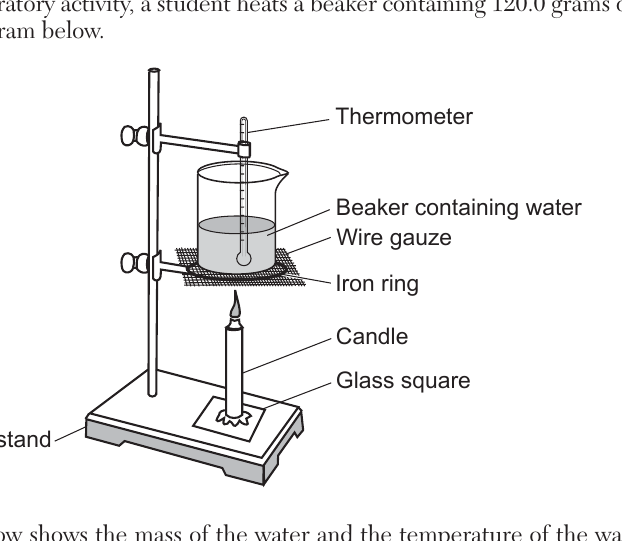
Base your answers on the information below and on your knowledge of chemistry. During a laboratory activity, a student heats a beaker containing 120.0 grams of water, as shown in a diagram of a ring stand setup with a candle heating a beaker of water (thermometer, wire gauze, iron ring, glass square shown). Data for Heating Water: Mass of 120.0 mL of water: 120.0 g Temperature of water before heating: 23.0 degrees C Temperature of water after heating 20.0 min: 86.0 degrees C State the direction of heat flow between the candle flame and the beaker of water during the time the candle is lit.
Worked solution
Because the flame is hotter than the water, thermal energy flows from the flame to the beaker of water, raising the water's temperature.
Show a numerical setup for calculating the amount of heat, in joules, absorbed by the water in the beaker as a result of the burning candle.
Worked solution
Using q = mCdeltaT with the specific heat of water (4.18 J/g degC), the mass of 120.0 g, and the temperature change of 63.0 degC gives the heat absorbed.
State how the molecular motion of the water molecules in the beaker changes as the temperature increases.
Worked solution
Since temperature reflects the average kinetic energy of particles, increasing temperature means the water molecules move with greater speed and increased motion.
Base your answers on the information below and on your knowledge of chemistry. Nitrogen dioxide gas, $NO_2(g)$, can reach equilibrium with dinitrogen tetroxide gas, $N_2O_4(g)$, in a closed system. At 1.0 atmosphere, the boiling point of $N_2O_4$ is 21 degrees C. The equation below represents this system. $2NO_2(g) \rightleftharpoons N_2O_4(g) + \text{energy}$ Compare the rate of the forward reaction to the rate of the reverse reaction when the system is at equilibrium.
Worked solution
By definition, dynamic chemical equilibrium is reached when the forward and reverse reaction rates become equal, even though the reaction continues in both directions.
State how the equilibrium shifts when the pressure on the equilibrium system is increased at constant temperature.
Worked solution
By Le Chatelier's principle, increasing the pressure shifts the equilibrium toward the side with fewer gas moles, which is the N2O4 (forward) side.
Compare the entropy of a sample of dinitrogen tetroxide gas at 25 degrees C and 1.0 atmosphere to the entropy of the same sample of dinitrogen tetroxide liquid at 15 degrees C and 1.0 atmosphere.
Worked solution
Gas particles are more disordered and have greater freedom of motion than particles in a liquid, so the gaseous N2O4 sample has higher entropy than the liquid sample.
Base your answers on the information below and on your knowledge of chemistry. When solid copper is placed in an aqueous silver nitrate solution, a reaction occurs, as represented by the equation below. $Cu(s) + 2AgNO_3(aq) \rightarrow 2Ag(s) + Cu(NO_3)_2(aq)$ State the change in oxidation state of copper in this reaction.
Worked solution
Elemental copper (oxidation state 0) is oxidized to Cu2+ in copper(II) nitrate, so its oxidation state increases from 0 to +2 as it loses two electrons.
Based on Table J, state why Cu(s) reacts spontaneously with $Ag^+(aq)$.
Worked solution
Since copper appears higher (more active) than silver on the Table J activity series, copper atoms will spontaneously give up electrons to silver ions, making the reaction spontaneous.
Write a balanced half-reaction equation to represent the reduction of the silver ions to silver atoms.
Worked solution
The reduction half-reaction shows each silver ion gaining one electron to become a neutral silver atom, which balances both charge and mass.
Base your answers on the information below and on your knowledge of chemistry. During a laboratory activity, 15.0 mL of hydrochloric acid, HCl(aq), is exactly neutralized by 18.2 mL of 0.11 M sodium hydroxide, NaOH(aq). During the laboratory activity, appropriate safety equipment is used and safety procedures are followed. Write the name of the laboratory procedure used in this activity.
Worked solution
Using a solution of known concentration to exactly neutralize a solution of unknown concentration to determine that unknown concentration is titration.
Show a numerical setup for calculating the molarity of the HCl(aq) solution.
Worked solution
Since HCl and NaOH react in a 1:1 mole ratio, the moles of NaOH used (volume times molarity) equal the moles of HCl present, which is then divided by the volume of HCl to get its molarity.
Base your answers on the information below and on your knowledge of chemistry. Several elements are considered endangered because there is a risk of these elements becoming unavailable for commercial uses in the next 100 years. Helium, zinc, gallium, indium, and tellurium are included in the list of these endangered elements. Identify the three endangered elements listed in the passage that are classified as metals.
Worked solution
Of the five elements listed, helium is a noble gas nonmetal and tellurium is a metalloid, leaving zinc, gallium, and indium as the three classified as metals.
Explain, in terms of electrons, why gallium and indium have similar chemical properties.
Worked solution
Elements in the same group have the same number of valence electrons, which largely determines chemical behavior; Ga and In are both Group 13 elements with 3 valence electrons.
Compare the density of a sample of helium at STP with the density of a sample of tellurium at STP.
Worked solution
Helium exists as a gas at STP with widely spaced, fast-moving particles, giving it a very low density, while tellurium is a solid at STP with tightly packed particles, giving it a much higher density.
Explain, in terms of electron shells, why the atomic radius of an atom of indium is greater than the atomic radius of an atom of gallium when both atoms are in the ground state.
Worked solution
Because indium is one period below gallium in Group 13, it has an additional occupied electron shell, increasing its atomic radius compared to gallium.
Determine the percent composition by mass of nitrogen in HNO$_3$ (gram-formula mass = 63.0 g/mol).
Worked solution
Divide the mass contributed by nitrogen (14.0 g/mol) by the total gram-formula mass of HNO3 (63.0 g/mol) and multiply by 100 to get percent composition.
Balance equation 1 in your answer booklet, using the smallest whole-number coefficients: NH$_3$(g) + O$_2$(g) $\rightarrow$ NO(g) + H$_2$O(g) + heat.
Worked solution
Balancing nitrogen, hydrogen, and then oxygen atoms in turn gives the smallest whole-number coefficients 4, 5, 4, 6.
Show a numerical setup for calculating the gram-formula mass of the NO$_2$(g) produced in equation 2.
Worked solution
Add the atomic mass of nitrogen to twice the atomic mass of oxygen to obtain the gram-formula mass of NO2.
Determine the number of moles of oxygen required to completely react with 4.0 moles of NO(g) in equation 2.
Worked solution
Using the 2:1 mole ratio of NO to O2 from the balanced equation, 4.0 mol NO requires 2.0 mol O2.
State the molecular polarity for each of the reactants in the equation: 6CO$_2$ + 6H$_2$O + light energy $\rightarrow$ C$_6$H$_{12}$O$_6$ + 6O$_2$.
Worked solution
CO2's linear symmetric shape causes its bond dipoles to cancel out (nonpolar), while water's bent shape leaves a net dipole (polar).
In the space in your answer booklet, draw a Lewis electron-dot diagram for a molecule of water.
Worked solution
Oxygen forms one single covalent bond with each hydrogen atom and retains two lone pairs, giving the correct Lewis structure for water.
Based on Table S, compare the strength of attraction of a carbon atom for electrons with the strength of attraction of an oxygen atom for the electrons in a bond between them.
Worked solution
Table S lists electronegativity values; oxygen's value is higher than carbon's, so oxygen attracts the shared bonding electrons more strongly.
State, in terms of element classification, why CO$_2$ is a molecular compound.
Worked solution
Bonds between two nonmetal elements are covalent, and covalently bonded substances are classified as molecular compounds.
Write the empirical formula for glucose (C$_6$H$_{12}$O$_6$).
Worked solution
Dividing all subscripts in the molecular formula of glucose by their greatest common factor, 6, gives the empirical formula CH2O.
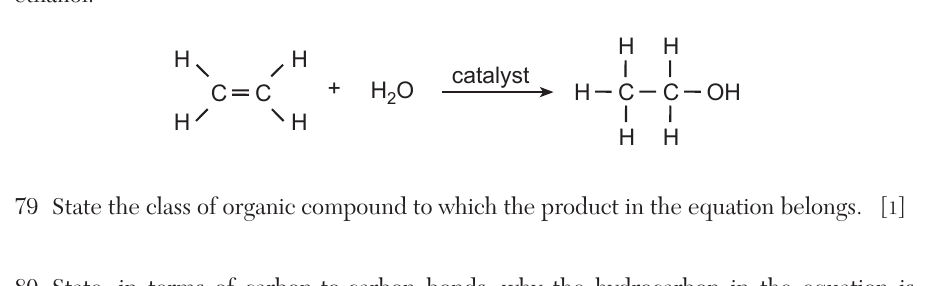
State the class of organic compound to which the product in the equation belongs (ethene + H$_2$O $\xrightarrow{\text{catalyst}}$ product shown as an H-C-C-H chain with an -OH group).
Worked solution
The product, ethanol, contains a hydroxyl (-OH) functional group attached to a carbon chain, which classifies it as an alcohol.
State, in terms of carbon-to-carbon bonds, why the hydrocarbon in the equation (ethene) is unsaturated.
Worked solution
A hydrocarbon is unsaturated when it contains at least one carbon-to-carbon double or triple bond; ethene has a C=C double bond.
Identify the element in the product of the reaction that allows it to be classified as an organic compound.
Worked solution
Organic compounds are, by definition, carbon-based compounds; the presence of carbon in ethanol is what makes it an organic compound.
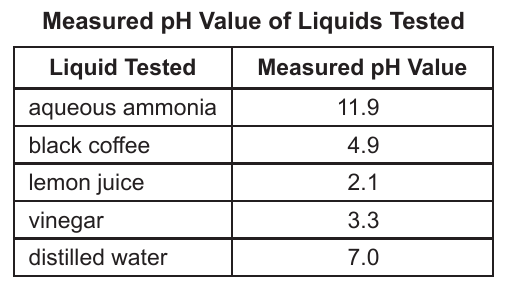
Based on the table (aqueous ammonia pH 11.9, black coffee pH 4.9, lemon juice pH 2.1, vinegar pH 3.3, distilled water pH 7.0), identify the liquid tested by the student that is most acidic.
Worked solution
The lower the pH value, the more acidic the solution; lemon juice has the lowest measured pH (2.1) of the liquids tested.
State the color of bromcresol green after the indicator is added to a sample of lemon juice.
Worked solution
Bromcresol green is yellow in acidic solutions (below about pH 3.8); since lemon juice has a pH of 2.1, the indicator turns yellow.
Complete the equation in your answer booklet by writing the formula of the missing product in the reaction of aqueous potassium hydroxide with the vinegar, acetic acid.
The partial equation to complete: CH3COOH(aq) + KOH(aq) -> H2O(l) + __________
Worked solution
This is a neutralization reaction between a base (KOH) and an acid (acetic acid) producing a salt (potassium acetate) and water; the missing product to be filled in the given equation is water, H2O.
Based on the pH value in the table, compare the concentration of hydronium ions to the concentration of hydroxide ions in the distilled water.
Worked solution
A pH of 7.0 indicates a neutral solution in which the hydronium ion concentration equals the hydroxide ion concentration, both at 1 x 10^-7 M.