June 2025 Algebra II Regents — Answer Key & Worked Solutions
Every question from the June 2025 Algebra II Regents exam, with the correct answer and a full step-by-step solution. Check your work, learn the method, then convert your raw score.
These are real questions from the June 2025 Algebra II New York State Regents examination, published by NYSED. Worked solutions are written by RegentsLab.
Which expression is equivalent to $2c\sqrt[3]{c}$ ?
- (A) $2c^{\frac{4}{3}}$ ✓
- (B) $2c^{\frac{3}{4}}$
- (C) $(2c)^{\frac{4}{3}}$
- (D) $(2c)^{\frac{3}{4}}$
Worked solution
Only the c is under the radical, so only c's exponent combines with 1; the coefficient 2 stays outside and unaffected.
Which investigation technique is most often used to determine the cause and effect of a medication?
- (A) observational study
- (B) survey
- (C) controlled experiment ✓
- (D) census
Worked solution
Only a controlled experiment can isolate the medication as the cause of an observed effect, since it controls for confounding variables.
What is the solution to $5(2)^{19x} = 50$?
- (A) $x = \dfrac{\log(50)}{19}$
- (B) $x = \dfrac{\log_2(10)}{19}$ ✓
- (C) $x = \dfrac{\log_2(45)}{19}$
- (D) $x = \dfrac{5}{19}$
Worked solution
Isolating the exponential term before taking the logarithm avoids incorrectly logging the original constant 50.
The function $P(t) = 256{,}485(0.965)^t$ models the decreasing population of a city from 1999 to 2014, where $t$ is the time in years since 1999. Which statement is not true?
- (A) The function estimated the population was 256,485 in 1999.
- (B) The decay rate was 0.35%. ✓
- (C) The decay factor is 0.965.
- (D) The population declined over 15 years.
Worked solution
The decay factor 0.965 corresponds to a 3.5% decay rate, not 0.35%, so that statement is the false one.
Four different surveys gathered data about the purchasing behaviors of pet owners. Pet owners from the same population were randomly selected. While collecting data, Chris surveyed 942 pet owners, John surveyed 410, Brooke surveyed 800, and Shane surveyed 100. Whose survey will likely have the smallest margin of error?
- (A) Brooke
- (B) Chris ✓
- (C) John
- (D) Shane
Worked solution
Since margin of error decreases as sample size increases, the survey with the most respondents (Chris, 942) has the smallest margin of error.
Given $i$ is the imaginary unit and $a = i^3$, $b = i^2$, and $c = i$, which expression is equivalent to $2ax^2 + 3bx - cx$?
- (A) $-2ix^2 - 3x + ix$
- (B) $-2ix^2 - 3ix$
- (C) $-2ix^2 - 3x - ix$ ✓
- (D) $-8ix^3 - 3x - ix$
Worked solution
Substituting the simplified powers of i for a, b, and c and combining like terms gives the equivalent expression.
Which sequence has a common ratio of $\frac{1}{2}$?
- (A) $-\dfrac{1}{4}a, -\dfrac{1}{8}a, -\dfrac{1}{16}a, -\dfrac{1}{32}a,\dots$ ✓
- (B) $\dfrac{1}{32}a, \dfrac{1}{16}a, \dfrac{1}{8}a, \dfrac{1}{4}a,\dots$
- (C) $20a, \dfrac{39}{2}a, 19a, \dfrac{37}{2}a,\dots$
- (D) $22a, 22.5a, 23a, 23.5a,\dots$
Worked solution
Choice (1) has each term half of the previous term, giving a common ratio of 1/2; choice (2) instead has ratio 2, and the others are arithmetic, not geometric.
The result of dividing $2x^3 + 6x^2 + 7x + 2$ by $x + 1$ is
- (A) $2x^2 + 4x + 3 - \dfrac{1}{x+1}$ ✓
- (B) $2x^2 + 4x + 3 + \dfrac{5}{x+1}$
- (C) $2x^2 + 8x - 15 + \dfrac{17}{x+1}$
- (D) $2x^2 + 8x + 15 - \dfrac{13}{x+1}$
Worked solution
Synthetic division with root -1 gives quotient $2x^2+4x+3$ and remainder -1, written as $-\frac{1}{x+1}$.
The probabilities that a randomly selected teenager uses social media websites $F$ and $I$ are shown below. $P(F) = 0.71$ $P(I) = 0.52$ $P(F \text{ or } I) = 0.77$ Given this information, what is $P(F \text{ and } I)$, the probability that a randomly selected teenager uses both websites?
- (A) 0.06
- (B) 0.19
- (C) 0.46 ✓
- (D) 0.96
Worked solution
Applying the addition rule for probability and solving for the intersection term gives 0.46.
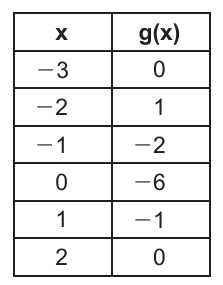
Consider $f(x) = (x-2)^2(x+3)$, and $g(x)$ as strictly defined in the table below. | x | g(x) | |---|------| | -3 | 0 | | -2 | 1 | | -1 | -2 | | 0 | -6 | | 1 | -1 | | 2 | 0 | Which statement or statements must be true, based on the information given? I. Both $f(x)$ and $g(x)$ have the same $x$-intercepts. II. Both $f(x)$ and $g(x)$ have a $y$-intercept at $y = -6$.
- (A) I, only ✓
- (B) II, only
- (C) I and II
- (D) neither I nor II
Worked solution
Both functions share zeros at x = -3 and x = 2, but their y-intercepts differ (12 vs -6), so only statement I must be true.
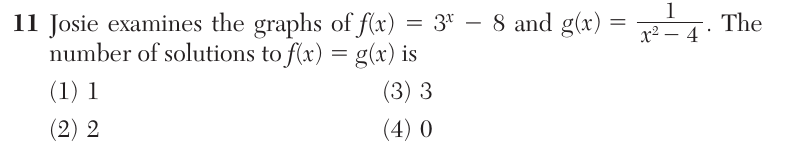
Josie examines the graphs of $f(x) = 3^x - 8$ and $g(x) = \dfrac{1}{x^2-4}$. The number of solutions to $f(x) = g(x)$ is
- (A) 1
- (B) 2
- (C) 3 ✓
- (D) 0
Worked solution
Comparing the increasing exponential f to the rational function g across each interval determined by g's asymptotes at x = ±2 shows exactly three intersection points.
Which binomial is a factor of $g^3 + 6g^2 + g - 14$?
- (A) $g - 1$
- (B) $g - 2$
- (C) $g + 1$
- (D) $g + 2$ ✓
Worked solution
By the Factor Theorem, since substituting g = -2 gives 0, (g+2) must be a factor of the polynomial.
Consider the recursively defined sequence below. $a_1 = 8$ $a_n = 2a_{n-1}$ Which explicit formula represents the same sequence?
- (A) $a_n = 2^n$
- (B) $a_n = 2(4^n)$
- (C) $a_n = 2^{n+2}$ ✓
- (D) $a_n = 8^n$
Worked solution
Rewriting the geometric sequence's explicit formula with base 2 shows it simplifies to $2^{n+2}$.
What is the exact value of $\tan\left(-\dfrac{5\pi}{6}\right)$?
- (A) $\dfrac{1}{\sqrt{3}}$ ✓
- (B) $-\dfrac{1}{\sqrt{3}}$
- (C) $\sqrt{3}$
- (D) $-\sqrt{3}$
Worked solution
Using tangent's odd symmetry and the reference angle π/6 in the second quadrant gives a final value of 1/√3.
Given $m \neq 0$ and $\left(17^{\frac{1}{m}}\right)^n = 17^2$, what is $n$ in terms of $m$?
- (A) $2m$ ✓
- (B) $\dfrac{2}{m}$
- (C) $\dfrac{m}{2}$
- (D) $2^m$
Worked solution
Equating exponents of the same base 17 and solving the resulting equation n/m = 2 for n gives n = 2m.
In order to qualify for a college tennis scholarship, Joe needs to win 90% of the matches he plays during his senior year of high school. If he has won 8 of the 10 matches that he has played, which equation can be used to determine how many more consecutive matches, x, Joe must win in order for his winning percentage to equal 90%?
- (A) $\dfrac{8+x}{x} = 0.90$
- (B) $\dfrac{8}{10+x} = 0.90$
- (C) $\dfrac{8}{10} + x = 0.90$
- (D) $\dfrac{8+x}{10+x} = 0.90$ ✓
Worked solution
Both the numerator (wins) and denominator (total matches) increase by x since he wins all x additional matches, giving the correct rational equation.
Consider the system of equations below. $3x + 2y = 1$ $2y + z = 2$ $2x - 2z = -6$ What is the value of $x$?
- (A) 1 ✓
- (B) -1
- (C) -4
- (D) 4
Worked solution
Expressing z in terms of x from two different equations and setting them equal isolates and solves for x = 1.
The point (2,-3) lies on the graph of the equation $y = f(x)$. Which point must lie on the graph of the equation $y = f(x-4)+1$?
- (A) (1,1)
- (B) (-2,-2)
- (C) (3,-7)
- (D) (6,-2) ✓
Worked solution
Adding 4 to the x-coordinate and 1 to the y-coordinate applies the horizontal and vertical shifts to the known point.
Which statement best describes the end behavior of the function $y = \log(x-3)$?
- (A) As $x \to -\infty$, $y \to -\infty$, and as $x \to \infty$, $y \to \infty$.
- (B) As $x \to 3$, $y \to -\infty$, and as $x \to \infty$, $y \to \infty$. ✓
- (C) As $x \to -\infty$, $y \to 0$, and as $x \to \infty$, $y \to \infty$.
- (D) As $x \to 3$, $y \to 0$, and as $x \to \infty$, $y \to \infty$.
Worked solution
The log function has a vertical asymptote at x = 3 (not defined for x ≤ 3), so its behavior is described relative to that asymptote rather than as x approaches negative infinity.
The black bear population for a certain area of the Adirondacks can be modeled by the equation $B = 5835.943(1.026)^t$, where $t$ is measured in years since 2010. Kieran would like to rewrite this model in terms of a 5-year growth rate. Kieran's model is best represented by
- (A) $B = 5835.943(1.005147)^{\frac{t}{5}}$
- (B) $B = 5835.943(1.005147)^{5t}$
- (C) $B = 5835.943(1.136938)^{\frac{t}{5}}$ ✓
- (D) $B = 5835.943(1.136938)^{5t}$
Worked solution
Rewriting the annual growth factor raised to the 5th power creates an equivalent model expressed in terms of 5-year growth periods.
Which expression or expressions are equal to 0 for all real numbers? I. $(x^2+y^2)^2+(x^2+y^2)^2-2(x^2+y^2)^2$ II. $(x^2+y^2)^2-(x^2-y^2)^2$ III. $(x^2+y^2)^2-(x^2-y^2)^2-(2xy)^2$
- (A) I, only
- (B) III, only
- (C) I and II, only
- (D) I and III, only ✓
Worked solution
Statement I is a trivial identity (a-a=0), and statement III simplifies to 4x^2y^2-4x^2y^2=0 using the difference of squares, while statement II simplifies to 4x^2y^2, which is not identically zero.
The equation $\frac{1}{x} - \frac{1}{5} = \frac{x}{5}$ has
- (A) rational solutions
- (B) irrational solutions ✓
- (C) imaginary solutions
- (D) no solutions
Worked solution
The discriminant 21 is not a perfect square, so the two real solutions are irrational.
For $x\neq\pm4y$, the expression $\frac{x^2+3xy-28y^2}{16y^2-x^2}$ is equivalent to
- (A) $-1-\frac{7}{4}y$
- (B) $\frac{x-7y}{4y-x}$
- (C) $\frac{x+7y}{x+4y}$
- (D) $\frac{-x-7y}{x+4y}$ ✓
Worked solution
Factor numerator and denominator, cancel the common (x-4y) factor, and simplify the sign.
Which equation represents a parabola with a focus of $(-2,1)$ and directrix of $y=5$?
- (A) $(x+2)^2=-8(y-3)$ ✓
- (B) $(x+2)^2=5(y-1)$
- (C) $(x+2)^2=-8(y-1)$
- (D) $(x+2)^2=8(y-3)$
Worked solution
The vertex lies halfway between the focus and directrix, and since the focus is below the directrix the parabola opens downward with 4p = -8.
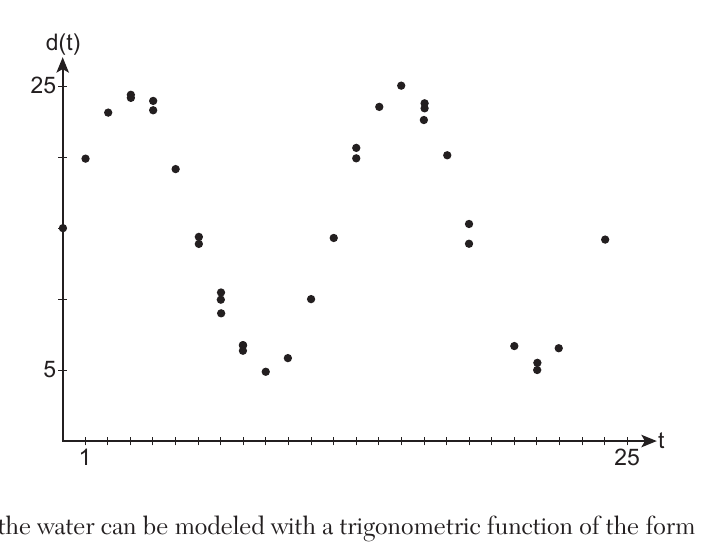
Data collected showing the depth of the water in a bay during a 24-hour period are shown in the graph below. The scatter plot shows depth $d(t)$ in feet on the vertical axis (with gridlines at 5 and 25 labeled) versus time $t$ in hours on the horizontal axis (labeled from 1 to 25). The plotted points oscillate up and down, reaching high clusters near $d\approx23$-$25$ around $t\approx2$-$4$ and again near $t\approx14$-$16$, and low clusters near $d\approx5$-$6$ around $t\approx8$-$10$ and again near $t\approx20$-$22$, suggesting a repeating wave pattern with a period of about 12 hours. The depth of the water can be modeled with a trigonometric function of the form $d(t)=A\sin\left(\frac{\pi}{6}t\right)+C$. Estimate the value of $A$, to the nearest integer. Justify your answer.
Worked solution
The amplitude of a sinusoidal model equals half the difference between the maximum and minimum data values, giving A approximately 10.
Algebraically determine the solution to the equation below. $\sqrt{x-2}+x=4$
Worked solution
Isolating the radical and squaring introduces an extraneous root; checking both candidates in the original equation shows only x=3 is valid.
Factor the expression completely. $(x-1)^2+5(x-1)-6$
Worked solution
Substituting u = x - 1 turns the expression into a simple trinomial that factors, then back-substituting gives the final factored form.
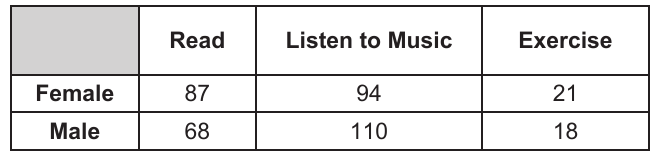
The results of a survey of the students at the local high school regarding the topic "What I Do to Relax" are displayed in the table below. | | Read | Listen to Music | Exercise | |---|---|---|---| | Female | 87 | 94 | 21 | | Male | 68 | 110 | 18 | If a student from this survey is selected at random, determine the exact probability that the person claims to relax by listening to music given that the person is female.
Worked solution
Conditional probability restricts the sample space to females only, so divide the number of females who listen to music by the total number of females.
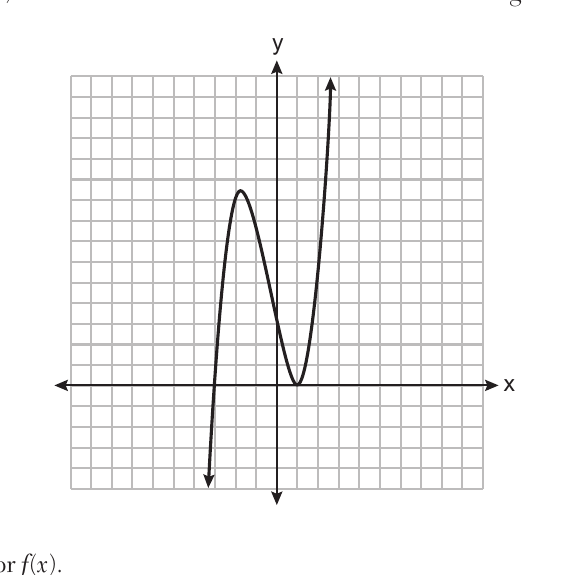
The graph of $y=f(x)$ is shown below. The cubic function has a leading coefficient of 1. The graph shows a curve that comes up from the bottom left, crossing the x-axis at $x=-2$, rising to a local maximum near $(-1,4)$, then decreasing to touch the x-axis (without crossing) at $x=1$, and then increasing steeply up through the top right of the graph. Write an equation for $f(x)$.
Worked solution
A single x-intercept where the graph crosses corresponds to a linear factor, and a point where the graph touches but does not cross corresponds to a squared (double root) factor.
Given $f(x)=\frac{2}{3}x+6$, write the equation of $f^{-1}(x)$.
Worked solution
To find the inverse, swap x and y in the original equation and solve for y.
On the coordinate plane below, sketch at least one cycle of the function $f(x)=4\cos(2x)$. Label the axes with an appropriate scale.
Worked solution
For y = A cos(Bx), amplitude is $|A|$ and period is 2 pi divided by B; plotting the five key points (max, zero, min, zero, max) over one period and labeling the axes with those values produces a correct sketch.
In a recent online contest with a large number of randomly selected human players, the computer player won 67% of the time. The game-design company claims that the computer player can beat human players 70% of the time. The company runs a simulation of a large number of games, with the same number of human players, assuming that the computer wins 70% of the time. The simulation is approximately normal with a mean of 0.705 and a standard deviation of 0.045. Does the contest result provide evidence to contradict the designer's claim? Use the simulation results to justify your answer.
Worked solution
Because the observed win rate of 0.67 falls well within two standard deviations of the simulated mean of 0.705, it is not an unusual result under the assumption that the true win rate is 70 percent, so there is no evidence to contradict the claim.
Solve algebraically for $x$: $\frac{2}{x}=\frac{2x+3}{x-4}$. Express your answers in simplest $a+bi$ form.
Worked solution
Cross-multiplying gives a quadratic with a negative discriminant, so the quadratic formula produces a complex conjugate pair, simplified using i^2 = -1.
A highly selective college reports that the mean score earned by accepted students on the Mathematics Level 2 subject test is 750 with a standard deviation of 20 and that the scores are approximately normally distributed. Given this information, determine the interval representing the middle 95% of student scores. To the nearest whole percent, determine the percentage of accepted students who scored a 760 or less.
Worked solution
The empirical rule places about 95 percent of a normal distribution within two standard deviations of the mean, and converting 760 to a z-score of 0.5 and reading the standard normal table gives the cumulative probability.
For $c(x)=3x^2-4x+7$ and $d(x)=x-2$, determine $c(x)\cdot d(x)-[d(x)]^3$ as a polynomial in standard form.
Worked solution
Expand the product c(x)d(x) and the cube (x-2)^3 separately, then subtract term by term and combine like terms.
Christopher works for a defense contractor and earned $85,000 his first year. For each additional year he will receive a 2.5% raise. Write a geometric series formula, $C_n$, for Christopher's total earnings over $n$ years. Use this formula to find Christopher's total earnings, to the nearest hundred dollars, over his first 10 years of employment.
Worked solution
Each year's salary is 2.5 percent more than the previous year's, forming a geometric sequence with first term 85000 and common ratio 1.025, and the sum of the first n terms gives total earnings.
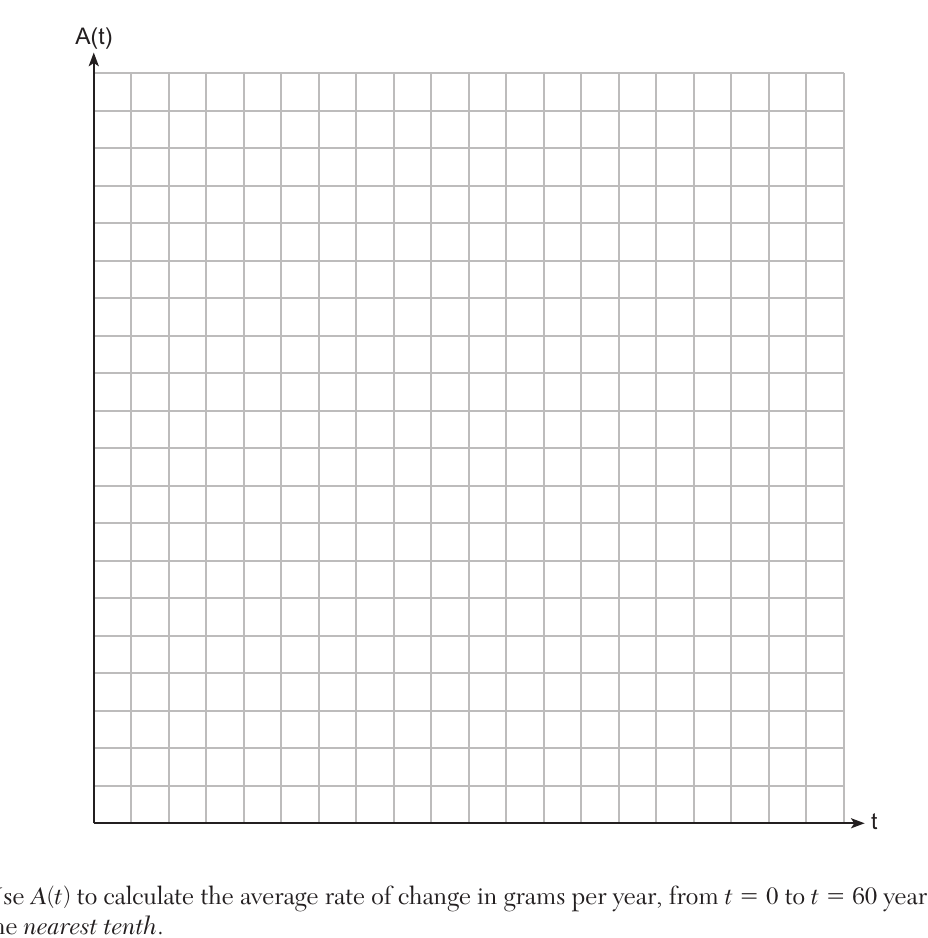
Cesium-137 decay can be modeled with the formula $A(t)=A_0e^{kt}$, where $A(t)$ represents the mass remaining in grams after $t$ years and $A_0$ represents the initial mass. A sample of 500 grams of cesium-137 takes approximately 60.34 years to decay to 125 grams. Use this sample with the given formula to determine the constant $k$, to the nearest thousandth. Use this value for $k$ to write a function, $A(t)$, that will find the mass of the 500-gram sample remaining after any amount of time, $t$, in years. Graph $A(t)$ on the graph below from $t=0$ to $t=150$ years. Use $A(t)$ to calculate the average rate of change in grams per year, from $t=0$ to $t=60$ years, to the nearest tenth. Explain what this value means in the given context.
Worked solution
Solving A(t)=A0 e^{kt} for k using the given decay data yields k approximately -0.023; using this rate, the average rate of change over the first 60 years is about -6.2 grams per year, meaning the sample's mass decreases on average by about 6.2 grams each year during that interval.