June 2024 Algebra II Regents — Answer Key & Worked Solutions
Every question from the June 2024 Algebra II Regents exam, with the correct answer and a full step-by-step solution. Check your work, learn the method, then convert your raw score.
These are real questions from the June 2024 Algebra II New York State Regents examination, published by NYSED. Worked solutions are written by RegentsLab.
Which expression is equivalent to $(x + 3)^2 + 4(x + 3) - 5$?
- (A) $(x + 5)(x - 1)$
- (B) $(x + 8)(x + 2)$ ✓
- (C) $(x - 2)(x + 4)$
- (D) $x^2 + 4x + 16$
Worked solution
Substituting u = x+3 turns the expression into a simple trinomial u^2+4u-5 that factors as (u+5)(u-1); replacing u back gives (x+8)(x+2).
Which value, to the nearest tenth, is an approximate solution for the equation $f(x) = g(x)$, if $f(x) = \frac{5}{x-3}$ and $g(x) = 2(1.3)^x$?
- (A) 3.2
- (B) 3.9 ✓
- (C) 4.0
- (D) 5.6
Worked solution
Using a graphing calculator to find the intersection of the two functions gives x ≈ 3.9, which is confirmed by substituting into both equations.
Which equation is graphed in the diagram below?
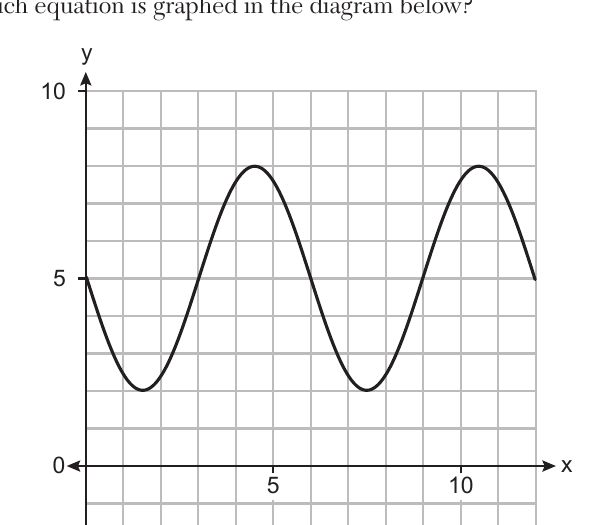
- (A) $y = -3\sin\left(\frac{\pi}{3}x\right) + 5$ ✓
- (B) $y = -3\cos\left(\frac{\pi}{3}x\right) + 5$
- (C) $y = -5\sin\left(\frac{\pi}{3}x\right) + 3$
- (D) $y = -5\cos\left(\frac{\pi}{3}x\right) + 3$
Worked solution
The graph has midline y = 5 and amplitude 3, starting at the midline and initially decreasing, which matches a negative sine function rather than a cosine function.
Which point is in Quadrant III and is a solution to the system below? $y = x^2 - 24$ $y = x - 12$
- (A) $(4,-8)$
- (B) $(-3,-15)$ ✓
- (C) $(-4,-16)$
- (D) $(-3,-33)$
Worked solution
Solving the system yields two intersection points, and only (-3,-15) has both coordinates negative, placing it in Quadrant III.
For which equations will the value $s = 4$ make the statement an identity? I. $(2x - 3)^2 = 4x^2 - 3sx + 9$ II. $(x - 2)^3 = (x - 2)(x^2 + sx + s)$
- (A) I, only ✓
- (B) II, only
- (C) I and II
- (D) neither I nor II
Worked solution
Expanding both sides of each equation shows that s = 4 makes statement I a true identity, but substituting s = 4 into statement II produces mismatched coefficients.
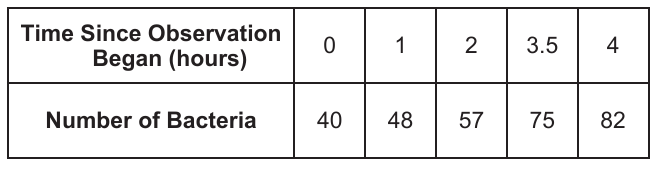
The number of bacteria in a sample, which can be modeled by an exponential regression, is shown in the table below. Time Since Observation Began (hours): 0, 1, 2, 3.5, 4 Number of Bacteria: 40, 48, 57, 75, 82 Assuming this trend continues, approximately how many bacteria would be present 8 hours after the observation began?
- (A) 123
- (B) 127
- (C) 168 ✓
- (D) 180
Worked solution
An exponential regression on the given data gives a growth factor of about 1.196 per hour, and evaluating the model at x = 8 gives approximately 168 bacteria.
Factored completely, $x^4 + 4x^3 - 9x^2 - 36x$ is equivalent to
- (A) $x(x + 9)(x - 9)(x + 4)$
- (B) $x(x + 3)(x - 3)(x + 4)$ ✓
- (C) $(x^3 - 9x)(x + 4)$
- (D) $x(x^2 - 9)(x + 4)(x + 4)$
Worked solution
Factoring out x and then grouping the remaining cubic reveals a common factor of (x+4), and the resulting difference of squares factors further into (x+3)(x-3).
The solution set for the equation $x + 1 = \sqrt{4x + 25}$ is
- (A) $\{\ \}$
- (B) $\{6\}$ ✓
- (C) $\{6,-4\}$
- (D) $\{-4\}$
Worked solution
Squaring both sides produces two candidate solutions, but substituting back shows x = -4 gives a negative left side equal to a positive square root, so it is extraneous, leaving only x = 6.
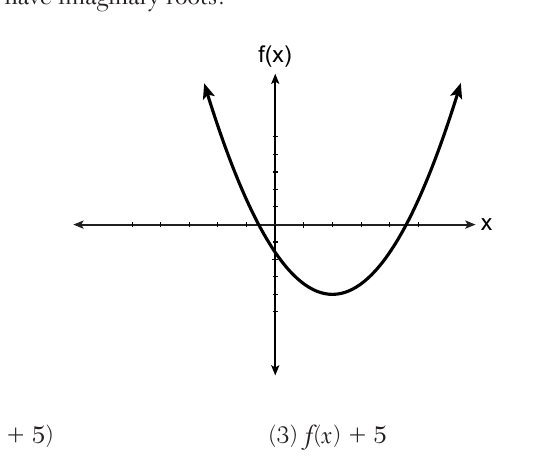
If $f(x)$ is represented by the graph below, which translation of $f(x)$ would have imaginary roots?
- (A) $f(x + 5)$
- (B) $f(x - 5)$
- (C) $f(x) + 5$ ✓
- (D) $f(x) - 5$
Worked solution
Since the original parabola's vertex is just below the x-axis with two real roots, only a vertical shift upward by 5, f(x)+5, would raise the vertex above the x-axis and produce imaginary roots.
The solutions to the equation $3x^2 - 4x + 2 = 2x - 3$ are
- (A) $\frac{2}{3} \pm \frac{\sqrt{2}}{3}i$
- (B) $1 \pm \frac{\sqrt{6}}{3}i$ ✓
- (C) $1 \pm \frac{\sqrt{12}}{3}$
- (D) $1 \pm 2\sqrt{6}i$
Worked solution
Moving all terms to one side gives a quadratic with a negative discriminant, and applying the quadratic formula produces complex solutions of the form 1 ± (√6/3)i.
A culture of 1000 bacteria triples every 10 hours. Which expression models the number of bacteria in the sample after $t$ hours?
- (A) $1000e^{3t}$
- (B) $1000(3)^t$
- (C) $1000(3)^{10t}$
- (D) $1000(3)^{\frac{t}{10}}$ ✓
Worked solution
Since the population triples every 10 hours, the exponent must represent the number of 10-hour periods that have passed, which is t/10.
An initial investment of $5000 in an account earns 3.5% annual interest. Which function correctly represents a recursive model of the investment after $n$ years?
- (A) $A = 5000(0.035)^n$
- (B) $a_0 = 5000$ $a_n = a_{n-1}(0.035)$
- (C) $A = 5000(1.035)^n$
- (D) $a_0 = 5000$ $a_n = a_{n-1}(1.035)$ ✓
Worked solution
A recursive model defines each term based on the previous term; since the account grows by 3.5% annually, each new balance equals the previous balance multiplied by 1.035.
Which expression is equivalent to $2xy^2\sqrt[3]{x^2y}$?
- (A) $2x^{\frac{5}{3}}y^{\frac{7}{3}}$ ✓
- (B) $2xy$
- (C) $2x^{\frac{2}{3}}y^{\frac{2}{3}}$
- (D) $2x^7y^4$
Worked solution
Rewriting the cube root as fractional exponents and adding exponents of like bases gives 2x^(5/3)y^(7/3).
Which statements must be true about the polynomial function $k(x) = -2x^3 - 11x^2 - 12x + 9$? I. $(x - 3)$ is a factor of $k(x)$ II. $k(0) = 9$ III. $\frac{k(x)}{x + 2}$ has a remainder of 5
- (A) II, only
- (B) I and II
- (C) II and III ✓
- (D) I, II, and III
Worked solution
Using the Remainder Theorem, k(3) is not 0 so I is false, k(0) directly gives 9 so II is true, and k(-2) equals 5 confirming the remainder in III, so only II and III must be true.
To prepare for lacrosse tryouts, Kole is increasing the amount of time he spends at the gym. This week he is spending 150 minutes there and he plans to increase this amount by 2% each week. The amount of time, in minutes, that he plans to spend at the gym $t$ weeks from now is given by the function $A(t) = 150(1.02)^t$. In terms of a daily growth rate, the amount of time Kole is planning to spend at the gym can best be modeled by the function
- (A) $A(t) = 150(1.14869)^{\frac{t}{7}}$
- (B) $A(t) = 150(1.14869)^{7t}$
- (C) $A(t) = 150(1.00283)^{\frac{t}{7}}$
- (D) $A(t) = 150(1.00283)^{7t}$ ✓
Worked solution
To convert a weekly growth rate into a daily one, find r such that r raised to the 7th power equals 1.02, then use 7t as the exponent since t weeks equals 7t days.
Mr. Zachary posts review assignments on the Betamath website for his students. On his last test, 49% of his students used Betamath and passed. Overall, 68% of his students used Betamath. Approximately what percentage of Mr. Zachary's students passed, given that they used Betamath?
- (A) 19%
- (B) 32%
- (C) 33%
- (D) 72% ✓
Worked solution
This is a conditional probability problem; dividing the joint probability of using Betamath and passing by the probability of using Betamath gives approximately 72%.
Given $\sin\theta = \frac{7}{25}$ and $\theta$ terminates in Quadrant II, what is the value of $\tan\theta$?
- (A) $-\frac{7}{24}$ ✓
- (B) $-\frac{24}{7}$
- (C) $\frac{7}{24}$
- (D) $\frac{24}{7}$
Worked solution
Using the 7-24-25 Pythagorean triple to find cosine, and recognizing cosine is negative in Quadrant II, gives a tangent value of -7/24.
A family owned grocery store in New Hartford, NY employs 49 people whose ages are approximately normally distributed with a mean of 36 years and a standard deviation of 6.2 years. Ryan has been hired to work at this store. He is 30 years old. How many people who work at this store would you expect to be younger than Ryan?
- (A) 17
- (B) 7
- (C) 41
- (D) 8 ✓
Worked solution
Converting Ryan's age to a z-score and finding the corresponding normal probability, then multiplying by the total number of employees, gives approximately 8 employees younger than Ryan.
For the function $d(x) = \sqrt[3]{x + 2}$, the inverse function, $d^{-1}(x)$, equals
- (A) $\sqrt[3]{x + 2}$
- (B) $x^3 + 2$
- (C) $-\sqrt[3]{x + 2}$
- (D) $x^3 - 2$ ✓
Worked solution
Swapping x and y in the original equation and solving for y (by cubing both sides) yields the inverse function d^{-1}(x) = x^3 - 2.
Given $f(x) = x^4 + x^3 - 3x^2 + 9x - 108$ and $f(3) = 0$, which values satisfy $f(x) = 0$?
- (A) $-4, 3$ only
- (B) $-3, 4$ only
- (C) $\pm3i, -4, 3$ ✓
- (D) $\pm3i, -3, 4$
Worked solution
Dividing out the known root x = 3 leaves a cubic that factors by grouping into (x+4)(x^2+9), giving the real root -4 and the imaginary roots ±3i.
The profit function, $p(x)$, is found by subtracting the cost function, $c(x)$, from the revenue function, $r(x)$. Which function below represents the cost function given $p(x) = -15x^2 + 600x + 60$ and $r(x) = -0.4x^2 + 130x + 1200$?
- (A) $c(x) = -14.6x^2 + 470x - 1140$
- (B) $c(x) = -14.6x^2 + 730x - 1260$
- (C) $c(x) = 14.6x^2 - 470x + 1140$ ✓
- (D) $c(x) = 14.6x^2 + 730x - 1260$
Worked solution
Since profit equals revenue minus cost, cost equals revenue minus profit; subtracting the polynomials term by term gives the cost function.
What is the remainder when $4x^3 - 3x + 3$ is divided by $x - 2$?
- (A) $-23$
- (B) $-7$
- (C) $13$
- (D) $29$ ✓
Worked solution
The Remainder Theorem states that dividing a polynomial f(x) by (x - a) leaves a remainder equal to f(a), so we evaluate the polynomial at x = 2.
The parabola with equation $12(y+1) = (x-4)^2$ has
- (A) a vertex at $(4,2)$
- (B) a focus at $(4,-1)$
- (C) a directrix $y = -4$ ✓
- (D) four units between the focus and vertex
Worked solution
Comparing to the standard form of an upward-opening parabola gives vertex (4,-1) and p = 3, so the directrix is the horizontal line y = -4, three units below the vertex.
Jay is training for a bike race over fifteen weeks. At the end of the first week, he has ridden ten miles, and he is planning to increase his weekly distance by nine percent each week. Approximately how many miles total will he have ridden from the beginning of his training to the end of the fifteenth week?
- (A) $10.989$
- (B) $33.417$
- (C) $163.5$
- (D) $293.609$ ✓
Worked solution
This is a geometric series with first term 10 and common ratio 1.09; summing 15 terms with the geometric series formula gives the total distance.
Given $x$ is a real number, write the expression in simplest $a + bi$ form: $(x+2i)(3-2xi) + 2x^2i$
Worked solution
Expanding the product using FOIL, substituting i^2 = -1, and combining like terms, then adding the remaining term, causes the x^2 terms to cancel, leaving a simplified a + bi expression.
Solve $3.8e^{1.5t} = 16$ algebraically for $t$ to the nearest hundredth.
Worked solution
Isolate the exponential expression, take the natural log of both sides, then divide by 1.5 to solve for t.
In an attempt to get the student body's opinion of a new dress code, members of the statistics class surveyed the students of the first period computer science class. Explain a statistical bias in the method of data collection.
Worked solution
Surveying only one class instead of a random sample of the whole student body means the results may not generalize, since that class's demographics or opinions could differ from the student body as a whole.
Sketch a graph of polynomial $P(x)$, given the criteria below: • $P(x)$ has zeros only at $-5, 1$, and $4$ • As $x \to \infty$, $P(x) \to -\infty$ • As $x \to -\infty$, $P(x) \to -\infty$
Worked solution
Since both end behaviors go to negative infinity, the polynomial must have even degree and negative leading coefficient; since only three zeros are listed, one of them (here x = 1) must have even multiplicity so the graph touches but does not cross the x-axis there.
The height, above ground, of a Ferris wheel car can be modeled by the function $h(t) = -103.5\cos\left(\frac{2\pi t}{5}\right) + 108.5$ where $h$ is measured in feet and $t$ is measured in minutes. State the period of the function and describe what the period represents in this context.
Worked solution
The coefficient of t inside the cosine determines the period; dividing 2π by that coefficient gives a period of 5 minutes, meaning the Ferris wheel completes one full rotation every 5 minutes.
Solve algebraically for all values of $x$: $\frac{8}{x+5} - \frac{3}{x} = 5$
Worked solution
Clearing denominators by multiplying through by the least common denominator turns the rational equation into a quadratic, which factors into two valid solutions that do not violate the domain restrictions.
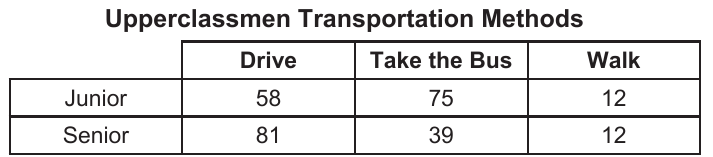
The transportation methods used by the upperclassmen at Calhoun High School are summarized in the table below. Upperclassmen Transportation Methods | | Drive | Take the Bus | Walk | |---|---|---|---| | Junior | 58 | 75 | 12 | | Senior | 81 | 39 | 12 | Are the events "being a junior" and "driving to school" independent? Using statistical evidence, justify your answer.
Worked solution
Two events are independent only if the conditional probability equals the overall probability; since the probability of driving given being a junior (0.4) differs from the overall probability of driving (about 0.502), the events are not independent.
Can $f(x) = x^3 + 7$ be classified as an odd function? Justify your answer.
Worked solution
Testing the definition of an odd function shows that f(-x) and -f(x) differ by the constant term (7 versus -7), for example f(0) = 7 but -f(0) = -7, so the function fails the odd-function test.
Solve the following system of equations algebraically for all values of $x$, $y$, and $z$: $3x - 8y + 2z = -60$ $2x - 7y - 5z = -31$ $-6x + 2y - 4z = 36$
Worked solution
Combining equations 1 and 3 conveniently eliminates both x and z at once, immediately yielding y; substituting back and eliminating z between two remaining equations gives x, and back-substitution gives z.
In the town of Skaneateles, New York, house prices since 2008 have changed based on the function $H(t) = 200{,}000(1.045)^t$, where $t$ is the number of years since 2008 and $H(t)$ is the median house price. Determine the average rate of change for the median house price in Skaneateles from 2010 to 2018 to the nearest dollar per year. Explain what this rate of change means as it relates to median house prices.
Worked solution
The average rate of change over an interval is the change in the function's value divided by the change in t; evaluating H at t = 2 and t = 10 and dividing the difference by 8 years gives the average yearly increase in median house price.
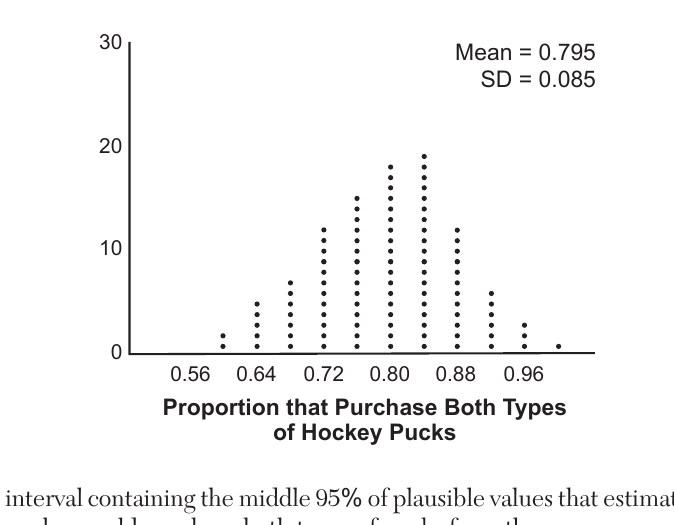
A sporting goods manufacturer is trying to determine if they should continue to produce multiple types of hockey pucks. The company surveyed 50 randomly chosen customers and asked them if they purchased both game regulation pucks and lighter training pucks. Of those surveyed, 40 of them said that they purchase both types of pucks. A simulation that was run 100 times based on the survey results produced approximately normal results with Mean = 0.795 and SD = 0.085. a) Determine an interval containing the middle 95% of plausible values that estimates the proportion of all customers who would purchase both types of pucks from the company. b) The company will continue to manufacture both types of hockey pucks if it is reasonable to assume that the true proportion of customers who buy both types of hockey pucks is above 0.60. Using the interval from part a, explain whether or not the company should continue to produce both types of hockey pucks.
Worked solution
For an approximately normal simulation distribution, the middle 95% of values lies within about 2 standard deviations of the mean; since this entire interval is above 0.60, the company has statistical justification to continue producing both puck types.
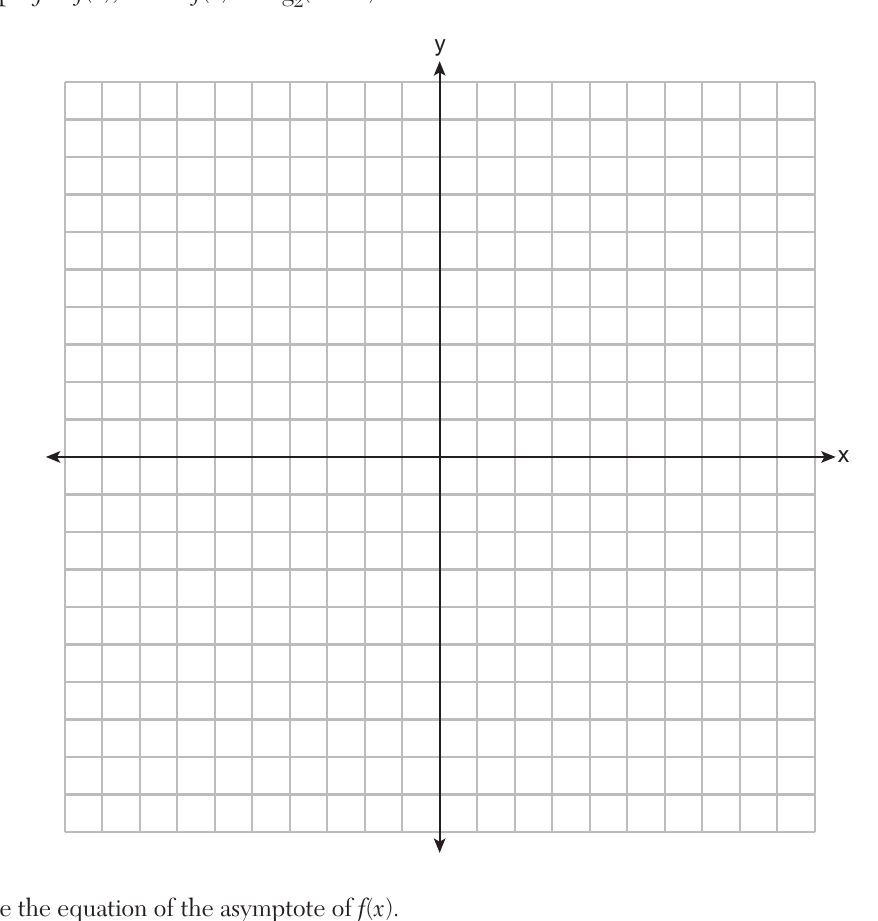
Graph $y = f(x)$, where $f(x) = \log_2(x-1) + 3$ on the set of axes below. State the equation of the asymptote of $f(x)$. When $f(x)$ is reflected over the line $y=x$, a new function is formed: $g(x) = 2^{x-3}+1$. State the equation of the asymptote of $g(x)$.
Worked solution
A logarithmic function has a vertical asymptote where its argument equals zero (here x = 1); since inverse functions are reflections over y = x, the vertical asymptote of the log function becomes the horizontal asymptote y = 1 for its exponential inverse.
Megan is performing an experiment in a lab where the air temperature is a constant 73°F and the liquid is 237°F. One and a half hours later, the temperature of the liquid is 112°F. Newton's law of cooling states $T(t) = T_a + (T_0 - T_a)e^{-kt}$ where: $T(t)$: temperature, °F, of the liquid at $t$ hours $T_a$: air temperature $T_0$: initial temperature of the liquid $k$: constant Determine the value of $k$, to the nearest thousandth, for this liquid.
Worked solution
Substituting the given air temperature, initial temperature, and the known temperature at t = 1.5 hours into Newton's Law of Cooling, then isolating the exponential term and taking the natural log, solves for the cooling constant k.