June 2023 Algebra II Regents — Answer Key & Worked Solutions
Every question from the June 2023 Algebra II Regents exam, with the correct answer and a full step-by-step solution. Check your work, learn the method, then convert your raw score.
These are real questions from the June 2023 Algebra II New York State Regents examination, published by NYSED. Worked solutions are written by RegentsLab.
The population of Austin, Texas from 1850 to 2010 is summarized in the table below. | Year | 1850 | 1870 | 1890 | 1910 | 1930 | 1950 | 1970 | 1990 | 2010 | |---|---|---|---|---|---|---|---|---|---| | Population | 629 | 4428 | 14,575 | 29,860 | 53,120 | 132,459 | 251,808 | 494,290 | 790,390 | Over which period of time was the average rate of change in population the greatest?

- (A) 1850 to 1910
- (B) 1990 to 2010 ✓
- (C) 1950 to 1970
- (D) 1890 to 1970
Worked solution
Average rate of change is the slope between two data points (population difference over time difference); comparing all four intervals, 1990 to 2010 gives by far the largest rate.
Which expression is not equivalent to $36x^6-25y^4$?
- (A) $6^2(x^3)^2-5^2(y^2)^2$
- (B) $(6x^3-5y^2)(6x^3+5y^2)$
- (C) $(6x^6-5y^4)(6x^6+5y^4)$ ✓
- (D) $(3\cdot2x^3-5y^2)(3\cdot2x^3+5y^2)$
Worked solution
The correct difference-of-squares factorization uses $6x^3$ and $5y^2$; squaring the exponents instead (choice 3) produces a different expression.
What are the zeros of $s(x)=x^4-9x^2+3x^3-27x-10x^2+90$?
- (A) $\{-3,-2,5\}$
- (B) $\{-2,3,5\}$
- (C) $\{-3,-2,3,5\}$
- (D) $\{-5,-3,2,3\}$ ✓
Worked solution
Combining like terms first, then testing rational-root candidates, shows the quartic factors completely with roots -5, -3, 2, and 3.
If $\theta$ is an angle in standard position whose terminal side passes through the point $(-2,-3)$, what is the numerical value of $\tan\theta$?
- (A) $\frac{2}{3}$
- (B) $\frac{3}{2}$ ✓
- (C) $-\frac{2}{\sqrt{13}}$
- (D) $-\frac{3}{\sqrt{13}}$
Worked solution
Tangent equals y over x for the point on the terminal side; both coordinates are negative so the ratio is positive.
The average monthly temperature, $T(m)$, in degrees Fahrenheit, over a 12 month period, can be modeled by $T(m)=-23\cos\left(\frac{\pi}{6}m\right)+56$, where $m$ is in months. What is the range of temperatures, in degrees Fahrenheit, of this function?
- (A) $[-23,23]$
- (B) $[33,79]$ ✓
- (C) $[-23,56]$
- (D) $[-79,33]$
Worked solution
Since cosine oscillates between -1 and 1, multiplying by -23 and shifting by 56 gives the range 33 to 79.
Which expression is an equivalent form of $a\sqrt[5]{a^4}$?
- (A) $a$
- (B) $a^{\frac{9}{5}}$ ✓
- (C) $a^{\frac{9}{4}}$
- (D) $a^{\frac{1}{5}}$
Worked solution
Convert the radical to a rational exponent and add exponents of the same base.
The expression $3i(ai-6i^2)$ is equivalent to
- (A) $3a+18i$
- (B) $3a-18i$
- (C) $-3a+18i$ ✓
- (D) $-3a-18i$
Worked solution
Distribute, then replace $i^2$ with $-1$ and $i^3$ with $-i$ to simplify to standard complex form.
Which equation best represents the graph below?
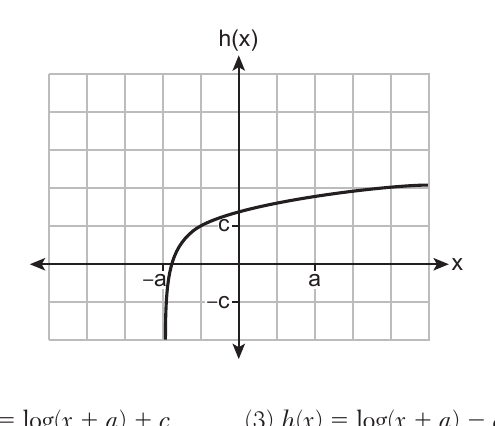
- (A) $h(x)=\log(x+a)+c$ ✓
- (B) $h(x)=\log(x-a)+c$
- (C) $h(x)=\log(x+a)-c$
- (D) $h(x)=\log(x-a)-c$
Worked solution
The graph shows a logarithmic curve with vertical asymptote at x = -a and y-intercept at c, matching a horizontal shift left by a and vertical shift up by c.
Which function has the characteristic as $x\to-\infty$, $f(x)\to-\infty$?
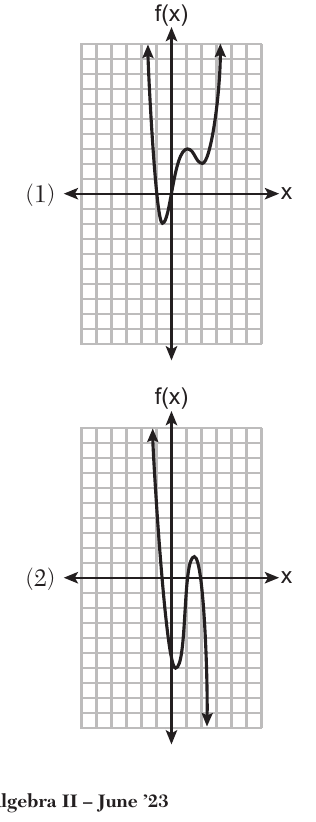
- (A) Graph (1): a polynomial-like curve shown in a grid
- (B) Graph (2): a polynomial-like curve shown in a grid
- (C) $f(x)=5(4)^{-x}$
- (D) $f(x)=-\log_5(-x)$ ✓
Worked solution
Testing the end behavior of each equation shows only the negative log function decreases without bound as x approaches negative infinity; the two graphed functions must also be checked visually for this behavior.
The expression $(x^2+3)^2-2(x^2+3)-24$ is equivalent to
- (A) $(x^2+9)(x^2-1)$
- (B) $(x^2-3)(x^2+7)$ ✓
- (C) $x^4-2x^2-21$
- (D) $x^4+4x^2-9$
Worked solution
Substituting u for the repeated quantity turns the expression into an easily factorable quadratic.
What is the solution for the system of equations below? $x+y+z=2$ $x-2y-z=-4$ $x-9y+z=-18$
- (A) $(-2,2,2)$
- (B) $(-2,-2,6)$
- (C) $(0,2,0)$ ✓
- (D) $(0,2,4)$
Worked solution
Adding and subtracting pairs of equations eliminates variables successively, giving y = 2, then x = 0, then z = 0.
The roots of the equation $x^2-4x=-13$ are
- (A) $2\pm3i$ ✓
- (B) $2\pm6i$
- (C) $2\pm\sqrt{17}$
- (D) $2\pm i\sqrt{13}$
Worked solution
Rewriting in standard form and applying the quadratic formula produces a negative discriminant, giving complex roots.
Which expression is equivalent to $\frac{2x^3+2x-7}{2x+4}$?
- (A) $x^2-2x+5-\frac{27}{2x+4}$ ✓
- (B) $x^2-1-\frac{3}{2x+4}$
- (C) $x^2+2x+5+\frac{13}{2x+4}$
- (D) $x^2+2x-3+\frac{5}{2x+4}$
Worked solution
Long division of the cubic by the linear binomial gives quotient $x^2-2x+5$ with remainder -27.
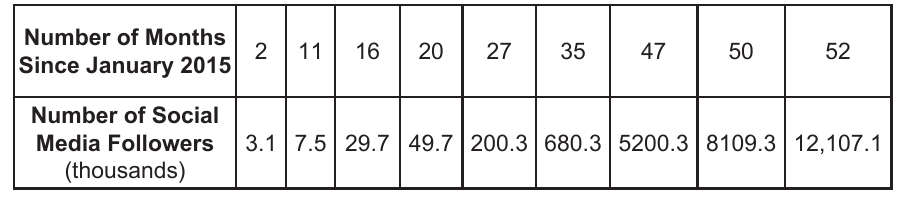
A popular celebrity tracks the number of people, in thousands, who have followed her on social media since January 1, 2015. A summary of the data she recorded is shown in the table below: | Number of Months Since January 2015 | 2 | 11 | 16 | 20 | 27 | 35 | 47 | 50 | 52 | |---|---|---|---|---|---|---|---|---|---| | Number of Social Media Followers (thousands) | 3.1 | 7.5 | 29.7 | 49.7 | 200.3 | 680.3 | 5200.3 | 8109.3 | 12,107.1 | The celebrity uses an exponential regression equation to model the data. According to the model, about how many followers did she have on June 1, 2018?
- (A) 13,000,000
- (B) 5,420,000
- (C) 1,850,000 ✓
- (D) 790,000
Worked solution
January 1, 2015 to June 1, 2018 is 36 months plus 5 more months, so x = 41. Fitting y = a times b to the x power (y in thousands) to the nine table points by regressing ln(y) against x gives a of about 1.768 and b of about 1.1848, so y(41) = 1.768 times 1.1848 to the 41st power is about 1851 thousand. Multiplying by 1000 gives approximately 1,850,000 followers, not 5,420,000, which would require x closer to 47 months.
Luminescence is the emission of light that is not caused by heat. A luminescent substance decays according to the function below. $I=I_0e^{3\left(-\frac{t}{0.6}\right)}$ This function can be best approximated by
- (A) $I=I_0e^{\left(-\frac{t}{0.18}\right)}$
- (B) $I=I_0e^{-5t}$
- (C) $I=I_0(0.0067)^t$ ✓
- (D) $I=I_0(0.0497)^{0.6t}$
Worked solution
The exponent simplifies as $3\left(-\frac{t}{0.6}\right) = -5t$, so $I = I_0 e^{-5t} = I_0(e^{-5})^t$. Since $e^{-5}$ is approximately 0.0067, the function is best approximated by $I_0(0.0067)^t$.
The heights of the students at Central High School can be modeled by a normal distribution with a mean of 68.1 and a standard deviation of 3.4 inches. According to this model, approximately what percent of the students would have a height less than 60 inches or greater than 75 inches?
- (A) 0.86%
- (B) 1.26%
- (C) 2.12%
- (D) 2.98% ✓
Worked solution
Converting both boundary heights to z-scores and finding the tail probabilities from the normal distribution, then adding them, gives the combined percent outside the range.
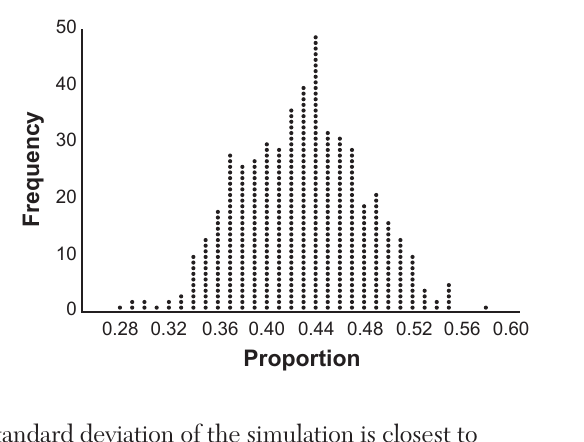
Marissa and Sydney are trying to determine if there is enough interest in their school to put on a senior musical. They randomly surveyed 100 members of the senior class and 43% of them said they would be interested in being in a senior musical. Marissa and Sydney then conducted a simulation of 500 more surveys, each of 100 seniors, assuming that 43% of the senior class would be interested in being in the musical. The output of the simulation is shown below (a dot plot of simulated sample proportions, roughly bell-shaped, centered near 0.43, spanning from about 0.28 to 0.60). The standard deviation of the simulation is closest to
- (A) 0.02
- (B) 0.05 ✓
- (C) 0.09
- (D) 0.43
Worked solution
The spread of the simulated sample proportions matches the theoretical standard deviation formula for a sample proportion, which comes out closest to 0.05.
For $f(x)=\cos x$, which statement is true?
- (A) $2f(x)$ and $f(2x)$ are even functions. ✓
- (B) $f(2x)$ and $f(x)+2$ are odd functions.
- (C) $2f(x)$ and $f\left(x+\frac{\pi}{2}\right)$ are odd functions.
- (D) $f(x)+2$ is an odd function and $f\left(x+\frac{\pi}{2}\right)$ is an even function.
Worked solution
Since cosine is an even function, scaling it by 2 or replacing x with 2x preserves evenness, making choice 1 the only true statement.
The solution set of $\frac{x+3}{x-5}+\frac{6}{x+2}=\frac{6+10x}{(x-5)(x+2)}$ is
- (A) $\{-6\}$ ✓
- (B) $\{5\}$
- (C) $\{-6,5\}$
- (D) $\{-5,6\}$
Worked solution
Clearing denominators and solving the resulting quadratic gives two candidate solutions, but x = 5 must be rejected since it makes the original denominators zero.
Given $x$ and $y$ are positive, which expressions are equivalent to $\frac{x^3}{y}$? I. $\left(\frac{y}{x^3}\right)^{-1}$ II. $\sqrt[3]{x^9}(y^{-1})$ III. $\frac{x^6\sqrt[4]{y^8}}{x^3y^3}$
- (A) I and II, only
- (B) I and III, only
- (C) II and III, only
- (D) I, II, and III ✓
Worked solution
Simplifying each expression using exponent and radical rules shows all three are algebraically equivalent to x^3 over y.
Given the inverse function $f^{-1}(x)=\frac{2}{3}x+\frac{1}{6}$, which function represents $f(x)$?
- (A) $f(x)=-\frac{2}{3}x+\frac{1}{6}$
- (B) $f(x)=-\frac{3}{2}x+\frac{1}{4}$
- (C) $f(x)=\frac{3}{2}x-\frac{1}{4}$ ✓
- (D) $f(x)=\frac{3}{2}x-\frac{1}{6}$
Worked solution
Swapping x and y in the inverse function and solving for y recovers the original function f(x).
How many equations below are identities? $x^2 + y^2 = (x^2 - y^2) + (2xy)^2$ $x^3 + y^3 = (x - y) + (x^2 - xy + y^2)$ $x^4 + y^4 = (x - y)(x - y)(x^2 + y^2)$
- (A) 1
- (B) 2
- (C) 3
- (D) 0 ✓
Worked solution
Each proposed equation is checked against the true algebraic identities (difference of squares, sum of cubes, etc.); none of the three given equations hold for all x and y, so the count of true identities is 0.
If the focus of a parabola is $(0, 6)$ and the directrix is $y = 4$, what is an equation for the parabola?
- (A) $y^2 = 4(x-5)$
- (B) $x^2 = 4(y-5)$ ✓
- (C) $y^2 = 8(x-5)$
- (D) $x^2 = 8(y-6)$
Worked solution
Since the focus lies above the directrix, the parabola opens upward with vertex halfway between them; using x^2 = 4p(y-k) with p = 1 and vertex (0,5) gives the equation.
John and Margaret deposit $500 into a savings account for their son on his first birthday. They continue to make a deposit of $500 on the child's birthday, with the last deposit being made on the child's 21st birthday. If the account pays 4% annual interest, which equation represents the amount of money in the account after the last deposit is made?
- (A) $S_{21} = 500(1.04)^{21}$
- (B) $S_{21} = \dfrac{500(1-1.04^{21})}{1-1.04}$ ✓
- (C) $S_{21} = 500(1.04)^{20} + 500$
- (D) $S_{21} = \dfrac{500(1-0.04^{21})}{1-1.04}$
Worked solution
The 21 equal deposits form a geometric series (an ordinary annuity) whose sum is given by the standard geometric series formula with ratio 1.04 and 21 terms.
The business office of a local college wishes to determine the methods of payment that will be used by students when buying books at the beginning of a semester. Explain how the office can gather an appropriate sample that minimizes bias.
Worked solution
Bias is minimized by ensuring every student in the population has an equal chance of being selected, rather than sampling only students who happen to be at the bookstore, which would exclude students using other payment/purchase methods.
Determine the solution of $\sqrt{3x+7} = x-1$ algebraically.
Worked solution
Squaring both sides produces a quadratic equation with two candidate solutions, but checking each in the original radical equation shows x = -1 is extraneous and only x = 6 satisfies the equation.
The population of bacteria, $P(t)$, in hundreds, after $t$ hours can be modeled by the function $P(t) = 37e^{0.0532t}$. Determine whether the population is increasing or decreasing over time. Explain your reasoning.
Worked solution
Because the exponent's coefficient (growth rate) k = 0.0532 is positive, the function e^{0.0532t} increases as t increases, so the bacteria population is increasing over time.
The polynomial function $g(x) = x^3 + ax^2 - 5x + 6$ has a factor of $(x-3)$. Determine the value of $a$.
Worked solution
By the Factor Theorem, if (x-3) is a factor of g(x), then g(3) must equal 0; substituting x = 3 and solving the resulting linear equation gives a = -2.
Write a recursive formula for the sequence $189, 63, 21, 7, \dots$
Worked solution
Each term is one third of the previous term, so the sequence is geometric with first term 189 and recursive rule multiplying the previous term by 1/3.
Solve algebraically for $x$ to the nearest thousandth: $2e^{0.49x} = 15$
Worked solution
Isolate the exponential term, take the natural log of both sides to bring down the exponent, then divide to solve for x, rounding the decimal result to the nearest thousandth.
For all values of $x$ for which the expression is defined, write the expression below in simplest form. $\dfrac{2x^3+x^2-18x-9}{3x-x^2}$
Worked solution
Factoring both numerator and denominator reveals a common factor of (x-3) that cancels, leaving a simplified rational expression valid wherever the original was defined (x not 0 or 3).
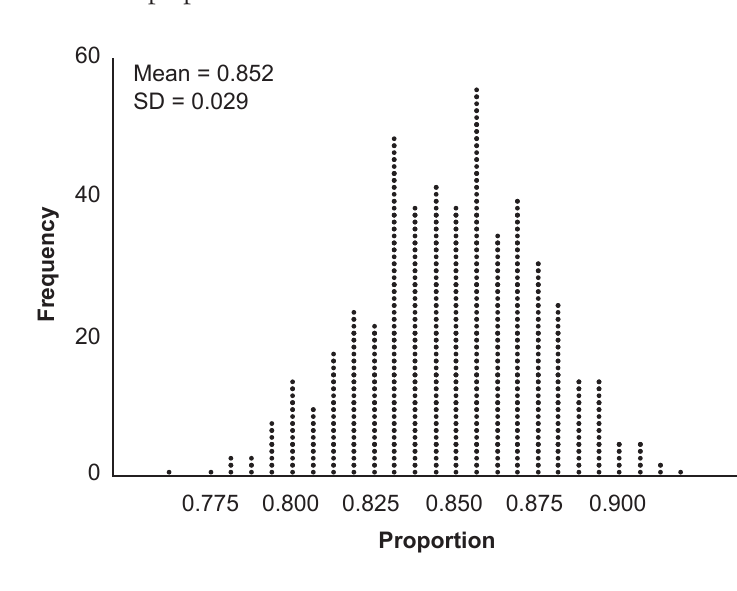
An app design company believes that the proportion of high school students who have purchased apps on their smartphones in the past 3 months is 0.85. A simulation of 500 samples of 150 students was run based on this proportion and the results are shown below (dot plot of sample proportions, Mean = 0.852, SD = 0.029, ranging roughly from 0.775 to 0.910). Suppose a sample of 150 students from your high school showed that 88% of students had purchased apps on their smartphones in the past 3 months. Based on the simulation, would the results from your high school give the app design company reason to believe their assumption is incorrect? Explain.
Worked solution
Since 0.88 falls less than one standard deviation above the simulated mean of 0.852, it is a plausible outcome under the assumption that the true proportion is 0.85, so there is not sufficient evidence to reject the company's assumption.
Patricia creates a cubic polynomial function, $p(x)$, with a leading coefficient of 1. The zeros of the function are 2, 3, and -6. Write an equation for $p(x)$. Sketch $y = p(x)$ on the set of axes provided.
Worked solution
With leading coefficient 1, the cubic is the product of (x - zero) factors for each given zero; expanding this product gives the polynomial in standard form, and its graph is a cubic crossing the x-axis at x = -6, 2, and 3.
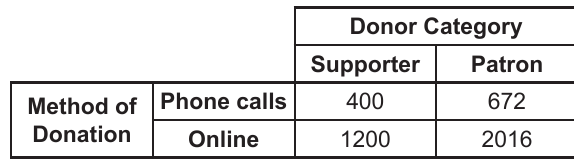
A public radio station held a fund-raiser. The table below summarizes the donor category and method of donation. | | Supporter | Patron | |---|---|---| | Phone calls | 400 | 672 | | Online | 1200 | 2016 | To the nearest thousandth, find the probability that a randomly selected donor was categorized as a supporter, given that the donation was made online. Do these data indicate that being a supporter is independent of donating online? Justify your answer.
Worked solution
The conditional probability of being a supporter given an online donation equals the overall (unconditional) probability of being a supporter, which is the defining test for independence of two events.
Algebraically solve the system: $(x-2)^2 + (y-3)^2 = 20$ and $y = -2x + 7$
Worked solution
Substituting the line equation into the circle equation reduces the system to a single quadratic in x, which factors easily because the substituted term is a multiple of (x-2); solving gives two intersection points.
On a certain tropical island, there are currently 500 palm trees and 200 flamingos. Suppose the palm tree population is decreasing at an annual rate of 3% per year and the flamingo population is growing at a continuous rate of 2% per year. Write two functions, $P(x)$ and $F(x)$, that represent the number of palm trees and flamingos on this island, respectively, $x$ years from now. State the solution to the equation $P(x) = F(x)$, rounded to the nearest year. Interpret the meaning of this value within the given context.
Worked solution
Setting the two population models equal and solving using logarithms gives the time at which the palm tree and flamingo populations are equal, about 18 years from now.
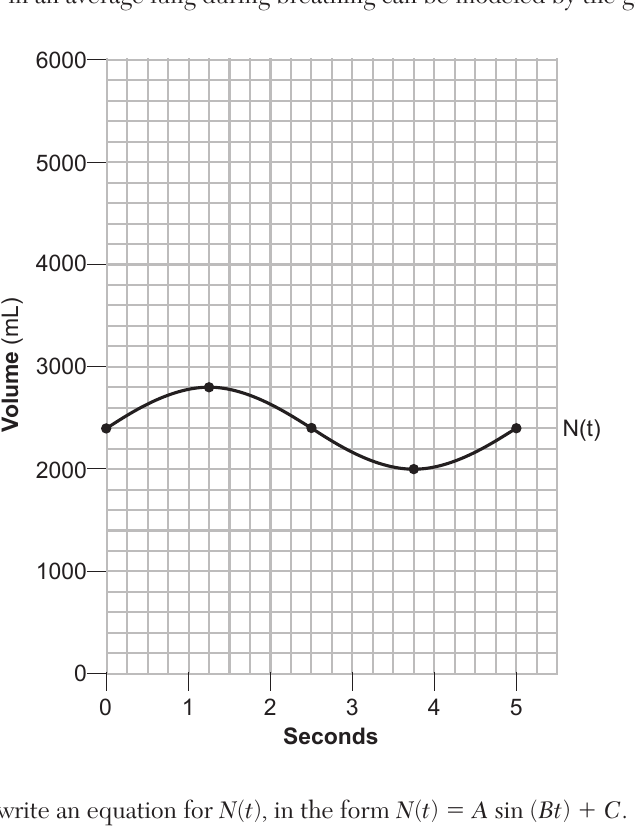
The volume of air in an average lung during breathing can be modeled by the graph below (a smooth wave-like curve N(t), with Volume in mL on the vertical axis from 0 to 6000 and Seconds on the horizontal axis from 0 to 5; the curve passes through (0, 2400), rises to a maximum of about 2800 at t = 1.25, falls back through (2.5, 2400), reaches a minimum of about 2000 at t = 3.75, and returns to (5, 2400)). Using the graph, write an equation for $N(t)$, in the form $N(t) = A\sin(Bt)+C$. That same lung, when engaged in exercise, has a volume that can be modeled by $E(t) = 2000\sin(\pi t)+3200$, where $E(t)$ is volume in mL and $t$ is time in seconds. Graph at least one cycle of $E(t)$ on the same grid as $N(t)$. How many times during the 5-second interval will $N(t)=E(t)$?
Worked solution
The resting-breathing graph is read for its midline, amplitude, and period to build the sine model N(t); comparing this to the given exercise model E(t) graphically over the 5-second window shows the two curves cross four times.