January 2025 Algebra II Regents — Answer Key & Worked Solutions
Every question from the January 2025 Algebra II Regents exam, with the correct answer and a full step-by-step solution. Check your work, learn the method, then convert your raw score.
These are real questions from the January 2025 Algebra II New York State Regents examination, published by NYSED. Worked solutions are written by RegentsLab.
The exact value of $\sin\left(\frac{8\pi}{3}\right)$ is
- (A) $\frac{1}{2}$
- (B) $-\frac{1}{2}$
- (C) $-\frac{\sqrt{3}}{2}$
- (D) $\frac{\sqrt{3}}{2}$ ✓
Worked solution
8π/3 is coterminal with 2π/3, which lies in Quadrant II where sine is positive and equal to √3/2.
A teacher randomly divides all of her students into two groups. She grades the homework for one group but does not grade the homework for the other group. All homework is returned to the students. She then compares test scores for each of the groups to see if grading homework has an effect on the test scores. This method of data collection is best described as
- (A) an experiment ✓
- (B) an unbiased survey
- (C) a simulation
- (D) an observational study
Worked solution
Since the teacher randomly assigns students to groups and imposes a treatment (grading or not grading), this is a controlled experiment, not an observational study.
Which expression is equivalent to $(x-2)^2 + 27(x-2) - 90$?
- (A) $(x+30)(x-3)$
- (B) $(x+28)(x-5)$ ✓
- (C) $(x-30)(x+3)$
- (D) $(x-2)(x+25)(x-90)$
Worked solution
Substituting u = x-2 turns the expression into a factorable quadratic in u, then resubstituting gives (x+28)(x-5).
Given the functions $f(x) = 2x + \frac{5}{2}$ and $g(x) = \frac{3}{x}$, what are the solutions to $f(x) = g(x)$?
- (A) $(0.75, 4)$ or $(-2,-1.5)$
- (B) $x = 0.75$ or $x = -2$ ✓
- (C) $y = -1.5$ or $y = 4$
- (D) $(-2, 0.75)$
Worked solution
Setting $2x + 2.5 = \frac{3}{x}$ and multiplying both sides by $x$ gives $2x^2 + 2.5x - 3 = 0$, or equivalently $4x^2 + 5x - 6 = 0$, which factors as $(4x - 3)(x + 2) = 0$, so $x = 0.75$ or $x = -2$. Since the question asks for the solutions to $f(x) = g(x)$ itself, the answer is these x-values rather than the intersection points of the two graphs.
Given $f(x) = 2x^3 - 3x^2 - 5x - 12$ and $g(x) = x - 3$, the quotient of $\frac{f(x)}{g(x)}$ is
- (A) $2x^2+3x+4$ ✓
- (B) $2x^3+3x^2+4x$
- (C) $2x^2-9x+22-\frac{78}{x-3}$
- (D) $2x^3-9x^2+22x-78$
Worked solution
Polynomial long division of f(x) by (x-3) gives an exact quotient of 2x^2+3x+4 with zero remainder.
Abby is told that each day there is a 50% chance it will rain. Which simulation can Abby perform to determine the likelihood of it raining for the next seven days?
- (A) Flip a coin seven times, count how many heads, and repeat 50 times. ✓
- (B) Roll a die seven times, count how many twos, and repeat 50 times.
- (C) Roll a pair of dice, count totals of seven, and repeat 50 times.
- (D) Flip a coin 50 times and count how many heads.
Worked solution
A fair coin flip has the same 50% probability as the daily rain chance, and seven flips model seven days; repeating the trial 50 times gives a reliable simulation.
What are the solutions to $4x^2 - 7x - 2 = -10$?
- (A) $-\frac{1}{4}, 2$
- (B) $\frac{7}{8} \pm \frac{\sqrt{79}}{8}i$ ✓
- (C) $\frac{7}{8} \pm \frac{\sqrt{241}}{8}$
- (D) $\frac{7}{8} \pm \frac{\sqrt{143}}{8}i$
Worked solution
Moving all terms to one side gives 4x^2-7x+8=0, whose discriminant is negative, producing complex solutions via the quadratic formula.
If $x-5$ is a factor of $p(x) = ax^4+bx^3+cx^2+dx+e$, then which statement must be true?
- (A) $p(-5) = 0$
- (B) $p(-5) \neq 0$
- (C) $p(5) = 0$ ✓
- (D) $p(5) \neq 0$
Worked solution
By the Factor Theorem, if x-5 divides p(x) evenly, then substituting x=5 into p(x) must yield zero.
In a small city, there are 22 gas stations. The mean price for a gallon of regular gas was $2.12 with a standard deviation of $0.05. The distribution of the data was approximately normal. Given this information, the middle 95% of the gas stations in this small city likely charge
- (A) $1.90 to $2.34 for a gallon of gas
- (B) $1.97 to $2.27 for a gallon of gas
- (C) $2.02 to $2.22 for a gallon of gas ✓
- (D) $2.07 to $2.17 for a gallon of gas
Worked solution
Under the empirical rule, about 95% of a normal distribution falls within 2 standard deviations of the mean, giving the interval $2.02 to $2.22.
The expression $\frac{4x^2-5}{x^2-1}$ is equivalent to
- (A) $4 - \frac{1}{x^2-1}$ ✓
- (B) $4 + \frac{1}{x^2-1}$
- (C) $4 - \frac{9}{x^2-1}$
- (D) $4 - \frac{4}{x^2-1}$
Worked solution
Rewriting the numerator in terms of (x^2-1) and splitting the fraction shows the expression equals 4 minus 1 over (x^2-1).
For all positive values of $x$, which expression is equivalent to $\sqrt{x} \cdot \sqrt[4]{x^{11}}$?
- (A) $x^{\frac{19}{22}}$
- (B) $x^{\frac{11}{8}}$
- (C) $x^{\frac{13}{4}}$ ✓
- (D) $x^{\frac{2}{11}}$
Worked solution
Converting both radicals to rational exponents and adding the exponents (common denominator 4) gives x^(13/4).
The expression $i^2(5x-2i)^2$ is equivalent to
- (A) $-25x^2+20xi-4$
- (B) $-25x^2+20xi+4$ ✓
- (C) $25x^2+20xi+4$
- (D) $25x^2+4$
Worked solution
Expanding the binomial square and using i^2 = -1 twice (once inside, once as the outer factor) yields -25x^2+20xi+4.
Functions $f$ and $g$ are given below. $f(x) = \frac{7}{2}x^2 - 5x + 11$ $g(x) = 3x^2 - 7x + 25$ When $2f(x)$ is subtracted from $g(x)$, the result is
- (A) $4x^2-3x-3$
- (B) $-4x^2+3x+3$ ✓
- (C) $4x^2-17x-47$
- (D) $-4x^2-17x+47$
Worked solution
Doubling f(x) and subtracting term by term from g(x) gives -4x^2+3x+3.
A manufacturer claims that the number of ounces of a beverage dispensed by one of its automatic dispensers is normally distributed with a mean of 8.0 ounces and a standard deviation of 0.04 ounces. To the nearest tenth of a percent, what percent of the cups filled by this company's dispenser will contain between 7.9 and 8.11 ounces?
- (A) 99.5
- (B) 99.4
- (C) 99.1 ✓
- (D) 97.6
Worked solution
Converting the bounds to z-scores and using the standard normal distribution gives approximately 99.1% of cups falling between 7.9 and 8.11 ounces.
What is the value of $x$ in the solution of the system of equations below? $5x+2y-z=-14$ $7y-z=31$ $5y+4z-5x=-23$
- (A) $-17$
- (B) $2$
- (C) $-\frac{1}{5}$
- (D) $-7$ ✓
Worked solution
Adding the first and third equations eliminates x, then substituting the second equation lets you solve for y, z, and finally x.
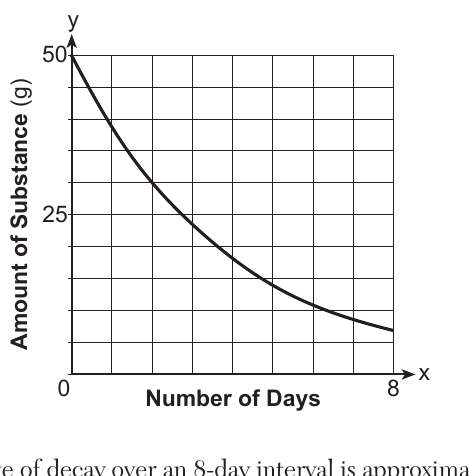
The graph below shows the amount of a radioactive substance left over time. The graph shows Amount of Substance (g) on the y-axis (labeled at 25 and 50) versus Number of Days on the x-axis (from 0 to 8), with a curve starting at (0, 50) and decaying to approximately 6 grams at x = 8. The daily rate of decay over an 8-day interval is approximately
- (A) 23% ✓
- (B) 95%
- (C) 5%
- (D) 77%
Worked solution
Reading the endpoint of the decay curve from the graph and solving the exponential decay model for the daily multiplier shows about a 23% daily decrease.
If $4(10^{5x-2}) = 12$, then $x$ equals
- (A) $\frac{2.3}{5}$
- (B) $\frac{1}{3}\left(\frac{\log 12}{\log 40}+5\right)$
- (C) $\frac{\log(3)+2}{5}$ ✓
- (D) $\frac{1}{5}\left(\frac{\log 12}{\log 4}+2\right)$
Worked solution
Dividing both sides by 4 isolates the power of 10, then taking the log base 10 of both sides and solving for x gives (log 3 + 2)/5.
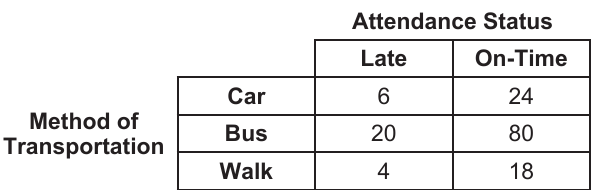
A random sample of 152 students was surveyed on a particular day about how they got to school. The survey results are summarized in the table below. Which statement is best supported by the data?
- (A) The probability of being late given that a student walked is greater than the probability that a student walked given that the student was late. ✓
- (B) The probability of being late given that a student walked is less than the probability that a student walked given that the student was late.
- (C) The probability of being late given that a student walked is equal to the probability that a student walked given that the student was late.
- (D) The probability of being late given that a student walked cannot be determined.
Worked solution
Computing both conditional probabilities from the table shows P(late given walked) ≈ 18.2% is greater than P(walked given late) ≈ 13.3%.
If $f(x) = \sqrt[3]{x} + 4$, then $f^{-1}(x)$ equals
- (A) $\sqrt[3]{x-4}$
- (B) $(x-4)^3$ ✓
- (C) $x^3+\frac{1}{4}$
- (D) $-\sqrt[3]{x}-4$
Worked solution
Swapping x and y and solving for y isolates the cube root, then cubing both sides gives the inverse function (x-4)^3.
Given the equation $S(x) = 1.7\sin(bx) + 12$, where the period of $S(x)$ is 12, what is the value of $b$?
- (A) $\frac{\pi}{6}$ ✓
- (B) $24\pi$
- (C) $\frac{\pi}{12}$
- (D) $6\pi$
Worked solution
Setting the standard sine period formula 2π/b equal to the given period of 12 and solving for b gives π/6.
Jin solved the equation $\sqrt{4-x} = x+8$ by squaring both sides. What extraneous solution did he find?
- (A) $-5$
- (B) $-12$ ✓
- (C) $3$
- (D) $4$
Worked solution
Squaring both sides introduces a solution that does not satisfy the original radical equation; here x=-12 fails to satisfy the original equation while x=-5 does.
The expression $(x^2+y^2)^2$ is not equivalent to
- (A) $(x^2-y^2)^2+(2xy)^2$
- (B) $(x+y)^4+2(xy)^2$ ✓
- (C) $x^2(x^2+2y^2)+(y^2)^2$
- (D) $(2x^2+y^2)^2-(3x^4+2x^2y^2)$
Worked solution
Expanding each choice and comparing to (x^2+y^2)^2 shows only option 2 introduces extra cross terms (4x^3y, 4xy^3) and a different coefficient on x^2y^2, so it is not equivalent.
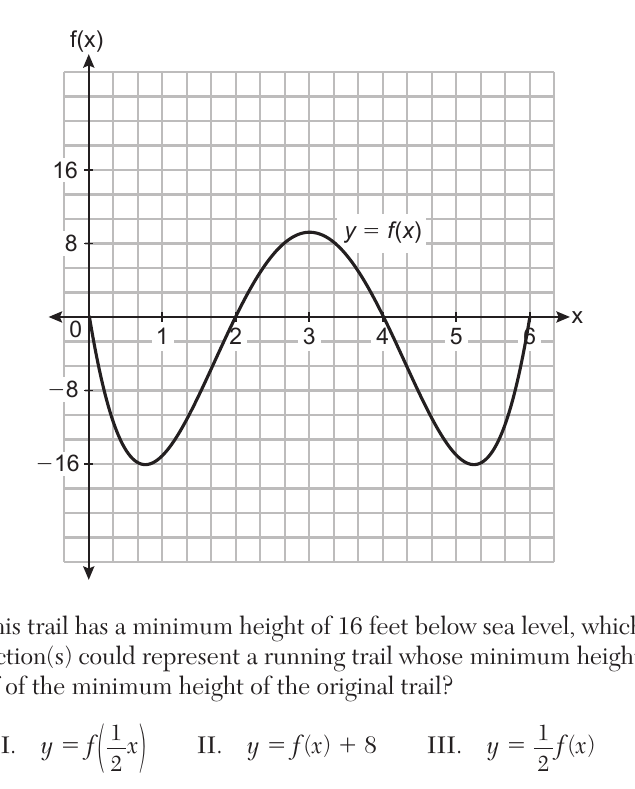
The height of a running trail is modeled by the quartic function $y=f(x)$ shown below, where $x$ is the distance in miles from the start of the trail and $y$ is the height in feet relative to sea level. If this trail has a minimum height of 16 feet below sea level, which function(s) could represent a running trail whose minimum height is half of the minimum height of the original trail? I. $y=f\left(\frac{1}{2}x\right)$ II. $y=f(x)+8$ III. $y=\frac{1}{2}f(x)$
- (A) I, only
- (B) II, only
- (C) I and III
- (D) II and III ✓
Worked solution
A horizontal stretch (I) doesn't change the minimum y-value, but shifting up 8 (II) or vertically compressing by 1/2 (III) both change the minimum from -16 to -8.
The crew aboard a small fishing boat caught 350 pounds of fish on Monday. From that Monday through the end of the week on Friday, the weight of the fish caught increased 15% per day. The total weight, in pounds, of fish caught is approximately
- (A) 411
- (B) 612
- (C) 1748
- (D) 2360 ✓
Worked solution
The catch each day forms a geometric sequence with ratio 1.15; summing the 5 days (Monday-Friday) gives the total weight of about 2360 pounds.
Describe the translations that map $f(x) = \log x$ to $g(x) = \log(x+3) - 5$.
Worked solution
Since g(x)=f(x+3)-5, the graph of f is shifted left 3 units (from the +3 inside) and down 5 units (from the -5 outside).
Solve algebraically for $x$: $\frac{1}{2x} - \frac{5}{6} = \frac{3}{x}$
Worked solution
Clearing the denominators by multiplying by 6x turns the rational equation into a linear equation that solves to x = -3, which checks in the original equation.
Given $\cos \theta = -\frac{2}{7}$ with $\theta$ in Quadrant II, find the exact value of $\sin \theta$.
Worked solution
Using the Pythagorean identity and choosing the positive root because sine is positive in Quadrant II gives sin θ = 3√5/7.
Given $a > 1$, use the properties of rational exponents to determine the value of $x$ for the equation below. $\dfrac{\sqrt[5]{a^{10}}}{(a^3)^{\frac{1}{2}}} = a^x$
Worked solution
Converting the radical to a rational exponent and applying the quotient rule for exponents gives a^(1/2), so x = 1/2.
Graph at least one cycle of $y = 5\sin(4x) - 3$ on the set of axes below.
Worked solution
The coefficient 5 sets the amplitude, the 4 inside the sine sets the period to π/2, and the -3 shifts the midline down 3, producing one full cycle between x=0 and x=π/2.
The cost of a brand-new electric-hybrid vehicle is listed at $33,400, and the average annual depreciation for the vehicle is 15%. The car's value can be modeled by the function $V(x) = 33{,}400(0.85)^x$, where $x$ represents the years since purchase. Julia and Jacob have each written a function that is equivalent to the original. Jacob's function: $V(x) = 33{,}400(0.1422)^{\frac{1}{12}x}$ Julia's function: $V(x) = 33{,}400(0.9865)^{12x}$ Whose function is correctly rewritten to reveal the approximate monthly depreciation rate? Justify your answer.
Worked solution
Since 0.85^12 ≈ 0.1422, Jacob's base is technically valid, but his exponent x/12 does not track months (months elapsed = 12x, not x/12), so his form doesn't isolate a monthly rate. Julia's exponent 12x correctly counts months, and her base 0.9865 is the monthly decay factor, so her function correctly reveals the monthly depreciation rate.
Write a recursive formula for the sequence 8, 20, 50, 125, 312.5,...
Worked solution
The sequence is geometric with a common ratio of 2.5, so the recursive rule multiplies the previous term by 2.5, starting from a1 = 8.
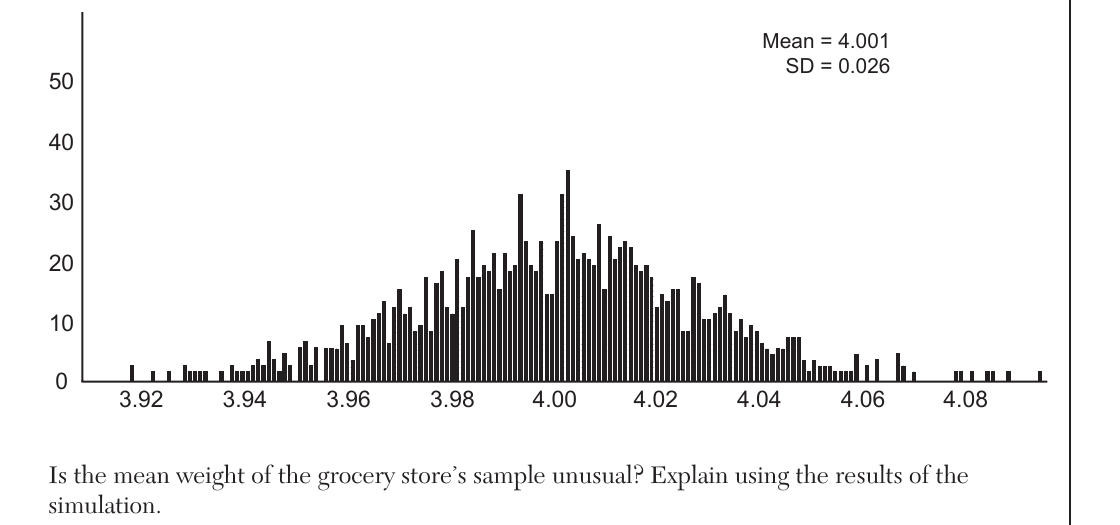
A grocery store orders 50 bags of oranges from a company's distribution center. The bags have a mean weight of 3.85 pounds per bag. The company claims that their bags of oranges have a mean weight of 4 pounds. The grocery store ran a simulation of 50 bags, 2500 times, assuming a mean of 4 pounds. The results are summarized in a histogram of sample means ranging from about 3.90 to 4.08 pounds, labeled Mean = 4.001, SD = 0.026. Is the mean weight of the grocery store's sample unusual? Explain using the results of the simulation.
Worked solution
The simulated sampling distribution has a mean of about 4.001 and SD of 0.026, and it visually spans only about 3.90 to 4.08; the store's sample mean of 3.85 is roughly 5.8 standard deviations below the simulated mean and falls entirely outside the simulated range, so it is unusual (very unlikely under the company's claim).
At the Lakeside Resort, the probability that a guest room has a view of the lake is 0.24. The probability that a guest room has a queen-size bed is 0.74. Let A be the event that the guest room has a view of the lake, and let B be the event that the guest room has a queen-size bed. Events A and B are found to be independent of each other. Determine the exact probability that a randomly selected guest room has a view of the lake and a queen-size bed. Determine the exact probability that a randomly selected guest room has a view of the lake or a queen-size bed.
Worked solution
For independent events, the probability of both occurring is the product of their individual probabilities, and the probability of either occurring uses the addition rule subtracting the overlap.
Which function has a greater average rate of change on the interval $[-1,4]$? Justify your answer. Function m is given by the table: x = -2,-1,0,1,2,3,4,5 with m(x) = -3,1,1,3,13,37,81,151, respectively. Function p is given by $p(x) = 3^x+1$.
Worked solution
Computing (f(4)-f(-1))/5 for each function shows p(x)=3^x+1 changes slightly faster on average (≈16.13) than m(x) (=16) over the interval [-1,4].
Determine an equation for the parabola with focus $(-2, 4)$ and directrix $y = 10$. (The use of the grid below is optional.)
Worked solution
The vertex lies halfway between the focus and directrix at (-2,7); since the focus is below the vertex, the parabola opens downward with 4p = -12, giving (x+2)^2 = -12(y-7).
Algebraically find the zeros of $c(x) = x^3+2x^2-16x-32$. On the axes below, sketch $y=c(x)$.
Worked solution
Factoring by grouping reveals the common factor (x+2), and factoring the resulting difference of squares gives the three zeros -4, -2, and 4; the graph is a standard cubic crossing the x-axis at these three points, falling to the left and rising to the right.
The populations of honeybees in two different colonies are studied for four months. During this time, the colony population can be approximated by $P(t) = P_0 e^{rt}$, where $P(t)$ is the colony population of bees at $t$ months, $P_0$ is the initial population, and $r$ is the growth rate. Colony A has an initial population of 10,000 bees and a continuous growth rate of 0.25. Colony B has an initial population of 6000 bees and a continuous growth rate of 0.45. Write functions for both $A(t)$ and $B(t)$ that model the honeybee populations of the colonies after $t$ months. Graph $A(t)$ and $B(t)$ for $0 \le t \le 4$. State, to the nearest tenth of a month, when the colonies will have the same population. Determine algebraically how long it will take, to the nearest tenth of a month, for the population in Colony A to triple.
Worked solution
Substituting the given initial populations and rates gives the two exponential models; setting them equal and solving with logarithms gives the time they match population, and solving A(t)=3(10,000) gives the tripling time.