June 2024 Algebra I Regents — Answer Key & Worked Solutions
Every question from the June 2024 Algebra I Regents exam, with the correct answer and a full step-by-step solution. Check your work, learn the method, then convert your raw score.
These are real questions from the June 2024 Algebra I New York State Regents examination, published by NYSED. Worked solutions are written by RegentsLab.
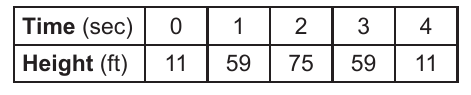
A ball was launched into the air, and its height above the ground was recorded each second, as shown in the table below. | Time (sec) | 0 | 1 | 2 | 3 | 4 | |---|---|---|---|---|---| | Height (ft) | 11 | 59 | 75 | 59 | 11 | Based on these data, which statement is a valid conclusion?
- (A) The ball lands on the ground at 4 seconds.
- (B) The ball reaches a maximum height of 11 feet.
- (C) The ball was launched from a height of 0 feet.
- (D) The ball reaches its maximum height at 2 seconds. ✓
Worked solution
The height values rise to a peak of 75 ft at t = 2 seconds and then mirror themselves going back down, showing the maximum occurs at t = 2.
A tour bus can seat, at most, 48 passengers. An adult ticket costs $18 and a child ticket costs $12. The bus company must collect at least $650 to make a profit. If $a$ represents the number of adult tickets sold and $c$ represents the number of child tickets sold, which system of inequalities models this situation if they make a profit?
- (A) $a + c < 48$ $18a + 12c > 650$
- (B) $a + c \le 48$ $18a + 12c \ge 650$ ✓
- (C) $a + c < 48$ $18a + 12c < 650$
- (D) $a + c \le 48$ $18a + 12c \le 650$
Worked solution
"At most" translates to $\le$, and "at least" translates to $\ge$, giving the system $a+c \le 48$ and $18a+12c \ge 650$.
Which equation is always true?
- (A) $x^2 \cdot x^3 = x^5$ ✓
- (B) $3^x \cdot 3^2 = 9^{2x}$
- (C) $-z^2 = z^2$
- (D) $7^a \cdot 7^b = 7^{ab}$
Worked solution
By the product of powers rule, $x^2 \cdot x^3 = x^{2+3} = x^5$ for all values of $x$, so it is always true; the others fail for at least some values.
The expression $-2(x^2 - 2x + 1) + (3x^2 + 3x - 5)$ is equivalent to
- (A) $x^2 + x - 4$
- (B) $x^2 - x - 7$
- (C) $x^2 + 7x - 4$
- (D) $x^2 + 7x - 7$ ✓
Worked solution
Distributing the $-2$ and combining like terms with the second polynomial gives $x^2 + 7x - 7$.
Which sum is irrational?
- (A) $-2\sqrt{12} + \sqrt{100}$ ✓
- (B) $-\sqrt{4} + \frac{1}{3}\sqrt{900}$
- (C) $\frac{1}{2}\sqrt{25} + \sqrt{64}$
- (D) $\sqrt{49} + 3\sqrt{121}$
Worked solution
Only the first expression simplifies to a rational number plus an irrational multiple of $\sqrt3$, so its sum is irrational; the rest simplify fully to rational numbers.
The solution to $\frac{4(x-5)}{3} + 2 = 14$ is
- (A) 15
- (B) 14 ✓
- (C) 6
- (D) 4
Worked solution
Subtracting 2 then multiplying by 3 and dividing by 4 isolates $x$, giving $x=14$.
On an island, a rare breed of rabbit doubled its population each month for two years. Which type of function best models the increase in population at the end of two years?
- (A) linear growth
- (B) linear decay
- (C) exponential growth ✓
- (D) exponential decay
Worked solution
A quantity that doubles every fixed time period grows by a constant multiplicative factor, which is exponential growth, not linear change.
What is the degree of the polynomial $2x - x^2 + 4x^3$?
- (A) 1
- (B) 2
- (C) 3 ✓
- (D) 4
Worked solution
The highest power of $x$ in the polynomial is $x^3$, so the degree is 3.
The zeros of the function $f(x) = x(x-5)(3x+6)$ are
- (A) 0, $-5$, and 2
- (B) 0, 5, and $-2$ ✓
- (C) $-5$ and 2, only
- (D) 5 and $-2$, only
Worked solution
Setting each factor equal to zero gives the three zeros $x=0$, $x=5$, and $x=-2$.
What is the $y$-intercept of the line that passes through the points $(-1,5)$ and $(2,-1)$?
- (A) $-1$
- (B) $-2$
- (C) 3 ✓
- (D) 5
Worked solution
Finding the slope between the two points and using point-slope form gives the line $y=-2x+3$, whose $y$-intercept is 3.
Nancy has just been hired for her first job. Her company gives her four choices for how she can collect her annual salary over the first eight years of employment. Each function below represents the four choices she has for her annual salary in thousands of dollars, where $t$ represents the number of years after she is hired. $a(t) = 2^t + 25$ $b(t) = 10t + 75$ $c(t) = \sqrt{400t} + 80$ $d(t) = 2(t+1)^2 - 10t + 50$ Which pay plan should Nancy choose in order to have the highest salary in her eighth year?
- (A) $a(t)$ ✓
- (B) $b(t)$
- (C) $c(t)$
- (D) $d(t)$
Worked solution
Evaluating all four functions at $t=8$ shows $a(t)$ gives by far the highest value (281), because exponential growth eventually outpaces linear, square-root, and quadratic-linear combinations.
The third term in a sequence is 25 and the fifth term is 625. Which number could be the common ratio of the sequence?
- (A) $\frac{1}{5}$
- (B) 5 ✓
- (C) $\frac{1}{25}$
- (D) 25
Worked solution
Since two terms apart in a geometric sequence differ by a factor of $r^2$, solving $625=25r^2$ gives $r^2=25$, so $r=5$ matches one of the given choices.
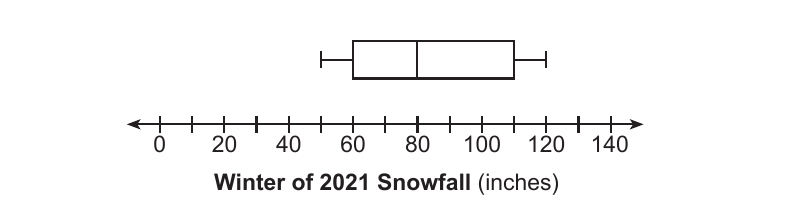
The box plot below summarizes the data for the amount of snowfall, in inches, during the winter of 2021 for 12 locations in western New York. What is the interquartile range?
- (A) 30
- (B) 50 ✓
- (C) 80
- (D) 110
Worked solution
Reading the left and right edges of the box (the first and third quartiles) off the box plot and subtracting gives an interquartile range of 50 inches.
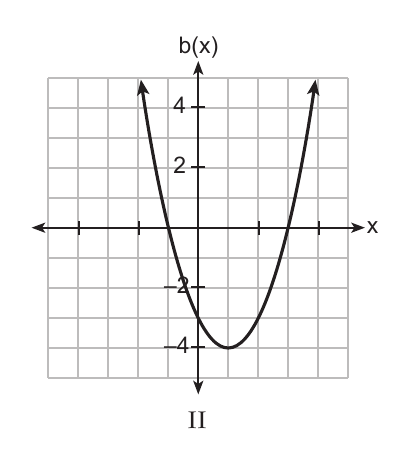
Four quadratic functions are represented below. I: $a(x) = (x-3)^2 - 7$ II: the graph of $b(x)$ III: $c(x) = x^2 + 6x + 3$ IV: a table of values for $d(x)$: | x | $d(x)$ | |---|---| | $-4$ | $-1$ | | $-3$ | $-4$ | | $-2$ | $-5$ | | $-1$ | $-4$ | | 0 | $-1$ | Which function has the smallest minimum value?
- (A) I ✓
- (B) II
- (C) III
- (D) IV
Worked solution
Function I has a minimum value of $-7$, which is lower than the minima of $-6$ (III), $-5$ (IV), and the minimum visible on the graph of $b(x)$ (II), so I has the smallest minimum.
The equation that represents the sequence $-2, -5, -8, -11, -14, \ldots$ is
- (A) $a_n = -3 + (-2)(n-1)$
- (B) $a_n = -2 + (-3)(n-1)$ ✓
- (C) $a_n = 3 + (-2)(n-1)$
- (D) $a_n = -2 + (3)(n-1)$
Worked solution
The sequence decreases by 3 each term with a first term of $-2$, so the explicit formula is $a_n = -2 + (-3)(n-1)$.
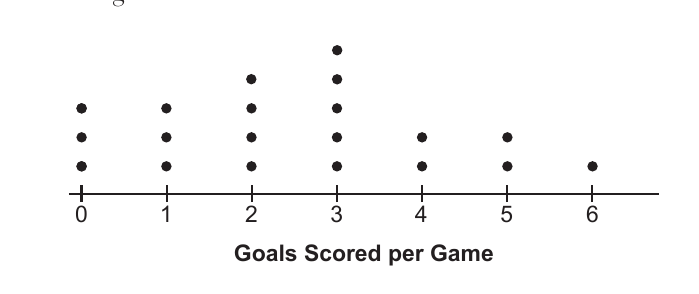
The dot plot below shows the number of goals Jessica scored in each lacrosse game last season. Which statement about the dot plot is correct?
- (A) mean > mode
- (B) mean = median ✓
- (C) mode = median
- (D) median > mean
Worked solution
Using the frequencies shown in the dot plot, the mean number of goals per game turns out equal to the median number of goals per game.
The students in Mrs. Smith's algebra class were asked to describe the graph of $g(x) = 2(x-3)^2$ compared to the graph of $f(x) = x^2$. Which student response is correct?
- (A) Ashley said that the graph of $g(x)$ is wider and shifted left 3 units.
- (B) Beth said that the graph of $g(x)$ is narrower and shifted left 3 units.
- (C) Carl said that the graph of $g(x)$ is wider and shifted right 3 units.
- (D) Don said that the graph of $g(x)$ is narrower and shifted right 3 units. ✓
Worked solution
A leading coefficient greater than 1 vertically stretches (narrows) the parabola, and $(x-3)$ shifts the graph 3 units to the right, matching Don's description.
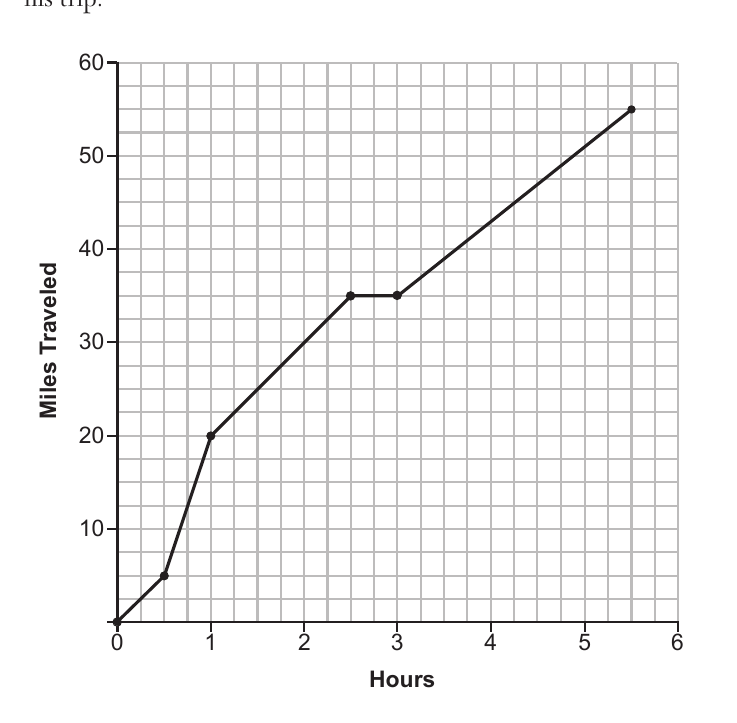
One Saturday, Dave took a long bike ride. The graph below models his trip, plotting Miles Traveled versus Hours. What was Dave's average rate of change, in miles per hour, on this trip?
- (A) 10 ✓
- (B) 11
- (C) 11.6
- (D) 14.5
Worked solution
The overall average rate of change is total distance divided by total time, from the start point (0,0) to the end point (5.5, 55), giving 10 miles per hour.
Which expression is equivalent to $(x-5)(2x+7) - (x+5)$?
- (A) $2x^2 - 2x - 30$
- (B) $2x^2 - 2x - 40$
- (C) $2x^2 - 4x - 30$
- (D) $2x^2 - 4x - 40$ ✓
Worked solution
Expanding the product and then subtracting $(x+5)$, combining like terms, gives $2x^2-4x-40$.
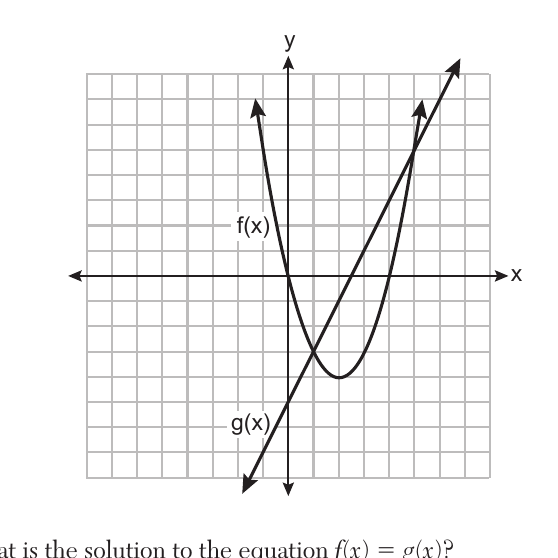
The functions $f(x)$ and $g(x)$ are graphed on the set of axes below. What is the solution to the equation $f(x) = g(x)$?
- (A) 1 and 5 ✓
- (B) $-5$ and 0
- (C) $-3$ and 5
- (D) 0 and 4
Worked solution
The solutions to $f(x)=g(x)$ occur exactly where the two graphs intersect, which the graph shows happening at $x=1$ and $x=5$.
When babysitting, Nicole charges an hourly rate and an additional charge for gas. She uses the function $C(h) = 6h + 5$ to determine how much to charge for babysitting. The constant term of this function represents
- (A) the additional charge for gas ✓
- (B) the hourly rate Nicole charges
- (C) the number of hours Nicole babysits
- (D) the total Nicole earns from babysitting
Worked solution
In a linear function of the form (rate)(h) + constant, the constant term is the value added regardless of the input, here representing the fixed gas charge.
When solved for $x$ in terms of $a$, the solution to the equation $3x - 7 = ax + 5$ is
- (A) $\frac{12}{3a}$
- (B) $\frac{12}{3-a}$ ✓
- (C) $\frac{3a}{12}$
- (D) $\frac{3-a}{12}$
Worked solution
Collect the x-terms on one side and constants on the other, then factor out x and divide.
Wayde van Niekerk, a runner from South Africa, ran 400 meters in 43.03 seconds to set a world record. Which calculation would determine his average speed, in miles per hour?
- (A) $\frac{400\text{ m}}{43.03\text{ sec}} \cdot \frac{1000\text{ m}}{0.62\text{ mi}} \cdot \frac{1\text{ hr}}{3600\text{ sec}}$
- (B) $\frac{400\text{ m}}{43.03\text{ sec}} \cdot \frac{0.62\text{ mi}}{1000\text{ m}} \cdot \frac{1\text{ hr}}{3600\text{ sec}}$
- (C) $\frac{400\text{ m}}{43.03\text{ sec}} \cdot \frac{0.62\text{ mi}}{1000\text{ m}} \cdot \frac{3600\text{ sec}}{1\text{ hr}}$ ✓
- (D) $\frac{400\text{ m}}{43.03\text{ sec}} \cdot \frac{1000\text{ m}}{0.62\text{ mi}} \cdot \frac{3600\text{ sec}}{1\text{ hr}}$
Worked solution
Correct dimensional analysis requires each conversion factor to cancel the unwanted unit; only choice 3 cancels both meters and seconds correctly, leaving miles per hour.
Which function has a domain of all real numbers and a range greater than or equal to three?
- (A) $f(x) = -x + 3$
- (B) $g(x) = x^2 + 3$ ✓
- (C) $h(x) = 3^x$
- (D) $m(x) = |x + 3|$
Worked solution
Since $x^2 \ge 0$ for every real number, adding 3 shifts the minimum value to exactly 3, giving domain all reals and range $[3,\infty)$; the other functions either have restricted domain/range or a minimum below 3.
Solve $5(x - 2) \le 3x + 20$ algebraically.
Worked solution
Distribute, collect variable terms on one side and constants on the other, then divide by a positive coefficient (no flip of inequality needed).
Given $g(x) = x^3 + 2x^2 - x$, evaluate $g(-3)$.
Worked solution
Substitute $x = -3$ into each term of the function and simplify carefully, paying attention to signs.
Given the relation $R = \{(-1,1), (0,3), (-2,-4), (x,5)\}$. State a value for $x$ that will make this relation a function. Explain why your answer makes this a function.
Worked solution
A relation is a function only if no x-value repeats with a different y-value. Since -1, 0, and -2 are already used as x-values, choosing any other value for x (such as 1) ensures every x-value maps to exactly one y-value, making R a function.
A survey of 150 students was taken. It was determined that $\frac{2}{3}$ of the students play video games. Of the students that play video games, 85 also use social media. Of the students that do not play video games, 20% do not use social media. Complete the two-way frequency table. | | Play Video Games | Do Not Play Video Games | Total | |---|---|---|---| | Social Media | | | | | No Social Media | | | | | Total | | | |
Worked solution
Use the given fraction and percent to find the four interior cells of the table, then sum rows and columns to get the totals, which should reconcile to 150.
Use the method of completing the square to determine the exact values of $x$ for the equation $x^2 + 10x - 30 = 0$.
Worked solution
Move the constant to the right side, add the square of half the linear coefficient to both sides to complete the square, then take the square root of both sides.
Factor $20x^3 - 45x$ completely.
Worked solution
First factor out the greatest common factor, $5x$, then recognize the remaining binomial as a difference of squares and factor it completely.
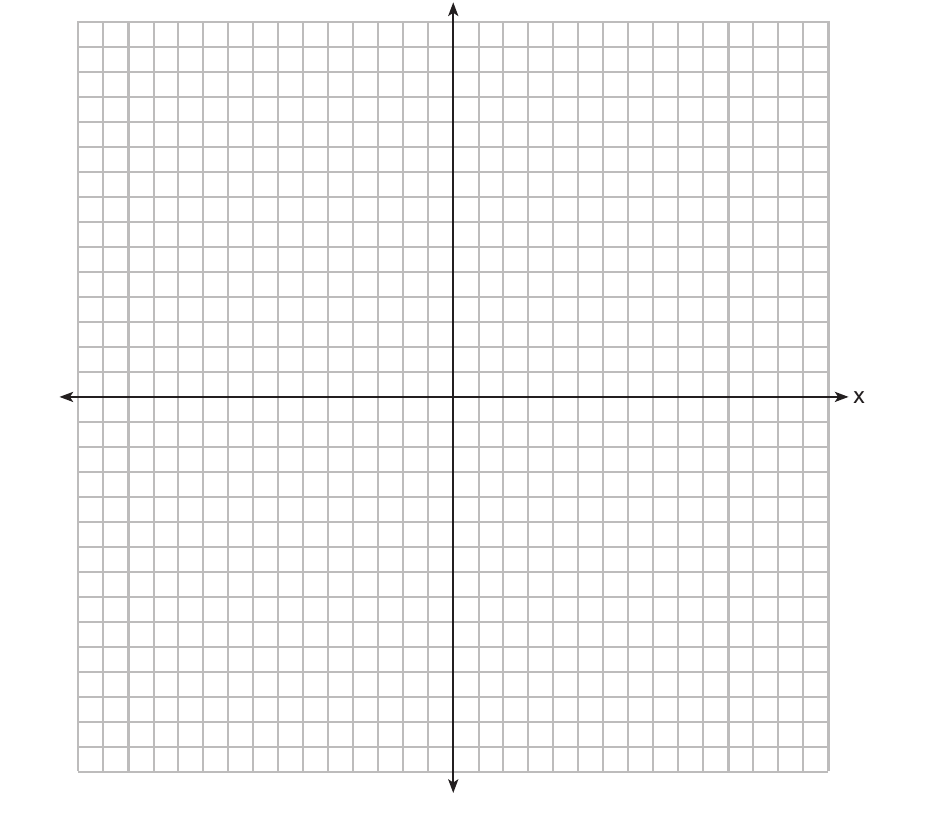
Graph the following system of equations on the set of axes below. $y = x^2 - 3x - 6$ $y = x - 1$ State the coordinates of all solutions.
Worked solution
Set the two expressions for y equal to find the x-coordinates of intersection, factor the resulting quadratic, then substitute back into the linear equation to get the corresponding y-values; graphing on the grid should show the parabola and line crossing at these two points.
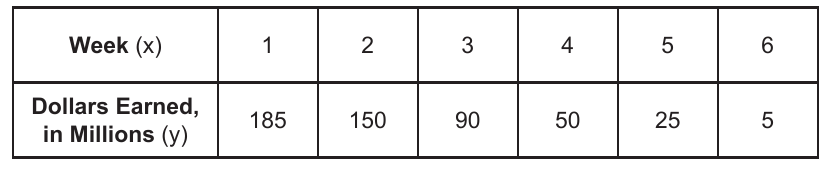
The table below shows the amount of money a popular movie earned, in millions of dollars, during its first six weeks in theaters. | Week (x) | 1 | 2 | 3 | 4 | 5 | 6 | |---|---|---|---|---|---|---| | Dollars Earned, in Millions (y) | 185 | 150 | 90 | 50 | 25 | 5 | Write the linear regression equation for this data set, rounding all values to the nearest hundredth. State the correlation coefficient to the nearest hundredth. State what this correlation coefficient indicates about the linear fit of the data.
Worked solution
Using least-squares regression on the six data points gives a strongly negative slope, and the correlation coefficient close to -1 shows the earnings decreased consistently and nearly linearly week to week, meaning the linear model is a very good fit.
Use the quadratic formula to solve the equation $3x^2 - 10x + 5 = 0$. Express the answer in simplest radical form.
Worked solution
Substitute the coefficients into the quadratic formula, simplify the radical $\sqrt{40} = 2\sqrt{10}$, and reduce the fraction to simplest radical form.
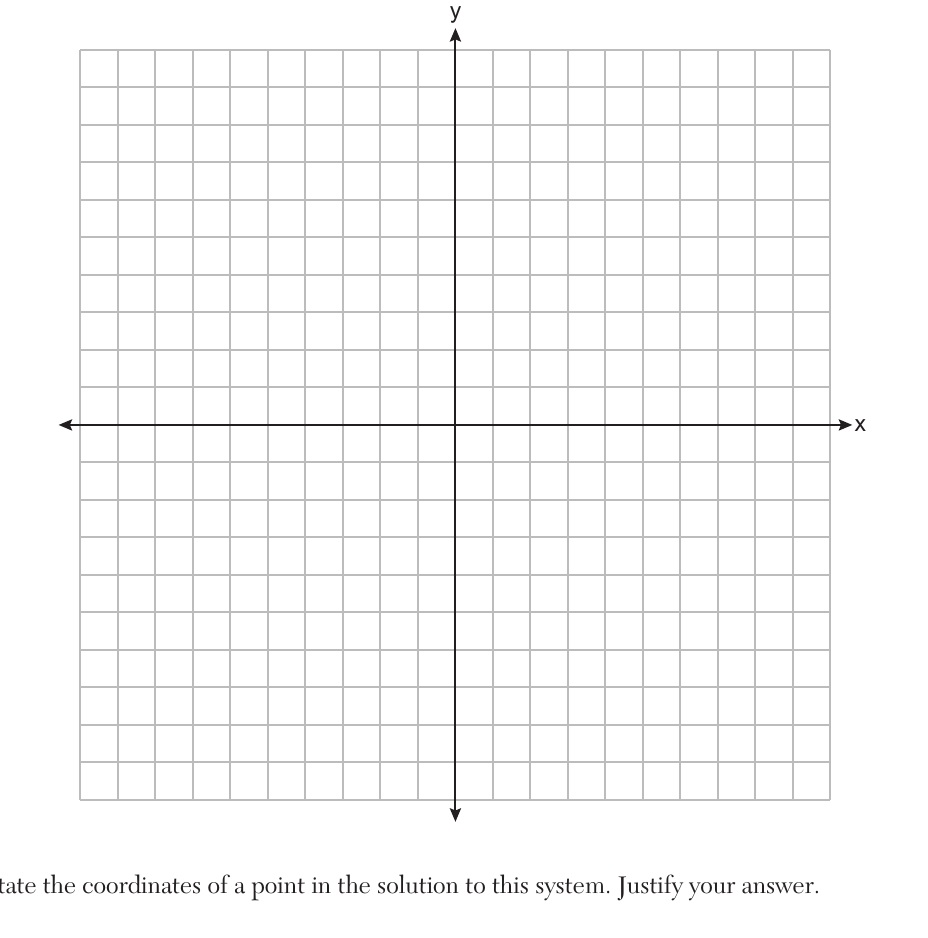
Graph the system of inequalities on the set of axes below. $3y + 2x \le 15$ $y - x > 1$ State the coordinates of a point in the solution to this system. Justify your answer.
Worked solution
Any point lying in the overlap of both shaded regions works; substituting (0,2) into both inequalities shows both are satisfied, confirming it is a valid solution, and graphing both boundary lines with correct shading (solid line and shading below/on for the first, dashed line and shading above for the second) shows the overlapping region.
Courtney went to a coffee shop to purchase lattes and donuts for her friends. One day she spent a total of $15.50 on four lattes and two donuts. The next day she spent a total of $18.10 on three lattes and five donuts. All prices included tax. If $x$ represents the cost of one latte and $y$ represents the cost of one donut, write a system of equations that can be used to model this situation. Courtney thinks that one latte costs $2.75 and one donut costs $2.25. Is Courtney correct? Justify your answer. Use your equations to determine algebraically the exact cost of one latte and the exact cost of one donut.
Worked solution
Translate the two purchase scenarios into a linear system, test Courtney's guessed values in both equations (they satisfy only one, so she is wrong), then solve the system by elimination to find the exact latte and donut prices.