June 2023 Algebra I Regents — Answer Key & Worked Solutions
Every question from the June 2023 Algebra I Regents exam, with the correct answer and a full step-by-step solution. Check your work, learn the method, then convert your raw score.
These are real questions from the June 2023 Algebra I New York State Regents examination, published by NYSED. Worked solutions are written by RegentsLab.
The expression $9m^2 - 100$ is equivalent to
- (A) $(3m-10)(3m+10)$ ✓
- (B) $(3m-10)(3m-10)$
- (C) $(3m-50)(3m+50)$
- (D) $(3m-50)(3m-50)$
Worked solution
This is a difference of squares, $a^2-b^2=(a-b)(a+b)$, with $a=3m$ and $b=10$.
Which expression represents an irrational number?
- (A) $\sqrt{16}+\sqrt{1}$
- (B) $\sqrt{25}+\sqrt{4}$
- (C) $\sqrt{36}+\sqrt{7}$ ✓
- (D) $\sqrt{49}+\sqrt{9}$
Worked solution
All choices except this one simplify to sums of two perfect square roots, which are rational. Here $\sqrt{7}$ is irrational, so the sum is irrational.
Which linear equation represents a line that passes through the point $(-3,-8)$?
- (A) $y=2x-2$ ✓
- (B) $y=2x-8$
- (C) $y=2x+13$
- (D) $y=2x-14$
Worked solution
Substitute $x=-3$ into each equation; only $y=2x-2$ gives $y=-8$, matching the given point.
The expression $(5x^2-x+4)-3(x^2-x-2)$ is equivalent to
- (A) $2x^2-2x+2$
- (B) $2x^2+2x+10$ ✓
- (C) $2x^4-2x^2+2$
- (D) $2x^4-2x^2+10$
Worked solution
Distribute the $-3$ across the second parenthesis, then combine like terms.
The $24^{\text{th}}$ term of the sequence $-5,-11,-17,-23,\ldots$ is
- (A) $-149$
- (B) $-143$ ✓
- (C) $133$
- (D) $139$
Worked solution
This is an arithmetic sequence with first term $-5$ and common difference $-6$; use $a_n=a_1+(n-1)d$.
When completing the square for $x^2-18x+77=0$, which equation is a correct step in this process?
- (A) $(x-9)^2=4$ ✓
- (B) $(x-3)^2=2$
- (C) $x=\pm13$
- (D) $x-9=\pm9$
Worked solution
Move the constant, then add the square of half the linear coefficient, $81$, to both sides to complete the square.
Which function will have the greatest value when $x > 1$?
- (A) $g(x)=2(5)^x$ ✓
- (B) $f(x)=2x+5$
- (C) $h(x)=2x^2+5$
- (D) $k(x)=2x^3+5$
Worked solution
An exponential function with base greater than 1 eventually grows faster than any linear, quadratic, or cubic function, and it already exceeds them for $x>1$.
Mike uses the equation $b=1300(2.65)^x$ to determine the growth of bacteria in a laboratory setting. The exponent represents
- (A) the total number of bacteria currently present
- (B) the percent at which the bacteria are growing
- (C) the initial amount of bacteria
- (D) the number of time periods ✓
Worked solution
In an exponential growth model $b=a(r)^x$, the exponent $x$ counts the number of time periods that have elapsed.
A company ships an average of 30,000 items each week. The approximate number of items shipped each minute is calculated using the conversion
- (A) $\dfrac{30{,}000\text{ items}}{1\text{ week}}\cdot\dfrac{7\text{ days}}{1\text{ week}}\cdot\dfrac{60\text{ min}}{1\text{ hr}}\cdot\dfrac{1\text{ day}}{24\text{ hrs}}$
- (B) $\dfrac{30{,}000\text{ items}}{1\text{ week}}\cdot\dfrac{1\text{ week}}{7\text{ days}}\cdot\dfrac{1\text{ day}}{24\text{ hrs}}\cdot\dfrac{1\text{ hr}}{60\text{ min}}$ ✓
- (C) $\dfrac{1\text{ week}}{30{,}000\text{ items}}\cdot\dfrac{1\text{ week}}{7\text{ days}}\cdot\dfrac{1\text{ day}}{24\text{ hrs}}\cdot\dfrac{1\text{ hr}}{60\text{ min}}$
- (D) $\dfrac{1\text{ week}}{30{,}000\text{ items}}\cdot\dfrac{7\text{ days}}{1\text{ week}}\cdot\dfrac{24\text{ hrs}}{1\text{ day}}\cdot\dfrac{60\text{ min}}{1\text{ hr}}$
Worked solution
Only choice (2) is set up so the units cancel correctly (week, then day, then hour), leaving items per minute; it gives 30,000 / (7 x 24 x 60) which is about 2.98 items per minute.
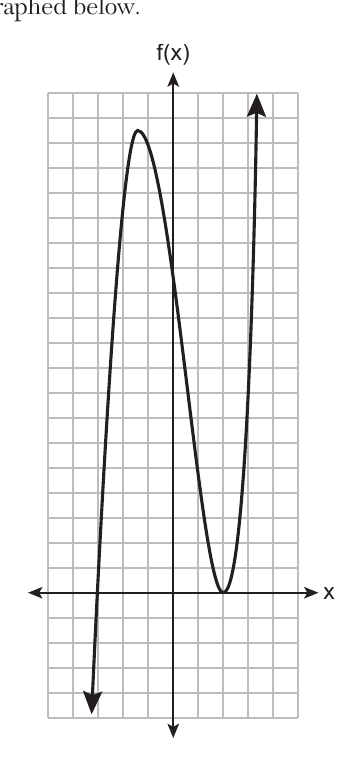
A function is graphed below. A possible equation for this function is
- (A) $f(x)=(x+2)(x-3)$
- (B) $f(x)=(x-2)(x+3)$
- (C) $f(x)=(x-2)^2(x+3)$ ✓
- (D) $f(x)=(x-2)(x+3)(x-12)$
Worked solution
The graph shows end behavior and root pattern of a cubic function with a repeated (tangent) zero at $x=2$ and a simple zero at $x=-3$, matching $(x-2)^2(x+3)$.
If $g(x)=-x^2-x+5$, then $g(-4)$ is equal to
- (A) $-15$
- (B) $-7$ ✓
- (C) $17$
- (D) $25$
Worked solution
Substitute $-4$ for $x$ and simplify using order of operations.
A movie theater's popcorn box is a rectangular prism with a base that measures 6 inches by 4 inches and has a height of 8 inches. To create a larger box, both the length and the width will be increased by $x$ inches. The height will remain the same. Which function represents the volume, $V(x)$, of the larger box?
- (A) $V(x)=(6+x)(4+x)(8+x)$
- (B) $V(x)=(6+x)(4+x)(8)$ ✓
- (C) $V(x)=(6+x)+(4+x)+(8+x)$
- (D) $V(x)=(6+x)+(4+x)+(8)$
Worked solution
Volume of a rectangular prism is length times width times height; only the length and width get the $+x$, and the height stays 8.
The expression $300(4)^{x+3}$ is equivalent to
- (A) $300(4)^x(4)^3$ ✓
- (B) $300(4^x)^3$
- (C) $300(4)^x+300(4)^3$
- (D) $300^x(4)^3$
Worked solution
By the product rule for exponents, $a^{m+n}=a^m\cdot a^n$, so $4^{x+3}=4^x\cdot4^3$.
Ashley only has 7 quarters and some dimes in her purse. She needs at least \$3.00 to pay for lunch. Which inequality could be used to determine the number of dimes, $d$, she needs in her purse to be able to pay for lunch?
- (A) $1.75+d\ge 3.00$
- (B) $1.75+0.10d\ge 3.00$ ✓
- (C) $1.75+d\le 3.00$
- (D) $1.75+0.10d\le 3.00$
Worked solution
Seven quarters equal \$1.75, each dime adds \$0.10, and "at least" means the total must be greater than or equal to \$3.00.
The formula for the area of a trapezoid is $A=\frac{1}{2}(b_1+b_2)h$. The height, $h$, of the trapezoid may be expressed as
- (A) $2A-b_1-b_2$
- (B) $\dfrac{2A-b_1}{b_2}$
- (C) $\dfrac{1}{2}A-b_1-b_2$
- (D) $\dfrac{2A}{b_1+b_2}$ ✓
Worked solution
Multiply both sides by 2 to clear the fraction, then divide by $(b_1+b_2)$ to isolate $h$.
The function $f(x)=|x|$ is multiplied by $k$ to create the new function $g(x)=k|x|$. Which statement is true about the graphs of $f(x)$ and $g(x)$ if $k=\frac{1}{2}$?
- (A) $g(x)$ is a reflection of $f(x)$ over the $y$-axis.
- (B) $g(x)$ is a reflection of $f(x)$ over the $x$-axis.
- (C) $g(x)$ is wider than $f(x)$. ✓
- (D) $g(x)$ is narrower than $f(x)$.
Worked solution
Since $0<k<1$, the graph is vertically compressed compared to $f(x)=|x|$, which makes it appear wider.
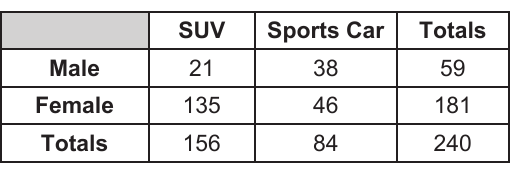
Some adults were surveyed to find out if they would prefer to buy a sports utility vehicle (SUV) or a sports car. The results of the survey are summarized in the table below. | | SUV | Sports Car | Totals | |---|---|---|---| | Male | 21 | 38 | 59 | | Female | 135 | 46 | 181 | | Totals | 156 | 84 | 240 | Of the number of adults that preferred sports cars, approximately what percent were males?
- (A) $15.8$
- (B) $45.2$ ✓
- (C) $64.4$
- (D) $82.6$
Worked solution
Divide the number of males who preferred sports cars (38) by the total number who preferred sports cars (84), then convert to a percent.
The solution to $2x^2=72$ is
- (A) $\{9,4\}$
- (B) $\{-4,9\}$
- (C) $\{6\}$
- (D) $\{\pm6\}$ ✓
Worked solution
Divide both sides by 2 to isolate $x^2$, then take the square root of both sides, keeping both the positive and negative roots.
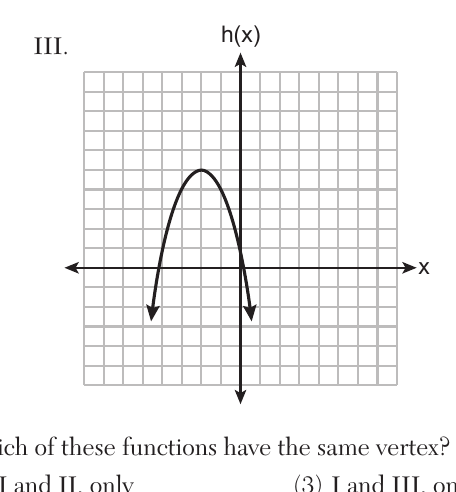
Three quadratic functions are given below. I. $f(x)=(x+2)^2+5$ II. | $x$ | $-4$ | $-3$ | $-2$ | $-1$ | $0$ | $1$ | |---|---|---|---|---|---|---| | $g(x)$ | $-3$ | $2$ | $5$ | $5$ | $2$ | $-3$ | III. (graph of $h(x)$, an upside-down parabola) Which of these functions have the same vertex?
- (A) I and II, only
- (B) II and III, only
- (C) I and III, only ✓
- (D) I, II, and III
Worked solution
Function I has vertex $(-2,5)$ by inspection of vertex form. The table's axis of symmetry falls at $x=-1.5$, giving a different vertex, while the graphed parabola III shares the vertex $(-2,5)$ with function I.
The domain of the function $f(x)=x^2+x-12$ is
- (A) $(-\infty,-4]$
- (B) $(-\infty,\infty)$ ✓
- (C) $[-4,3]$
- (D) $[3,\infty)$
Worked solution
Polynomial functions have no restrictions (no denominators, radicals, or logs), so the domain is all real numbers.
A father makes a deal with his son regarding his weekly allowance. The first year, he agrees to pay his son a weekly allowance of $10. Every subsequent year, the allowance is recalculated by doubling the previous year's weekly allowance and then subtracting 8. Which recursive formula could be used to calculate the son's weekly allowance in future years?
- (A) $a_n = 2n - 8$
- (B) $a_n = 2(n+1) - 8$
- (C) $a_1 = 10$, $a_{n+1} = 2a_n - 8$ ✓
- (D) $a_1 = 10$, $a_{n+1} = 2(a_n - 8)$
Worked solution
A recursive formula must define the first term and a rule relating each term to the one before it; doubling then subtracting 8 translates directly to $a_{n+1}=2a_n-8$.
What is the solution to the inequality below? $4 - \frac{2}{5}x \ge \frac{1}{3}x + 15$
- (A) $x \le 11$
- (B) $x \ge 11$
- (C) $x \le -15$ ✓
- (D) $x \ge -15$
Worked solution
Clearing the fractions by multiplying by the least common denominator (15) and isolating x gives the inequality x <= -15.
Which statement is correct about the polynomial $3x^2 + 5x - 2$?
- (A) It is a third-degree polynomial with a constant term of $-2$.
- (B) It is a third-degree polynomial with a leading coefficient of 3.
- (C) It is a second-degree polynomial with a constant term of 2.
- (D) It is a second-degree polynomial with a leading coefficient of 3. ✓
Worked solution
The polynomial's highest power of x is 2 (second-degree), and the coefficient attached to that x^2 term (the leading coefficient) is 3.
A store manager is trying to determine if they should continue to sell a particular brand of nails. To model their profit, they use the function $p(n)$, where $n$ is the number of boxes of these nails sold in a day. A reasonable domain for this function would be
- (A) nonnegative integers ✓
- (B) rational numbers
- (C) real numbers
- (D) integers
Worked solution
Since n counts a whole number of boxes sold in a day, it cannot be negative or fractional, so the reasonable domain is the nonnegative integers.
Solve the equation algebraically for x: $-2.4(x + 1.4) = 6.8x - 22.68$
Worked solution
Distributing and combining like terms isolates x, giving x = 2.1.
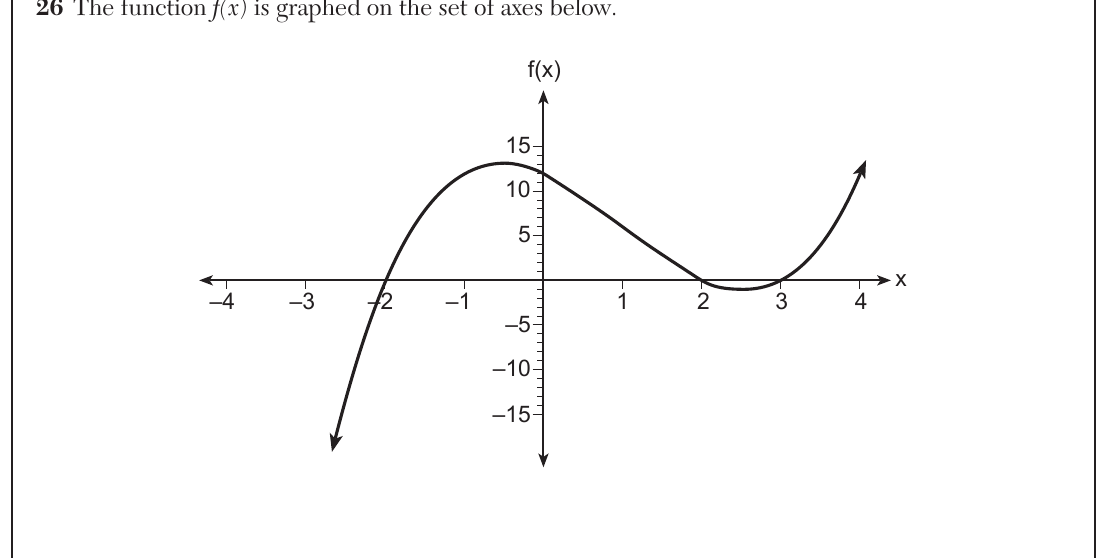
The function f(x) is graphed on the set of axes below. State the zeros of f(x). Explain your reasoning.
Worked solution
The zeros of a function are the x-values where the graph intersects the x-axis; here the graph crosses through the axis at x = -2 and is tangent to the axis at x = 2.
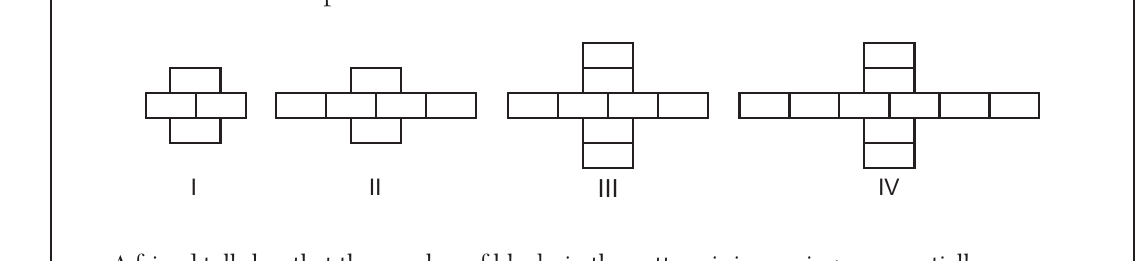
Breanna creates the pattern of blocks below in her art class (figures I, II, III, and IV, each a plus-sign shaped arrangement of unit squares that grows from one figure to the next). A friend tells her that the number of blocks in the pattern is increasing exponentially. Is her friend correct? Explain your reasoning.
Worked solution
An exponential pattern would multiply the previous total by a constant ratio each time, but here each figure simply adds the same fixed number of blocks to the previous figure, which is the signature of arithmetic (linear), not exponential, growth.
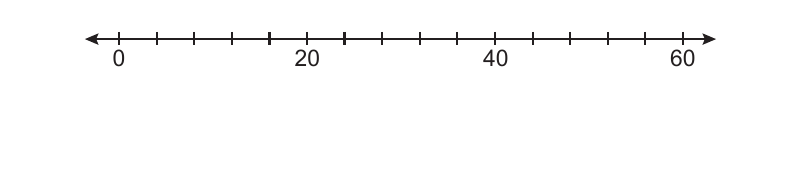
The data set 20, 36, 52, 56, 24, 16, 40, 4, 28 represents the number of books purchased by nine book club members in a year. Construct a box plot for these data on the number line below.
Worked solution
Ordering the data and finding the median splits it into two halves; the medians of those halves give Q1 and Q3, and together with the min and max these form the five-number summary used to draw the box plot (box from 18 to 46 with a line at 28, whiskers extending to 4 and 56).
Given: $A = x + 5$, $B = x^2 - 18$. Express $A^2 + B$ in standard form.
Worked solution
Squaring A and adding B, then combining like terms, gives the polynomial in standard form.
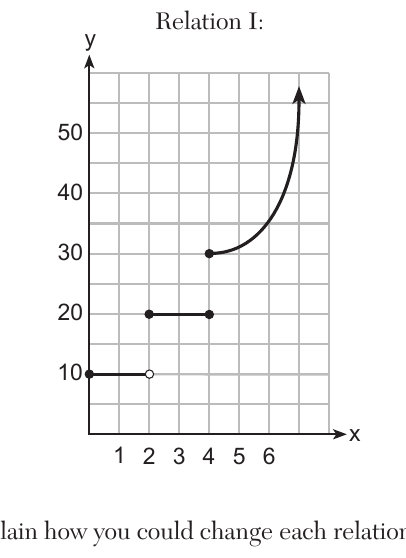
The two relations shown below are not functions. Relation I: a graph with a segment from (1,10) [closed] to (2,10) [open circle], a segment from (2,20) [closed] to (4,20) [closed], and a curve starting at (4,30) [closed] that increases toward the upper right. Relation II: $\{(-5,-2),(-4,0),(-2,1),(-1,3),(-4,4)\}$ Explain how you could change each relation so that they each become a function.
Worked solution
A relation is a function only if every input has exactly one output; both relations have one x-value paired with two different y-values, so removing or reassigning one of the conflicting points for each x-value would make each relation a function.
Factor $2x^2 + 16x - 18$ completely.
Worked solution
Factoring out the GCF first simplifies the trinomial, which then factors into two binomials whose product gives back the original expression.
Solve $3d^2 - 8d + 3 = 0$ algebraically for all values of d, rounding to the nearest tenth.
Worked solution
Since the trinomial does not factor over the integers, the quadratic formula is used, giving two irrational roots that round to 2.2 and 0.5.
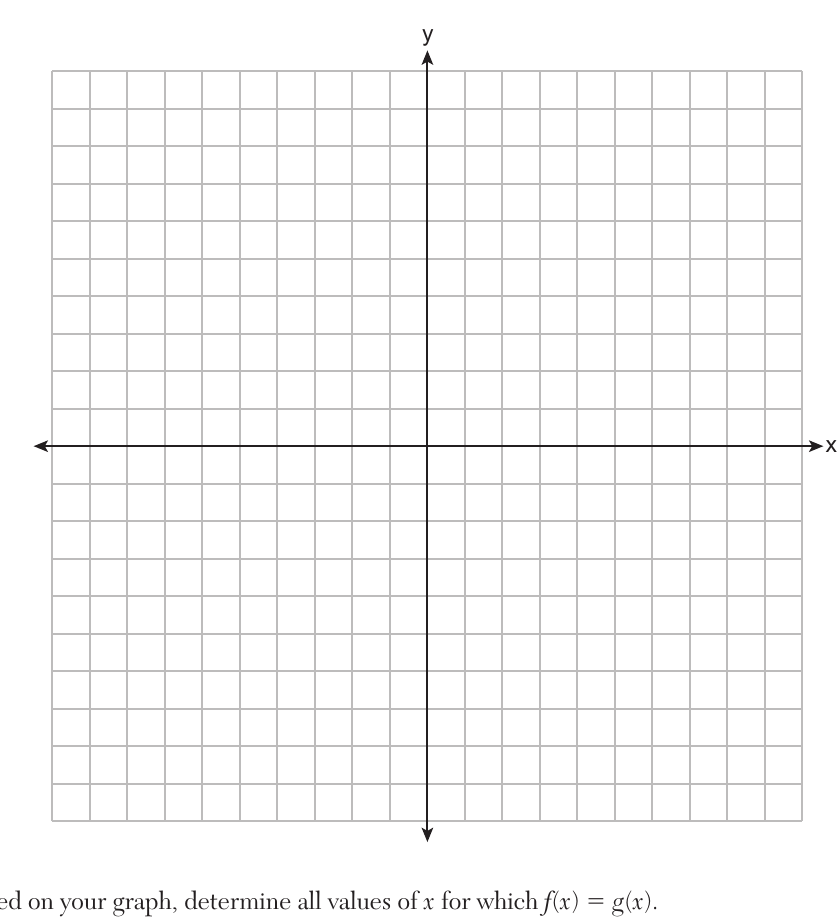
Graph $f(x) = |x| + 1$ and $g(x) = -x^2 + 6x + 1$ on the set of axes below. Based on your graph, determine all values of x for which $f(x) = g(x)$.
Worked solution
Graphing both functions shows they intersect at two points; splitting the absolute value into cases and solving each piecewise equation confirms the intersection points occur at x = 0 and x = 5.
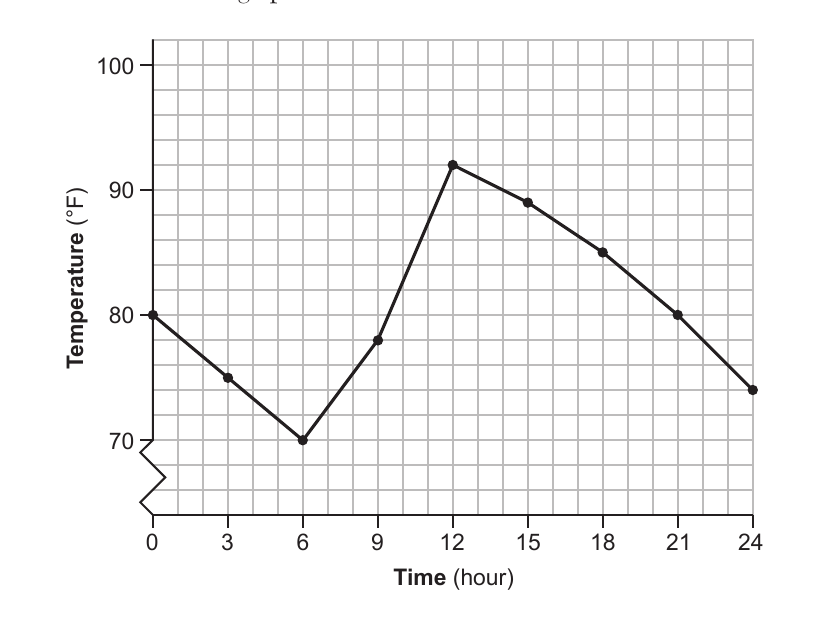
Jean recorded temperatures over a 24-hour period one day in August in Syracuse, NY. Her results are shown in the table below. Time (hour): 0, 3, 6, 9, 12, 15, 18, 21, 24 Temperature (°F): 80, 75, 70, 78, 92, 89, 85, 80, 74 Her data are modeled on the graph (a line graph connecting these points, with a break in the y-axis below 70). State the entire interval over which the temperature is increasing. State the three-hour interval that has the greatest rate of change in temperature. State the average rate of change from hour 12 to hour 24. Explain what this means in the context of the problem.
Worked solution
Reading the table, the temperature rises without interruption only between hour 6 and hour 12; comparing consecutive 3-hour changes shows the 9-to-12 interval has the steepest increase; and the overall slope from hour 12 to 24 shows the temperature fell by an average of 1.5°F each hour over that span.
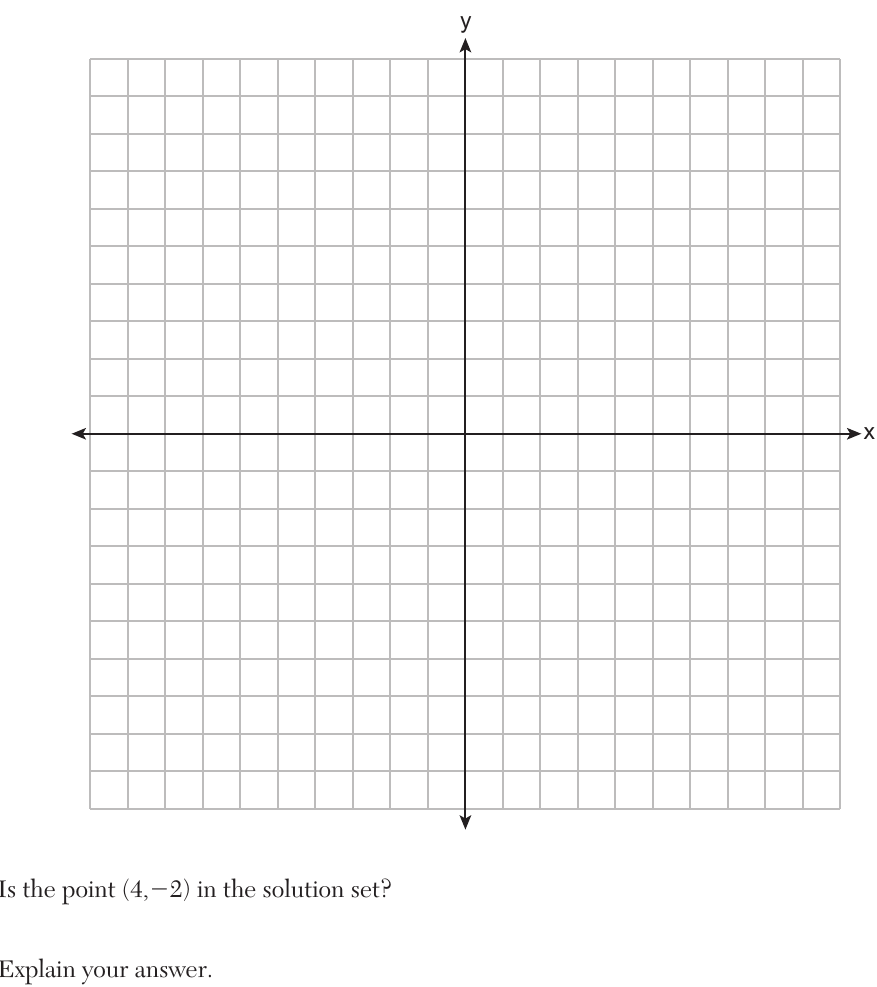
Solve the following system of inequalities graphically on the set of axes below. $2x + 3y \ge -6$ $x < 3y + 6$ Label the solution set S. Is the point (4, -2) in the solution set? Explain your answer.
Worked solution
A point is in the solution set of a system only if it satisfies every inequality; (4,-2) satisfies the first inequality but not the second, so it is not part of the shared shaded region S.
Suzanna collected information about a group of ponies and horses. She made a table showing the height, measured in hands (hh), and the weight, measured in pounds (lbs), of each pony and horse. Height (hh) x: 11, 12, 13, 14, 15, 16, 17 Weight (lbs) y: 264, 638, 700, 850, 1000, 1230, 1495 Write the linear regression equation for this set of data. Round all values to the nearest hundredth. State the correlation coefficient for the linear regression. Round your answer to the nearest hundredth. Explain what the correlation coefficient indicates about the linear fit of the data in the context of the problem.
Worked solution
Using calculator/regression formulas on the table data produces a regression line with slope about 184.82 and intercept about -1706.07, and a correlation coefficient near 0.99, showing the linear model fits the height-weight data extremely well.
Dana went shopping for plants to put in her garden. She bought three roses and two daisies for $31.88. Later that day, she went back and bought two roses and one daisy for $18.92. If r represents the cost of one rose and d represents the cost of one daisy, write a system of equations that models this situation. Use your system of equations to algebraically determine both the cost of one rose and the cost of one daisy.
Worked solution
Setting up two linear equations from the purchase totals and solving by substitution/elimination gives the individual prices: a rose costs $5.96 and a daisy costs $7.00.